Haissam El-Aawar, Omar Mohammad (2024). Revolutionizing Automotive Industry for Servicing An Autonomous Adaptive Lift System. In: Human Interaction and Emerging Technologies (IHIET 2024). AHFE Open Access, vol. 157, pp. 77–83. https://doi.org/10.54941/ahfe1005466
The automotive industry stands at the cusp of a transformative innovation with the development of an autonomous adaptive lift system designed to revolutionize vehicle servicing. Traditional automotive lifts require manual adjustments to fit various car sizes and positions, often leading to inefficiencies and safety concerns. In response, our proposed model introduces an autonomous lift system that detects and adjusts to the optimal lifting points for diverse vehicles, eliminating the need for human intervention in positioning.Powered by cutting-edge hardware components, including an Arduino controller serving as the main board, REV kit for motor and extruder assembly, and precision servomotors, this system incorporates advanced sensor technologies like IR(infrared), ultrasonic sensors, and specialized point detection sensors. This comprehensive sensor array enables the lift to comprehensively assess a vehicle's dimensions, weight distribution, and ideal lifting positions upon entry.By harnessing an amalgamation of sensors, actuators, and programmed instructions within the Arduino controller, the lift autonomously adapts to diverse vehicle shapes and sizes, facilitating precise and safe adjustments. This integrated system, comprising sensors for dimensional analysis, actuators for responsive adjustments, and sophisticated programming, enables the lift to dynamically conform to various vehicles. Furthermore, stringent safety protocols, including failsafe mechanisms and emergency stop functionalities, are inherent to this hardware setup, ensuring unwavering reliability and operational security.This research aims to elucidate the pivotal role of this autonomous adaptive lift system in reshaping the automotive servicing landscape. It will delve into the technological innovations, operational functionalities, and the added value this system brings to garage operations, emphasizing its potential to elevate safety standards, increase efficiency, and transform the industry's approach to vehicle maintenance.
Human Factors Engineering involves understanding the need for comprehensive the integration of autonomous systems in automotive services considered a significant aspect in the enhancement process of operational services efficiency and safety. while the traditional practices of vehicle maintenance using a lifting system must undergo a transformative approach
toward automictic functions. Numerous studies have been undertaken in Spain to address the public priority of preventing workplace injuries (Park, 2023). These studies have focused on various topics, such as trends over time for fatal injuries caused by occupational accidents in all industries (Santamaría, 2006). Occupational injuries can cause people to lose their jobs temporarily or permanently, resulting in a fall in labor earnings. Furthermore, businesses are burdened with various direct and indirect costs, such as compensation payments to injured workers, repair of damaged materials (machinery and assets), production delays, fines and criminal penalties, employment and training costs for replacement workers, and a decrease in the company’s credibility (Heinrich, 1980). According to the European Union’s Information Agency for Occupational Safety and Health (EU-OSHA,2017), occupational injuries cause economic losses of €2.68 trillion globally (3.9% of the world’s GDP) and €476 billion in the EU 28 countries (3.3% of the total GDP) (Dietmar, 2017). Furthermore, the projected economic losses from occupational injuries in the Republic of Korea range between 3.35% and 5.91% of the country’s GDP (Heinrich, 1980). Furthermore, according to data from the United Nations International Labor Organization (ILO) from 2015 to 2018, the Republic of Korea has the third highest occupational injury rate after Turkey and Mexico. As a result, occupational injury prevention has emerged as a critical policy concern for the government to solve. Our research will focus on technological innovation, the consequential added value to garage car services, safety, efficiency, and industry transformation.
LITERATURE REVIEW
Technological advancements have significantly transformed automotive servicing, evolving from labor-intensive manual processes to highly precise automated services. In the early days of the automotive industry, a simple peg-based jack was used for vehicle maintenance. However, as automobiles grew heavier, this type of jack became unsuitable due to the risk of collapse. It was eventually superseded by the scissor jack, now the standard equipment provided by manufacturers for vehicle lifting (Yekinni, 2018). The development of a motorized rack and pinion car lift system was introduced in 2014. This system features a combination of flat and round helical gears in a rack and pinion arrangement, with additional spur gears connected by a chain drive, all powered by a 12V battery (Thirugnanam, 2014). Further enhancements to the scissor or toggle jack design have been made by incorporating an electric DC motor, as noted in studies by Osman and Ehab (ekinni, 2018). An integrated automated hydraulic automobile jack system for four-wheelers has been presented, which includes a hydraulic pump powered by an electric motor and a hydraulic cylinder for vehicle lifting. This mechanism enables the activation of the automobile jack with a single push button, allowing hydraulic jacks to be activated separately for each side of the vehicle during breakdowns. The hydraulic system has an advantage over pneumatic systems due to the incompressibility of oil, which provides greater lifting capability. To efficiently handle the hydraulic circuit,
Revolutionizing Automotive Industry for Servicing an Autonomous Adaptive Lift System 79
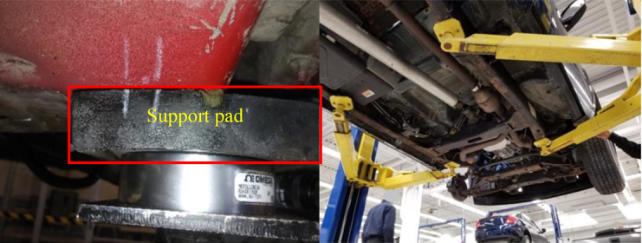
the system uses single-acting cylinders controlled by control valves, as well as a relief valve (Pradhan, 2022). This document outlines the built-in jack in automobiles. The hydraulic jack system is coupled to the automobile’s front and rear chassis. It may be simply fitted to various automotive chassis and frames. A hydraulic jack is centrally located in the front and rear suspensions ofautomobiles, between the wheels. It uses hydraulic power and requires a 12v DC to function. Implementing this approach simplifies vehicle maintenance, particularly for heavier vehicles. The hydraulic jack mechanism operates based on Pascal’s principle. The pressure remains constant across a closed container or cylinder at all points. Connect two cylinders, one tiny and one huge. The force exerted by a huge cylinder increases as its area increases, as long as the pressure remains constant. The equation P=F/A leads to F=PA. Hydraulic jacks employ oil pressure to lift and lower automobiles by moving the handler. Hydraulic fluids serve as a driving force in hydraulic machinery. Hydraulic cylinders run on hydraulic fluid. In this arrangement, the hydraulic fluid does not absorb the energy (Sathyan, 2019). Designed an automobile jack that is permanently welded to the car chassis and can be lifted using a wiper motor. The motor responds to commands from a mobile app. Redesigned the car’s chassis model to line the jack with the chassis. This prevents the jack from hitting any road obstacles (Anon., 2020). But, for maintenance we still need the two-post lifter to be comfortable as in (Québec, 2021) reveals that Mechanics use automotive lifts to raise vehicles off the ground for maintenance and repair. In Quebec, where this survey was conducted, the joint sector-based group estimates that roughly 30,000 lifts are installed in the automotive services sector. By the end of 2020, the province had licensed 5.4 million vehicles and light trucks. Nowadays, two- post above-ground (2PAG) lifts are the most prevalent in garages because they provide unobstructed access under the car (Figure 1) and are suitable for normal maintenance (e.g., tire changes, oil changes, etc.). The ability to change all four tires at once which is not achievable with four-post lifts. ((ALI), 2008). Moreover, the author creates a new contribution using an experimental design, support pad slippage on a 2PAG lift caused by external forces acting on a vehicle. this will help in the grip but still need the intervention of labor to direct the two posts under the car. (Burlet-Vienney, 2021).
Figure 1: 2PAG with added pad (Burlet-Vienney, 2021).
80 El-Aawar and Mohammad
METHODOLOGY
To develop and evaluate an automated alignment and lifting system for two- post automotive lifts, we conducted an experimental study that integrated advanced sensor technology, precise motor controls, and a microcontroller to automate the vehicle lifting process with unparalleled precision and safety. The system’s core components, including an Arduino Uno microcontroller, infrared (IR) sensors for under-car detection, servo motors coupled with gear lines for precise arm movement, a Gear DC motor for the lifting mechanism, and an RGX motor drive for high current demand handling, were specified and integrated. Software control algorithms were developed in C++ using the Arduino IDE, focusing on automating the alignment of lift arms with vehicle-specific markings (colored blocks or circle) for accurate lifting point identification. Upon the vehicle’s entry, the two-post lift arms, initially positioned on the ground, commence their precision movement beneath the vehicle, facilitated by a servo motor and a gear line system. The moment the integrated infrared (IR) sensors detect the lift arms have successfully positioned themselves under the vehicle, the movement halts, initiating the process of searching for the predefined alignment points. If these points are not immediately located, the lift arms undergo a slight forward adjustment, continuing to oscillate open and close in their search for the correct points. Upon identifying the optimal alignment points on both sides of the vehicle, flags within the system’s code are triggered, signifying the precise alignment of the two posts. Following this confirmation through sensor data, the system engages a Gear DC motor, meticulously adjusting the torque to accommodate various vehicle types. This enables the lift to elevate the car to the desired height securely. Operators then have the flexibility to further adjust the vehicle’s height as needed, using simple up and down buttons, ensuring the lift’s arms are perfectly positioned at the vehicle’s designated points. This entire process, fully automated, significantly minimizes errors in vehicle alignment on the lift, enhancing both safety and efficiency in automotive servicing tasks. A prototype was constructed to embody this design, followed by a series of functional tests within a controlled environment that simulated real-world conditions with vehicles marked for alignment testing. These tests assessed the prototype’s ability to accurately move under the vehicle, detect the correct alignment points via IR sensors, and adjust the arm positioning as necessary until successful alignment was confirmed. The system demonstrated high accuracy in aligning with the marking points across different vehicles, efficiency in operation with minimal adjustments needed, and enhanced safety with a stable lifting process. The entire testing phase confirmed the system’s functionality, proving its capability to significantly improve the precision, efficiency, and safety of vehicle lifting in automotive servicing operations, thereby confirming the success of the developed methodology in achieving the project’s objectives.
IMPLEMENTATION The implementation of the automated two-post lift system began with the meticulous assembly of its core hardware components, including servo
Revolutionizing Automotive Industry for Servicing an Autonomous Adaptive Lift System 81
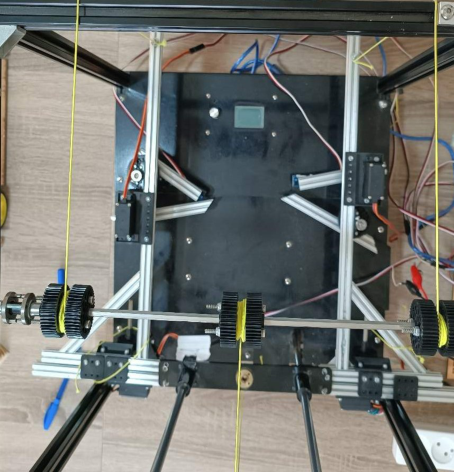
motors, gear lines, and infrared sensors. A comprehensive control program was developed to manage the entire process, from the car’s entry to the precise alignment of the lift arms, ensuring a seamless and highly efficient operation. the integration of servo motors and gear lines, ingeniously designed to facilitate precise horizontal movement beneath the vehicle. This crucial step ensured the lift arms could accurately navigate and position themselves for optimal alignment as shown in Figure 2.
Figure 2: The complete setup of the automated two-post lift system.
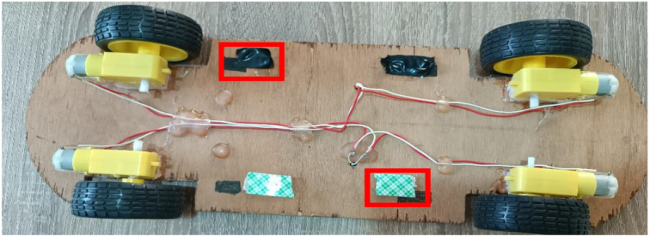
Simultaneously, infrared (IR) sensors were installed and meticulously calibrated to detect the exact moment the lift arms slid into place under the car, marking the beginning of the automated alignment phase, see Figure 3.
Figure 3: The marking blocks for accurate point identification.
82 El-Aawar and Mohammad
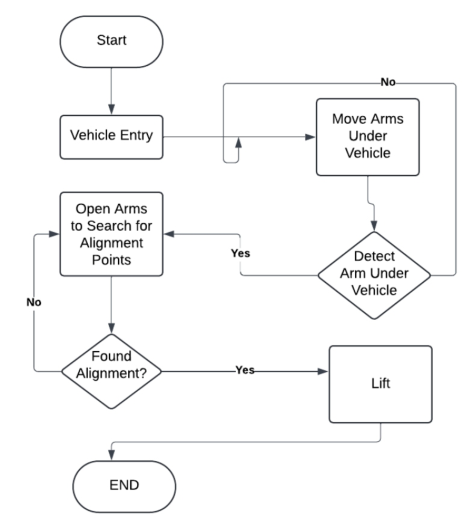
Following hardware setup, we connected an Arduino micro-controller that was programmed to control the entire lifting operation: from activating the servo motors and gear lines for initial positioning, processing the IR sensor input for accurate detection under the vehicle, to controlling the Gear DC motor responsible for adjusting torque according to the vehicle’s weight. This programming phase was critical, involving the development of sophisticated detection and alignment algorithms. These algorithms processed the data from the IR sensors, directing the system to adjust the lift arms’ position incrementally until the designated alignment points on the vehicle were located, see Figure 4. Upon successful alignment, indicated by specific flags in the system’s code, the lifting process was initiated. the flowchart below describes the whole process.
Figure 4: The decision-making process employed by the system in response to sensor data.
CONCLUSION
This study presents the successful design, development, and implementation of an innovative automated two-post lift system for automotive servicing. Our approach leverages cutting-edge sensor technology, precise motor control, and intelligent software algorithms to revolutionize vehicle lifting with enhanced precision, efficiency, and safety. Leveraging advanced sensor technology, precise motor controls, and intelligent software algorithms, our system streamlines the vehicle lifting process with enhanced precision, efficiency, and safety. This automated alignment process significantly reduces
Revolutionizing Automotive Industry for Servicing an Autonomous Adaptive Lift System 83
the need for manual intervention, minimizing errors and improving overall operational efficiency. Functional tests have demonstrated the system’s capability to reliably detect and align with vehicle lifting points, while safety evaluations have underscored its stable lifting performance and user-friendly operation.
Overall, our research signifies a significant advancement in automotive servicing technology, offering a practical solution to enhance the precision and safety of vehicle lifting operations. With further refinement and real- world testing, our automated two-post lift system has the potential to revolutionize automotive servicing practices, improving productivity and ensuring optimal service quality in the automotive industry.
ACKNOWLEDGMENT
The authors would like to thank the president of Lebanese International University HE Abdel Rahim Mourad and the LIU Bekaa campus administration for their continuous encouragement of research activities at the university.
REFERENCES
(ALI), A. N. S. I. (. a. A. L. I., 2008. Standard for automotive lifts–safety requirements for operation, inspection and maintenance (ALOIM), New York: ALI Cortland (NY). Anon., 2020. Automatic Car Jack and Pressure Monitoring. International Journal of
Engineering Research & Technology (IJERT), 9(3), pp. 748–751. Burlet-Vienney, D. a. G. B. a. B. K. C., 2021. Analysis of vehicle stability when using two-post above-ground automotive lifts: Distribution of forces in arms. Safety science, Volume 134, p. 105042. Dietmar, E. a. T. J. a. R. J., 2017. An International Comparison of the Cost or
Work-Related Accidents and Illnesses. An International Comparison of the Cost or Work-Related Accidents and Illnesses. Heinrich, H. W. a. P. D. a. R. N. a. o., 1980. Industrial Accident Prevension: A Safety Management Approach. New York. Park, S. a. K. M.-J., 2023. Corporate characteristics and occupational injuries by
industry. Safety and health at work, 14(3), pp. 259–266. Pradhan, U. K. a. K. P. a. V. A. a. S. S. S., 2022. Inbuilt Hydraulic Jack System for Light Motor Vehicles and Heavy Motor Vehicles. IJRASET, 10(7), pp. 429–433. Québec, S. d. l. A. d., 2021. Nombre de Véhicules en Circulation Selon Le Type
D’utilisation, Le Type de Véhicule Et L’âge Du Véhicule, Québec Et Régions Administratives, Quebec, QC, Canada: Government Report. Santamaría, N. N. C. a. F. G. B., 2006. Tendencias temporales de las lesiones mortales (traumáticas) por accidente de trabajo en España (1992–2002). Gaceta Sanitaria, Volume 20, pp. 280–286. Sathyan, V. K. V. S. H. P. S., 2019. Effective Performance and Infleuence of Automated
Inbuilt Hydraulic Jack in a Four Wheeler Vehicle. IJETS, 6(5), pp. 34–37. Thirugnanam, A. a. D. P. a. R. L., 2014. Design and Fabrication of Rack and Pinion lift. Middle-East J. Sci. Res, 20(6), pp. 744–748. Yekinni, A. a. O. K. a. B. A. a. O. O. a. S. O., 2018. Design and Development of
Motorised Vehicle Lifter. yekinni2018design.
LISTED IN THE AHFE DIGITAL BOOKSTORE CATALOGUE
Explore the complete digital volume
Human Interaction and Emerging Technologies (IHIET 2024)
Read this individual research paper free through the original publisher, or explore the full digital proceedings book.
ISBN 978-1-964867-33-5
Explore this ISBN in the AHFE Bookstore ↗Listed in the July 2026 bookstore catalogue; search by ISBN to confirm current availability · Digital book purchase optional