Luca Casarotto, Lisa Battagliarin, Filippo Carnovalini, Marco Marigo, Giulio Pitteri, Mauro Longo, Carlo Manara, Jacopo Gonzato, Andrea Pavan, Antonino Di Bella, Antonio Rodà (2024). Smart IoT soundproofing panels for enhanced environmental comfort. In: Human Interaction and Emerging Technologies (IHIET 2024). AHFE Open Access, vol. 157, pp. 479–488. https://doi.org/10.54941/ahfe1005507
In the context of Ambient Assisted Living, the SISSI project aims to integrate soundproofing panels with IoT technologies, developing a new modular system to improve the comfort of people living and working in shared environments by taking advantage of the acoustic properties of the panels and the automatic monitoring of some relevant environmental variables. To reach a satisfying solution the need to experiment with different technologies arose, and thus the team needed to share observations, problems, and solutions right from the design phase. The first step was checking if perforating the company's current sound-absorbing panels and incorporating electronic components would affect their efficiency, measuring the material's performances in the laboratory to verify its sound absorption value.Measurements were conducted in compliance with ISO 354 standards, assessing both types of sound-absorbing materials in various configurations. They show that arranging the material in a checkerboard pattern or in "thinned" lines is more advantageous in terms of absorption. Indeed, the laboratory tests have shown that a smaller amount of material results in better sound-absorbing characteristics. With this data, the final IoT panel will be more sustainable because less material can be used.In the second step, new panels with integrated sensors to monitor temperature, humidity, CO2, brightness, and people's presence were tested. Based on the data collected, the team defined the functions of the panel, which will be able to monitor the level of air oxygenation and control room or desk brightness level and to switch on or off when the user is present, thus reducing energy consumption.The experimental results changed the redesign of the panels, which now feature accessible electronic components and an interior that is not fully packed with material. Furthermore, the system is designed to integrate additional elements, such as lighting and electronic devices, for seamless interaction with the surrounding environment. Importantly, the sound-absorbing panel system will also provide clear user signals about the monitoring status, enhancing comfort.
Ambient Assisted Living (Calvaresi et al., 2017) is a research field aimed at integrating new and existing technologies into people’s life environments, supporting everyday living and promoting healthier and more sustainable lifestyles, and thus improving the overall quality of life of its users (Abtoy et al., 2020), with a particular attention to users with special needs (e.g. Zanolla et al., 2013; Mandanici et al., 2018).
In this context, the SISSI project aims to integrate soundproofing panels with IoT technologies, developing a new modular system to improve the comfort of people living and working in shared environments by taking advantage of the acoustic properties of the panels and the automatic monitoring of some relevant environmental variables.
The research project is being developed by a multidisciplinary team with several partners, including a manufacturing company, acoustic engineers, computer scientists and designers.
Making a system of sound-absorbing panels aimed at environmental monitoring led to the need to experiment with different technologies. Integrating electronic components for monitoring led to novel panel designs. These led to testing and experimenting with new functions and ways of using the sound-absorbing panels.
The design phase followed multidisciplinary sharing dynamics based on digitized Industry 4.0 processes and on the principles of circular design. The panels are designed to be composed of parts, which can be easily disassembled, accessed, and repaired, recyclable or destined for correct recycling according to the Ellen MacArthur Foundation’s butterfly diagram (Ellen MacArthur Foundation, 2020). Using the Jira Software platform by Atlassian, along with periodic meetings, enabled the team to share observations, problems, and solutions right from the design phase.
The team first tested if perforating the company’s current sound-absorbing panels and incorporating electronic components would affect their efficiency. The sound-absorbing materials used were measured in the laboratory to verify the sound absorption value of the material.
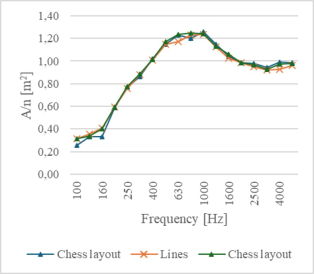
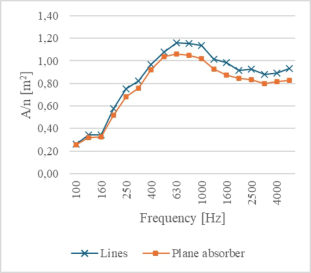
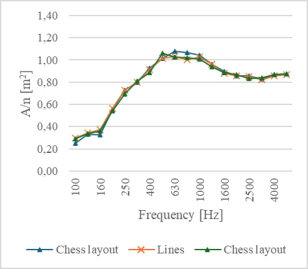
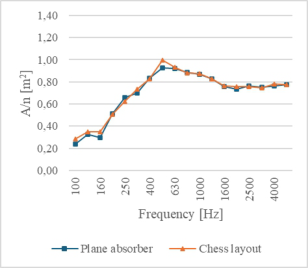
Measurements were conducted in compliance with ISO 354 standards, assessing both types of sound-absorbing materials in various configurations. The laboratory results obtained were compared in terms of unit absorption change (1A/n, m2). They show that arranging the material in a checkerboard pattern or in “thinned” lines is more advantageous in terms of absorption.
Thus, less sound-absorbing material inside the panel results in being more effective than a full arrangement of material. Indeed, the laboratory tests have shown that a smaller amount of material results in better sound-absorbing characteristics. With this data, the final IoT panel will be more sustainable because less material can be used. The data are interesting not only for the specific case but also because they open up new design possibilities. It will be possible to envision new solutions and assembly processes for panels that are more sound-absorbent.
In a second phase, new panels with integrated sensors to monitor temperature, humidity, CO2, brightness, and people’s presence were
Smart IoT Soundproofing Panels for Enhanced Environmental Comfort 481
tested. The interaction of these data in the ThingsBoard platform enabled monitoring of the state of the environment and user well-being.
Based on the data collected, the team defined the functions of the panel, which will be able to monitor the level of air oxygenation and control room or desk brightness level and to switch on or off when the user is present, thus reducing energy consumption.
The experimental results changed the redesign of the panels, which now feature accessible electronic components and an interior that is not fully packed with material. Furthermore, the system is designed to integrate additional elements, such as lighting and electronic devices, for seamless interaction with the surrounding environment. Importantly, the sound- absorbing panel system will also provide clear user signals about the monitoring status, enhancing comfort.
ACOUSTIC MEASUREMENTS HSI experts contribute by ensuring that human capabilities and limitations are considered. It has become clear that treating the system as separate from the users results in poor performance and potential failure in the operational setting. Continued growth in technology has not delivered desired results. Systems engineers and others are beginning to understand the role humans play in technology systems. The core challenge is to balance successful hardware and software solutions with human friendly implementations. To define the requirements of humans as a fundamental system component, it is essential to understand the inherent capacity of user populations and their typical operational environment (Booher, 2003). A description of a population’s capacity incorporates more than the basic anthropometrics or the cognitive capability of the average member of the user population (Chapanis, 1996).
Evaluation of Panel’s Material Sound-Absorbing Capabilities
Figure 1: Equivalent absorption area per panel A/n of elements under test with different arrangement modes (checkerboard layout and thinned lines) for 53.3% reverberation chamber occupancy compared to the maximum occupancy made.Figure 2: Equivalent absorption area per panel A/n of elements under test with different arrangement modes (thinned lines and plane absorber installation type “A”) for 60% reverberation chamber occupancy compared to the maximum occupancy made.
The materials tested were polyester fiber panels, size 100x120 cm thickness 5 cm, nominal density 40 kg/m3. The evaluation of their sound-absorbing properties involved measuring the equivalent sound absorption area according to different configurations of the material inside the reverberation chamber. Specifically, the materials were arranged according to the typical pattern of continuous plane absorbers (type “A,” Appendix B of ISO 354), with checkerboard arrangement treating them as discrete objects and as “thinned” lines.
The materials were arranged in such a way as to create full and empty areas, so the treated surface is not completely covered by sound-absorbing elements but consists of a regular alternation of absorbing and reflecting elements. Figures 1–4 show the values for the equivalent absorption area divided by the number of panels tested (8, 9, 10, or 12), according to the arrangement as a continuous, checkerboard, and thinned-line surface based on the occupancy of the reverberation chamber relative to the maximum occupancy made.
Figure 3: Ezquivalent absorption area per panel A/n of elements under test with different arrangement modes (checkerboard layout and thinned line) for 66.7% reverberation chamber occupancy compared to the maximum occupancy made.
Smart IoT Soundproofing Panels for Enhanced Environmental Comfort 483
Figure 4: Equivalent absorption area per panel A/n of elements under test with different arrangement modes (matrix and plane absorber installation type “A”) for 80% reverberation chamber occupancy compared to the maximum occupancy made.
PANEL DESIGN Sustainable Panel Design
The design of the panels was focused on improving the sustainability of the products. To this end, the amount of materials used was reduced, as well as the processing and components employed. The project also aimed at reducing energy consumption in the application context and facilitated user-side monitoring and improvement of application environments.
To optimize the design and production process in terms of sustainability, it was to transition from a linear to a circular design. It was therefore useful to refer to the Ellen MacArthur Foundation’s butterfly diagram, which illustrates the continuous flow of materials in a circular process. This model divides the cycle into two parts: the first concerns materials and their technological transformation, while the second, on the right, directly involves design and production. Products and materials are kept in circulation through reuse, repair, regeneration, and recycling, with smaller cycles that allow preserving and acquiring maximum value from the product (Saidani, 2019).
To design a system of smart panels, it was necessary to ensure that the products were easily repairable, modular, with replaceable and/or upgradable components, and that these components were easily separable for recycling. Given the choice to use recycled polyester, one of the specific objectives was to verify whether reducing the amount of material used could still maintain optimal sound-absorbing quality (McDonough et al., 2002).
Sensor Design and Microcontroller Choice In a first phase the research focused on the analysis and definition of the system architecture: specifically, attention was paid on the analysis of user’s needs and comparison with similar existing systems; on the analysis of necessary technological requirements and the characteristics of materials to be used; and on the description of the logical level of the prototypes that are intended to be developed.
These initial analyses led to the definition of a more precise technology, chosen as a demonstrator of the project’s goals: namely, desk panels. This type of sound-absorbing panels are furnishing accessories to be placed on office desks, as a divider in shared desks, or as a background element for desks placed against a wall.
In the initial phases of the project, through brainstorming activities that involved the entire research team, the project brief was defined. One driving factor for the design of these demonstrators was the technical requirement to be able to insert sensors necessary for environmental monitoring in the panel, and for potential access maintenance. For this goal, two approaches were explored. The first involved the creation of aluminum extrusions which would cover two or three sides of the panel and in which the fabric can be inserted. The missing sides would be then attached with a zip or a Velcro strip.
By doing this, if it were necessary to remove or access the internal components, it would not be a problem considering the design of the product made it reversible. Depending on the design of the extruded aluminum lateral closure and on how the fabric would be attached in the specific inlets, the panel would take different shape aesthetics, while maintaining the characteristics necessary to access the electronic components.
Once the structure was defined, the first prototype sound-absorbing panel was equipped with acoustic transducers (speakers), temperature sensor, humidity sensor, light sensor, presence/motion sensor i.e. infrared (PIR), ultrasonic distance sensor, LCD character screen. This panel used a ESP32 processor, capable of internet connection.
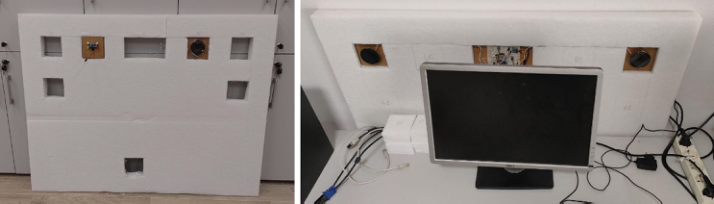
The sensors were installed by creating square holes (10x10cm) in the panel, which were filled with cardboard structures to support the electronic components (see image 5). Everything was then enclosed in fabric to check the system’s overall functionalities.
Figure 5: The panel used for the prototype for the first solution. On the left it’s shown in full view with the housings for the electronic components and two example cardboard “modules”. On the right, it’s shown housed behind a desk where the functionalities of the various sensors were evaluated. During the tests, the facade was then covered with fabric to test the sensors’ response in this condition.
It quickly emerged that some sensors, when covered by fabric, lose their functionality or become noticeably less precise. We considered keeping some sensors outside the fabric, or perforating the fabric over the sensors. Various
Smart IoT Soundproofing Panels for Enhanced Environmental Comfort 485
ways to be able to transfer these solutions on large scale production were considered, but we finally considered these solutions to be impractical, and therefore the main structure of the prototype was changed.
From the initial solutions, which envisaged the integration of all parts, the design evolved towards a panel with the electronic components separated from the sound-absorbing part. A configuration was then chosen that positioned the technology on top, allowing the sound-absorbing element to be integrated with a lateral structure. This configuration made it possible to join or separate the panels, which already had a tested production cycle, and to concentrate the technological parts in an aluminum profile, facilitating access and disassembly of the parts (Braungart et al., 2007).
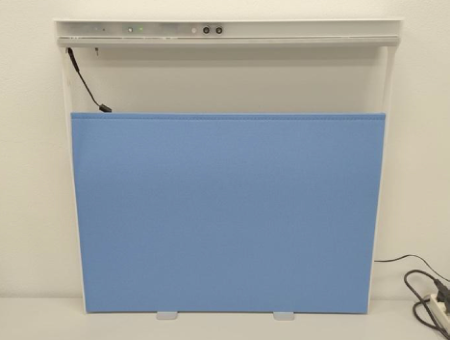
The panel therefore ended up very similar to those already made by the partner of SISSI research “Ambiente 1985”, but sustained by a lateral structure that holds the components, keeping them on an “arch” above the sound-absorbing part. This arch will be an extrusion in aluminum made specifically to contain the electronic components (sensors and actuators), holding a continuous band of LEDs (along the entire length of the panel), housing the appropriate covers and obtaining specific useful lanes for inserting further accessories.
Figure 6: Prototype with sensors inserted into the ALL-LED extruded profile, with the addition of a LED strip for lighting.
In the prototyping phase, to reduce prototyping costs, an already existing commercially available extrusion was used and therefore not customized. In this new iteration of the prototype, a LED strip has been added to the sensors allowing desk-mounted panels to also provide lighting. Compared to the first prototype, a CO2 sensor and a microphone used for ambient noise detection were also added. The resulting prototype is shown in image 6.
The following table summarizes the main electronic components chosen for the prototypes, excluding resistors, switches, connection cables, and other minor components.
Table 1. Sample human systems integration test parameters (Folds et al., 2008).
Table available in the original PDF paper.
Electronic Component Category Purpose ESP32-WROOM-32E Microcontroller Control of sensors, WiFi/Internet communication, actuator management DHT11 Sensor Temperature and humidity SCD41 Sensor CO2 MSM26S4030H0 Microphone Environmental noise control HC-SR04 Sensor Distance AS312 Sensor Infrared presence (PIR) VCNL4200 Sensor Luminosity MAX98357A Amplifier Sound emission through speakers
Subsequently, three more panels with the same characteristics were produced, to be used for demonstrating purposes and to carry out environmental comfort experiments.
RESULTS
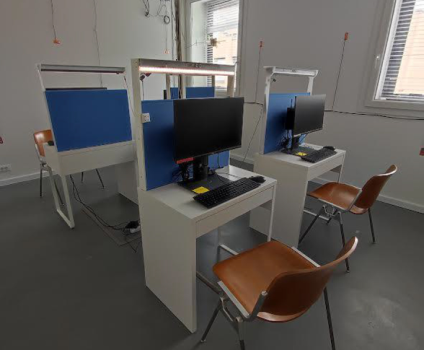
To carry on environmental comfort experiments the four built panels were placed inside a testing laboratory room equipped with ambient sensors, together with the capability to change and control light, temperature, humidity and CO2. The room setup was done as follows: four desks were placed one in front of the other with two desks per side, and each desk was equipped with a workstation and the panel sitting behind it at the bottom edge of the desk. The laboratory room with the four panels in place is shown in Figure 7.
Figure 7: Photo of the panels placed inside the environmental testing laboratory room.
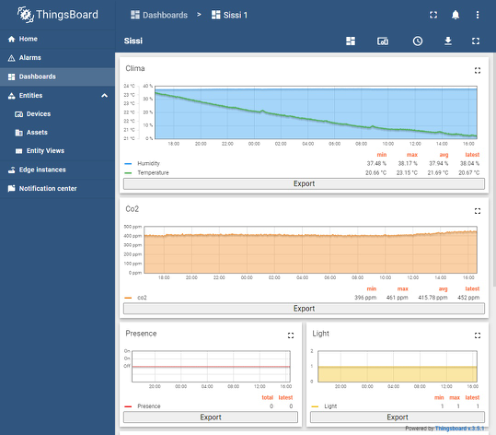
The panels have been placed and turned on for a week and they sent their data continuously to the ThingsBoard platform (see Figure 8) and their
Smart IoT Soundproofing Panels for Enhanced Environmental Comfort 487
measurements were compared with the one gathered from the laboratory room instruments. Overall a total of about 50 Mb of data were collected without noticeable data loss. Regarding the microcontroller resources usage it is worth noting that with the ESP32 chip the code nearly uses all the memory available, in particular considering the FFT code used to evaluate the environmental noise was already heavily optimized both regarding memory usage and computational time. Moreover, the masquerading noise was encoded using a plain PCM scheme, thus avoiding computing-heavy encodings such as mp3, considering the limited cpu frequency available to the microcontroller.
CONCLUSION
The study of the equivalent sound absorption area of the materials tested showed that, with the same materials used, the achievable differences depend on the way the materials are installed. It was observed that checkerboard or in thinned line arrangements, i.e., installations that have fewer panels than the total area that can be occupied by a continuous arrangement, are more advantageous. It can therefore be effective to use a small number of “isolated” panels compared to an extended arrangement in this way it is possible to reduce the amount of sound-absorbing material to have equal sound-absorbing quality. This is also an excellent result from the standpoint of product sustainability which, from a design perspective, can thus reduce its environmental impact while maintaining technical performance. Tests conducted in the laboratory have shown that the panels are capable of correctly measuring and sending to the dashboard the main environmental telemetry values.
Figure 8: Example screenshot of the ThingsBoard dashboard used to collect sensor data from the panels.
One consideration regarding possible future improvements may arise regarding the capability of the panels to communicate between themselves without requiring an existing WiFi infrastructure (router), to which extent an already existing technology such as “Data over Sound” may be employed (Pitteri et al., 2021).
Another aspect may be the extension of the panels functionalities to include work stress related aspects, in a way that the user may be alerted regarding the need for a pause, or even helping the user’s stress decompression by means of a mobile app linked to the panel’s facade buttons, utilizing a gamification approach to increase the stress avoidance efficiency (Pitteri et al., 2019).
ACKNOWLEDGMENT
This research was carried out within the project “Sistemi modulari Inclusivi per la gestione del comfort ambientale attraverso lo Sviluppo di pannelli fonoassorbenti Sensorizzati e Interattivi (SISSI)” (Modular inclusive systems for the management of environmental comfort through the design of interactive sensorized sound-absorbing panels). funded by Regione Veneto on the POC 2014–2020 program. Project ID: 10449164.
REFERENCES
Abtoy, A., Touhafi, A., & Tahiri, A. (2020). Ambient Assisted living system’s models and architectures: A survey of the state of the art. Journal of King Saud University- Computer and Information Sciences, 32(1), 1–10. Braungart, M., McDonough, W., & Bollinger, A. (2007). Cradle-to-Cradle Design:
Creating Healthy Emissions – A Strategy for Eco-Effective Product and System Design. Journal of Cleaner Production, 15(13-14), 1337–1348. Calvaresi, D., Cesarini, D., Sernani, P., Marinoni, M., Dragoni, A. F., & Sturm, A.
(2017). Exploring the ambient assisted living domain: A systematic review. Journal of Ambient Intelligence and Humanized Computing, 8, 239–257. Ellen MacArthur Foundation. (2020). Circular Economy Diagram: The Butterfly Diagram. Ellen MacArthur Foundation. ISO. Acoustics — Measurement of sound absorption in a reverberation room,
Standard 354:2003, International Organization for Standardization, 2003. Mandanici, M., Altieri, F., Rodà, A., & Canazza, S. (2018). Inclusive sound and music serious games in a large-scale responsive environment. British Journal of Educational Technology, 49(4), 620–635. McDonough, W., & Braungart, M. (2002). Cradle to Cradle: Remaking the Way We
Make Things. North Point Press. Pitteri, G., Micheloni, E., Fantozzi, C., & Orio, N. (2021). Listen by Looking: A framework to support the development of serious games for live music. Entertainment Computing, 37, 100394. Pitteri, G., Micheloni, E., Rodà, A., Fantozzi, C., & Orio, N. (2019, September).
Listen By Looking: a mobile application for augmented fruition of live music and interactive learning. In Proceedings of the 5th EAI International Conference on Smart Objects and Technologies for Social Good (pp. 136–141). Saidani, M., Yannou, B., Leroy, Y., Cluzel, F., Kendall, F. (2019). A taxonomy of circular economy indicators. In Journal of Cleaner Production, vol. 207 (pp. 542–559). Zanolla, S., Canazza, S., Rodà, A., Camurri, A., & Volpe, G. (2013). Entertaining
listening by means of the stanza logo-motoria: An interactive multimodal environment. Entertainment Computing, 4(3), 213–220.
LISTED IN THE AHFE DIGITAL BOOKSTORE CATALOGUE
Explore the complete digital volume
Human Interaction and Emerging Technologies (IHIET 2024)
Read this individual research paper free through the original publisher, or explore the full digital proceedings book.
ISBN 978-1-964867-33-5
Explore this ISBN in the AHFE Bookstore ↗Listed in the July 2026 bookstore catalogue; search by ISBN to confirm current availability · Digital book purchase optional