Estefany Rey-becerra, Sascha Wischniewski (2024). How many Robots is too many? Findings about Single-Human Multiple-Robot Systems. In: Human Interaction and Emerging Technologies (IHIET 2024). AHFE Open Access, vol. 157, pp. 20–32. https://doi.org/10.54941/ahfe1005460
Mobile robots are increasingly being used to perform tasks that are difficult for humans to reach. Due to their high degree of autonomy, a human can control multiple robots through a graphical user interface, which is called one-human multiple-robot (SHMR) system. However, information about them is scarce. The current literature review synthesizes the features of SHMR systems related to safety and health at work for the operator and system performance. A total of 658 records were identified through an exploratory search since 2000, and 35 were selected to meet the inclusion criteria. The characteristics were consolidated and provide valuable insights about field of application, team composition, and reported outcomes. Future research can focus on exploring these systems in industries that have not yet been studied, or it can examine the impact of individual operator characteristics on these systems.
Mobile robots are automatic machines with locomotion mechanisms and a sense of position that enables to navigate a space with minimal intervention (Rubio et al., 2019, Siegwart and Nourbakhsh, 2004). As an example are zoomorphic robots that can be used for remote inspection (BostonDynamics, 2023). These robots are particularly useful in areas that are difficult for humans to reach, such as in a natural disaster (Casper and Murphy, 2003), or for progress monitoring, such as in construction (Kim et al., 2022), among other fields. In addition, these robots do not require a human operator on board to perform their intended tasks and can be remotely controlled (Huang, 2004). Depending on their purpose, they can navigate on the ground (Unmanned Ground Vehicle – UGV), in the water (Unmanned Surface/Underwater Vehicles – USV/UUV), or in the air (Unmanned Aerial Vehicle – UAV, also known as drone) (Balestrieri et al., 2021). A group of these robots is called a swarm, which typically follows a single command autonomously (Wilson et al., 2023).
Autonomy in robots is required to support effective performance (sense an environment, plan based on it, and act in it to reach a goal) without external control (Beer et al., 2014). However, even with the current level of artificial intelligence, these robots are not fully autonomous and still require humans to evaluate tasks, modify goals, or intervene when the system
How Many Robots Is Too Many? Findings About Single-Human Multiple-Robot Systems 21
fails (Patel et al., 2022). With a high degree of autonomy, an operator can coordinate multiple robots, which is referred to as Single-Human Multiple- Robots (SHMR) systems (Wong et al., 2011). In general, SHMR systems are used for resource optimization, e.g., reduce labor costs, and improve system performance, e.g., more goals in less time (Wong and Seet, 2017). Among the levels of shared interaction, we focus on the collective structure on supervising multiple robots, where each robot has a task assigned directly by the operator (Yanco and Drury, 2002).
In order for humans to interact with multiple robots, a graphical user interface (GUI) is used as an intermediary (Lewis, 2013). This means that the relationship between humans and multiple robots is established through one or more screens. Therefore, it is important to consider the field of human-computer interaction (HCI) (Kawamura et al., 2003), especially to understand how this interaction affects human performance (Lewis, 2013). The use of robots interacting with human workers raises new safety and health concerns that must be addressed in order to ensure the safe use of robotic systems in the workplace (Murashov et al., 2016). In the case of SHMR systems, some scholars have found that the human workload may increase with each additional robot (Adams, 2009, Trouvain and Wolf, 2002, Velagapudi et al., 2008), and that switching attention from one robot to another may reduce supervisor’s awareness (Prewett et al., 2009), leading to a greater tendency to fail to complete critical tasks (Wickens, 2008).
Regarding system effectiveness, some scholars have proposed equations to estimate the number of robots an operator can effectively control. Olsen Jr. & Wood (2004) and Crandall et al. (2005) developed the fan- out equation, which is the ratio between the effective time a robot can operate without human intervention and the time required by the operator to interact with a robot. Crandall & Cummings (2007) and Cummings & Mitchell (2008) complemented the equation with the waiting times caused by the operator, including interaction with other robot, human decision- making queue, and loss of situation awareness. Later, Breslow et al. (2014) incorporated the time available for humans to solve a robot problem before a damage considering that several robots are likely to require human attention at the same time. Parallel, Boussemart and Cummings (2011) used a model with Markov chains to create a predictor of operator actions in the area of human-monitored automated systems. Understanding the threshold at which the number of robots becomes too large for a single operator to effectively manage is critical to the design and implementation of these systems. To this end, it is essential to examine the limits of the system considering the relevant user states, which include workload, engagement, situational awareness, attention, fatigue, and emotional state (Schwarz et al., 2014), in particular by interacting with the robots through a GUI.
Some reviews have been made so far. Prewett et al. (2009) and Lewis (2013) performed literature search that involved remote human supervision on multiple unmanned vehicles, its performances indices and human effects. However, the literature is outdated. A more recent meta-analysis is done by Hocraffer and Nam (2017), who evaluated the state of research of mobile robots, but they focus on unmanned aerial vehicle swarm only. One more specific is done by Moud et al. (2018) in the construction sector. And one
22 Rey-Becerra and Wischniewski
more broadly is done by Chen and Barnes (2021), who cover the human- robot interaction in a detailed and comprehensive manner, without focusing on the SHMR systems of interest. Therefore, this literature review seeks to comprehend the features of SHMR systems that researchers have reported in any task or industry, excluding the military sector. This manuscript provides a synthesize of the main characteristics such as the field of application, the number and type of robots and outcome measurements related to the operator and system performance. The findings will help practitioners to develop effective SHMR systems.
METHODOLOGY
We conducted a literature review in September 2023 following the “Methodology for developing evidence-informed management knowledge” by Tranfield et al. (2003), divided into three stages. In the first stage, planning the review, we focused on the research question: What are the characteristics of SHMR systems? Here, characteristics refer to field of application, team composition and reported outcomes. Inclusion criteria were systems with one human and multiple highly automated robots, mobile robots coexisting with the human, and the human as operator or supervisor. Multiple humans, industrial manipulators, swarms with a common goal, interactions without a GUI, technical studies focused on algorithms, and the military sector were excluded.
In the second stage of conducting the review, we searched on the Ebsco Discovery Service databases (EBSCO, 2023) using the following keywords within our scope: (“Highly automated robot” OR “mobile robots” OR “Remotely operated vehicle” OR “Autonomous underwater vehicle” OR “Unmanned ground vehicle” OR “Unmanned aerial vehicle”) AND (“Human–robot interaction” OR “Human–robot interface” OR “Human robot interaction” OR “Human robot interface”) NOT (Militar*). Only articles and conference proceedings published in English in peer-reviewed journals from the year 2000 onward that included experiments with more than two participants were included. We did not include short reports, conference posters, or abstracts.
A total of 444 records were found in the literature search directly from the EBSCO database. The references of the papers were checked and a further 214 records were identified. After the first scan, 134 documents were excluded as duplicates or irrelevant. After screening, 86 reviews on robotics, 32 articles on the military field, and 245 on other topics were discarded. This left 161 eligible manuscripts. After reading all the papers, 28 were excluded because they dealt with a single robot, 47 because they were technical, and 50 because they did not meet the criteria, leaving 16 journal articles and 19 proceedings to be included. Data from 35 documents were extracted and classified according to the following aspects:
Field of application: industry where the SHMR system was tested;
Team composition: number and type of robots (e.g. UGV, USV/UUV, UAV).
Reported outcomes: operator and system performance (Steinfeld et al., 2006).
How Many Robots Is Too Many? Findings About Single-Human Multiple-Robot Systems 23
Finally, in the third, reporting and dissemination stage, we answer the research question in the next section, which provides a descriptive analysis of the findings, and then we critically evaluate the sources to identify and discuss strengths and weaknesses. Later, we consolidate the results of the literature review and derive a checklist for developing effective SHMRS. In the end, our conclusions provide insights into how humans can effectively manage multiple robots simultaneously.
RESULTS
Team Composition
Table 1 shows the team composition that the different authors have explored, including the number and type of robots. Around 63% of the studies used UGV only, 17% drones only, and 11.4% a combination of both. Just two authors were found to used different mobile robots: Glas et al. (2012) who tested social robots for monitoring guides in a shopping mall and Sellner et al. (2006a), (2006b) who used a combination of Roving eye, UGV and a Crane robot to simulate remote assembly in construction sites.
About 49% of the records investigated the influence of the operator- robot ratio on system performance. Adams (2009), Humphrey et al. (2007), Velagapudi et al. (2008) evaluated robot team composition to see the effects on task and operator performance. Chandarana et al. (2021) used four combinations to simulate costs in different scenarios. Crandall and Cummings (2007) tested the usefulness and appropriateness of different metrics for SHMR. Other authors conducted mixed designs to evaluate performance of the SHMR system, varying the number of robots and different factors such as coordination techniques (Glas et al., 2012), exploration modes (Vilela et al., 2013, Wang et al., 2009b), operation modes (Hong et al., 2019), different task conditions (Lewis et al., 2010), different environments (Trouvain et al., 2003, Trouvain and Wolf, 2002), interaction modes (Villani et al., 2020), video displays (Wang et al., 2009a), automation and latency level (Khasawneh et al., 2019), and automation reliability and scheduling discipline (Chien et al., 2013).
Table 1. Team composition in the experiments per each author.
Table available in the original PDF paper.
ID Author Number of robots Type of robots [1] Adams (2009) 1H: 1,2,4R UGVs [2] Brooks et al. (2011) 1H:12R UGVs [3] Chandarana et al. (2021) 1H: 5,8,10,15R UGVs [4] Chien et al. (2013) 1H:3,6R UGVs [5] Crandall and Cummings (2007) 1H:2,4,6,8R UGVs + UAVs
(Continued)
24 Rey-Becerra and Wischniewski
Table 1. Continued ID Author Number of robots Type of robots
Table available in the original PDF paper.
[6] Crandall et al. (2005) 1H:3R UGVs [7] Dietz et al. (2017) 1H:10R UGVs [8] Donmez et al. (2010) 1H:5R UGVs + UAVs [9] Fooladi Mahani et al. (2021) 1H:3R UAVs [10] Frische and Ludtke (2013) 1H:3R UAVs [11] Fuchs et al. (2014) 1H:4R UAVs [12] Glas et al. (2012) 1H:2,3,4R Social robots [13] Goodrich et al. (2007) 1H:3R UGVs [14] Hong et al. (2017) 1H:4R UAVs [15] Hong et al. (2019) 1H:5,10,15,20R UGVs [16] Humphrey et al. (2007) 1H:6,9R UGVs [17] Khasawneh et al. (2019) 1H:1,2R UGVs [18] Lewis et al. (2010) 1H:4,8,12R UGVs [19] Lewis et al. (2014) 1H:6R UGVs [20] Olsen Jr and Wood (2004) 1H:18R UGVs [21] Ratwani et al. (2010) 1H:5R UAVs [22] Roldán et al. (2017) 1H:2R UGVs + UAVs [23] Rosenfeld et al. (2017) 1H:3R UGVs [24] Ruiz et al. (2015) 1H:3R UAVs [25] Sellner et al. (2006a) 1H:3R Roving eye + UGV + Crane [26] Sellner et al. (2006b) 1H:3R Roving eye + UGV + Crane [27] Setter et al. (2015) 1H:5R UGVs [28] Trouvain and Wolf (2002) 1H:2,4,8R UGVs [29] Trouvain et al. (2003) 1H:1,2,4R UGVs [30] Velagapudi et al. (2008) 1H:4,8,12R UGVs [31] Vilela et al. (2013) 1H:1,2,3,4R UGVs [32] Villani et al. (2020) 1H:2,3,12R UGVs + UAVs [33] Wang and Lewis (2007) 1H:3R UGVs [34] Wang et al. (2009a) 1H:4,8,12R UGVs [35] Wang et al. (2009b) 1H:4,8,12R UGVs
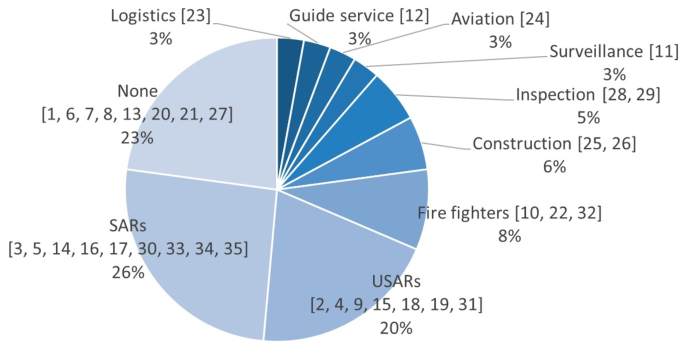
Fields of Application Most studies focused on search and rescue (SARs) and urban search and rescue (USARs), in particular for victim detection. Others authors researched on fire fighters, assembly in construction, inspections, surveillance, aviation, guide service and logistics. Eight studies did not specify the application of domain (see also Figure 1).
Reported Outcomes According to Steinfeld et al. (2006), common metrics for human-robot interaction assess the performance rather for the operator, the system or the robot. From a human factor perspective, operator performance in human- robot interaction is influenced by a combination of cognitive, physical, and psychological factors (Hopko et al., 2022). The outcomes are listed in Table 2.
How Many Robots Is Too Many? Findings About Single-Human Multiple-Robot Systems 25
Figure 1: Distribution of field of domains [IDs] can be found in Table 1.
As expected, the most common operator performance measures were workload and situational awareness (SA). Of the 22 authors who measured workload, 18 used NASA-TLX, while others measured workload with robot attention demand, the operator utilization rate, the ZEIS rating method by Pitrella (1989), or the heart rate. In the case of SA, some scholars used standardized methods such as the SAGAT by Endsley (1988) or the 3D SART by Taylor (1990, 2017), while others used eye movement or tracking, navigation or perception metrics, and operator response or waiting times. In addition, attention was measured in three studies using vehicle wait times due to operator attentional inefficiencies. Other studies investigated the trust in automation or in the robots. Only one author considered emotional state using the SAM questionnaire by Bradley and Lang (1994).
Table 2. Operator performance outcomes.
Table available in the original PDF paper.
Outcome Measuring instrument IDs Workload NASA-TLX [1, 2, 3, 4, 13, 16, 17, 18, 19, 22, 23, 24, 25, 27, 29, 30, 34, 35] Other instruments [6, 8, 28, 32] Situational awareness SAGAT and 3D SART [16, 22, 24] Eye movement or tracking [10, 21] Other instruments [5, 14, 25, 26] Attention Waiting times [8, 13, 33] Trust Trust in automation [4, 17] Trust in the system [9] Emotional state SAM questionnaire [7]
System performance measures, on the other hand, are those that assess how well the human and robots perform as a team (Steinfeld et al., 2006). The compilation of these outcomes is listed in Table 3. In summary, in search
26 Rey-Becerra and Wischniewski
and rescue, including fire fighters, most authors considered the number of victims found (performance rate) or missed or (error rate) as an effectiveness measure, and the time to complete the mission and the area covered or missed by the robots as efficiency measures. Just three authors considered the mean fan-out depending on the workload or SA.
In other fields, scholars focused more on number of successful task completions or task completion time, number of errors or false alarms, waiting time or interaction time. Other outcomes included percentage of collisions or robot damage, robot‘s detection accuracy, progress, speed, or synchronization, maneuverability, force mapping, path and perceived usefulness.
Search and rescue (including fire fighters) Task completion time [3, 10, 15, 16, 19, 30] Area explored [3, 4, 15, 19, 31, 33, 34, 35] Fan-out [5, 30, 35] Others [9, 14, 15, 22] Other fields Task success [1, 8, 12, 21, 23, 25, 28] Task completion time [1, 6, 8, 13, 20, 25, 28, 29] Errors or false alarms [1, 26] Others [7, 11, 27, 29]
DISCUSSION
The objective of this literature review was to comprehend the characteristics of SHMR systems and provide a synopsis of the most important features. We found that SHMRs are mainly used for search and rescue operations. In this domain, robots assist the operator during natural disasters by entering a hard-to-reach disaster area and understanding the environment in order to save lives (Kruijff-Korbayová et al., 2015). About 80% of the identified records used only one type of mobile robot. Combining different types of robots might bring advantages (e.g., increased area coverage), especially in emergency situations where the landscape is mixed (Magid et al., 2022), or in construction sites where the structure is constantly changing (Kim et al., 2022). Studies have primarily focused on evaluating mental workload using the NASA TLX, and to a lesser extent, situational awareness using various techniques. Therefore, cognitive factors have been studied but with questionnaires that seem to show less sensitivity to task changes (Barajas- Bustillos et al., 2023, Rubio et al., 2004). Besides, when interacting with robots through a GUI, it is necessary to consider all multidimensional user states (Schwarz et al., 2014), including motivation, which has not been studied. Hence, there is a need to explore physical and psychological factors of the operator when interacting with multiple robots using one or multiple screens.
Among the system performance outcomes, some studies have shown that the more robots are used, the more problems may occur, such as robot
How Many Robots Is Too Many? Findings About Single-Human Multiple-Robot Systems 27
damage or low task performance. This is due to increased operator workload (Adams, 2009) or decreased operator’s attentional capacity (Crandall and Cummings, 2007). Finally, researchers have tested different robot team combinations, but few authors have explored the robot threshold at which system performance is no longer improved by adding additional robots. Wang et al. (2009b) and Velagapudi et al. (2008) proposed a fan-out of 9 robots, while Crandall and Cummings (2007) explained that there seems to be a plateau at 6 robots. Regarding robot automation, some authors argued that it might reduce operator workload by managing attention, reducing robot demands, and improving task performance (Goodrich et al., 2007, Hong et al., 2019). On the contrary, others explained that a higher level of automation does not necessarily improve system performance (Chien et al., 2013, Khasawneh et al., 2019). Although we conducted an exploratory search, it is likely that we did not find more documents related to the topic of interest given our keywords, and therefore we obtained more records from other authors’ references than directly from the database. Nevertheless, the synthesis presented here offers an overview of the current state of the systems. In summary, SHMR systems have the potential to enhance task performance, but their effect on the operator has not been sufficiently explored. Future research could focus on exploring these systems in industries that have not yet been studied (e.g., energy industry, gas or electricity), and analyzing the impact of individual characteristics, such as age or gender, on these systems.
FUNDING The author(s) declare that they have received financial support for the research, writing, and/or publication of this article. This work is part of the project F2557 “Human Centered Technologies for a Safer and Greener European Construction Industry” (HumanTech), which is funded by the European Union’s research and innovation program Horizon Europe under grant agreement N
101058236) and the project F2569 “Optimized Work Design for Network Control Centers of Critical Infrastructure” (Beautiful), which is funded by the Federal Ministry of Education and Research (Bundesministerium für Bildung und Forschung, BMBF) (funding code: 03SF0694) and is coordinated by the Project Management Agency Jülich (PTJ).
REFERENCES
Adams, J. A. 2009. Multiple robot / single human interaction: effects on perceived workload. Behaviour & Information Technology, 28, 183–198. Balestrieri, E., Daponte, P., De Vito, L. & Lamonaca, F. 2021. Sensors and
Measurements for Unmanned Systems: An Overview. Sensors [Online], 21. Barajas-Bustillos, M. A., Maldonado-Macías, A. A., Serrano-Rosa, M. A., Hernandez-Arellano, J. L., Llamas-Alonso, L. & Balderrama-Armendariz, O. 2023. Impact of experience on the sensitivity, acceptability, and intrusive of two subjective mental workload techniques: The NASA TLX and workload profile. Work, 75, 1265–1275.
28 Rey-Becerra and Wischniewski
Beer, J. M., Fisk, A. D. & Rogers, W. A. 2014. Toward a framework for levels of robot autonomy in human-robot interaction. J Hum Robot Interact, 3, 74–99. Bostondynamics. 2023. Spot - Innovating work across industries [Online]. Available:
https://bostondynamics.com/industry/ [Accessed 9. April 2024]. Boussemart, Y. & Cummings, M. L. 2011. Predictive models of human supervisory control behavioral patterns using hidden semi-Markov models. Engineering Applications of Artificial Intelligence, 24, 1252–1262. Bradley, M. M. & Lang, P. J. 1994. Measuring emotion: The self-assessment manikin
and the semantic differential. Journal of Behavior Therapy and Experimental Psychiatry, 25, 49–59. Breslow, L. A., Gartenberg, D., Mccurry, J. M. & Trafton, J. G. 2014. Dynamic Operator Overload: A Model for Predicting Workload During Supervisory Control. IEEE Transactions on Human-Machine Systems, 44, 30–40. Brooks, N., Scerri, P., Sycara, K., Wang, H., Chien, S.-Y. & Lewis, M. 2011.
Asynchronous Control with ATR for Large Robot Teams. Proceedings of the Human Factors and Ergonomics Society Annual Meeting, 55, 444–448. Casper, J. & Murphy, R. R. 2003. Human-robot interactions during the robotassisted urban search and rescue response at the World Trade Center. IEEE Transactions on Systems, Man, and Cybernetics, Part B (Cybernetics), Systems, Man, and Cybernetics, Part B: Cybernetics, IEEE Transactions on, IEEE Trans. Syst., Man, Cybern. B, 33, 367–385. Chandarana, M., Hughes, D., Lewis, M., Sycara, K. & Scherer, S. 2021. Planning
and Monitoring Multi-Job Type Swarm Search and Service Missions. Journal of Intelligent & Robotic Systems, 101, 1–14. Chen, J. Y. C. & Barnes, M. J. 2021. Human–Robot Interaction. Handbook of Human Factors and Ergonomics. Chien, S.-Y., Lewis, M., Mehrotra, S. & Sycara, K. 2013. Imperfect Automation in
Scheduling Operator Attention on Control of Multi-Robots. Proceedings of the Human Factors and Ergonomics Society Annual Meeting, 57, 1169–1173. Crandall, J. W. & Cummings, M. L. 2007. Developing performance metrics for the supervisory control of multiple robots. IEEE. Crandall, J. W., Goodrich, M. A., Olsen, J. D. R. & Nielsen, C. W. 2005.
Validating Human-Robot Interaction Schemes in Multitasking Environments. IEEE Transactions on Systems, Man & Cybernetics: Part A, 35, 438–449. Cummings, M. L. & Mitchell, P. J. 2008. Predicting Controller Capacity in Supervisory Control of Multiple UAVs. IEEE Transactions on Systems, Man, and Cybernetics - Part A: Systems and Humans, Systems, Man and Cybernetics, Part A: Systems and Humans, IEEE Transactions on, IEEE Trans. Syst., Man, Cybern. A, 38, 451–460. Dietz, G., Kim, L. H., Jane, L. E., Follmer, S. & Washington, P. Human perception of
swarm robot motion. 2017. Association for Computing Machinery, 2520–2527. Donmez, B., Nehme, C. & Cummings, M. L. 2010. Modeling Workload Impact in Multiple Unmanned Vehicle Supervisory Control. IEEE Transactions on Systems, Man, and Cybernetics - Part A: Systems and Humans, Systems, Man and Cybernetics, Part A: Systems and Humans, IEEE Transactions on, IEEE Trans. Syst., Man, Cybern. A, 40, 1180–1190. Ebsco, C. 2023. What content is included in my EBSCO Discovery Service
(EDS) profile? [Online]. Available: https://connect.ebsco.com/s/article/What-con tent-is-included-in-my-EBSCO-Discovery-Service-EDS-profile?language=en_US [Accessed April 2024].
How Many Robots Is Too Many? Findings About Single-Human Multiple-Robot Systems 29
Endsley, M. R. Situation awareness global assessment technique (SAGAT). Proceedings of the IEEE 1988 national aerospace and electronics conference, 1988. IEEE, 789–795. Fooladi Mahani, M., Jiang, L. & Wang, Y. 2021. A Bayesian Trust Inference Model for Human-Multi-Robot Teams. International Journal of Social Robotics, 13, 1951–1965. Frische, F. & Ludtke, A. 2013. SA-Tracer: A tool for assessment of UAV swarm
operator SA during mission execution. IEEE. Fuchs, C., Borst, C., De Croon, G. C. H. E., Van Paassen, M. M. & Mulder, M. 2014.
An Ecological Approach to the Supervisory Control of UAV Swarms. International Journal of Micro Air Vehicles, 6, 211–229. Glas, D. F., Kanda, T., Ishiguro, H. & Hagita, N. 2012. Teleoperation of Multiple Social Robots. IEEE Transactions on Systems, Man & Cybernetics: Part A, 42, 530–544. Goodrich, M. A., Mclain, T. W., Anderson, J. D., Sun, J. & Crandall, J. W. 2007.
Managing autonomy in robot teams: Observations from four experiments. IEEE. Hocraffer, A. & Nam, C. S. 2017. A meta-analysis of human-system interfaces in unmanned aerial vehicle (UAV) swarm management. Appl Ergon, 58, 66–80. Hong, A., Igharoro, O., Liu, Y., Niroui, F., Nejat, G. & Benhabib, B. 2019.
Investigating Human-Robot Teams for Learning-Based Semi-autonomous Control in Urban Search and Rescue Environments. Journal of Intelligent & Robotic Systems, 94, 669–686. Hong, A., Lee, D., Bülthoff, H. & Son, H. 2017. Multimodal feedback for teleoperation of multiple mobile robots in an outdoor environment. Journal on Multimodal User Interfaces, 11, 67–80. Hopko, S., Wang, J. & Mehta, R. 2022. Human Factors Considerations and Metrics
in Shared Space Human-Robot Collaboration: A Systematic Review. Front Robot AI, 9, 799522. Huang, H.-M. 2004. Autonomy Levels for Unmanned Systems (ALFUS) Framework - Volume I: Terminology. National Institute of Standards and Technology. Humphrey, C. M., Henk, C., Sewell, G., Williams, B. W. & Adams, J. A. 2007.
Assessing the scalability of a multiple robot interface. IEEE. Izadi Moud, H., Shojaei, A. & Flood, I. Current and Future Applications of Unmanned Surface, Underwater, and Ground Vehicles in Construction. Construction Research Congress 2018, 106–115. Kawamura, K., Nilas, P., Muguruma, K., Adams, J. A. & Chen, Z. An agent-based architecture for an adaptive human-robot interface. 36th Annual Hawaii International Conference on System Sciences, 2003. Proceedings of the, 6–9 Jan. 2003, p. 8. Khasawneh, A., Rogers, H., Bertrand, J., Madathil, K. C. & Gramopadhye, A. 2019.
Human adaptation to latency in teleoperated multi-robot human-agent search and rescue teams. Automation in Construction, 99, 265–277. Kim, Y., Kim, H., Murphy, R., Lee, S. & Ahn, C. R. 2022. Delegation or Collaboration: Understanding Different Construction Stakeholders’ Perceptions of Robotization. Journal of Management in Engineering, 38, 1–12. Kruijff-Korbayová, I., Colas, F., Gianni, M., Pirri, F., Greeff, J., Hindriks, K.,
Neerincx, M., Ögren, P., Svoboda, T. & Worst, R. 2015. TRADR Project: Long-Term Human-Robot Teaming for Robot Assisted Disaster Response. KI: Künstliche Intelligenz, 29, 193–201.
30 Rey-Becerra and Wischniewski
Lewis, M. 2013. Human Interaction With Multiple Remote Robots. Reviews of Human Factors and Ergonomics, 9, 131–174. Lewis, M., Chien, S.-Y., Mehortra, S., Chakraborty, N. & Sycara, K. 2014. Task
Switching and Single vs. Multiple Alarms for Supervisory Control of Multiple Robots. In: Harris, D. (ed.) International Conference on Engineering Psychology and Cognitive Ergonomics. Lewis, M., Huadong, W., Shih Yi, C., Velagapudi, P., Scerri, P. & Sycara, K. 2010.
Choosing Autonomy Modes for Multirobot Search. Human Factors, 52, 225–233. Magid, E., Matsuno, F., Suthakorn, J., Svinin, M., Bai, Y., Tsoy, T., Safin, R., Lavrenov, R., Zakiev, A., Nakanishi, H., Hatayama, M. & Endo, T. 2022. e- ASIA Joint Research Program: development of an international collaborative informational system for emergency situations management of flood and land slide disaster areas. Artificial Life & Robotics, 27, 613–623. Murashov, V., Hearl, F. & Howard, J. 2016. Working safely with robot workers:
Recommendations for the new workplace. J Occup Environ Hyg, 13, D61–71. Olsen J. R., D. R. & Wood, S. B. Fan-out: Measuring human control of multiple robots. 2004. 231–238. Patel, J., Sonar, P. & Pinciroli, C. 2022. On multi-human multi-robot remote interaction: A study of transparency, inter-human communication, and information loss in remote interaction. Swarm Intelligence, 16, 107–142. Pitrella, F. D. 1989. A Cognitive Model of the Internal Rating Process, Forschungsges.
für Angewandte Naturwiss. Prewett, M. S., Saboe, K. N., Johnson, R. C., Coovert, M. D. & Elliott, L. R.
2009. Workload in Human-Robot Interaction: A Review of Manipulations and Outcomes. Proceedings of the Human Factors and Ergonomics Society Annual Meeting, 53, 1393–1397. Ratwani, R. M., Mccurry, J. M. & Trafton, J. G. 2010. Single operator, multiple robots: An eye movement based theoretic model of operator situation awareness. Roldán, J. J., Peña-Tapia, E., Martín-Barrio, A., Olivares-Méndez, M. A., Del Cerro, J. & Barrientos, A. 2017. Multi-Robot Interfaces and Operator Situational Awareness: Study of the Impact of Immersion and Prediction. Sensors (14248220), 17, 1720. Rosenfeld, A., Agmon, N., Maksimov, O. & Kraus, S. 2017. Intelligent agent
supporting human–multi-robot team collaboration. Artificial Intelligence, 252, 211–231. Rubio, F., Valero, F. & Llopis-Albert, C. 2019. A review of mobile robots: Concepts, methods, theoretical framework, and applications. International Journal of Advanced Robotic Systems, 16. Rubio, S., Díaz, E., Martín, J. & Puente, J. M. 2004. Evaluation of Subjective Mental
Workload: A Comparison of SWAT, NASA-TLX, and Workload Profile Methods. Applied Psychology, 53, 61–86. Ruiz, J. J., Martinez-De-Dios, J. R., Ollero, A. & Viguria, A. Immersive displays for building spatial knowledge in multi-UAV operations. 2015. Institute of Electrical and Electronics Engineers Inc., 1043–1048. Schwarz, J., Fuchs, S. & Flemisch, F. Towards a more holistic view on user state
assessment in adaptive human-computer interaction. 2014 IEEE International Conference on Systems, Man, and Cybernetics (SMC), 5–8 Oct. 2014, 1228–1234. Sellner, B., Heger, F. W., Hiatt, L. M., Simmons, R. & Singh, S. 2006a. Coordinated Multiagent Teams and Sliding Autonomy for Large-Scale Assembly. Proceedings of the IEEE, 94, 1425–1444.
How Many Robots Is Too Many? Findings About Single-Human Multiple-Robot Systems 31
Sellner, B. P., Simmons, R., Singh, S. & Hiatt, L. M. Attaining situational awareness for sliding autonomy. 2006b. Association for Computing Machinery (ACM), 80–87. Setter, T., Fouraker, A., Kawashima, H. & Egerstedt, M. 2015. Haptic Interactions
With Multi-Robot Swarms Using Manipulability. Journal of Human-Robot Interaction, 4. Siegwart, R. & Nourbakhsh, I. R. 2004. Introduction to autonomous mobile robots, Cambridge, Mass. [u.a, MIT Press]. Steinfeld, A., Fong, T., Kaber, D., Lewis, M., Scholtz, J., Schultz, A. & Goodrich, M.
2006. Common metrics for human-robot interaction. Proceedings of the 1st ACM SIGCHI/SIGART conference on Human-robot interaction. Salt Lake City, Utah, USA: Association for Computing Machinery. Taylor, R. M. Situational Awareness Rating Technique (SART): The development of a toll for aircrew systems design. In: AGARD Conference Proceedings No. 478, Situational Awareness in Aerospace Operations. Aerospace Medical Panel Symposium. Copenhagen, 2nd–6th October, 1989, 1990. Taylor, R. M. 2017. Situational awareness rating technique (SART): The development
of a tool for aircrew systems design. Situational awareness. Routledge. Tranfield, D., Denyer, D. & Smart, P. 2003. Towards a Methodology for Developing Evidence-Informed Management Knowledge by Means of Systematic Review. British Journal of Management, 14, 207–222. Trouvain, B., Schlick, C. & Mevert, M. Comparison of a map-vs. camera-based user
interface in a multi-robot navigation task. SMC’03 Conference Proceedings. 2003 IEEE International Conference on Systems, Man and Cybernetics. Conference Theme-System Security and Assurance (Cat. No. 03CH37483), 2003. IEEE, 3224–3231. Trouvain, B. & Wolf, H. L. 2002. Evaluation of multi-robot control and monitoring performance. Piscataway, NJ, USA, USA: IEEE. Velagapudi, P., Scerri, P., Sycara, K., Huadong, W., Lewis, M. & Jijun, W. 2008.
Scaling effects in multi-robot control. IEEE. Vilela, J., Yugang, L. & Nejat, G. 2013. Semi-autonomous exploration with robot teams in urban search and rescue. IEEE. Villani, V., Capelli, B., Secchi, C., Fantuzzi, C. & Sabattini, L. 2020. Humans interacting with multi-robot systems: A natural affect-based approach. Autonomous Robots, 44, 601–616. Wang, H., Lewis, M., Chien, S.-H. & Velagapudi, P. 2009a. Scaling Effects for
Synchronous vs. Asynchronous Video in Multi-robot Search. Proceedings of the Human Factors and Ergonomics Society Annual Meeting, 53, 364–368. Wang, H., Lewis, M., Velagapudi, P., Scerri, P. & Sycara, K. 2009b. How search and its subtasks scale in N robots. ACM/IEEE International Conference on Human- Robot Interaction, 141–148. Wang, J. & Lewis, M. 2007. Human control for cooperating robot teams. IEEE. Wickens, C. D. 2008. Multiple Resources and Mental Workload. Human Factors,
50, 449–455. Wilson, J., Chance, G., Winter, P., Lee, S., Milner, E., Abeywickrama, D., Windsor, S., Downer, J., Eder, K., Ives, J. & Hauert, S. 2023. Trustworthy Swarms. Proceedings of the First International Symposium on Trustworthy Autonomous Systems.
32 Rey-Becerra and Wischniewski
Wong, C. Y. & Seet, G. 2017. Workload, awareness and automation in multiple-robot supervision. International Journal of Advanced Robotic Systems, 14. Wong, C. Y., Seet, G. & Sim, S. K. 2011. Multiple-robot systems for USAR:
Key design attributes and deployment issues. International Journal of Advanced Robotic Systems, 8, 85–101. Yanco, H. A. & Drury, J. L. A Taxonomy for Human-Robot Interaction. AAAI Fall Symposium on Human-Robot Interaction, 2002. 111–119.
LISTED IN THE AHFE DIGITAL BOOKSTORE CATALOGUE
Explore the complete digital volume
Human Interaction and Emerging Technologies (IHIET 2024)
Read this individual research paper free through the original publisher, or explore the full digital proceedings book.
ISBN 978-1-964867-33-5
Explore this ISBN in the AHFE Bookstore ↗Listed in the July 2026 bookstore catalogue; search by ISBN to confirm current availability · Digital book purchase optional