Izza Anwer, Irfan Yousuf (2024). Prospects of Autonomous Vehicles In Evolving Countries: A Users’ Perspective. In: Usability and User Experience. AHFE Open Access, vol. 156, pp. 151–162. https://doi.org/10.54941/ahfe1005425
Autonomous vehicles (AVs) are going through many phases of trail and testing in advanced countries. Though the technological aspects are progressing, yet the social aspects of AVs related to users from developing countries are under-studied. Therefore, this study aimed to investigate the grounds for prospects of AVs in evolving countries. From users’ perspective, technical, regulatory, and social challenges were addressed for smoother inclusion of AVs in mainstream traffic and markets. The research methodology involved the development of a questionnaire, which was piloted and was ethically approved. 600 subjects from metropolitan city of evolving country were recruited through random sampling technique. The collected data was analyzed through multiple methods including correlation and descriptive analysis following multiple linear regression techniques. A few findings on the awareness were that 52.5 % respondents had minor understanding of AVs whilst 47.5% were not aware of AVs at all. 25.6 % respondents were attracted to the fact that AVs have less human engagement factor, 25% were aware and hopeful that AVs are support for those who cannot drive due to physical disabilities, physical mobility constraints, 24% were aware of its self-parking features, 24% considered AVs a symbol of status for elite members of society. Regarding barriers towards AVs were also evaluated that presents the main reasons for AVs not yet being thought about or implemented. Results showed that 26% respondents were concerned about the poor infrastructure to support inclusion of AVs, 29.7% were about higher capital cost, 25% were about cyber security issues, 24% were about reduction in drivers' employment, and 27% were about the absence of legislative framework and pre-hand measures to adopt AVs. Based on the detailed study and its findings, the study shows an in-depth picture of the understanding and concerns of the people which was required to understand. The study recommended that the policymakers and industry stakeholders should focus on increasing awareness about the benefits of AVs whilst addressing concerns about cost and infrastructure. It is also required to design comprehensive frameworks regarding complex issues related to legislations, transport system’s existence and upgradation requirements, transport policy inclusive of AVs and promotion of incentives for early adopters. The study is useful for academicians, researchers, engineers, managers, and policy makers of evolving countries.
PROBLEM STATEMENT Autonomous vehicles (AV’s) are self-driving vehicles with minimum to no human intervention. These vehicles use various sensors such as cameras, lidars, and radars to gather information about their surroundings and make decisions based on that information. Advanced algorithms are developed to collect, analyses and utilize data to take on-spot decisions to control the vehicle’s movements (Sun, Cao et al., 2021). The adoption of AV’s holds sig- nificant promise for transforming transportation systems by enhancing safety, reducing traffic congestion, and increasing overall efficiency of the trans- portation system (Xu, 2020). However, the widespread adoption of AV’s faces several challenges that need to be addressed. These challenges include tech- nical issues, regulatory frameworks, and social acceptance. Technical chal- lenges include developing robust and reliable autonomous systems, ensuring cybersecurity, and integrating AV’s with existing transportation infrastructure (Ahangar, Ahmed et al., 2021). Regulatory challenges involve establishing appropriate legal frameworks, insurance policies, and liability regulations for AV’s. Social challenges include addressing public concerns about safety, job displacement, and privacy issues associated with autonomous driving tech- nology (Parekh, Poddar et al., 2022). In addition, how third world countries perceive AV’s and how AV’s should become the part of the mainstream traffic. This study focuses on these aspects from users’ perspective.
AV’s have the potential to revolutionize urban mobility and offer numer- ous benefits. They can reduce accidents caused by human error, optimize traffic flow, and potentially decrease the need for individual car ownership. The number of AV’s on roads worldwide is difficult to quantify precisely due to the rapidly evolving nature of the industry and the lack of standard- ized reporting (Xu, 2020). However, numerous companies are actively testing autonomous vehicles in various locations around the world. Some of the lead- ing companies in AV development include Waymo (a subsidiary of Alphabet Inc.), Tesla, Cruise (a subsidiary of General Motors), Uber ATG (Advanced Technologies Group), and Argo AI (backed by Ford and Volkswagen), among others (Xu, 2020).
Many of these companies operate AV’s testing fleets in selected cities or regions where regulations permit. However, it’s essential to note that most AV’s on roads are operating in pilot phases, with safety drivers or opera- tors onboard to monitor vehicle performance and intervene if necessary. The number of AV’s in testing phases is continually changing as companies expand their testing programs, improve technology, and seek regulatory approval for broader deployment. Additionally, advancements in AV’s’ technology and regulations governing their operation will influence the pace and scale of adoption in the coming years (Xu, 2020).
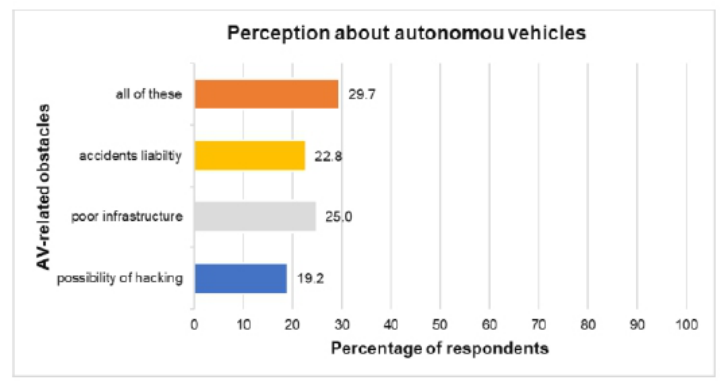
AV’s face a multitude of challenges in adoption (Xu, 2020). These chal- lenges encompass a wide range of issues, including inadequate infrastructure, poorly maintained roads, inadequate traffic management systems, limited access to electricity, and concerns about safety, liability, and charging infras- tructure. The barriers to Av adoption are complex and interconnected, requir- ing a comprehensive understanding of both internal and external factors Muratori, Alexander et al. (2021). To pave the way towards successful inte- gration of AV’s into our transportation system, it is essential to address
Prospects of Autonomous Vehicles In Evolving Countries: A Users’ Perspective 153
these obstacles and promote user acceptance, technology maturity, regula- tory frameworks, safety measures, and appropriate legislation, Muratori, Alexander et al. (2021).
Research shows that respondents with greater technological optimism and an inclination toward driving technology tend to hold more positive views of AV’s. Conversely, those who derive enjoyment from driving and exhibit sociable behavior toward fellow road users tend to express more negative perceptions of AV’s. However, the negative relationship between driving sociability and Av enthusiasm is moderated by overall technological opti- mism. The requirement for future is that exposure to different in future research (Acheampong, Cugurullo et al., 2021) (Xu, 2020).
Numerous studies (Qayyum, Usama et al., 2020; Wang, Li et al., 2020; Xu, 2020) have focused on the security concerns related to AV’s but the primary factor in any new technology’s success is social approval. Accidents involving AV’s may have an impact on general approval, particularly given that some people do not trust machines. People feel worried of AV’s, and as more acci- dents are recorded, people’s degree of fear of AV’s rises. Unlike human drivers, AV’s have predetermined decision-making processes regarding accidents, a factor that intensifies this contradiction within their operational settings. This has a huge impact on the public’s acceptance (Qayyum, Usama et al., 2020; Xu, 2020).
The deployment of AV’s on road networks will boost efficiency, reduce energy consumption by automobiles, and upgrade roadway protection by lowering number of accidents. Studies related to the potential barriers of AV’s’ adoption could include high costs for automobiles and related technol- ogy, ethical and legal problems, privacy difficulties, cybersecurity challenges, and hacking issues. Large corporations such as Waymo, Tesla, and Uber, as well as Chinese companies like Baidu and Alibaba, are investing heavily in autonomous vehicle technology. The Chinese government has set a target for driverless vehicles to account for 30% of new automobile sales by 2030. Japan, Singapore, and other countries also anticipate a future where most cars will be autonomous, operating without human intervention, by around 2035 (Mordue, Yeung et al., 2020; Wang, Li et al., 2020). In such complicated global scenario, where does third world countries stand? Therefore, public awareness, perceptions, and concerns related to AV’s, are of prime concern and this research will contribute to better under- stand the readiness of society for the adoption of AV’s. The main objective is to find the extent of understanding of public regarding AV’s and to iden- tify the barriers in implementing them. The findings will provide valuable insights for policymakers, researchers, and industry stakeholders to develop strategies that promote the successful integration of AV’s into the transporta- tion system. It is crucial to identify and address the barriers to Av adoption to realize the potential benefits they offer in terms of safety, efficiency, and sus- tainability. This study aims to contribute to the growing body of research on AV’s and provide recommendations for fostering their adoption in evolving countries such as Pakistan. By identifying the challenges and opportunities, policymakers can make informed decisions and develop appropriate policies and initiatives to ensure a smooth and successful transition to autonomous transportation.
154 Anwer and Yousuf
METHODOLOGY
To carry out the objective of study a questionnaire was developed to collect and analyze data. The data was collected from passengers at various stops, stations, and public places, through online forms, vehicle owners, charging station owner/user with a total sample of 600 respondents. The questionnaire had four sections divided based on the type of information to be collected. First section involves awareness about AV’s, second, about the safety related issues, third, about the affordability, cyber security of AV’s and willingness to buy and fourth involves the demographic information of sample. Survey was conducted through random sampling technique. It aims to provide a clear and concise overview of the data collected for the study.
Socio-Demographic Information Results show that the data comprises of different age groups of categories 18–25, 26–35, 36–45, 46–60 and >60. The respondents with the age range of 26–35 were dominant with 29.5% and the least was of group >60 which was 14%. Male respondents dominated with response rate of 55.5% whilst female respondents were 39.9%. People earning 50,000/- to 100,000/- were 27.3%. Graduate respondents were in high percentage of 33.4% while post- graduate respondents were least in percentage of 14.9%. People doing private jobs were dominant in percentage with 38%. Respondents belonged to middle class were high in percentages with 61%. People owning motorbikes/- cycles were high in percentage with 29.4% and daily commuters were in high percentage of 25.6% are shown in Table 1.
Table 1. Variables and percentage distribution regarding socio-economic and demographic features.
Table available in the original PDF paper.
Variables Percentages Variables Percentages Age Education 18–25 21.5 primary education 21.1 26–35 29.4 inter/diploma 24.6 36–45 25.1 Graduate 33.4 46–60 18.8 post-graduate 14.9 >60 0.6 Travel frequency Socio-economic group Occasionally 25.6 lower class 17.8 Daily 37.4 middle class 61 Weekly 17.2 higher class 15.6 Monthly 14 Employment Vehicle usage Student 21.6 Car 25.6 Government 32.6 motorbike/cycle 29.4 Private 38 public transport 23.4 Retired 0.6 Gender Income Male 55.5 less than 25000 18.9 Female 39.9 25k-50k 29.1 50k-100k 27.3 more than 100k 18.1
Prospects of Autonomous Vehicles In Evolving Countries: A Users’ Perspective 155
RESULTS AND DISCUSSION
This section mentions the results obtained from analysis. Descriptive and correlational analysis is presented.
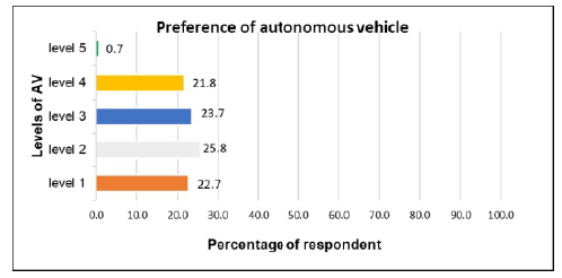
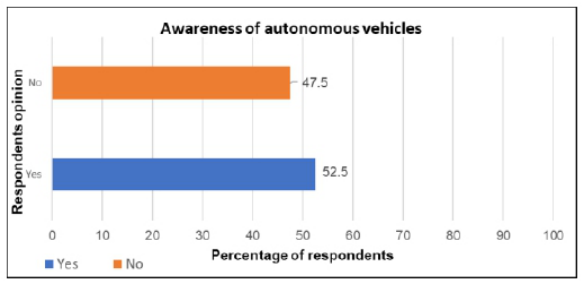
Awareness and Preferred Level of Automation Results show that 52.5% of the respondents were familiar with AV’s. This indicates that more than half of the participants had at least a basic under- stand ding of AV’s technology. Whereas 47.5% showed no awareness about AV’s Figure 2. Among different levels of AV’s, 27% preferred Level 2, which involves advanced driver assistance systems that can assist with steering, acceleration, and braking, but still require human supervision. 25% preferred lever 3, that allows vehicle to take full control of driving tasks under certain conditions, but it still requires the driver to be ready to intervene when nec- essary. 24% preferred level 1 AV’s that offers basic driver assistance features such as cruise control and lane keeping. 23% favored level 4 that are highly automated but still require a human driver as a backup. Only 1% opted for level 5 which is fully automated without any need for human intervention Figure 2. This suggests that respondents may have reservations or concerns about completely removing the human driver from the equation.
Figure 1: Preferred level of automation in AV’s.Figure 2: Awareness among people in AV’s.
156 Anwer and Yousuf
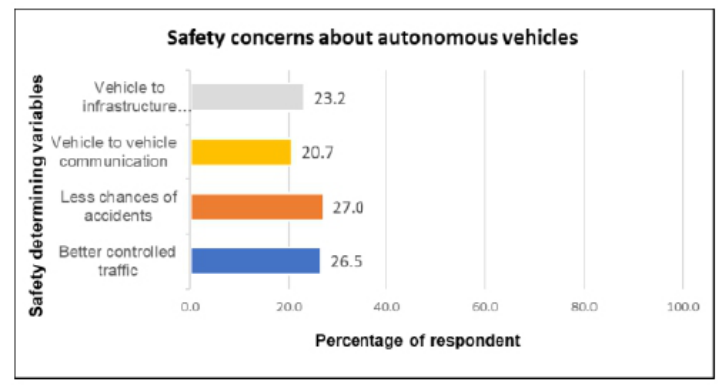
AV’s in the Perspective of Lahore 27% of people in Lahore believed that AV’s can contribute to better con- trolled traffic, implying that these vehicles have the potential to improve traffic flow and congestion management. On the other hand, 28% of indi- viduals hold the belief that accidents will be reduced as the involvement of human factors decreases with the adoption of AV’s. Moreover, 24% of respondents express their belief that AV’s exhibit superior communication capabilities with existing infrastructure, potentially enabling smoother inte- gration and coordination. Additionally, 21% of people are of the opinion that AV’s excel in communication with other vehicles, suggesting enhanced cooperative behavior on the roads Figure 5.
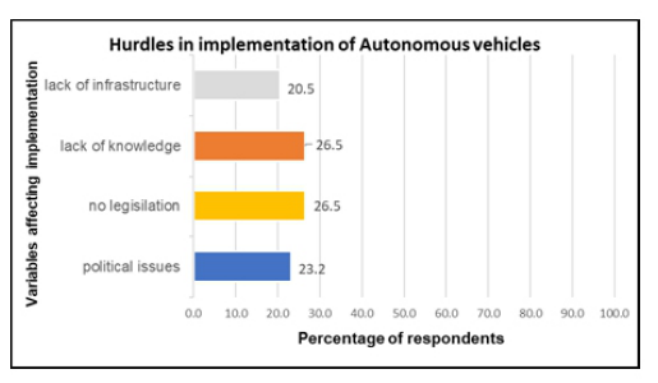
Figure 3: Purchase of AV’s by common people.Figure 4: Hurdles to make AV’s include in mainstream traffic of Pakistan.
Prospects of Autonomous Vehicles In Evolving Countries: A Users’ Perspective 157
Figure 5: Perception about AV’s expressed by common people.Figure 6: AV’s not adopted in Pakistan.
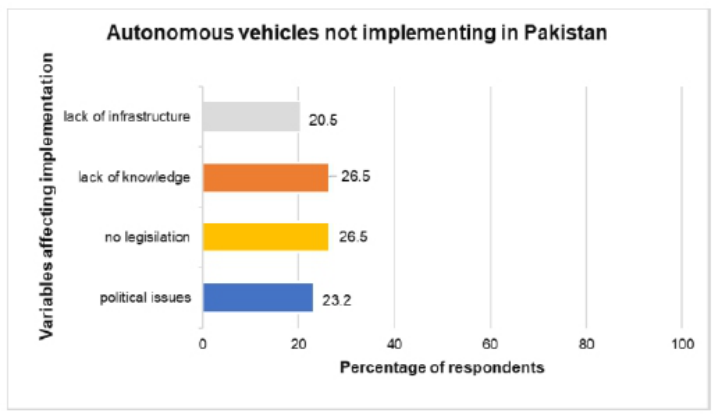
Hurdles in Adopting AV’s 27% respondents consider that the lack of knowledge is the main reason for not implementing AV’s in Pakistan. This suggests that a significant por- tion of the population may not have sufficient information or awareness about AV technology, which could hinder its adoption. Additionally, 28% of the respondents identified the absence of legislation as a major factor preventing the implementation of AV’s Figure 4. This implies that the legal framework and regulations governing AV’s are not yet in place in Pakistan, creating uncertainty and inhibiting their deployment. Furthermore, 28% of respondents mentioned both the lack of legislation and 21% cited the lack
158 Anwer and Yousuf
of infrastructure for the delay in implementing AV’s in Pakistan. This high- lights the importance of having appropriate legal and regulatory frameworks, as well as the necessary infrastructure, such as roads and communication networks, to support the safe and effective operation of AV’s.
Figure 7: Safety concerns of common people about AV’s.Figure 8: Factors that discourages common people about AV’s.
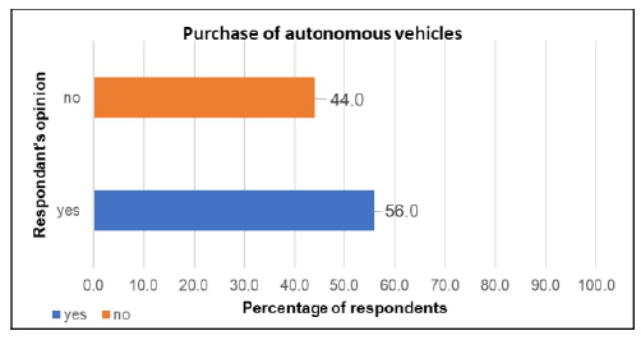
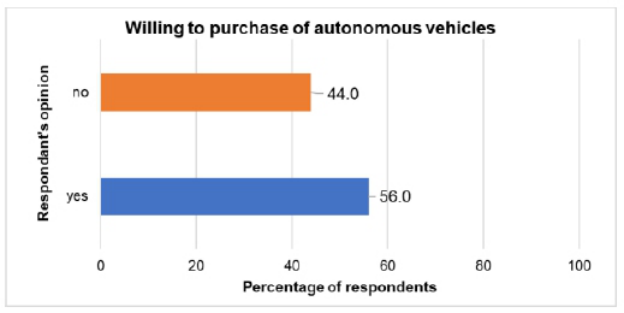
Purchasing of AV’s Survey results show that 56% of the respondents expressed their willingness to purchase AV’s if they are available. This indicated a significant interest and potential market demand for AV’s among the respondents. Whereas 44% of
Prospects of Autonomous Vehicles In Evolving Countries: A Users’ Perspective 159
the respondents indicated that they would not consider purchasing AV’s as they may have reservations or concerns about Av technology, or they may prefer conventional vehicles for various reasons.
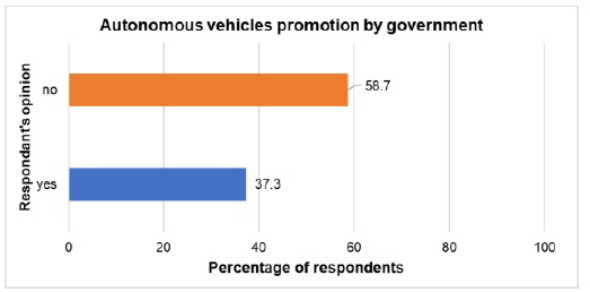
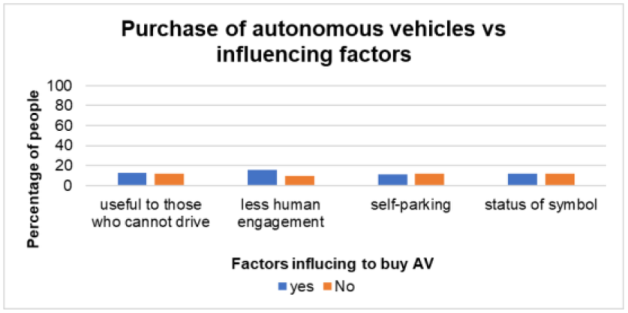
Figure 9: Government policies and goals to get AV’s into mainstream transport system (Pakistan).Figure 10: Common people show their willingness to purchase AV’s.Figure 11: Factors that affects the purchase of AV’s.
160 Anwer and Yousuf
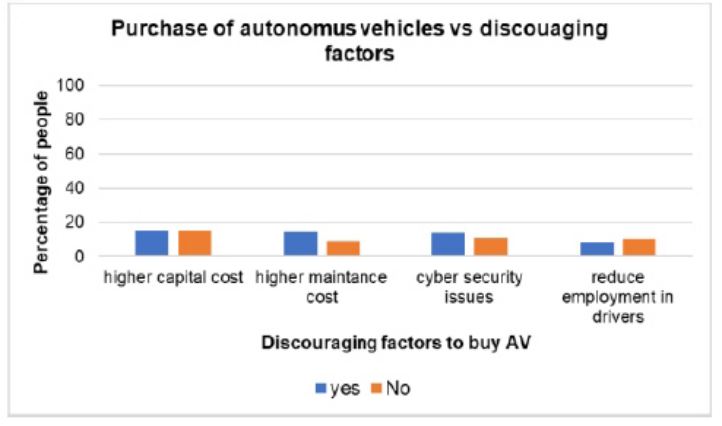
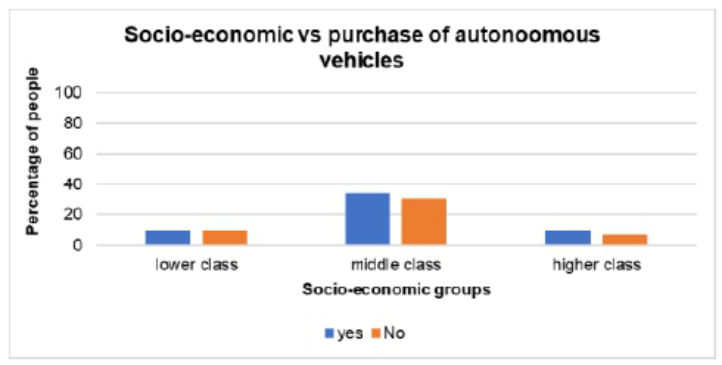
Figure 12: Discouraging factors that affects the purchase of AV’s.Figure 13: Socio-economic conditions and interest to purchase AV’s.
Figure 9, Figure 10, Figure 11, Figure 12, and Figure 13 shows that the main hurdles in including AV’s in main stream traffic is that if government design policies by keeping in view the needs of public, then it will be a fruitful action. The middle class took more interest towards driving of AV’s.
This study offers valuable insights into public perceptions of AV’s mod- erate awareness about AV’s, with preferences leaning toward Level 2 and 3 autonomies. Factors attracting respondents include reduced human engage- ment and self-parking features. Concerns center around system failures and road obstacles. Younger individuals exhibit greater interest in AV’s, while the
Prospects of Autonomous Vehicles In Evolving Countries: A Users’ Perspective 161
government’s promotion of AV’s was perceived as insufficient by a majority of respondents.
Pearson Correlation (PC) Analysis of Factors Affecting Various Aspects of AV’s
Table 2 shows the relationship and its strength between purchase of AV’s with other variables. The correlation of between purchase of Av and awareness of Av was statistically significant at p-value = 0.002 with a weak positive rela- tion, with crashes was statistically significant at p-value = 0.005 and was a weak negative relation. With promotion policies towards public was signif- icant p-value = 0.01 and was a weak positive relation. With education was significant at p-value = 0.01 and was a weak positive relation. With income was significant at p-value = 0.01 and was a strong positive relation.
Table 2. Results from Pearson correlation that shows the strength of relations between purchase of AV’s and different variables.
Table available in the original PDF paper.
Dependent Variable Independent Variable Relation Purchase of AV Awareness of AV Weak positive relation Idea about AV No relation Level Preference No relation Information Source Strong negative relation AV safer No relation Factors for choice No relation Crashes of AV Weak negative Discourage from buying No relation Issues concerned about AV Moderate positive relation Time spend in AV Weak positive relation Promotion to Public Weak positive relation Gender Weak positive relation Age Weak positive relation Income level Strong positive relation Education level Weak positive relation Profession No relation Socio economic group No relation Vehicle type used No relation Travel pattern No relation
CONCLUSION
The objective of the study was to unearth the aspects that were the concerns, aspects and interests of common people of evolving countries such as Pakistan to make a pace with global innovations such as AV’s. Global technological progress and required policy considerations should be integrated to fill the gap in human and AV’s interactions on roads. So far there appears no concrete concerns of Pakistan Government to intake AV’s on road whereas results shows that a considerable percentage of people assume that there exists a policy.
It was evident that a significant percentage of respondents had awareness about AV’s i.e., 52.5% and preferred AV’s levels were level 2 and 3. The main
162 Anwer and Yousuf
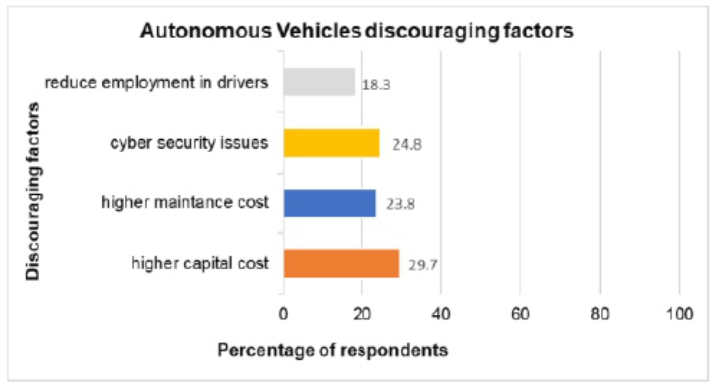
barriers existed are poor infrastructure 26%, high capital costs 29.7%, cyber- security concerns 25%, liability to accidents 23%, lack of knowledge 27%, reduced employment prospects for drivers 24%, and absence of relevant legislation 27% in Pakistan.
Overall, it can be concluded that based on the findings that many respon- dents had limited awareness of AV’s, but some were attracted to the idea of less human engagement and support for those with physical disabilities. Bar- riers to AV’s adoption included poor infrastructure, high capital costs, cyber security concerns, job loss, and lack of legislative framework. Policymakers and industry stakeholders should take these findings into consideration.
It is recommended to research and draft about the environment that sup- ports smooth inclusion of AV’s in Pakistan and develop strategies to test the AV’s, develop infrastructure and design supportive policies. The finding of the study will be useful to researchers, academicians, government, legislators and consultants to stimulate the think tank process so to meet the progressive pace with the world.
ACKNOWLEDGMENT
We highly acknowledge the cooperation of students to collect the data.
FUNDING SOURCE This work was partially funded by the Korea Institute of Science and Technology (KIST) under KIST School Partnership Project for its alumni.
REFERENCES
Acheampong, R. A., F. Cugurullo, M. Gueriau and I. Dusparic (2021). “Can autonomous vehicles enable sustainable mobility in future cities? Insights and pol- icy challenges from user preferences over different urban transport options.” Cities 112: 103134. Ahangar, M. N., Q. Z. Ahmed, F. A. Khan and M. Hafeez (2021). “A survey
of autonomous vehicles: Enabling communication technologies and challenges.” Sensors 21(3): 706. Mordue, G., A. Yeung and F. Wu (2020). “The looming challenges of regulating high level autonomous vehicles.” Transportation research part A: Policy and practice 132: 174–187. Parekh, D., N. Poddar, A. Rajpurkar, M. Chahal, N. Kumar, G. P. Joshi and W. Cho
(2022). “A review on autonomous vehicles: Progress, methods and challenges.” Electronics 11(14): 2162. Qayyum, A., M. Usama, J. Qadir and A. Al-Fuqaha (2020). “Securing connected & autonomous vehicles: Challenges posed by adversarial machine learning and the way forward.” IEEE Communications Surveys & Tutorials 22(2): 998–1026. Sun, X., S. Cao and P. Tang (2021). “Shaping driver-vehicle interaction in
autonomous vehicles: How the new in-vehicle systems match the human needs.” Applied ergonomics 90: 103238. Wang, K., G. Li, J. Chen, Y. Long, T. Chen, L. Chen and Q. Xia (2020). “The adaptability and challenges of autonomous vehicles to pedestrians in urban China.” Accident Analysis & Prevention 145: 105692. Xu, W. (2020). “From automation to autonomy and autonomous vehicles: Chal-
lenges and opportunities for human-computer interaction.” Interactions 28(1): 48–53.
LISTED IN THE AHFE DIGITAL BOOKSTORE CATALOGUE
Explore the complete digital volume
Usability and User Experience
Read this individual research paper free through the original publisher, or explore the full digital proceedings book.
ISBN 978-1-964867-32-8
Explore this ISBN in the AHFE Bookstore ↗Listed in the July 2026 bookstore catalogue; search by ISBN to confirm current availability · Digital book purchase optional