Bingyu Mu, Fang Bin Guo, Xiaohui Chu (2024). Assisting Human-centred Ship Bridge Design through Virtual Reality. In: Advances in Human Factors of Transportation. AHFE Open Access, vol. 148, pp. 729–739. https://doi.org/10.54941/ahfe1005265
The maritime industry is experiencing rapid evolution, fueled by technological advancements that offer unprecedented opportunities for enhancing navigation performances. Virtual Reality (VR), renowned for its immersive and interactive capabilities, has successfully penetrated various domains. Integrating VR into ship bridge design promises to redefine design capabilities by facilitating interactive scenarios, engaging end-users and stakeholders, and streamlining both design production and evaluation processes. This paper presents an innovative approach to leverage VR technology as a transformative tool in the human-centered ship bridge design process. The focus is on enhancing performances during maritime navigation. The proposed methodology underscores the pivotal roles of prototypes and scenarios in producing and evaluating design concepts. It elucidates which design phases and activities in ship bridge design procedure are suitable for utilizing VR prototypes and scenarios, contributing to a more informed and participatory design process.Despite advancements in navigation equipment and automated aids, human errors persist as significant contributors to maritime accidents (Grech, 2008). Acknowledging this, the necessity is to address latent risks and underlying problems associated with human errors (Wróbel, 2021). As Norman (2019) proposed, shifting from technology-centered design to human-centered design (HCD), will benefit the complex social-technical system of ship bridge, to to upgrade the human machine interaction (HMI) with minimum cognitive load and optimal situation awareness (SA).VR technology, recognized for its effectiveness in maritime crew training, offers experiential learning through well-designed simulation tasks (Stevens and Kincaid, 2015). The "sense of being there" in virtual environments enhances spatial understanding, providing navigators with contextual and scenario-based learning experiences (Mallam and Nazir, 2021). Beyond training, the paper advocates for leveraging VR in ship bridge domain for iterative design processes and usability tests, ensuring a friendly and intuitive user experience (UX).VR is confirmed as a novel mode of visualisation and interaction to support design reviews (Wolfartsberger, 2019). Representative prototypes were adopted in usability testing within the cycled design process to help designers identifying problems and seeking correction. By engaging with end-users, those model representations (physical & digital, 2D & 3D, with & without context) could elicit useful feedback on design parmeters basing on partipated users’ experiential refelctions, which increase designers’ understandings of user needs, working contexts, and existing design issues, and inpired innovative and well-supported design solutions (Osterman, Berlin, and Bligard, 2016). In most cases, the physical prototype’s production are time-consuming and expensive. Additionally, it always requires more time and effort for remaking to adapt design changes. VR can make up for the deficiency of physical prototypes forementioned. Besides, it create realistic environment and scenarios for participants to engage and interact with. In summary, VR enables cost benefits and agility in the design and development process. Recently, a web-based collabrative platform launched for designing ,sharing, and reviewing 3D models (Bezel, 2022), which may help design and develop team to accelarte working efficiency on VR environment establishment. Moreover, VR-based evaluation approach can simulate a dynamic and immersive context which allows review design solutions both by designers and participated users during an intuitive interaction process. The use of VR has been adopted in automobile sector to execute usability testing with virtual prototypes, dynamic simulations, and component aesthetic evaluations (Freitas et al., 2020). The domain of ship bridge should also orchestrate with VR during the iterative design process for enhanced performances of maritime navigation. In this complex and safety-critical realm, ensuring the optimal SA for navigators is paramount. VR has potentials to integrate the SA assessing measurements into the scenarios intuitively to avoid bias results caused by interventions.In summary, this paper proposes a methodology for applying VR techniques in human-centered ship bridge design. It demonstrates periodical outcomes of developed VR prototypes and scenarios, aiming to minimize cognitive workload and optimize situational awareness in maritime navigation. The findings are expected to benefit ship bridge designers and have broader implications for creating intuitive HMIs in contemporary industries.
Maritime industry is undergoing rapid evolution fuelled by technological advancements. Despite advancements in navigation equipment and auto- mated aids, human errors remain a significant contributor to maritime accidents (Grech, 2008). The MAIB (2022)’s 2021 annual report identified a connection between safety issues and design deficiencies in some com- menced accident investigations. This aligns with Wróbel (2021)’s proposition, emphasizing the importance of addressing latent risks and underlying prob- lems associated with human errors rather than solely attributing them to navigators’ “inattention” or “mistake”.
Transitioning From TCD to HCD in Ship Bridge Design The empirical evidence indicate that the mere adoption of updated technol- ogy does not suffice the prevention of maritime accidents as anticipated.
While seafarers exhibit adaptability to evolving work environments, com- bined with various contextual factors, surpass operators’ capabilities. This mismatch results in human errors, leading to incidents or accidents (Lützhöft and Dekker, 2002; Nilsen et al., 2016; Puisa et al., 2018). The indiscrimi- nate introduction of new technologies may outpace operators’ training and familiarization processes, posing risks of over-reliance on equipment/systems rather than the well-honed navigation skills. Additionally, the absence of con- sistent interfaces across diverse navigational equipment can elevate cognitive load. As Norman (2019) advocates, a shift from technology-centred design to human-centred design (HCD) is crucial for optimizing the intricate social- technical system, such as the ship bridge, thereby enhancing human-machine interaction and overall performance.
Adopting HCD in Ship Bridge Design The integration of human factor knowledge into ship bridge design has been consistently advocated by pertinent researchers over several decades (Millar, 1980; Lützhöft, 2004; Costa and Lützhöft, 2014; Mallam et al., 2015; Praetorius et al., 2015; Ahola et al., 2018; Gernez, 2019; Danielsen et al., 2021). The adoption of Human-Centred Design (HCD) in ship bridge design seeks to optimize navigator performance by enhancing user expe- riences through a design-oriented approach. Human-centred ship bridge design incorporates HCD principles, promoting active user involvement and a comprehensive understanding of their tasks, capabilities, limitations, and working contexts (Marguire, 2001). Given the complexity and multiplic- ity of stakeholders in ship bridge, primarily involving seafarers, shipown- ers, and equipment suppliers—a multidisciplinary design team is essential. Successful implementation of HCD in ship bridge design hinges on collabo- ration among stakeholders and the application of human factor knowledge (Mallam, 2017). Stakeholders are encouraged to participate in the HCD design process, contributing insights from diverse professional perspectives. An integral aspect of HCD is iteration, leveraging end-users’ and stakehold- ers’ feedback, along with designers’ reflections, in a continuous improvement design cycle. However, challenges may arise in this participatory ergonomic process, such as discrepancies in designers’ understanding of users and their work environment, and varying perceptions of the navigator’s role in relation to the technical system (Meck et al., 2009). Additionally, the geographical and organizational diversity of stakeholders poses collaborative challenges. To address these issues, digitized prototypes play a valuable role in presenting design concepts for feedback, supplemented by using scenario descriptions to gain insights and inspirations for ongoing design enhancements.
Potentials of VR in Ship Bridge Design In tandem with the accelerated pace of technology, virtual reality (VR) has emerged as a novel tool of visualization and interaction to facilitate design reviews (Wolfartsberger, 2019). VR offers the capability to construct 3D assets and narrative scenarios within a virtual environment, enabling the inte- gration of prototypes and immersive experiences. Representative prototypes
Assisting Human-Centred Ship Bridge Design Through Virtual Reality 731
play a pivotal role in usability testing, aiding designers in identifying and rectifying issues throughout the iterative design process. Engaging end-users in usability testing, whether through physical or digital model representa- tions, 2D or 3D presentations, and within or without working context, proves invaluable in eliciting insightful feedback based on users’ experiential reflec- tions. This participatory approach enhances designers’ understanding of user needs, working contexts, and existing design challenges, inspiring innovative and well-supported design solutions (Osterman et al., 2016). While phys- ical prototypes are often time and cost-consuming to produce and require additional effort for adaptations to design changes. VR serves as a versa- tile and collaborative alternative. It addresses those limitations by offering adjustability, flexibility, and collaboration. Moreover, VR provides interac- tive scenarios in a close-to-realistic environment, fostering user immersion, motivation, and emotional engagement. Drawing parallels with industrial practices, VR adoption has gained popularity in the automobile sector for usability testing with virtual prototypes, dynamic simulations, and compo- nent aesthetic evaluations (Freitas et al., 2020). The ship bridge domain can similarly benefit from integrating VR technologies. In summary, VR presents a cost-effective and agile solution in design and development pro- cesses. Notably, a recent development includes the launch of web-based collaborative platforms for designing, sharing, and reviewing 3D models online (Bezel, 2022), offering potential enhancements in working efficiency for establishing VR environments.
Within the maritime domain, Virtual Reality (VR) technology has garnered recognition for its efficacy in crew training, facilitating experiential learn- ing through meticulously designed simulation tasks (Stevens and Kincaid, 2015). The presence in virtual environments enhances spatial comprehension, delivering navigators with contextual and scenario-based learning experi- ences (Renganayagalu et al., 2021). Over the past two decades, full-mission bridge has emerged as primary tools for maritime education and training. VR, in conjunction with other immersive technologies such as augmented reality and mixed reality, heralds a new era of effective teaching and learn- ing within the Maritime Education and Training sector. Aylward (2021) and her colleagues employ VR environments to replicate simulation sce- narios, training seafarers to adeptly navigate operations in Arctic waters. Renganayagalu et al.’s (2019) research substantiates the efficacy of immer- sive training simulators involved VR technology in eliciting higher motivation among trainees compared to traditional methods. Some leading companies and organizations, including Kongsberg, Lloyd’s Register, and LNG Shipping (UK), have actively embraced VR technology for maritime safety education (Markopoulos et al., 2019). VR’s advantages of participatory, collaborative, and adaptive capabilities become particularly evident when integrated with traditional simulators. Beyond the purview of training, practitioners advo- cate for the utilization of VR in ship bridge design, emphasizing its utility in both iterative design processes and collaborative design evaluations. This strategic incorporation ensures to deliver a user-friendly and intuitive User Experience (UX), enhancing overall performance ultimately.
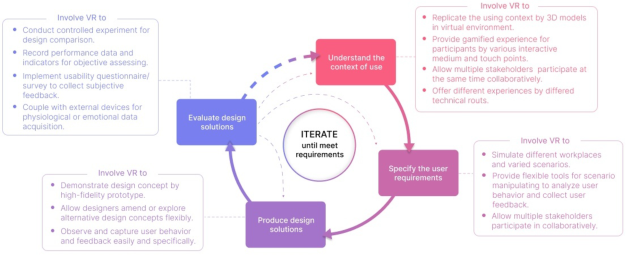
METHODOLOGY DEVELOPMENT This study proposes a methodology for integrating VR technology into human-centred ship bridge design, with the objective of creating a user- friendly interface and interaction to enhance maritime navigation. Following ISO: 9241–210 (2019), HCD activities encompass understanding the con- text of use, specifying user requirements, producing design solutions, and evaluating design solutions. The involvement of VR can be applied to each phase of the iterative design process within HCD, as illustrated in Figure 1. In the development demonstration, emphasis is placed on establishing a VR-constructed layered scenario mapping to facilitate designers’ comprehen- sive understanding of the ship bridge’s usage context, employing the layered scenario mapping technique proposed by Lurås (2016).
Figure 1: Applying VR’s potential involvements to the HCD design activities (2024).
VR’s Involvements in the Iterative Design Process of HCD To understand the context of use, field research assumes a pivotal role in aiding designers to acquire detailed insights into the intended design param- eters (Lurås and Nordby, 2015). Crucially, the data collected from field studies necessitates translation into representative outcomes such as user profiles, personas, and “as-is” scenarios, enabling designers to achieve a unified and comprehensive understanding of users, tasks, and work envi- ronments. This representation often faces inadequacies, as highlighted by Diggins and Tolmie (2003) in their assertion that it is a “relatively unex- plored topic”. They advocate for representative insights derived from raw field research data to be economical, presented in an appropriate format, log- ically organized, and indexical. Aligning the representation with the concept of “boundary objects” as delineated by Star and Griesemer (1989), repre- sentative insights should serve as shared knowledge repositories for design team members. VR’s incorporation becomes essential in creating a close- to-real and interactive representation of using contexts. Designers take on multiple roles in building this VR representation, acting as collectors and visualizers of primary and secondary research data, developers constructing the virtual environment, and users interacting subjectively with simulated VR scenarios of the workplace replica. Other stakeholders’ engagements pri- marily manifest as pragmatic advice and knowledge input. They serve as instructors guiding designers through the VR representation’s development.
Assisting Human-Centred Ship Bridge Design Through Virtual Reality 733
They may also immerse themselves in VR scenarios to offer intuitive feed- back on similarities and differences compared to actual using contexts. VR’s integration establishes a collaborative platform for the entire design team, fostering a consolidated and comprehensive understanding essential for a multi-disciplinary team faced less familiar design entities.
During the user requirement specification, VR proves instrumental in eliciting user needs and requirements through simulated environments and diverse scenarios. VR offers flexible toolkits enabling designers to observe, record, and analyse user challenges within gamified scenarios, thereby eluci- dating user capabilities and limitations. Designers can immerse themselves in the context experienced by users, facilitating a comprehensive review of requirements. This immersive experience aids in resolving trade-offs by considering professional guidance and adhering to regulatory standards.
In the design production stage, transitioning from “as-is” to “to-be” scenarios is imperative to meet specified user requirements. This involves inte- grating user tasks, user-system interaction, and interface considerations into the design concept, iterating as needed. Utilizing VR, a high-fidelity prototype of the ship bridge is developed, fearturing 3D models of equipment, work- place layouts, task scenarios, and interactive interfaces, for a comprehensive representation. VR facilitates flexible and collaborative decision-making of design, allowing exploration of alternative concepts. Specific user behaviours and feedback captured during evaluation enhance the refinement of design concepts in terms of quality and completeness.
HCD underscores the iterative design process by prioritizing user-centred evaluation, ideally conducted within a context closely resembling real-life conditions (ISO, 2019). This approach facilitates collecting additional user needs and feedback, aiding continuous improvements. The fulfilment of user requirements serves as a fundamental indicator for examining design solutions, contributing to the establishment of design criteria. VR-involved evaluation bridges the gap between design demonstration and field valida- tion in a virtual way, offering a collaborative and flexible evaluation method in an immersive context. This allows for convenient manipulation of condi- tions for controlled experiments, facilitating the recording of the evaluation process with time-stamped precision. In addition, VR’s interactive interfaces enable the integration of usability questionnaires during without frozen time, and its compatibility opens avenues for acquiring additional physiological and emotional data through external devices.
VR-Constructed Layered Scenario Mapping Technique In accordance with HCD principles, a foundational aspect for subsequent design production is comprehending the usage context, especially in special- ized domains such as ship bridge design where designers often lack prior experience and knowledge. Field studies, as previously mentioned, emerge as an irreplaceable method for obtaining valuable information, stimulating design reflection, and fostering insights within the design team. Lurås (2016) recognizes the challenge of appropriately presenting and transferring frag- mented data collected from field research within the design team. In the Ulstein Bridge Concept design, Lurås proposed and employed the layered scenario mapping technique to interpret the “situation to design for” for the
entire team. The representative map generated, a 0.9*4.3m poster hanging on the wall, efficiently communicated knowledge of the using context for unfamiliarized designers and served as a well-structured guidance for design inspiration and discussion in future. However, Lurås (2016) suggests explor- ing the digitization of layered scenario mapping to create a digital knowledge database, offering easy access, revision, editing, and communication with- out constraints of time and place (Wodehouse and Ion, 2010). Despite the advantages, concerns about the scenario technique focusing on user actions rather than the person (Nielsen, 2002) persist. Lurås and Nordby (2014) highlight “experiencing life at sea” as a crucial element in design-driven field research for ship bridge design, akin to empathetic approaches in emotional design (Norman, 2004). To address these concerns, integrating Virtual Real- ity (VR) technology becomes a viable solution, potentially compensating for the identified deficiencies.
VR has the capability to convert diverse materials acquired from field studies and secondary resources into visualized 3D assets within an inter- active virtual environment. Scenarios in VR are furnished by replicated 3D prototypes of ship bridges and simulated videos/animations. The lay- ered information deconstructed of the selected scenario can be presented in the interactive VR interface, enhancing the design team’s understanding, and encouraging iterative design thinking. Technically, VR scenarios can be systematically developed into an integrated application tailored for VR head-mounted devices, facilitating immersive engagement. Simultaneously, a web-based digital twin can be established to enable convenient remote access and foster collaborative interaction.
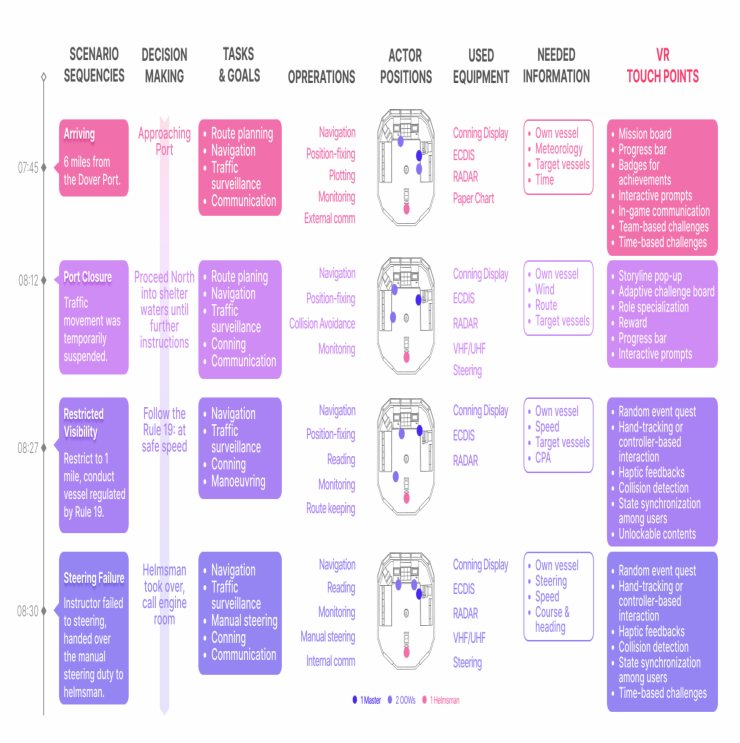
This study aims to develop a VR-adapted layered scenario map for a 60-minute training scenario. We draw upon methods employed in Lurås’s map (2016) and incorporate additional techniques such as Hierarchical Task Analysis (Annett and Stanton, 2000) and Decision Action Diagram (Kirwan and Ainsworth, 1992). The inclusive information “layers” (refer to Figure 2) encompass scenario description, decision-making, tasks and goals, opera- tions and activities, equipment utilization, involved actors and their positions, required information, and VR-provided touchpoints to enhance designers’ understanding of using contexts. The layered scenario information is dynam- ically constructed in VR scenes, aligning with scenario sequences, utilizing various mediums and touchpoints offered by VR technology. Diverging from the paper-based map, the VR mapping narrates the scenario in a gamified manner, engaging participants through interaction rather than relying solely on textual descriptions, charts, and images in a linear timeline matrix.
This exemplary map delineates layered scenario information through key event sequences on a timeline. Extracted from a 30-minute segment of a training session in an actual ship bridge simulator. The deconstruction serves as a crucial preliminary step subsequent construction in VR environment. Marked sequences encompass ongoing navigation tasks and pre-set emer- gencies designed to challenge the bridge team’s capabilities. Each event in the scenario necessitates corresponding decision-making and a series of opera- tions. The equipment used and required information are pivotal for design orientation, while the involved actors and their positions elucidate the struc- ture and interactions within the bridge team. Noteworthy is the bottom
Assisting Human-Centred Ship Bridge Design Through Virtual Reality 735
‘layer’, VR touchpoints, which suggest potential interactive prompts for use in the VR-constructed layered scenario map. VR technology, equipped with interactive touchpoints, communicates through gamified narratives, actively engaging users’ interests. Some touchpoints are adapted from serious games to meet the specific goal of aiding designers in understanding the ship bridge’s using context.
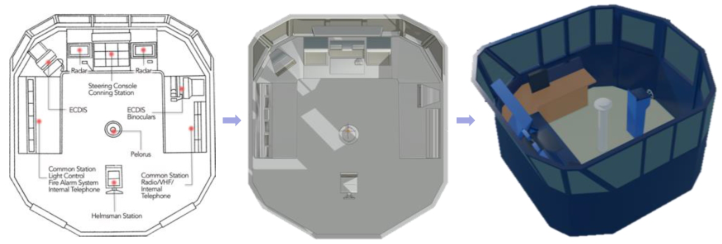
The subsequent phase involves creating the VR environment for the chosen scenario within the simulator. The floor plan of the simulator (depicted to the left in Figure 3) was detailed in a previous study (Guo et al., 2022), providing a scaled representation of equipment layout in a top view. The initial step towards constructing layered scenarios in VR is the replication of a digital twin of the simulator, utilizing the floor plan and dimension measurements. Figure 3 (displayed in the middle) showcases the ongoing modelling efforts in Blender 3.1 (Blender, 2024) for the interior and equipment layout of the simulator.
Figure 2: Example of layered information by deconstructing the training scenario (2024).
In the agile development of the VR-constructed layered scenario mapping for the understanding using contexts, the focus lies on replicating spatial perceptions and interactions between users and equipment within the 3D replica. To adhere to time constraints and budget considerations, the intricate tasks of sculpturing, texturing, rendering, and lighting have been streamlined. In this instance (Figure 3, right side), the 3D models are prototyped with precise shapes and dimensions, albeit not fully polished. They are predomi- nantly coated with general, glass, and metal materials to align with the actual textures of the objects in reality. Monochromatic colours are applied to dis- tinguish different equipment, while one point light and an HDRI image of ocean environment are utilized to simulate natural shadows and reflections within the authentic usage context.
Figure 3: Development progress of 3D prototypes for VR-constructed layered scenario (2024).
Subsequent efforts will focus on the ongoing development of graphic user interfaces within VR to implement the layered information mapped in Figure 2. Leveraging the endowed touchpoints, VR facilitates a rapid understanding of the interface and interactions within the using context for inexperienced users (unfamiliarized design team), when they engage with the virtual scenarios.
CONCLUSION
Integrating VR technology into human-centred ship bridge design expands its application beyond the prevailing focus on maritime education and train- ing. This study, building upon the layered scenario mapping technique (Lurås, 2016), digitizes paper-based maps using VR to enhance effectiveness in design activities. This methodology empowers designers to leverage research data comprehensively, gaining a nuanced understanding of the design situation within a virtual context, thereby supporting subsequent design activities. The proposed approach aligns seamlessly with research objectives on mul- tiple fronts. Firstly, information layers offer requisite details at a necessary granularity for design activities. Secondly, VR’s interactive capabilities allow designers to subjectively experience and understand the design situation within the using context, fostering design reflection without excessive time
Assisting Human-Centred Ship Bridge Design Through Virtual Reality 737
and cost constraints. This achieves the essence of “experiencing life at sea” (Lurås and Nordby, 2015). Thirdly, VR-constructed layered scenarios, as digital content, can be easily stored, modified, and shared, evolving into a continuously refined digital repository to support ongoing design activi- ties. Furthermore, this approach is adaptable to design situations in other domains, particularly those specialized and niche social-technical systems involving both human and technology elements.
ACKNOWLEDGMENT
The authors would like to thank all participants for their valuable dedication to this research. This research is partially supported by Henan Provincial Department of Science and Technology (project number 232102321070).
REFERENCES
Ahola, M., Murto, P. and Mallam, S. (2018) When people are the mission of a ship: Design and user research in the marine industry. Mar Des, 13, 285–290. Annett, J. and Stanton, N. (2006) Task analysis. International Review of Industrial
and Organizational Psychology 2006, 21, 45–78. Aylward, K., Dahlman, J., Nordby, K. and Lundh, M. (2021) Using operational scenarios in a virtual reality enhanced design process. Education Sciences, 11 (8), 448. Bezel. (2024) Available at: https://www.bezi.com. Blender. (2024) Available at: https://www.blender.org/. Costa, N. and Lützhöft, M. (2014) “The values of ergonomics in ship design and
operation”, In: The Royal Institution of Naval Architects-Human Factors in Ship Design & Operation Conference of Conference. Danielsen, B.-E., Lützhöft, M. and Porathe, T. (2021) “Still unresolved after all these years: Human-technology interaction in the maritime domain”, In: International conference on applied human factors and ergonomics of Conference. Diggins, T. and Tolmie, P. (2003) The ‘adequate’ design of ethnographic outputs for
practice: Some explorations of the characteristics of design resources. Personal and Ubiquitous Computing, 7, 147–158. Freitas, F., Oliveira, H., Winkler, I. and Gomes, M. (2020) “Virtual reality on product usability testing: A systematic literature review”, In: 22nd Symposium on Virtual and Augmented Reality (SVR) of Conference. Gernez, E. (2019) Connecting ship operation and architecture in ship design pro-
cesses. Journal of Ship Production and Design, 35 (01), 88–101. Grech, M., Horberry, T. and Koester, T. (2008) Human factors in the maritime domain. CRC press. Guo, F. B. (2022) “Towards an Ergonomic Interface in Ship Bridges: Identification
of the Design Criteria”, In: AHFE International: Industrial Cognitive Ergonomics and Engineering Psychology, 35, 108–117. ISO. (2019) Ergonomics of human-system interaction. Available at: https://www.iso.
org/standard/77520.html. Kirwan, B. and Ainsworth, L. K. (1992) A guide to task analysis: The task analysis working group. CRC press. Lurås, S. (2016) Layered scenario mapping: A multidimensional mapping technique
for collaborative design. CoDesign, 12 (3), 133–150.
Lurås, S. and Nordby, K. (2014) Field studies informing ship’s bridge design at the ocean industries concept lab. Lurås, S. and Nordby, K. (2015) Shaping designers’ sea sense: A guide for design-
driven field research at sea. Lützhöft, M. (2004) “The technology is great when it works”: Maritime Technology and Human Integration on the Ship’s Bridge thesis, Linköping University Electronic Press. Lützhöft, M. H. and Dekker, S. W. (2002) On your watch: Automation on the bridge.
The Journal of Navigation, 55 (1), 83–96. Maguire, M. (2001) Methods to support human-centred design. International Journal of Human-Computer Studies, 55 (4), 587–634. Mallam, S. C., Lundh, M. and MacKinnon, S. N. (2015) Integrating Human Fac-
tors & Ergonomics in large-scale engineering projects: Investigating a practical approach for ship design. International Journal of Industrial Ergonomics, 50, 62–72. Mallam, S. C., Lundh, M. and MacKinnon, S. N. (2017) Integrating participatory practices in ship design and construction. Ergonomics in Design, 25 (2), 4–11. Markopoulos, E., Lauronen, J., Luimula, M., Lehto, P. and Laukkanen, S. (2019)
“Maritime safety education with VR technology (MarSEVR)”, In: 10th IEEE International Conference on Cognitive Infocommunications (CogInfoCom) of Conference. Meck, U., Schiller, F. and Brüggemann, U. (2009) Interaction design in ship building: An investigation into the integration of the user perspective into ship bridge design. Journal of Maritime Research, 6 (1), 15–32. Millar, I. (1980) The need for a structured policy towards reducing human-factor
errors in marine accidents. Maritime Policy and Management, 7 (1), 9–15. Nielsen, L. (2002) “From user to character: an investigation into user-descriptions in scenarios”, In: 4th conference on Designing interactive systems: Processes, practices, methods, and techniques of Conference. Nilsen, M., Almklov, P., Haugen, S. and Bye, R. J. (2016) “A discussion of risk influ-
encing factors for maritime accidents based on investigation reports”, In: (ed.) Risk, reliability and safety: Innovating theory and Practice: Proceedings of ESREL 2016 (Glasgow, Scotland, 25–29 September 2016). CRC Press. pp. 113–119. Norman, D. (2019) Do Industrial Designers have a future? Available at: https://jnd.
org/do_industrial_designers_have_a_future/. Norman, D. (2004) Emotional design: Why we love (or hate) everyday things. Civitas Books. Österman, C., Berlin, C. and Bligård, L.-O. (2016) Involving users in a ship bridge
re-design process using scenarios and mock-up models. International Journal of Industrial Ergonomics, 53, 236–244. Praetorius, G., Kataria, A., Petersen, E. S., Schröder-Hinrichs, J.-U., Baldauf, M.
and Kähler, N. (2015) Increased awareness for maritime human factors through e-learning in crew-centred design. Procedia Manufacturing, 3, 2824–2831. Puisa, R., Lin, L., Bolbot, V. and Vassalos, D. (2018) Unravelling causal factors of maritime incidents and accidents. Safety Science, 110, 124–141. Renganayagalu, S. K., Mallam, S., Nazir, S., Ernstsen, J. and Haavardtun, P.
(2019) Impact of simulation fidelity on student self-efficacy and perceived skill development in maritime training. Renganayagalu, S. K., Mallam, S. C. and Nazir, S. (2021) Effectiveness of VR head mounted displays in professional training: A systematic review. Technology, Knowledge and Learning, 1–43.
Assisting Human-Centred Ship Bridge Design Through Virtual Reality 739
Star, S. L. and Griesemer, J. R. (1989) Institutional ecology, translations and boundary objects: Amateurs and professionals in Berkeley’s Museum of Vertebrate Zoology, 1907–39. Social studies of science, 19 (3), 387–420. Stevens, J. A. and Kincaid, J. P. (2015) The relationship between presence and perfor-
mance in virtual simulation training. Open Journal of Modelling and Simulation, 3 (02), 41. Wodehouse, A. and Ion, W. (2010) Digital information support for concept design.
CoDesign, 6 (1), 3–23. Wolfartsberger, J. (2019) Analyzing the potential of Virtual Reality for engineering design review. Automation in Construction, 104, 27–37. Wróbel, K. (2021) Searching for the origins of the myth: 80% human error impact
on maritime safety. Reliability Engineering & System Safety, 216, 107942.
LISTED IN THE AHFE DIGITAL BOOKSTORE CATALOGUE
Explore the complete digital volume
Advances in Human Factors of Transportation
Read this individual research paper free through the original publisher, or explore the full digital proceedings book.
ISBN 978-1-964867-24-3
Explore this ISBN in the AHFE Bookstore ↗Listed in the July 2026 bookstore catalogue; search by ISBN to confirm current availability · Digital book purchase optional