Melanie Juppe, Farzaneh Darbanian, Wolfgang Schildorfer, Reinhard Tockner, Christian Rudloff, Stefan Seer (2024). Ridesharing as a part of modal shift: An Austrian Pilot case study. In: Advances in Human Factors of Transportation. AHFE Open Access, vol. 148, pp. 537–548. https://doi.org/10.54941/ahfe1005245
Changing mobility behavior is a dynamic process that involves a combination of individual choices, technological advancements, and policy interventions to create a more sustainable and efficient transportation system. Efforts to change mobility behavior often focus on creating a multimodal transportation system that offers a variety of options for different circumstances. This can involve a combination of improving existing infrastructure, implementing new technologies, and adopting policies that encourage sustainable and efficient transportation choices. In the DOMINO project, we were focused on using ridesharing as a part of modal shift in Upper Austria. In a detailed elaboration, strategic and organizational prerequisites for an efficient control of transport infrastructure and means of transport (intermodal mobility) were recorded within the pilot regions of the DOMINO project. Thus, important preliminary work has already been done, which provided a basis for the further implementation of the project. The DOMINO pilot has provided valuable insights into the ridesharing field by evaluating the user data collected, especially by gathering experiential knowledge about what works and what does not. Despite these advances, ridesharing has yet to take root in the minds of users, and the transition from the convenience and flexibility of owning a vehicle remains a gradual process.
The rise in urban population often leads to a higher demand for transporta- tion options, and especially the rise in road traffic. This can result in traffic congestion, air pollution, and challenges in maintaining efficient and sustain- able transportation networks (Lazarus et al.,) (Esztergar-Kiss, Shulha, Aba, Tettamanti, 2021). Over the past decade, the transportation ecosystem in many urban areas in Europe and around the world has evolved to include a range of technology-enabled shared mobility services such as carsharing, bike sharing, scooter sharing, and transportation network companies (ride sourcing and ride hailing) (Hartl, Sabitzer, Hofmann, Penz, 2018). Mature online ride-matching platforms became available in the 1990s. Since 2004, ridesharing grounded in technology support, has entered a high growth phase (Chan and Shaheen, 2012). In ridesharing, drivers share empty seats in their
vehicles and users’ access instant rides via Internet-connected mobile appli- cations. (Shaheen & Cohen, 2021a). This service utilizes unused seats in vehicles and multi-passenger rides to reduce the cost of travel (Si, Shi, Hua, Cheng, De Vos, Li, 2023) (Shaheen and Cohen, 2021). Individual, private car use is the main mode of transport in highly industrialized nations (Urry, 2004). Ridesharing is a mode of transportation in which several people share a vehicle (usually a private car) for a ride and, as mentioned before, share the cost of it. In this way, they can enjoy the comfort and speed of private car rides without paying much more than using public transportation (Furuhata et al., 2013), plus they get around more sustainably. It is different from ride hailing services that connect riders to drivers for-profit and through smart- phone applications. Ridesharing has been used on a regular basis since the 1970s by means of carpools. It is usually understood as an organized and regular ridesharing service (e.g., employees driving together to work). With the advent of the Internet and the enormous adoption of mobile commu- nication technologies, modern ridesharing is also characterized by a more dynamic (or even real-time) scheduling of rides (Chan and Shaheen, 2012). Obviously, there is a considerable potential to reduce overall vehicle miles traveled by resorting to the empty car seats not yet utilized. Raising car occu- pancy levels would also indirectly contribute to the sustainability goals by reducing oil dependency with a view to the tense situation on the energy markets (Heinitz, 2022a). However, even though ridesharing is based on a win-win collaboration and modern mobile communication technologies have significantly eased discovering and managing ride matches, the adoption of ridesharing has paradoxically decreased during the last years (Sánchez et al., 2018). Ridesharing is a useful complement to other forms of mobility, but the behavioral changes required to achieve it are not easy and usually take time because it requires a person to disrupt a current habit while simultaneously fostering a new, possibly unfamiliar, set of actions (Call, 2020). There is an urgent need to fundamentally change people’s mobility behavior. The scale of the problem has been completely underestimated, and the measures taken by governments at all levels do not do justice to the seriousness of the situation.
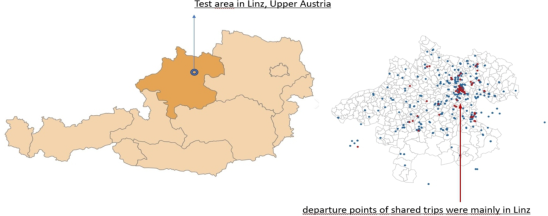
CASE DESCRIPTION The initial situation before the start of the DOMINO Upper Austrian pilot was as follows. The DOMINO project as part of the research, energy, and innovation program “Mobility of the Future”, which was funded by the Federal Ministry for Climate Protection, Environment, Energy, Mobility, Innovation and Technology (BMK), developed a smart, intermodal mobility service (www.domino-maas.at, 2022) in the past four years. The nationwide project has been tested in three pilot regions - Lower Austria, Upper Aus- tria, and Salzburg. As part of the Upper Austrian pilot, the DOMINO Upper Austrian app was founded as an offer for commuters in the central region of Upper Austria (www.domino-ooe.at, 2022). This offering for Upper Aus- tria was supplemented with private rides in the DOMINO Upper Austrian app to very specifically in a test area reduce congestion and increase the occupancy rate of private cars in a test area in Upper Austria (shown in
Ridesharing as a Part of Modal Shift: An Austrian Pilot Case study 539
Figure 1). Achieving these goals required close collaboration with commu- nities and businesses affected by commuter traffic. The close involvement of stakeholders can thus be named as a necessary step for the successful imple- mentation of MaaS (Mobility as a Service), as the problems and challenges of the pilot area were identified at the beginning of the project together with the different stakeholder. This was done by means of on-site interviews in the companies and communities. After the start of the pilot, workshops were held several times a year with the participating communities and companies to find out about the desired further developments of the app, i.e., to obtain information from the users about the app used at that time. Workshops were also held internally with the stakeholders to discuss possible further develop- ments and their benefits or feasibility. After three years of preliminary work on the project, the app was developed, and the ideas associated with it were put into practice with the pilot in Upper Austria. The test period ran from Mid-March 2022 until the end of September 2022, and the data collected from the users and the posted and shared journeys were evaluated, provid- ing us with a deeper overview of the commuters needs, but also of the weak points that still need to be addressed.
Figure 1: Departure points in the test area around Linz, upper Austria.
The DOMINO Upper Austrian app was designed as a white label solu- tion and provided by the technology partner Fluidtime; no own app was developed, but project-specific adaptations (e.g., integration of ridesharing) were implemented based on the existing Fluidtime solution. The app was made available to users (e.g., commuters) free of charge. The app contains the functions of a ridesharing exchange, and a multimodal and intermodal mobility offer was achieved by connecting it to the regional mobility offer with a so-called “MaaS Consumer Platform”. The regional mobility offer was represented by VAO, whereby it was still planned to integrate the offer of other mobility service providers (e.g., cab companies, e-scooters...), but this was not implemented in the pilot. Like the app, the MaaS consumer plat- form was provided by Fluidtime and did not have to be developed first. It can already be stated here that the operator model will be continued after the end of the project, i.e., MaaS will continue to be supported by the local govern- ment in Upper Austria and Lower Austria (incl. financial issues), which is a strong signal that they believe in the further development of MaaS.
METHODOLOGY
This section explains how the pilot results have been found. The information utilized in this research originates from the DOMINO Upper Austria pilot phase, which took place from mid-March through the conclusion of Septem- ber 2022. With the help of the evaluation of this data, new insights into the use of the mobility app are to be generated. The following research questions arose in the course of the DOMINO project: RQ 1: How can competition positively influence the frequency of use? RQ 2: Can user behavior be positively influenced by information campaigns?
RQ 3: Does being a club member result in an increase in the number of joint trips?
RQ 4: Do environmental awareness and the frequency of app use correlate? To answer the first two research questions (RQ1 and RQ 2), we used our data collected through the Fluidtime and RISC backoffice. The dataset contains daily observations at a time-based level. To comprehensively under- stand our user and trip growth, we aggregated the data on a weekly basis. Table 1 presents descriptive statistics for the aggregated datasets, including the number of users and trips.
Table 1. Aggregated dataset summary.
Table available in the original PDF paper.
Count Sum Mean Sd Median Users 89 1980 22.2 25.97 12 Trips 89 183 2.05 2.88 0
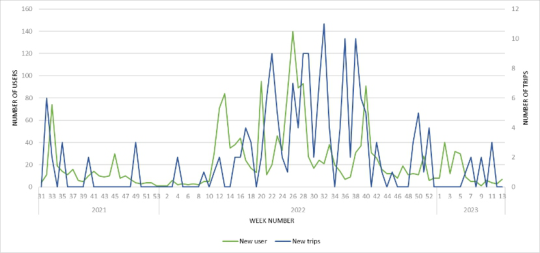
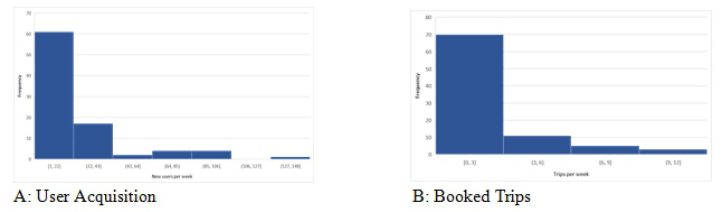
To examine user behavior more closely, we analyzed the data from mul- tiple perspectives. Figure 2 is a line graph that tracks user acquisition and booked trips on a weekly basis, showing similar trends but on different scales. Figure 3 is a histogram that analyzes weekly new user intake and trips, which allows us to identify any outliers or unusual spikes in our growth. Both graphs exhibit a left-skewed distribution.
Figure 2: Weekly new user acquisition.
Ridesharing as a Part of Modal Shift: An Austrian Pilot Case study 541
Figure 3: Weekly histogram analysis.
Our first two research questions focus on the impact of “Competition” and “Campaign” on user behavior. Table 2 shows the time period of these events.
Table 2. Comparison of events time.
Table available in the original PDF paper.
Event All Competition Campaign Date 28 Jul 2021 to 28 Mar 2023
1 April 2022 to 30 September 2022
30 May 2022 to 17 July 2022
To clarify, we noticed an overlap between our competition and campaign initiatives, so we created a new group called “Competition and Campaign” to test our hypotheses. Our baseline group was event 1, consisting of normal days without any competition or campaign activity. We had two additional groups: event group 2, with only competition, and event group 3, with both competition and campaign activities, to test our second hypothesis. This approach allowed us to accurately measure the impact of competition and campaign activities on our desired outcomes and make informed decisions for future initiatives.
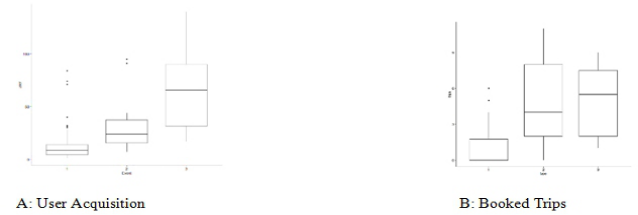
Figure 4 shows the distribution of new user and booked trips based on the three event groups with a box plot graph. The y-axis represents the number of users in A and number of trips in B, while the x-axis represents the event group.
Figure 4: Comparison of the distribution of data for event groups with boxplot.
To analyze user behavior, we examined the growth in the number of new users and the number of trips created by them in two separate analyses. We
used Kruskal-Wallis test (McKight and Najab, 2010) with the ‘kruskal.test’ function (as a part of Stats package) in Rstudio to compare the number of new users and booked trips per week across three independent groups (normal days, competition days, and competition+campaign days) with the following null hypothesis: H0: mediannormal days = mediancompetition days = median competition + campaign days
For each analysis, we performed the Wilcoxon test using the ‘pair- wise.wilcox.test’ function in Rstudio to compare the effect between two groups. Multiple hypothesis testing was adjusted using the ‘Benjamini- Hochberg’ method.
The results of analysis for user acquisition and booked trips are as follows.
User Acquisition As shown in Table 3 and 4, the median number of new users per week for three independent event groups (normal days, competition days, and competition+campaign days) were 8.5, 24, and 65.5 user- s/week, respectively. The Kruskal-Wallis rank sum test showed a sig- nificant difference (p-value<0.001) between the three event groups. The false discovery rate adjusted p-values for pairwise comparisons between groups are shown in Table 5, and they indicate signifi- cant differences as well (P-valuenormal days vs competition days <0.001, P- valuenormal days vs competition+campaign days <0.001, P-valuecompetition days vs competition+campaign days = 0.034). Therefore, we can conclude that there are significant differences between all three groups.
The median number of new users per week for the three independent groups of normal days, competition days, and competition+campaign days were 8.5, 24, and 65.5 events/week, respectively, with a significant difference (p-value < 0.001) based on the Kruskal-Wallis rank sum test. Furthermore, pairwise comparisons between groups using the false discovery rate adjusted p-value also showed significant differences (Pvaluenormal days vs competition days <0.001, Pvaluenormal days vs competition+campaign days <0.001, Pvaluecompetition days vs competition+campaign days = 0.034).
Table 3. Descriptive statistics for number of trips for each event group.
Table available in the original PDF paper.
Event group Count Mean Sd Median IQR normal days 62 13.9 16.9 8.5 9.75 competition days 19 31 24.4 24 22 competition+campaign days 8 66.2 42.3 65.5 58.5
Table 4. Trips- Kruskal-Wallis rank sum test result.
Table available in the original PDF paper.
Kruskal-Wallis test summary df 2 p-value 3.331e−07 chi-squared 29.83
Ridesharing as a Part of Modal Shift: An Austrian Pilot Case study 543
Table 5. Trips-pairwise comparisons using Wilcoxon rank sum test result.
Table available in the original PDF paper.
Normal days Competition days competition days 8.8e−05 - competition+campaign days 8.8e−05 0.034
After conducting both Kruskal-Wallis and Wilcoxon tests and analyzing the median values of the groups, we have concluded that competitions can boost user intake compared to normal days. Additionally, we anticipate more growth in the number of users with the implementation of a campaign. How- ever, while both competitions and campaigns can encourage users to create more trips than on normal days, combining them does not yield a significant difference compared to days with just competitions.
Other questions that the project consortium asked themselves during the project were whether club memberships increase carpooling, and whether environmental concerns positively influence ride sharing. In surveys con- ducted prior to the start of the project, many of the respondents said that they would prefer to share a ride with someone they already knew or would prefer to share a ride with someone they already knew. The answer is given in the following part.
TARGET GROUPS To gather information for the design of the ridesharing app and the roll out campaign an online survey was conducted by a market institute within the catchment area. The target group of the survey were people who travel to the Linz metropolitan area for work or education by car or park&ride. The survey used the MyTrips Methodology (see (Rudloff, Straub, 2021) for details) that combines the collection of standard stated preference data about preferences of the respondents and their current mobility behaviour, questions on their preferences for the ridesharing app (what information is important in the app), as well as a simple mobility diary where respon- dents gave the details of their commuter trip (start, destination of the trip) and a stated preference-off-revealed preference stated choice experi- ment (Train, Wilson, 2008) based on the real trip containing ridesharing alternatives.
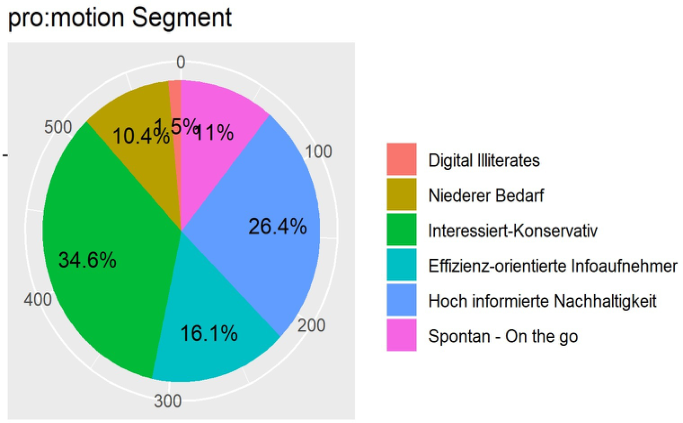
In addition, question to determine the type of user in a transportation infor- mation based typology (see (Markvica, 2020)) for clustering respondents into behaviourally homogeneous groups were asked in the survey to determine groups that might respond well to ridesharing were asked in the survey. A sample of 586 was collected. The sample contained a good spread of ages amongst people in education or working as well as a good spread of people in all the promotion types apart from digital illiterates (see Figure 5), which was expected due to the survey being online but unimportant since the type of digital illiterates consist of people with very limited capabilities to use online services like ridesharing apps.
Figure 5: Different promotion types of app user.
One of the outcomes of the survey was, that people have a strong ten- dency to act as ridesharing drivers rather than passengers with 41.6% saying they would act only as drivers, 11.3% saying they would only act as passen- gers and 47.1% saying they would be happy to be in either role. Also, the hypothesis that membership in a club significantly influences participation in ridesharing was discounted with only 12.7% of respondent saying it is at least somewhat important to see club membership of the other ridesharing party in the app. These findings were even strengthened in the stated choice experiment.
LESSONS LEARNED In order to provide advice on how Maas projects can be successfully imple- mented, we have already done previous research on the DOMINO project, which focused on how MaaS could survive and on the role of the different stakeholders involved (University of Applied Sciences Upper Austria, 2023) and on MaaS implementation in Austria, including our lessons learned, chal- lenges in general and evaluation (Juppe et al., 2022). The research examined the roles, responsibilities, and contributions of entities such as government agencies, transportation providers, technology companies, and also commu- nity organizations. With the experience gained during the four-year project with various qualitative findings and quantitative analyses, such as the results shown above, combined with our research findings, we can recommend the following points as a way of thinking when developing ridesharing apps as shown in Table 6.
Ridesharing as a Part of Modal Shift: An Austrian Pilot Case study 545
Table 6. Research findings.
Table available in the original PDF paper.
DISCUSSIONS In times of climate protection and rising energy costs, ridesharing is a sensi- ble and important measure. Climate protection, climate targets and rising energy prices alone are not enough to bring about a change in mobility behavior, especially ridesharing. Most people do not change their mobility behavior because of the climate and climate protection, with the exception of a relatively small group of active users - ridesharing is not a self-perpetuator.
This finding was also confirmed in the community workshops that were held; the response to the topic of mobility was rather low. It must therefore be made clearer who can benefit from which measure and how. This applies not only to the population, but also to the communities themselves. There was political interest and commitment on the part of Upper Austria and the municipalities, but it must also be made clearer to the municipalities to what extent they (can) profit from it. Therefore, a comprehensible message and a simple recipe for the ride is needed, which is easy to implement for munici- palities and, if possible, without their own resources. Then greater interest at the community level can also be expected, especially if there are pioneering communities that can serve as role models.
Incentives are needed to change behavior. In the Upper Austrian pilot, an attempt was made to create this by means of a competition. It turned out that this incentive aroused interest at the beginning, but in the long term it also needs clearly recognizable and measurable benefits for the users (reward for each individual activity - whether as a driver or passenger). Even small amounts could make a difference - see also the learning results from the Lower Austria pilot. Furthermore, ride sharing requires a high communication effort to promote the (new) offer.
From the side of the companies and businesses, there was great interest in the Upper Austrian pilot and the topic of ridesharing. One reason for the interest on the part of the entrepreneurs is that there is an obvious advantage in this regard. If fewer employees drive to work alone in their own cars,
companies have to provide fewer parking spaces. The space thus saved can be put to other uses. The advantages for (fellow) drivers, on the other hand, are not so clear, which has led to the fact that the offer of the Upper Austrian pilot has not been accepted as hoped.
However, this emphasizes once again that incentives for the formation of ride sharing must be created. Companies and businesses can set these incen- tives themselves, for example by making employee parking spaces available only to carpoolers or if users of internally organized platforms benefit finan- cially. The mobility challenge of RISC, a company involved in the project, can serve as a best-practice example. Employees who come to work at least 10 times a month by means of an alternative to the car (ridesharing, public trans- port, bicycle) receive 50 € in the form of meal vouchers. An internal chat was set up for users to find their matching co-riders. In addition to commuters, events and property developers are other future use cases for ride sharing. Especially when it comes to green events, ridesharing seems to be a sensible alternative to traveling by car or public transport. Events can be awarded a “certificate” and must fulfill certain criteria: Alternative means of travel to one’s own private car must be made possible - of course, this primarily means public transport, but there is no restriction regarding the recognition of car- pools. Property developers can also include the issue of carpooling in their mobility concepts by explicitly designating parking spaces for carpools.
CONCLUSION/RESEARCH OUTLOOK MaaS could contribute positively to mobility policy outcomes (Brown, 2020; Heinitz, 2022b), so the use and also further development of MaaS ser- vices is crucial to achieve change in the mobility sector. The successful implementation of MaaS requires practical implementation projects rather than remaining confined to theoretical approaches. Within this context, it’s important to recognize the existence of potential MaaS users, although not universally applicable. However, tapping into this potential hold’s signifi- cance. A crucial aspect to address is the optimization of traffic information channels with the intent of inducing behavior change. Exploring this avenue is essential.
Furthermore, there exists untapped potential within new target groups for ridesharing beyond the scope of commuting, particularly within the realm of leisure mobility tied to events. This expansion could open up new avenues for MaaS adoption and will be worked on by us in a follow-up project of DOMINO. In terms of motivations for ridesharing, the social aspect and its relevance to rural mobility could provide fresh angles to explore. A novel hypothesis has emerged suggesting that ridesharing might function more effectively within closed communities compared to open communities. Build- ing upon this concept, a project proposal could involve seamlessly extending ride offers from closed communities to open ones with a single click. It’s important to acknowledge that a comprehensive MaaS solution might not be capable of encompassing all mobility stakeholders. This realization warrants attention in project planning and execution.
Ridesharing as a Part of Modal Shift: An Austrian Pilot Case study 547
In conclusion, this project has provided valuable insights into the realm of ridesharing, primarily by accumulating experiential knowledge about what works and what doesn’t. Despite these advancements, ridesharing has yet to establish a firm foothold in the minds of users, and the transition from the convenience and flexibility of personal vehicles remains a gradual process. The journey towards considering ridesharing a genuine alternative for trans- portation is ongoing. Consequently, further research in this field is imperative to unravel the full potential of ridesharing and pave the way for its broader adoption.
REFERENCES
Brown, Anne E. (2020): Who and where rideshares? Rideshare travel and use in Los Angeles. In Transportation Research Part A: Policy and Practice 136, pp. 120–134. doi: 10.1016/j.tra.2020.04.001. Call, M. (Ed.) (2020): Why is behavior change so hard? Accelerate Learning Com-
munity. Available online at https://accelerate.uofuhealth.utah.edu/resilience/why- is-behavior-change-so-hard, checked on 10/23/2023. Chan, Nelson D.; Shaheen, Susan A. (2012): Ridesharing in North Amer- ica: Past, Present, and Future. In Transport Reviews 32 (1), pp. 93–112. doi: 10.1080/01441647.2011.621557. Esztergar-Kiss, D., Shulha, J., Aba, A., Tettamanti, T. (2021): Promoting sustainable mode choice for commuting supported by persuasive strategies. In Sustainable Cities and Society 74 (103264). Furuhata, Masabumi; Dessouky, Maged; Ordóñez, Fernando; Brunet, Marc-
Etienne; Wang, Xiaoqing; Koenig, Sven (2013): Ridesharing: The state-of-the-art and future directions. In Transportation Research Part B: Methodological 57, pp. 28–46. doi: 10.1016/j.trb.2013.08.012. Hartl, B., Sabitzer, T., Hofmann, E., Penz, E. (2018): “Sustainability is a nice bonus” the role of sustanability in carsharing from a consumer perspective. In Journal of Cleaner Production 202, pp. 88–100. Heinitz, Florian (2022a): Sustainable development assessment of incentive-driven
shared on-demand mobility systems in rural settings. In Eur. Transp. Res. Rev. 14 (1). doi: 10.1186/s12544-022-00565-y. Heinitz, Florian (2022b): Sustainable development assessment of incentive-driven shared on-demand mobility systems in rural settings. In Eur. Transp. Res. Rev. 14 (1). doi: 10.1186/s12544-022-00565-y. Jessica R. Lazarus; Juan D. Caicedo; Alexandre M. Bayen; Susan A. Shaheen:
To Pool or Not to Pool? Understanding opportunities, challenges, and equity considerations to expanding the market for pooling. Juppe, M.; Millonig, A.; Pichler, S., Nemec, M., Schildorfer, W. (Eds.) (2022): MaaS implementation in Austria. Lessons learnt, challenges and evaluation methodol- ogy. ITS Europe. Toulouse, 30 May–1 June. University of Applied Sciences Upper Austria. Conference book: ITS Europe. Markvica, K. et al. (2020): Promoting active mobility behavior by addressing infor-
mation target groups: The case of Austria. In Journal of transport geography 83 (102664). McKight, Patrick E.; Najab, Julius (2010): Kruskal-Wallis Test. In Irving B. Weiner, W. Edward Craighead (Eds.): The Corsini Encyclopedia of Psychology: Wiley, p. 1.
Rudloff, C., Straub, M. (2021): Mobility surveys beyond stated preference: Introducing MyTrips, an SP-off-RP survey tool, and results of two case studies. In European Transport Research Review 13, pp. 1–16. Sánchez, David; Martínez, Sergio; Domingo-Ferrer, Josep (2018): Co-utile Rideshar-
ing. In Josep Domingo-Ferrer, David Sánchez (Eds.): Co-utility, vol. 110. Cham: Springer International Publishing (Studies in Systems, Decision and Control), pp. 117–138. Shaheen, Susan A.; Cohen, A. (2021): Shared mobility: An overview of definitions, current practices, andits relationship to mobility on demand and mobility as a service. In International Encyclopedia of Transporta- tion, 155–159. Available online at https://www.sciencedirect.com/science/ article/abs/pii/B9780081026717104208?via%3Dihub. Si, H., Shi, J., Hua, W., Cheng, L., De Vos, J., Li, W. (2023): What influences people to choose ridesharing? An overview of the literature. In Transport Reviews. Train, K., Wilson, W. W. (2008): Estimation on stated-preference experiments con-
structed from revealed-preference choices. In Transportation Research Part B: Methodological 42.3, pp. 191–203. University of Applied Sciences Upper Austria (2023): How can MaaS survive and what is the role of municipalities, public authorities, transport providers and employers? Experience report from 3 years of project work in DOMINO. With assistance of M. Juppe, W. Schildorfer, R. Tockner, M. Nemec, H. Zamut. ITS European Congress, 22–24 May: ITS Europe. Urry, John (2004): The ‘System’ of Automobility. In Theory, Culture & Society 21
(4-5), pp. 25–39. doi: 10.1177/0263276404046059. www.domino-maas.at. webpage (2022). www.domino-ooe.at (2022).
LISTED IN THE AHFE DIGITAL BOOKSTORE CATALOGUE
Explore the complete digital volume
Advances in Human Factors of Transportation
Read this individual research paper free through the original publisher, or explore the full digital proceedings book.
ISBN 978-1-964867-24-3
Explore this ISBN in the AHFE Bookstore ↗Listed in the July 2026 bookstore catalogue; search by ISBN to confirm current availability · Digital book purchase optional