Morgan Mcalphin, Robert Gutzwiller, D'mitri Seymour (2025). Responses to and Recognition of Simultaneously-Occurring Driving Hazards using Auditory and Visual In-Vehicle Alerts. In: Advances in Human Factors of Transportation. AHFE Open Access, vol. 186, pp. 290–300. https://doi.org/10.54941/ahfe1006518
Proper allocation of attention while driving is imperative to safety. In-vehicle alerts, meant to signal towards potential hazards, can effectively direct driver attention. However, research on in-vehicle alerts has primarily been limited to single-hazard scenarios. Scenarios in which two hazards occur simultaneously may seem unlikely – yet at least a handful of impactful real-world conditions create such a scenario. An example could include making a right turn at an intersection when there is another car turning left into the same area (hazard 1) while a pedestrian is crossing the crosswalk (hazard 2).This study aims to better understand the impact that in-vehicle alert modalities have on driver attention towards simultaneously occurring road hazards. Specifically, measuring the effect of two different in-vehicle alert modalities (auditory and visual) on driver recognition of two simultaneous hazards across two experimental drives is undertaken. Brake response time, and responses to a post-drive situation awareness question are analyzed, along with the driver’s self-reported trust in the alert system, and experience with driving and alert systems (to identify any confounding effects).Participants were randomly assigned to one of two alert conditions, auditory or visual, where they were presented with the alert modality across two different hazard scenarios. The auditory alert consisted of three short tones through the simulator speaker system, on the higher end of the range recommended by NHSTA (Jeon et al., 2022). This alert was selected to signify urgency. The visual alert consisted of an image of a red circle flashing 3 times on the simulator screen and it was confirmed in pilot testing that it did not block any of the hazards as they occurred. The semantic meanings of the two alerts were balanced and meant to alert participants to the presence of a hazard without giving them specific directions. Study findings did not support the hypothesis that auditory alerts would be more effective than visual alerts in alerting drivers to both hazards in a scenario. An analysis of variance (ANOVA) conducted on responses to the hazard observance question showed that there was not a significant effect of condition on response accuracy. An exploratory analysis of verbally indicated hazard observance by type of hazard revealed an interesting pattern in which there was one hazard that was much more likely to be recognized by participants in each scenario. This pattern was likely due to hazard salience, where the more recognized hazard may have been more salient and therefore more likely to be recognized. This is also consistent with attentional blink, in which a hazard may have been more likely to be missed while appearing alongside another, more salient, hazard. Most driving research is limited to single hazard conditions. However, recent work has demonstrated the importance of multi-hazard study (Sall & Feng, 2019; Wan & Sarter, 2022). Our study adds to this limited area and suggests that additional research should be conducted to further understand the impacts of alert modality on drivers’ hazard observance, particularly simultaneously occurring hazards.
Driving requires humans to constantly disperse and switch their attention between multiple tasks at any given time, known as sequential multitasking (Salvucci & Taatgen, 2011). In-vehicle alerts can help drivers detect hazards, react to them faster, and maintain greater overall situational awareness (Gugerty, 2011). The advancement of vehicle technologies based on LIDAR and radar signals have led to a suite of warning signals inside the vehicle. These alerts (whether auditory, visual, or tactile) are all more effective in warning drivers than no alert at all (Ho et al., 2005; Ho et al., 2007; Scott & Gray, 2008). However, most of the research on in-vehicle alerts has investigated singular hazards. There is a gap in knowledge, specifically about the effects of alerting across multiple hazards, especially when alerts are presented in a short time span or simultaneously (Wan & Sarter, 2022).
At an initial glance, scenarios in which two hazards occur simultaneously may seem unlikely – yet at least a handful of real-world conditions create such a scenario. An example may include making a right turn at an intersection when another car is turning left into the same area (hazard 1) while a pedestrian is crossing the crosswalk (hazard 2). Another example could be changing lanes on a busy highway where one monitors the area in front of
Responses to and Recognition of Simultaneously-Occurring Driving Hazards 291
their car for braking (hazard 1) and their blind spot nearly simultaneously (hazard 2). Lastly, while less consequential, driving in a busy parking lot where any number of cars could be a hazard alongside pedestrians.
Any hazard co-occurring with another hazard will naturally challenge the driver to select the best task to allocate attention to, which could create problems leading to performance decrements due to limited attentional resources. Although alerts can help direct limited driver attention, they also require attentional resources. Alerts must be salient enough to capture attention, without entirely distracting from other tasks and potential hazards. Further, alert issues in the case of multiple alarms must be viewed through the lens of their modality, which may or may not create interference with other alerts due to overlapping signal (e.g., multiple auditory alarms), or interference with the task itself (e.g., a visual alert interfering with a visual hazard) according to Multiple Resource Theory (Wickens, 2002; 2008). Furthermore, the tasks performed during driving are intensely visually demanding (Sivak, 1996), leading to generally high resource overlap and few visual attentional resources to use outside of the driving task. Alternatively, if a modality not in high demand is required in a task, the driver may still have resources available that allow for task completion and successful avoidance of overload (Wickens, 2008). Auditory alerts have reaction time (RT) benefits for auditory targets as well as targets in different modalities (Driver & Spence, 2004; Spence, McDonald, & Driver, 2004; Wickens, McCarley, & Gutzwiller, 2022). Drivers may have spare auditory attentional resources that can be allocated towards unexpected tasks, such as observing and reacting to a sudden hazard alert, without putting them at the same risk for overload.
Therefore, while adding alarms and alerts seems like a common way to aid drivers with hazard recognition, higher mental load during driving can be brought on by resource conflicts; such load is known to increase or lead to inattentional blindness, higher error rates, and reduced target detection, which have dangerous implications in driving (Recarte & Nunes, 2003). Though drivers do not experience constant cognitive overload, the unexpected nature of many hazards (or their alarms) means that the overload is unexpected. Furthermore, while a driver may be able to react to a single alert or hazard appropriately, attentional demands become even higher as the number of stimuli they must observe in a short timespan increases (Wan & Sarter, 2022). The multi-hazard / multi-alerting problem presents a relatively unexamined, and unique case in which the limits of attention are particularly strained: drivers must detect and mitigate multiple concurrent events, similar to tests of single-channel theories of attention (Hibberd et al., 2013; Levy et al., 2006; Wickens, McCarley, & Gutzwiller, 2022).
Alert Modality As covered above, modality of alert can interact with interference to attention to the driving task, as well as with other alerts (if present). Modality of alerts is already an area of great research in the driving domain. For example, research studying the salience of auditory and visual alerts has
shown auditory alerts to be more salient, and therefore more effective in directing both auditory and visual attention. Auditory alerts are also audible from greater distances and do not require operators to scan instruments (Doll & Folds, 1986). Although auditory alerts may be better than visual in the visually demanding driving environment, there is extensive evidence on auditory stimuli’s ability to involuntarily interrupt selective attention (Parmentier, 2008), are known to be more disruptive and have the potential to capture attention and pull it away from a higher priority task (“auditory preemption”; see Proctor & Proctor, 2006; Wickens, Dixon & Seppelt, 2005). The cueing benefits of auditory alerts also last longer when the cues are predictive of a target. Once cued by an alert, people may find it difficult to divide their attention between different locations due to the spatial links between auditory and visual attention (Spence & Driver, 1997; Spence et al., 2000; Wickens, McCarley, & Gutzwiller, 2022). However, auditory alerts may be less effective in indicating the direction of a hazard, and have a greater potential for driver annoyance (Marshall et al., 2007). Of particular relevance, auditory alerts have also been shown to be more effective than visual alerts in directing attention towards hazards as well as shortening reaction times while driving (Scott & Gray, 2008; Lee et al., 2002). However, these studies examined singular hazard events in time rather than co-occurring or overlapping hazards.
Visual alerts, on the other hand, can be impacted by inattentional blindness, causing drivers to miss the onset of an alert - even when it is presented in their central vision (Herslund & Jorgensen, 2003). Visual alerts also pose the risk of masking other important visual information in an environment (Maltz & Shinar, 2003), and have resulted in longer reaction times compared to auditory or tactile alerts (Maltz & Shinar, 2004; Scott & Gray, 2008, Sarter et al., 2013). Visual attentional interference has been shown in other research where the overlay of visual information on the environment can lead to longer reaction times than traditional displays when detecting hazards on a runway (Fischer, 1980), sometimes resulting in missing them altogether. Finally, there is additional risk of missing visual alerts when they occur amongst lights and clutter in the visual periphery (Nikolic et al., 2004). Another attention component is also at play in the case of multiple hazards; attentional blink, wherein, when two stimuli are presented 200–500 ms apart, there is difficulty detecting the second stimuli due to a temporal delay of attention after processing the first (Raymond et al., 1992). In support of attentional blink occurring in hazard detection in driving, there is evidence that when presented with multiple hazards simultaneously, drivers’ hazard detection accuracy decreases (Sall & Feng, 2019).
A final, measurable component to driving and hazard recognition is situation awareness (SA), as “an understanding of the state of the environment” and “the primary basis for subsequent decision making and performance in the operation of complex, dynamic systems” (Endsley, 1995). Gugerty (2011) defined the role of SA in driving as “the updated, meaningful knowledge of an unpredictably changing, multifaceted situation that operators use to guide choice and action when engaged in real-time
Responses to and Recognition of Simultaneously-Occurring Driving Hazards 293
multitasking”. SA is critical for understanding hazard observance. In the current study, SA for hazard observance was measured through online, objective elements (RTs) and offline post-drive hazard observance questions. While questionnaires are useful, performance-based measures of hazard avoidance may avoid occasional memory failures which affect recalled knowledge (Gugerty, 1997; 2011; Gugerty & Falzetta, 2005).
Current Aim This research aims to understand the impact of in-vehicle alerts and their modality on driver attention towards simultaneously occurring road hazards, measured using brake RT, and SA. The driver’s self-reported trust in the alert system, and experience with driving and vehicle alert systems, were also evaluated to identify any confounding effects. It was hypothesized that consistent with Multiple Resource Theory (Wickens, 2008), the auditory alert condition would result in earlier brake times and more accurate awareness of both hazards.
METHODS
Participants Participants consisted of 29 undergraduate students from the Arizona State University HSE 101 subject pool. The study was approved by the ASU IRB and participants were compensated with research credit. Participants provided informed consent and to take part in the study, they were required to have a valid driver’s license, speak English, have normal or corrected vision, and pass a motion sickness prescreening (history of motion sickness meant ineligibility). Participants completed a practice drive to further ensure motion sickness was not an issue and for familiarity with the simulator before the experimental trials.
Materials
The study used a DriveSafety driving simulator. During the study, participants sat in the front half of a Ford sedan. Drive Safety’s Hyperdrive software was used to design and program the simulator drives. Brake time, brake pressure, steering direction, and time to collision data were collected during each trial. The lights in the simulator room were kept off during all drives.
A between-subjects design was used to study the effects of alert modality on awareness and reactions to simultaneously occurring hazards. There were two conditions for alert modality, either auditory or visual. The auditory alert consisted of three short 1846 Hz tones through the simulator speaker system, on the higher end of the range recommended by NHTSA (Jeon et al., 2022). This alert was selected to signify urgency. The visual alert consisted of an image of a red circle flashing 3 times on the simulator screen. The circle was 300 × 300 pixels, and it was confirmed in pilot testing that it did not block any of the hazards as they occurred. The semantic meanings of the two alerts were balanced and were meant to alert participants without giving
them specific directions. Each alert occurred at the same time as the hazard was presented.
Procedure Upon arrival, participants were briefed with the experiment instructions and asked to complete a survey about their driving and in-vehicle alert experience [How many years of driving experience do you have?; Do you have experience with any driving alert systems? If so, what kind? – options included sound, visual, vibration, and “other” alert options], as well as a 12-item trust survey in the alert system (a version of the Jian et al., 2000 scale modified only to use “alert system” instead of “system”. The Jian scale was also administered for a second time after the final drive.
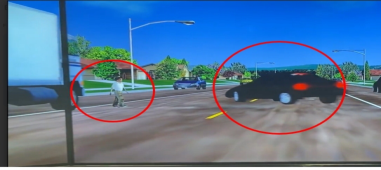
Participants were randomly assigned to one of two alert conditions, auditory or visual. After informed consent, participants completed a driving experience and trust questionnaire, followed by a practice drive free from hazards and alerts to ensure they did not experience motion sickness and felt comfortable operating the simulator. They then completed two test drives in their assigned alert condition. The drive order was randomly assigned and counterbalanced to control for any learning effects that occurred across multiple trials. Each test drive contained a hazard scenario in which two simultaneously occurring hazards were presented to the driver. In scenario one, a pedestrian runs out from behind a truck on the driver’s left side, while a car unexpectedly pulls out from a driveway on the right (Fig. 1).
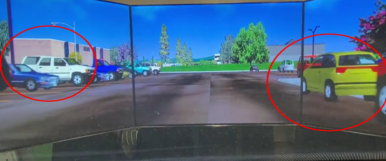
Figure 1: Scenario one hazards: pedestrian hazard on left; black car hazard, center.Figure 2: Scenario two hazards: blue car hazard to driver’s left; yellow car hazard on right.
In scenario two, a car begins to back out of a parking space on the driver’s left, while a car on the driver’s right quickly pulls out in front of the driver (Fig. 2). During the drives, verbal navigational directions were provided by the study facilitator (instructions on turns, for example).
Responses to and Recognition of Simultaneously-Occurring Driving Hazards 295
After each drive, the simulator’s screen was blanked and participants were asked to describe the drive they just experienced, reporting any important details, safety hazards, and problems experienced. The first time the question was asked, participants were also given an example answer. Participants’ responses were recorded by the facilitator while the participant remained in the simulator cab. Participants’ brake reaction time (time between hazard onset to participant applying the brakes), brake pressure, and steering direction were collected. Upon completion of the final drive, participants were asked to complete the trust survey again.
RESULTS
Data for two participants was excluded from all analyses due to a participant experiencing motion sickness during the test drive, and a technical malfunction in the driving simulator where the hazard was not displayed. RT data was excluded for two other participants, one of which applied their brakes before the hazard onset and continued to brake throughout the remainder of the scenario; the other did not brake at all during the hazard scenario. Data for these participants was still included for other analyses as they experienced and verbally responded to the hazards normally. Due to technical difficulties with the driving simulator, hazard onset data necessary for calculating RTs for the scenario two drives failed to be collected. Trust results are not our focus and are not reported here in detail.
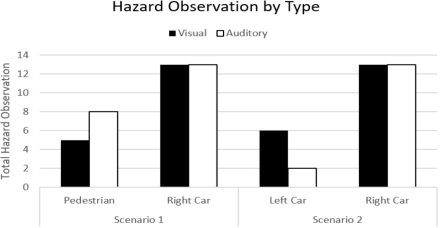
Awareness A 2x2 mixed analysis of variance (ANOVA) was used to evaluate whether there was a significant effect of the alert modality (audio, visual) and driving scenario (S1, S2) on driver hazard observance. Inclusion of drive order as a fixed factor showed no significant effects, F(1, 26) = .925, p = .346, ηp2= .037. There was also no significant effect of condition on hazard observance, F(1, 26) = .099, p = .755, ηp2 = .004, or interaction effect between condition and drive order, F(1, 26) = .695, p = .413, ηp2 = .028. Although SA measures did not reveal differences based on condition or order, a breakdown by type of hazard and whether it was observed does reveal an interesting pattern (Fig. 3).
Figure 3: Hazard observation by hazard type across scenarios.
In scenario one, the car pulling out of the driveway on the right was recognized by nearly all participants, whereas the pedestrian on the left was observed by only 13 participants. In scenario two, almost all participants also observed the vehicle pulling in front of them on the right, but only 8 noticed the second car hazard pulling out on their left. One potential explanation is that these hazards are particularly salient; but in either case, the data reveal that experiencing more than a single hazard simultaneously means one of them is likely to be missed. This echoes results from single-channel driving experiments (Hibberd et al., 2013; Levy et al., 2006).
Reaction Time While scenario two’s data was unavailable, an examination of scenario one was still performed. A two-way ANOVA for modality condition and drive order on brake RTs for scenario one was analyzed. Drive order, included as a fixed factor, was statistically significant, F(1, 24) = 8.390, p = .008, ηp2 = .276. Participants who completed scenario one first (order: 1, 2) displayed greater mean RTs for scenario one, than those who completed scenario two first (order: 2, 1). However, condition was not statistically significant (F(1, 24) = .213, p = .649, ηp2 = .01), nor was the interaction effect between drive order and condition (F(1, 24) = .233, p = .634, ηp2 = .01.)
Driving Experience The average driving experience for participants was 4.41 years (Min = 2, Max = 15, SD = 2.72). One participant reported additional experience because they began driving with their parent at the age of 11. Experience with alert systems found most with auditory alert systems (12), followed by visual (9), and tactile (6). Two participants reported experience with steering assist technology. A set of exploratory ANCOVAs using driving experience as a covariate factor for SA and RT revealed that controlling for driving experience, there was no significant impact of condition on RT (F(1, 24) = .103, p = .751, ηp2 = .004). Additionally, inclusion of driving experience as a covariate was not significant for RT, F(1, 24) = 3.099, p = .092, ηp2 = .119. There was also no impact of condition on SA, F(1, 26) = .012, p = .915, ηp2 = .000. However, inclusion of driving experience as a covariate for SA showed a significant effect, (F(1, 26) = 4.632, p = .041, ηp2 = .156.) Though there was not a significant impact of alert condition on SA, the significance of driving experience as a covariate indicates that there is a significant relationship between driving experience and SA.
DISCUSSION
Overall, there was no difference between the use of auditory and visual alerts to hazards in the two scenarios despite our hypothesis. However, the meaningful safety issue - the need to detect simultaneously occurring hazards - was emphasized by finding that some hazard types were less frequently noticed, and that only very rarely were both hazards noticed. In part, this
Responses to and Recognition of Simultaneously-Occurring Driving Hazards 297
was a function of our scenarios: designing drives to implement simultaneous hazard scenarios is challenging and limited us to hazard combinations that were fully avoidable with braking. Nonetheless, inattention still poses a risk of collision, and drives in which braking does not mitigate both hazards could pose an even larger risk, especially if the less salient hazard must be avoided in another way.
The current findings did not support previous findings related to auditory and visual hazard alerts (Ho et al., 2005; Liu, 2001; Scott & Gray, 2008; Wan & Sarter, 2022). However, a control group was needed to assess whether the alerts themselves were effective (versus no alert). We discuss two related challenges for co-occurring hazard research in driving: (1) hazard salience, and (2) the potential for attentional blink.
Hazard Salience In exploratory analyses, we discovered that each hazard was recognized at very different rates. One explanation may have been hazard salience. Some road hazards are easier to detect than others due to precursor cues that may alert the driver (Crundall et al., 2012), or because of greater visual salience, such as abrupt onset or strong contrast between the hazard and its environment (Wickens, McCarley, & Gutzwiller, 2022). On the other hand, hazards obscured by the environment, such as a pedestrian behind a truck, or hazards immersed in more cluttered displays (especially those that contain homogenous stimuli, such a car parked amongst many other parked cars) are more difficult to detect, especially for drivers with less experience (Crundall et al., 2012; Ho et al., 2001; Wickens, McCarley, & Gutzwiller, 2022). To research multiple co-occurring hazards may require some salience equivalencing, which is not typically performed in driving hazard research. For example, in scenario one (Fig. 1), the car pulling out of the driveway on the right was identified as the higher salience hazard, resulting in more observations from participants versus the pedestrian on the left. In the second scenario, most participants observed the vehicle pulling in front of them from their right side but far less observed the second car hazard in the parking spot to the left of them (Fig. 2).
Attentional Blink Consistent with Raymond et al.’s (1992) explanation of attentional blink, the two hazards, presented in close temporal proximity, resulted in an inability to detect a second hazard in close to half of the drives in both scenarios (Fig. 3). An attentional blink phenomenon was found comparing high versus low hazard salience conditions in driving scenarios by Sall and Feng (2019), with more high-salience hazards detected. Salience was not our focus but its role in co-occurring hazard recognition is likely.
Limitations & Future Directions The results may have been impacted by the small sample size, low number of trials, a lack of RT data for scenario two, and variation of driving experience. A larger sample is needed to explore these factors together. Completion
of additional drives could help balance learning effects with additional experience. Experience is related to development of effective visual search strategies and mental models used to identify and mitigate road hazards (Crundall & Underwood, 1998; Crundall et al., 2012; Konstantopoulos et al., 2010; Upahita et al., 2018). Additionally, a control group would provide further information about whether the two alert conditions were more effective in increasing hazard observance than a no-alert condition.
Though the alerts in the study were matched across auditory and visual conditions for their semantic meaning, cross-modal matching was not performed, but is recommended by Pitts et al. (2015). Using cross-modal matching would mitigate confounds due to differences in the salience of alerts across modalities. Nevertheless, this still would not level the saliency across different hazards.
In addition to the inclusion of more trial drives and cross-modal matching, future studies would benefit from the use of multiple online hazard observance measures provided by evolving driving simulator technology, such as gas-off reaction times, visual gaze (measured through eye tracking), or physiological measures such as heart rate (Stojan et al., 2024; Lachance- Tremblay et al., 2025; Ju et al., 2022).
Contribution Most driving research is limited to single hazard conditions. Recent work has demonstrated the importance of multi-hazard study (Sall & Feng, 2019; Wan & Sarter, 2022). Our study adds to this limited area and suggests additional research should be conducted to further understand the impacts of alert modality of drivers’ hazard observance, particularly how attention is directed for simultaneously occurring hazards.
REFERENCES
Crundall, D., Chapman, P., Trawley, S., Collins, L., van Loon, E., Andrews, B., & Underwood, G. (2012). Some hazards are more attractive than others: Drivers of varying experience respond differently to different types of hazard. Accident Analysis & Prevention, 45, 600–609. Crundall, D. E., & Underwood, G. (1998). Effects of experience and processing
demands on visual information acquisition in drivers. Ergonomics, 41(4), 448–458. Doll, T. J., & D. J. Folds. (1986). Auditory signals in military aircraft: Ergonomics principles versus practice. Applied Ergonomics, 17(4), 257–64, Endsley, M. R. (1995). Measurement of situation awareness in Dynamic Systems.
Human Factors, 37(1), 65–84. Gugerty, L. (1997). Situation awareness during driving: explicit and implicit knowledge in dynamic spatial memory. Jrnl Exp Psych: Applied, 3, 42–66. Gugerty, L. (2011). Situation awareness in driving. In J. Lee, M. Rizzo, D. Fisher
& J. Caird, Handbook for Driving Simulation in Engineering, Medicine, and Psychology. CRC Press. Gugerty, L., & Falzetta, M. (2005). Using an event-detection measure to assess drivers’ attention and situation awareness. Proceedings of the Human Factors and Ergonomics Society Annual Meeting, 49(22).
Responses to and Recognition of Simultaneously-Occurring Driving Hazards 299
Fischer, Haines, R. F., & Price, T. A. (1980). Cognitive issues in head-up displays.
National Aeronautics and Space Administration Report #1711. Herslund, M. B., & Jørgensen, N. O. (2003). Looked-but-failed-to-see-errors in traffic. Accident Analysis and Prevention, 35(6), 885–891. Hibberd, D. L., Jamson, S. L., & Carsten, O. M. J. (2013). Mitigating the effects of in-
vehicle distractions through use of the Psychological Refractory Period paradigm. Accident Analysis and Prevention, 50, 1096–1103. Ho, C., Reed, N., & Spence, C. (2007). Multisensory in-car warning signals for collision avoidance. Human Factors, 49(6), 1107–1114. Ho, G., Scialfa, C. T., Caird, J. K., & Graw, T. (2001). Visual search for traffic signs:
The effects of clutter, luminance, and aging. Human Factors, 43(2), 194–207. Ho, C., Tan, H. Z., & Spence, C. (2005). Using spatial vibrotactile cues to direct visual attention in driving scenes. Transportation Research Part F: Traffic Psychology and Behaviour, 8(6), 397–412. Jeon, M., Nelson, D. N., Nadri, C., & Lautala, P. T. (2022). In-vehicle auditory alerts
literature review - Transportation. U. S. Department of Transportation. https://ra ilroads.dot.gov/ Jian, J. Y., Bisantz, A. M., & Drury, C. G. (2000). Foundations for an empirically determined scale of trust in automated systems. International Journal of Cognitive Ergonomics, 4(1), 53–71. Ju, U., Chuang, L. L., & Wallraven, C. (2022). Acoustic cues increase situational
awareness in accident situations: A VR car-driving study. IEEE Transactions on Intelligent Transportation Systems, 23(4), 3281–3291. Konstantopoulos, P., Chapman, P., & Crundall, D. (2010). Driver’s visual attention as a function of driving experience and visibility. using a driving simulator to explore drivers’ eye movements in day, night and rain driving. Accident Analysis & Prevention, 42(3), 827–834. Lachance-Tremblay, J., Tkiouat, Z., Léger, P.-M., Cameron, A.-F., Titah, R.,
Coursaris, C. K., & Sénécal, S. (2025). A gaze-based driver distraction countermeasure: Comparing effects of multimodal alerts on driver’s behavior and visual attention. International Journal of Human-Computer Studies, 193, 103366. Lee, J. D., McGehee, D. V., Brown, T. L., & Reyes, M. L. (2002). Collision warning timing, driver distraction, and driver response to imminent rear-end collisions in a high-fidelity driving simulator. Human Factors, 44, 314–334. Levy, J., Pashler, H., & Boer, E. (2006). Central interference in driving: is there
any stopping the psychological refractory period? Psychological Science, 17(3), 228–235. Liu, Y. C. (2001). Comparative study of the effects of auditory, visual and multimodality displays on drivers’ performance in Advanced Traveller Information Systems. Ergonomics, 44(4), 425–442. Maltz, & Shinar, D. (2003). New alternative methods of analyzing human behavior in cued target acquisition. Human Factors, 45(2), 281–295. Maltz, & Shinar, D. (2004). Imperfect in-vehicle collision avoidance warning systems
can aid drivers. Human Factors, 46(2), 357–366. Marshall, D. C., Lee, J. D., & Austria, P. A. (2007). Alerts for in-vehicle information systems: Annoyance, urgency, and appropriateness. Human Factors, 49(1), 145–157. McAlphin, M. (2023). Unintentional Costs of Vehicle Warning Modality for Driving
Hazards. [Masters thesis, Arizona State University]. ProQuest Dissertations and Theses Global. Nikolic, M. I., Orr, J. M., & Sarter, N. B. (2004). Why pilots miss the green box: How display context undermines attention capture. The International Journal of Aviation Psychology, 14(1), 39–52.
Parmentier, F. B. R. (2008). Towards a cognitive model of distraction by auditory novelty: The role of involuntary attention capture and semantic processing. Cognition, 109(3), 345–362. Pitts, B., Riggs, S. L., & Sarter, N. (2015). Crossmodal matching: A critical but neglected step in multimodal research. IEEE Transactions on Human-Machine Systems, 46(3), 445–450. Proctor, R. W., & Proctor, J. D. (2006). Sensation and perception. In G. Salvendy
(Ed.), Handbook of human factors and ergonomics (pp. 53–88). John Wiley & Sons, Inc.. Raymond, J. E., Shapiro, K. L., & Arnell, K. M. (1992). Temporary suppression of visual processing in an RSVP task: An attentional blink? Jrl of Exp Psych: Human Perception and Performance, 18(3), 849–860. Recarte, M. A., & Nunes, L. M. (2003). Mental workload while driving: Effects
on visual search, discrimination, and decision making. Journal of Experimental Psychology: Applied, 9(2), 119–137. Sall, R. J., & Feng, J. (2019). Dual-target hazard perception: Could identifying one hazard hinder a driver’s capacity to find a second? Accident Analysis & Prevention, 131, 213–224. Salvucci, D. D., & Taatgen, N. A. (2011). Sequential Multitasking, Problem State, and
Task Suspension and Resumption. In The Multitasking Mind. Oxford University Press. Scott, J. J., & Gray, R. (2008). A comparison of tactile, visual, and auditory warnings for rear-end collision prevention in simulated driving. Human Factors, 50(2), 264–275. Sivak, M. (1996). The information that drivers use: Is it indeed 90% visual?
Perception, 25(9), 1081–1089. Spence, C., & Driver, J. (1997). Cross-modal links in attention between audition, vision, and touch: Implications for interface design. International Journal of Cognitive Ergonomics, 1(4), 351–373. Spence, C., McDonald, J., & Driver, J. (2004). Exogenous spatial-cuing studies of
human crossmodal attention and multisensory integration. Crossmodal Space & Crossmodal Attention, 277–320. Spence, C., Ranson, J. & Driver, J. (2000). Cross-modal selective attention: On the difficulty of ignoring sounds at the locus of visual attention. Perception & Psychophysics, 62, 410–424. Stojan, R., Bock, O., Mack, M., & Voelcker-Rehage, C. (2024). Effect of additional
tasks on the reaction time of braking responses in simulated car driving: Beyond the PRP effect. Psychological Research, 88(7), 2096–2106. Upahita, D. P., Wong, Y. D., & Lum, K. M. (2018). Effect of driving experience and driving inactivity on young driver’s hazard mitigation skills. Transportation Research Part F: Traffic Psych & Behaviour, 59, 286–297. Wan, Y., & Sarter, N. (2022). Attention limitations in the detection and identification
of alarms in close temporal proximity. Human Factors, Wickens, C. D. (2002). Multiple resources and performance prediction. Theoretical Issues in Ergonomics Science, 3(2), 159–177. Wickens, C. D. (2008). Multiple resources and mental workload. Human Factors,
50(3), 449– 455. Wickens, C. D., Dixon, S. R., & Seppelt, B. (2005). Auditory preemption versus multiple resources: Who wins in interruption management? Proceedings of the Human Factors and Ergonomics Society Annual Meeting, 49(3), 463–466. Wickens, C. D., McCarley, J. S., & Gutzwiller, R. S. (2022). Applied attention theory
(2nd edition). CRC Press.
LISTED IN THE AHFE DIGITAL BOOKSTORE CATALOGUE
Explore the complete digital volume
Advances in Human Factors of Transportation
Read this individual research paper free through the original publisher, or explore the full digital proceedings book.
ISBN 978-1-964867-62-5
Explore this ISBN in the AHFE Bookstore ↗Listed in the July 2026 bookstore catalogue; search by ISBN to confirm current availability · Digital book purchase optional