Jie Meng (2024). Facilitating Social Engagement for Middle-Aged and Older Individuals: Examining the Role of Idle Goods and Product-Service Design. In: Human Factors in Aging and Special Needs. AHFE Open Access, vol. 133, pp. 41–50. https://doi.org/10.54941/ahfe1004892
This article is grounded in the context of middle-aged and older individuals (aged 55 and above) in China living separately from their families due to population aging and shifts in traditional family structures. It delves into their requirements for social engagement and the potential of idle goods to foster connections among this demographic, thereby stimulating economic growth and influencing consumer behaviour. Drawing from a literature review and a survey of 212 participants, the article suggests that innovative approaches are essential to address social isolation and promote meaningful interaction among older individuals. It offers recommendations for future research and practical intervention strategies, emphasizing the importance of product-service design frameworks and community-based initiatives. In sum, this article enhances our comprehension of the challenges and opportunities associated with population aging in China and highlights the critical role of social cohesion and inclusive community development in supporting the well-being of older people.
‘Population aging’ is a global phenomenon with significant social ramifica- tions, particularly pronounced in China where the traditional family structure is undergoing rapid transformation (Zhang & Wang, 2022). As middle-aged and older people (in this paper, referring to individuals aged 55 and above) increasingly live apart from their offspring, the need for appropriate forms of social engagement becomes paramount (Zhang et al., 2018). Much research underscores the potential health benefits of social activities, highlighting interactive engagement as vital in averting psychological ailments and pro- longing the lifespan of middle-aged and older people (Liu, 2013; Yang, 2000; Bath et al., 2005; Xu, 1994). However, existing social frameworks often fail to engage older individuals adequately (Zhang, 2020; Lu, 2019).
In China, the trading of second-hand goods has surged in popularity, driven by economic growth and evolving consumer trends (Liang, 2018). This trend resonates with the interests of older individuals who possess purchasing
power, ample free time, and social inclinations. Consequently, idle goods – i.e., spare products that people own but are not using – have emerged as a bridge, facilitating new social connections for many older people.
This study aims to investigate the potential of idle goods in enhancing social engagement among older adults. The primary research question is: “How can idle goods facilitate active social connections among older indi- viduals?” This question guides two main objectives: first, to evaluate the effectiveness of idle goods in fostering social engagement among older peo- ple; and second, to explore the attitudes of middle-aged and older individuals toward utilizing idle goods for social interaction. Through this approach, the study seeks to examine the current landscape, preferences, and attitudes regarding idle goods and their social impact among middle-aged and older individuals, with the goal of transforming idle goods into catalysts for social innovation and meaningful human connections.
The concept of product-service design entails blending tangible products with intangible services, underscoring a dedication to crafting and experienc- ing meaningful interactions (Sakao & Lindahl, 2009). This holds particular significance for the older demographic, whose sense of well-being is intri- cately tied to social engagement. Through a comprehensive review of liter- ature and a survey-based analysis of social interaction among middle-aged and older adults, the study advocates for embracing a product-service design framework that not only transcends conventional socialization methods but also provides tangible products and services. This design approach fosters in-person social interactions among older individuals, with the overarching aim of bolstering their mental well-being and overall quality of life.
LITERATURE REVIEW
Social Imperatives for an Aging Demographic In China, individuals aged 60 and above are considered elder adults, accord- ing to the “Law on the Protection of the Rights and Interests of the Elderly” (People’s Republic of China, State Council, 2018). For centuries, the tra- ditional Chinese family structure has been characterized by extended living arrangements that included grandparents, parents, children, and grandchil- dren, a custom that traces back to matrilineal social systems (Ogihara, 2023). However, this longstanding tradition has been increasingly upended in con- temporary China where middle-aged and older people are no longer living with their family members (Zhang et al., 2018). Nowadays, a growing number of middle-aged and older people are entering their pre- and post- retirement years without cohabiting with their children and family members (Feng et al., 2020; Feng, 2013).
A review of data from successive national censuses reveals a consistent decline in the size of Chinese households. The average number of people per household has steadily decreased from 4.41 in the 1982 census, 3.96 in the 1990 census, 3.44 in the 2000 census, 3.10 in the 2010 census, to just 2.62 in the 2020 census, bringing the average Chinese family size to below three members for the first time in recorded history (Cai, 2013). This transformation has led to a reduction in socialization opportunities for older
Facilitating Social Engagement for Middle-Aged and Older Individuals 43
people, necessitating the search for new avenues of interaction. The impera- tive for meaningful social engagement among seniors is thereby emphasized, as numerous studies suggest proper face-to-face interaction with people can effectively prevent mental illness and even prolong the life cycle, significantly boosting well-being. It may be more effective than physical exercise in main- taining health, preventing cognitive decline and increasing longevity (Tan et al., 2024; Hou & Zhang, 2023; Liu et al., 2020). However, many middle- aged and older people are not actively engaged in social interactions, which can have significant negative consequences on their well-being and overall quality of life, including feelings of loneliness, depression, and, tragically, even suicide (Gu et al., 2020). Despite the widespread use of social platforms, the current landscape falls short of adequately meeting the unique social needs of this demographic (Yang et al., 2021). One of the primary issues with existing social platforms is their reliance on online formats such as mobile applications and websites, often lacking in face-to-face interactions (Dou et al., 2020). Consequently, there is an urgent need to explore innovative approaches to stimulate older people’s motivation for socialization.
Idle Goods: Catalysts for Middle-Aged and Older People’s Social Engagement In China, older individuals often lean towards frugality and tend to accumu- late unused items, shaped by the economic hardships they endured during periods such as the pre-reform era under Mao Zedong, in contrast to the more prosperous conditions following China’s reform and opening-up poli- cies. As a result, older generations tend to be more reluctant to part with their possessions. However, with economic growth and evolving consumer trends, the trading of second-hand goods has gained popularity as a fash- ionable trend (Liang & Xu, 2018). This trend encompasses various items, ranging from small everyday objects like pens and books to larger assets such as cars and real estate. On the other hand, this trend presents opportunities for older individuals to sell their idle goods and generate economic returns (Fortuna & Diyamandoglu, 2017; Steffen, 2017). Bartering and reselling have become increasingly prevalent methods of transaction, contributing to the proliferation of online second-hand trading platforms.
In January 2022, the National Development and Reform Commission, along with other relevant departments, issued guidance aimed at accelerating the development of a circular economy for waste materials (PRC National Development and Reform Commission, 2022). This initiative aims to fur- ther refine the policy framework for recycling and enhance resource reuse by 2025. According to Xianyu, one of China’s largest online platforms for second-hand trading, data reveals that sellers aged 50 and above constitute 17% of all users, with buyers in the same age group making up an even larger proportion, reaching 20%. In the user base, the number of users aged 60–70 reaches about 1.84 million, and the user group aged 50–60 is even larger, close to 10 million (Xianyu, 2020). Surprisingly, the activity of middle-aged and older people users seems to exceed expectations. Accord- ing to the data report, the top five categories of products with the largest transaction volume among users over fifty on the Xianyu platform include
44 Meng
mobile phones, joint rent, and wheelchairs. The total sales volume of these goods exceeds 20 million orders each year, becoming the main driving force for middle-aged and older people to consume on Xianyu. In the digital age, middle-aged and older people convey their needs and attitudes towards life through consumer behavior. The interest of middle-aged and older people in idle goods is consistent with their actual life state: they have consumption power, a large amount of free time, and social needs (Gong et al., 2022; Ying & Yao, 2006). Idle goods have become a connection, opening up new social fields for many middle-aged and older people.
METHODS
Study Design This study employed a robust mixed-methods approach, commencing with an exhaustive literature review to delineate existing knowledge regard- ing the social needs and psychological well-being of older individuals. To glean nuanced insights, methodological tools encompassing extensive sur- veys were utilized to gather quantitative data on social needs, preferences, and tendencies related to idle goods among the target demographic.
Participants This study was situated in Wuhan, Hubei Province, China, a city steeped in history and celebrated for its humanistic ambiance and residents’ high levels of well-being. It investigated the social needs and well-being of older individuals within the city’s dynamic urban landscape. As Wuhan contends with a pronounced and swift aging demographic, the government has priori- tized the expansion of community and home care services. This commitment was reflected in the provision of health service stations, parks, squares, and recreational areas within each residential community (‘xiaoqu’ in Mandarin). Against this backdrop, the study engaged 212 participants, with 156 valid respondents recruited offline from 10 xiaoqu across Wuhan.
RESULTS
A total of 212 questionnaires were collected, yielding 156 valid responses across 20 questions. Exclusions included 56 invalid submissions: 23 with completion times under 2 minutes, 10 exhibiting significant logical inconsis- tencies, 17 displaying repeated or patterned responses, and 6 deemed invalid due to age discrepancies. Questions 1–6 captured basic respondent informa- tion, 7–15 delved into the social psychological needs of middle-aged and older adults, while questions 16–20 explored user habits related to idle goods and design possibilities.
Data analysis revealed that 33.02% of respondents fell within the 55–65 age bracket, 26.42% were aged 66-80, and 14.15% were 81 years or older. Furthermore, 34.62% of respondents lived alone, 28.85% resided with a partner, and 12.82% lived with children, with an additional 17.95% living with caregivers. In terms of education, 33.33% had no formal education, 37.18% had only primary school education, 22.44% had vocational school education, and merely 7.05% had attained college education or higher.
Facilitating Social Engagement for Middle-Aged and Older Individuals 45
Notably, most respondents reported lower education levels. Detailed ques- tionnaire settings and the probability distribution of selected options are outlined in Table 1.
Table 1. Basic information from the questionnaire.
Table available in the original PDF paper.
Gender information Variables Study population (¯x ± s/%)
Excluded sample (n) (x ± s/%)
28 (17.95) 9 (16.07)
Gender Men 66 (42.31) 21 (37.50) Women 90 (57.69) 35 (62.50) Missing value 0 Age (years) 55–65 70 (33.02) 23 (41.07) 66–80 56 (26.42) 18 (32.14) ≥81 30 (14.15) 15 (26.79) Missing value 0 Living status Living alone 54 (34.62) 12 (21.43) Living with partner 45 (28.85) 18 (32.14) Living with children 20 (12.82) 14 (25.00) Living with a caregiver or caregivers Others 9 (5.77) 3 (5.36) Missing value 0 Educational level Illiterate 52 (33.33) 18 (32.14) Primary school 58 (37.18) 22 (14.10) Vocational school 35 (22.44) 12 (21.42) College and above 11 (7.05) 4 (7.12) Missing value 0
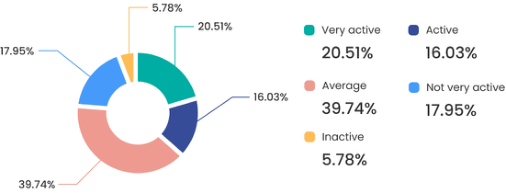
Based on the questionnaire, several key findings emerged. 60.26% of respondents reported regularly participating in social activities, while 39.74% indicated otherwise, stating they do not engage in such activities regularly. When asked about their level of social involvement, 39.74% of respondents perceived their participation as “average.” While over 30% viewed their engagement as somewhat or very active, approximately 20% felt their social involvement was below average. This data is illustrated in Figure 1. Regarding willingness to participate in more social activities when feeling lonely or lacking social support, 71.79% of participants expressed their openness to engaging in such activities.
Figure 1: Self-assessment of social engagement level.
46 Meng
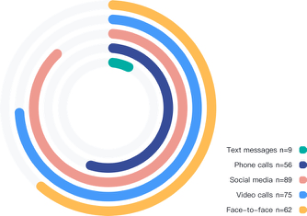
Inquiring about the preferred methods of staying in touch with family and friends, respondents predominantly favored social apps like WeChat, face- to-face communication, and video calls. Telephone communication followed, with text messaging being the least preferred method. Detailed statistics are depicted in Figure 2. In response to the question, “Which social interaction method do you find most effective or preferred?” approximately 70% of individuals indicated that face-to-face communication is the most effective means of interpersonal exchange for them.
Figure 2: Preferred methods for maintaining social interactions with others.
Additionally, when asked about preferred social pastimes, 39.1% of par- ticipants cited watching TV, followed by 25% who preferred reading news- papers. Interactions with family and friends accounted for 33.33%, while communicating with neighbors and other community members comprised 14.74%. Overall, most participants exhibited limited social engagement, relying heavily on TV, phones, and newspapers for external interactions, indicating a rather monotonous social life.
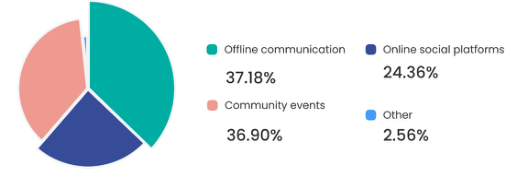
A significant portion of participants expressed reluctance to discard old belongings and showed a tendency to collect them. Over 82.34% reported the habit of accumulating unused items at home, expressing a desire to uti- lize them but lacking suitable means to do so. When asked about sharing or exchanging these items, 72.13% expressed willingness. Further, inquir- ing about preferred methods for sharing or exchanging idle goods, offline communication and community events were favored, followed by online platforms, as depicted in Figure 3.
Figure 3: Preferences for sharing or exchanging idle goods.
Facilitating Social Engagement for Middle-Aged and Older Individuals 47
The survey revealed that the majority of respondents engage in social activ- ities regularly, albeit to varying degrees. When faced with loneliness, most are willing to increase their social interactions. Social apps, face-to-face commu- nication, and video calls are the primary means of staying connected with family and friends, while watching TV is the most popular social enter- tainment activity. Respondents generally hesitate to discard old belongings and are open to sharing or exchanging them. These findings underscore the importance of social interaction and the potential of idle goods in fostering community engagement.
DISCUSSION
Product-Service Design: A Conceptual Framework The concept of service design is rooted in the orchestration of pre-sale, sale, and post-sale phases of tangible products, enhanced by the strategic use of both tangible and intangible mediums to deliver experiences. It involves a systematic transformation process—taking human, material, equipment, financial, informational, and technological resources from input to output service products (Vasantha et al., 2012). This process, defined by Stephen Moritz, aims to innovate or refine services to make them more user-friendly, accessible, customer-responsive, and efficient for organizations, marking it as a novel, holistic, interdisciplinary, and integrated domain. The field of service design, as understood by the Copenhagen Interaction Design Association, concentrates on conceptualizing robust ideas that encapsulate experiences via tangible means. It encompasses designing systems and procedures to offer comprehensive services to users, focusing on value creation attuned to user needs. This collaborative practice integrates a spectrum of design, man- agerial, and process engineering competencies, vital in a knowledge-driven economy (Saravia-Pinilla et al., 2016).
Introduced by Shostak in 1984, the notion of merging tangible products with intangible services characterizes service design as an all-encompassing, systemic philosophy. It stands apart from product design, which allows for assembly line production and retail sales, with consumption commencing post-purchase. Conversely, service design necessitates concurrent production and consumption, involving service providers in the design phase to ensure exceptional experiences. Moving further, product service system design rep- resents an evolution in ‘sustainable design’, focusing on the interplay between products and services. It emerges from a change in business strategy, as described by Manzini, shifting from selling commodified products to offer- ing a system of products and services tailored to meet specific user needs, reflecting a progressive social development.
The literature and survey findings underscore the importance of social interaction for both individuals and communities, while also highlighting the potential of idle goods in promoting the involvement of middle-aged and older individuals in community activities. Research indicates that pos- itive social interactions not only benefit individual psychological well-being and quality of life but also positively impact community cohesion and inclu- sivity. Idle goods, as abundant resources, can serve as effective tools for
48 Meng
fostering social interaction, providing middle-aged and older individuals with increased opportunities to participate in community activities.
Moreover, offline and online product-service design methods hold promise for enhancing social interaction among middle-aged and older individu- als. Future research can create more flexible and diverse social experiences for this demographic by combining physical community spaces with digital applications. For example, designing physical spaces conducive to face- to-face interaction, coupled with online platforms, allows participants to share, exchange, or trade idle goods in virtual spaces. This integrated design approach not only enhances the social interaction experience for middle-aged and older individuals but also effectively mobilizes idle goods, improving resource utilization and promoting sustainable consumption patterns.
Physical spaces serving as activity centers provide participants with a sense of purpose and belonging. This not only addresses social isolation but also replaces traditional business models, promoting community sharing and mutual assistance. Given the current understanding of the sharing economy, these service systems are scalable and adaptable to other environments, with potential for widespread adoption and application in different regions and communities.
Limitations and Future Plans This study has several limitations that warrant consideration. Firstly, the sample may not fully represent of the diverse population of middle-aged and older individuals in China. The research may have focused on specific geographic regions or communities, thus limiting the generalizability of the findings. Another limitation is methodological constraints: the reliance on surveys and literature reviews may introduce biases and limitations. Surveys are susceptible to response biases, and the scope of literature reviews may overlook relevant research, potentially influencing the comprehensiveness of the findings. Additionally, resource constraints, including limited time, fund- ing, and access to data, may have constrained the scope and depth of the study, potentially overlooking important aspects of the research topic.
Moving forward, future studies should aim to address these limitations by expanding the sample size and reaching out to a broader range of participants. Longitudinal studies should also be conducted to track the long-term effects of idle goods utilization on social interaction among middle- aged and older individuals. This approach would provide insights into the sustainability and effectiveness of interventions over time.
Furthermore, future research should focus on validating the effectiveness of utilizing idle goods in design activities. Through on-site observation and quantitative analysis, the impact of such service systems on social interaction and community cohesion among middle-aged and older individuals can be assessed.
Additionally, future research should conduct case studies focusing on product-service system design. These studies should aim to validate the prac- tical usage and effectiveness of utilizing idle goods, which are no longer needed but have reuse potential. This approach can lead to the development
Facilitating Social Engagement for Middle-Aged and Older Individuals 49
of service products that better meet the needs and lifestyles of middle-aged and older individuals.
CONCLUSION
In conclusion, this study sheds light on the potential of idle goods in fostering social interaction among middle-aged and older people in China. Through a comprehensive analysis of literature and survey findings, this study has identified the significance of social engagement for the well-being of this demographic group, as well as the untapped potential of idle goods as catalysts for community cohesion.
Despite the limitations of this study, including sampling biases, method- ological constraints, and resource limitations, the findings suggest promising avenues for future research and practical interventions. By expanding sam- ple sizes, conducting longitudinal studies, and validating the effectiveness of utilizing idle goods through case studies, researchers can further explore and harness the benefits of idle goods in promoting social interaction among middle-aged and older populations.
Furthermore, from a product-service system design perspective, innova- tive utilization of idle goods holds promise for the development of service products that are more tailored to the needs and lifestyles of middle-aged and older people. By leveraging technology and community-based initiatives, this study suggests that age-friendly environments can be created to enhance social cohesion and well-being among aging populations.
In summary, this study underscores the importance of addressing social iso- lation and promoting meaningful engagement among middle-aged and older people. By recognizing the value of idle goods and adopting innovative design approaches, this study suggests that inclusive and supportive communities can be created, enabling middle-aged and older people to lead fulfilling and connected lives.
REFERENCES
Bath, P. A., & Deeg, D. (2005). Social engagement and health outcomes among older people: introduction to a special section. European Journal of Ageing, 2(1), 24–30. Cai, Y. (2013). China’s new demographic reality: learning from the 2010 census.
Population and Development Review, 39(3), 371–396. Chen, Y., Hicks, A., & While, A. E. (2014). Quality of life and related factors: a questionnaire survey of older people living alone in Mainland China. Quality of Life Research, 23(5), 1593–1602. Chen, K., Qiu, J., Wang, W., Hu, Q., & Qiao, H. (2024). Analysis of health risk
factors for older adults living alone in China and establishment and evaluation of a nomogram prediction model. Frontiers in Public Health, 12, 1309561. Feng, J., Li, Q., & Smith, J. P. (2020). Retirement effect on health status and health behaviors in urban China. World Development, 126, 104702. Feng, Q., Yeung, W. J. J., Wang, Z., & Zeng, Y. (2019). Age of retirement and human
capital in an aging China, 2015–2050. European Journal of Population, 35(1), 29–62. Guiyang, D. (2012). Research on social participation of urban elderly (Unpublished doctoral dissertation). Central University for Nationalities.
50 Meng
Hou, B., & Zhang, H. (2023). Latent profile analysis of depression among older adults living alone in China. Journal of Affective Disorders, 325, 378–385. Liang, J., & Xu, Y. (2018). Second-hand clothing consumption: A generational
cohort analysis of the Chinese market. International Journal of Consumer Studies, 42(1), 120–130. Lu, J., Zhang, C., Xue, Y., Mao, D., Zheng, X., Wu, S., & Wang, X. (2019). Moderating effect of social support on depression and health promoting lifestyle for Chinese empty nesters: a cross-sectional study. Journal of Affective Disorders, 256, 495–508. Ogihara, Y. (2023). Chinese culture became more individualistic: Evidence from
family structure, 1953–2017. F1000Research, 12, 189. People’s Republic of China, State Council. (2018). Law of the People’s Republic of China on the Protection of the Rights and Interests of the Elderly, Rule Num- ber 2. Retrieved from https://flk.npc.gov.cn/detail2.html?ZmY4MDgwODE2 ZjEzNWY0NjAxNmYyMGY0YmY4NTE3NDY%3D Qi, X., Pei, Y., Wang, K., Han, S., & Wu, B. (2023). Social isolation, loneliness
and accelerated tooth loss among Chinese older adults: A longitudinal study. Community Dentistry and Oral Epidemiology, 51(2), 201–210. Sakao, T., & Lindahl, M. (Eds.). (2009). Introduction to Product/Service System Design. Springer Science & Business Media. Saravia-Pinilla, M. H., Daza-Beltrán, C., & García-Acosta, G. (2016). A comprehen-
sive approach to environmental and human factors into product/service design and development. A review from an ergoecological perspective. Applied Ergonomics, 57, 62–71. Tan, S., Liu, D., Zhang, Y., Li, S., Zhang, K., Tang, Z., & Zuo, H. (2024). Loneliness, Living Alone, and Risk of Cardiovascular Disease Among Older Adults in China. The Journals of Gerontology, Series A: Biological Sciences and Medical Sciences, 79(5), glae079. Vasantha, G. V. A., Roy, R., Lelah, A., & Brissaud, D. (2012). A review of product–
service systems design methodologies. Journal of Engineering Design, 23(9), 635–659. Xu, Q. (1994). Social interaction among the elderly in urban China. Northwest Population, (04), 54–59. Yang, Z. (2000). The social participation of the elderly population. Journal of Wuhan
University (Humanities and Social Sciences Edition), (01), Zhang, C., Zhu, R., Lu, J., Xue, Y., Hou, L., Li, M., & Zheng, J. (2018). Health promoting lifestyles and influencing factors among empty nesters and non-empty nesters in Taiyuan, China: a cross-sectional study. Health and Quality of Life Outcomes, 16, 1–8. Zhang, L., & Wang, G. (2022). Research on the changes and existing problems in
Chinese family structure. Social Development Research, 2, 17–32. Zhang, Y. (2020). Are empty-nest elders unhappy? Re-examining Chinese empty-nest elders’ subjective well-being considering social changes. Frontiers in Psychology, 11, 523302.
LISTED IN THE AHFE DIGITAL BOOKSTORE CATALOGUE
Explore the complete digital volume
Human Factors in Aging and Special Needs
Read this individual research paper free through the original publisher, or explore the full digital proceedings book.
ISBN 978-1-964867-09-0
Explore this ISBN in the AHFE Bookstore ↗Listed in the July 2026 bookstore catalogue; search by ISBN to confirm current availability · Digital book purchase optional