Wondea Jung (2024). Investigation of human performance in diagnosing unexpected events at nuclear power plants. In: Human Error, Reliability, Resilience, and Performance. AHFE Open Access, vol. 132, pp. 72–78. https://doi.org/10.54941/ahfe1004882
Diagnosing unexpected events at nuclear power plants is one of the main control room crew's most critical and challenging tasks. It is crucial to understand human performance in event diagnosis during emergencies to assess the risk of a power plant. This study examines the human performance of the crew diagnosing unexpected events at nuclear power plants. Collecting and analysing simulator data, we investigate the time taken for event diagnosis and the characteristics of diagnosis errors in various unplanned events. Analysis results such as event diagnosis time, unsafe act type, and the possibility of occurrence are expected to provide the proper technical basis for risk assessment or design improvement of the relevant nuclear power plant.
When an unplanned event occurs at a nuclear power plant (NPP), the main control room (MCR) crew’s task is to initially diagnose the event and deter- mine the optimal response, which is crucial for the plant’s safety (Park, 2003; Colquhoun, 1984). Therefore, to evaluate the safe-ty of a power plant, it is necessary to know how likely the crew is to quickly and accurately diagnose an unexpected event. However, limited information on human performance related to event diagnosis is available (NEA, 2012; Chang, 2012).
This study investigated the human performance of the crew’s task of diag- nosing unexpected events at an NPP. Using simulator data, we scrutinized the time spent on event diagnosis and the characteristics of diagnostic errors in various unplanned events. To gather human performance data on event diagnosis, we conducted a field study using a full-scope simulator of a ref- erence plant. We simulated five emergency scenarios to observe and record crew response behaviours during emergencies.
We identified the procedures and steps the crews had undertaken during event diagnosis using verbal protocol analysis (Park, 2003) on the simulated records. We also extracted the crew response time for each procedural step through timeline analysis (Park, 2002). Furthermore, we collected data on unsafe acts (UA) occurring during the event diagnosis process and analysed them to identify the types, influencing factors, and characteristics of diagnosis errors (Choi, 2016).
Investigation of Human Performance in Diagnosing Unexpected Events 73
DIAGNOSIS OF UNEXPECTED EVENT As mentioned in the introduction, a diagnosis task is crucial for the safety of an NPP and is one of the most challenging tasks for MCR crews. When MCR crews diagnose an unexpected event accurately at an early stage, the plant can be shut down in a safe state quickly according to a procedure opti- mized for the event. Therefore, the diagnosis task is essential for plant safety. However, because an event occurs unexpectedly and the plant’s behaviour changes rapidly in the early stages after the event, accurately diagnosing the event is challenging, even for skilled operators.
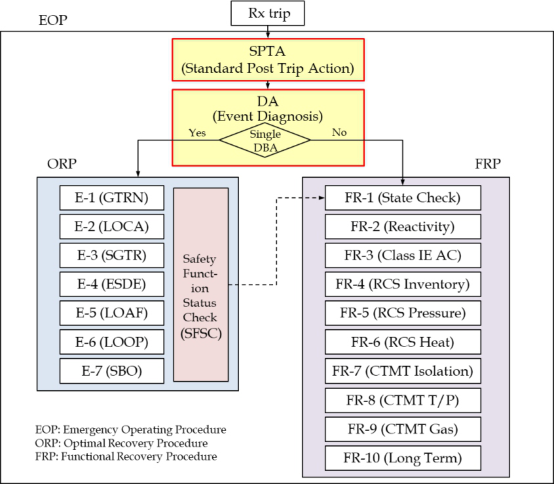
When an unexpected reactor trip occurs, the operator must check the plant’s initial status, diagnose the event causing a reactor trip, and take a series of response actions according to the diagnosis results. MCR crews perform these emergency response actions according to instructions of emer- gency operating procedures (EOPs) (Jung, 2018). Figure 1 shows the EOPs configuration of the reference NPP. As shown in Figure 1, the crew’s emer- gency responses have three stages. The first is the SPTA (standard post trip action) procedure, which checks the status of the plant’s safety functions; the second is the DA (diagnostic action) procedure, which diagnoses the event that occurred unexpectedly; and the last is one of the optimal recovery pro- cedures (ORPs) optimized for the event determined in the DA procedure. If the crew cannot diagnose an event or diagnose it as multiple events at the DA procedure, then they should start FR-1 of the functional recovery procedures (FRPs). This study defines the SPTA and DA procedures in Figure 1 as an event diagnosis task under emergencies.
Figure 1: EOPs configuration and ‘event diagnosis’ definition.
74 Jung
Procedural Steps for Event Diagnosis To identify specific actions performed by crews to diagnose an event, we performed a task analysis of the SPTA and DA procedures. First, the SPTA is a procedure that checks the status of the plant at the early stage of an event. It consists of nine steps to verify the status of the safety functions and two steps to determine the following procedure. Table 1 shows part of the task analysis content for steps 1 and 2 of the SPTA procedure. There are six task types in the instructions of the SPTA: check ‘Value (trend),’ check ‘Value (range),’ check ‘Value (trend/range),’ check ‘Alarms,’ check ‘Component State,’ and check ‘Safety function state.’
Table 1. A part of instructions and relevant task types of the SPTA procedure.
Table available in the original PDF paper.
Step Function Instructions of the SPTA Task Type
1 Verify Reactivity Control
Determine that reactivity control acceptance criteria are met by performing ALL of the following steps: a. Verify that Reactor Power is lowering. b. Verify that Start-up Rate is negative. c. Verify that no more than one full strength CEA is NOT inserted.
Determine that Maintenance of Vital Auxiliaries acceptance criteria are met by performing ALL of the following steps: a. Verify that the Main Turbine is tripped.
The DA is a flowchart-type procedure that diagnoses the type of event that occurred. The DA procedure also determines the event type by checking the safety function’s status. The DA procedure of the reference NPP has a two- stage diagnosis approach. In the first stage, a preliminary diagnosis is made based on the essential safety function status. The second stage determines whether it is a multiple event through checking auxiliary safety parameters (Park, 2004). The crew should immediately start the FR-1 of FRPs if it is determined to be a multiple event or if diagnosis is impossible.
DATA COLLECTION AND ANALYSIS We used a training simulator of the reference plant to collect data on human performance under emergencies. The reference NPP is a PWR (pressur- ized water reactor) type plant with digitalized human-machine interfaces. We conducted data collection and observation of crew responses in simu- lated scenarios. The simulator has a video recording device that records all
Investigation of Human Performance in Diagnosing Unexpected Events 75
crews’ actions and a device that keeps logs regarding all signals, alarms, and operating parameters.
There are two ways to collect simulator data: 1) obtain records from phys- ical equipment such as a simulator or a camcorder, and 2) record related performance data from an observer. Simulator logs record all the information regarding the plant’s status and crew’s responses during simulation: injected malfunctions, alarms, values, and trends of critical operational parameters, manipulations performed by operators, and state changes of components. We could extract execution time data by analysing the simulator logs regarding alarms, plant parameters, and operator responses recorded during simula- tions. In addition, we can confirm all the information from the operator responses during simulation from video records, specifically communication between operators, movement line of each operator, and manipulation of a specific component at a particular time point.
Table 2 summarizes the collected simulation records. We collected 105 records from the simulation of five scenarios, and 12 operating crews par- ticipated in the simulator experiments. Among the five scenarios, LOCA (loss of coolant accident) and SGTR (steam generator tube rupture) included three and two scenarios of different complexity, respectively. ESDE (excessive steam demand event) also has high complexity, including situations where one safety system fails. Based on the simulator records, we identified what procedure and which steps the crews had performed using a verbal proto- col analysis. We extracted an execution time for each procedural step by a time-line analysis.
Table 2. A part of instructions and relevant task types of the SPTA procedure.
Table available in the original PDF paper.
Scenario Number of Simulation Records
49 31 4 10 11
LOCA (Loss of Coolant Accident) SGTR (Steam Generator Tube Rupture) ESDE (Excessive Steam Demand Event) LOAF (Loss of All Feed water) SBO (Station Blackout)
To extract data on human performance from simulator experiments, we developed a guideline for collecting raw information from simulations and analysing them to extract human performance measures like execution time and error. We applied the HuREX (human reliability data extraction) (Jung, 2020) framework and taxonomy to analyse a diagnosis error.
ANALYSIS RESULTS Event Diagnosis Time
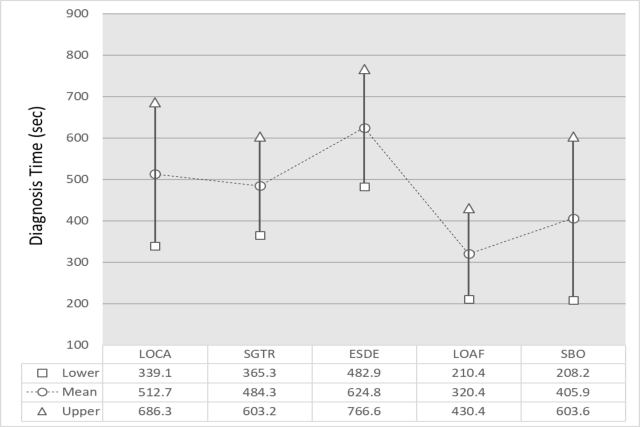
From the analyses above mentioned, we produced the time taken to diagnose an event, which is the time to perform the SPTA and the DA procedures. Figure 2 shows the diagnosis times for five simulated events.
76 Jung
When an unexpected event occurs, the crew has to respond to the situation according to the EOPs. After a reactor trip, the crew verifies the plant’s status according to the SPTA procedure. They should diagnose the event based on the DA procedure, which leads them to an ORP. To choose a proper ORP, the crew must perform the DA procedure correctly. From the viewpoint of a human reliability analysis, it is essential to know how long it takes to fin- ish the event diagnosis (DA procedure) after a reactor trip because that time would be a definitive point to calculate an operator’s performance time for human failure events modelled in a risk assessment.
Figure 2 shows the average performance time with upper and lower to complete an event diagnosis concerning each simulated scenario. The diag- nosis time means the net time required to complete the SPTA and DA procedures. Mean diagnosis time is largest in the following order: ESDE, LOCA, SGTR, SBO, and LOAF. Event diagnosis time was the longest at 624.8 seconds for ESDE and the shortest at 320.4 seconds for LOAF. As mentioned in the previous section, the diagnosis time has increased for LOCA, SGTR, and ESDE because they include highly complex scenarios.
Figure 2: Diagnosis times for five simulated events.
Unsafe Act in Event Diagnosis The introduction mentions that event diagnosis is critical to the operator’s emergency response performance. Fast and accurate event diagnosis leads to optimal response through the corresponding ORP. On the other hand, late or inaccurate event diagnosis may fail to respond as needed within the allowed time or lead to inappropriate actions. In this study, we applied the HuREX framework to analyse unsafe acts (UA) that occurred during the event diag- nosis process, and the results are summarized in Table 3. Because we collected
Investigation of Human Performance in Diagnosing Unexpected Events 77
data from the official simulator education/training program, event diagnosis was also subject to time constraints. If the time limit was exceeded during the simulation, the instructor intervened. Therefore, the UA does not directly mean a diagnosis failure. However, Table 3 shows what types of UA may occur and their likelihood in event diagnosis. Misdiagnosis is the UA that incorrectly diagnoses an event A as B, leads to the ORP for B, or judges it as a multiple event, proceeding to the FRP. Late diagnosis is the UA in which event diagnosis takes much time, so the simulation is stopped, or instructors intervene. In the event diagnosis process, 15 UAs were observed, 11 of which were ‘misdiagnosis’ and four of which were ‘late diagnosis.’ All UAs occurred in the LOCA, SGTR, and ESDE scenarios. As explained in the previous sec- tion, LOCA, SGTR, and ESDE had high complexity scenarios, whereas LOAF and SBO were relatively simple and apparent symptoms.
Table 3. Unsafe acts observed during the event diagnosis.
Table available in the original PDF paper.
Event # of Simulator Records Unsafe Act (UA) in Event Diagnosis # of UA Misdiagnosis Late Diagnosis
The task of event diagnosis is crucial for the plant’s safety. It is crucial to understand human performance in event diagnosis during emergencies to assess the risk of an NPP. Unfortunately, there is limited availability of rel- evant data on this matter. This study scrutinized the human performance related to the MCR crew’s event diagnosis task in emergencies at an NPP. We collected 105 simulator records by simulating five scenarios in the full-scope simulator of the reference plant and analysed them to determine the time taken for event diagnosis and UAs observed during the diagnosis process.
The results of the analysis showed that ESDE had the longest diagnosis time, followed by LOCA, SGTR, SBO, and LOAF. The mean time required for event diagnosis was 624.8 seconds for ESDE and 320.4 seconds for the shortest LOAF. In the case of LOCA, SGTR, and ESDE, increasing the com- plexity of the scenario by injecting additional malfunctions is interpreted as the reason why event diagnosis took more time. In the event diagnosis pro- cess, 15 UAs were observed, 11 of which were ‘misdiagnosis’ and four of which were ‘late diagnosis.’ All UAs occurred in the LOCA, SGTR, and ESDE scenarios, which is also interpreted to be due to the high complexity of these scenarios.
ACKNOWLEDGMENT
The Nuclear Safety Research Program supported this work through the Korea Foundation of Nuclear Safety (KoFONS) of the Republic of Korea (No. 2106054).
78 Jung
REFERENCES
Chang J, Lois E (2012). Overview of the NRC’s HRA data program and current activities, Proceedings of 11th International Conference on Probabilistic Safety Assessment and Management (PSAM 11), Helsinki, Finland. Choi, S. Y., Kim, Y., Park, J., Kim, S., Jung, W. (2016). A process for identifying
unsafe act for HEP quantification with simulated off-normal training records, Pro- ceedings of 13th International Conference on Probabilistic Safety Assessment and Management (PSAM 13), Seoul, Korea. Colquhoun R (1984). Development of symptoms-oriented operating procedures, Nuclear Safety, Volume 25(3), pp. 341–349. Jung W, Park J, Kim Y, Choi S, Kim S. (2020). HuREX – A framework of HRA data
collection from simulators in nuclear power plants, Reliability Engineering System Safety, Volume 194, 106235. Jung, W. (2018). New procedural path for F&B operation and its risk impact on a nuclear power plant, Nuclear Technology, Volume 202, pp. 210–219. NEA (2012), Simulator studies for HRA purposes, NEA/CSNI/R (2012), Vienna,
Austria, Nuclear Energy Agency. Park J, Jung W, Ha J, Park C. (2002). The step complexity measure for emergency operating procedures: measure verification, Reliability Engineering System Safety, Volume 77(1), pp. 45–59. Park, J., Jung, W. (2003). The requisite characteristics for diagnosis procedures based
on the empirical findings of the operators’ behaviour under emergency situations, Reliability Engineering System Safety, Volume 81, pp. 197–213. Park, J., Jung, W. (2004). A study on the systematic framework to develop effective diagnosis procedures of nuclear power plants, Reliability Engineering System Safety, Volume 84, pp. 319–335.
LISTED IN THE AHFE DIGITAL BOOKSTORE CATALOGUE
Explore the complete digital volume
Human Error, Reliability, Resilience, and Performance
Read this individual research paper free through the original publisher, or explore the full digital proceedings book.
ISBN 978-1-964867-08-3
Explore this ISBN in the AHFE Bookstore ↗Listed in the July 2026 bookstore catalogue; search by ISBN to confirm current availability · Digital book purchase optional