Fabian Fritsch, Oliver Straeter (2024). Human reliability in the German site selection for a nuclear waste repository. In: Human Error, Reliability, Resilience, and Performance. AHFE Open Access, vol. 132, pp. 1–7. https://doi.org/10.54941/ahfe1004874
In Germany, a geological system is to be created for the final disposal of high-level radioactive waste. Classical methods for assessing human reliability consider people performing tasks in an existing system. This paper is intended to show which reliability aspects need to be addressed to humans in earlier phases of a system development based on typical phases. Also, a method is described for measuring human reliability in the phase of system analysis and system conception for complex and novel research and modeling activities. These are typical of the search for the best possible site for high-level nuclear waste. For the development of reliable systems, reliable human actions are crucial, especially in the early phases of system development. In the later phases, adjustments to the system become increasingly expensive and time-consuming.
Following the conventional use of nuclear energy, Germany is currently in a search process for a repository that provides the best possible protec- tion for people and the environment from ionizing radiation. The storage is planned to be deep geological for a period of one million years. These and other requirements are legally regulated in the Site Selection Act (Stan- dortauswahlgesetz - StandAG, 2017). The Federal Company for Radioactive Waste Disposal (Bundesgesellschaft für Endlagerung - BGE) is responsible for the search and selection process, excluding unsuitable sites in a step-by-step procedure. Depending on how it progresses, the search process will be com- pleted between 2046 and 2068. An environmental impact assessment will then be carried out by the responsible regulatory authority and the legislator will make the final decision on the site. The construction of the repository as a system and storage will follow. For this purpose, rock salt, clay rock, and crystalline rock are considered.
context and recognized human reliability enhancing aspects (e.g. SLIM). The development of methods for assessing human reliability can be attributed to the analysis of incidents in the nuclear field. These methods enable the evaluation of human reliability within systems by fundamentally examining the tasks performed by individuals in a given system and quantifying the reliability of human actions. All steps of a system development (before the existing system can be evaluated) are equally dependent on human actions. This applies to both overarching decisions and the planning, execution, or evaluation of seemingly small aspects. This paper is intended to show which human influences dominate the entire path of a system development and at the same time describe a method.
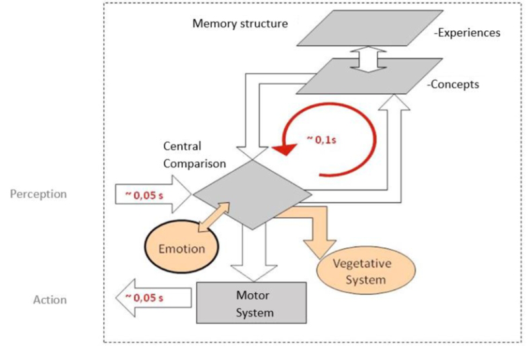
HUMAN INFORMATION PROCESSING For an understanding of the role of humans in system development, human information processing is fundamental. It is universal and illustrates the cog- nitive processes of human actions. It can be simplified into three phases. In the first phase, information is received via sensory organs. For stim- uli to be processed, they must reach a certain threshold stimulus strength (Schlick et al., 2018). The second phase describes the central processes of human information processing, in which the corresponding stimuli are matched with memory contents as a result of a central comparison (Sträter et al., 2012). This processing can take place in a controlled manner (requires high concentration) or in an automated manner. Automatic processing occurs without cognitive effort or attentional resources (Wentura & Frings, 2013). In the third phase, the comparison results in changes of the autonomic sys- tem such as the release of neurotransmitters and the activation of the motor system, which triggers actions matching the perception (Sträter et al., 2012). This process of human information processing takes about 200 msec and is shown in Figure 1.
Figure 1: Processing cycle according to Sträter (2005).
Human Reliability in the German Site Selection for a Nuclear Waste Repository 3
In addition to the threshold stimulus strength described above and other external influences such as the representativeness of the information, intrapsychic factors also play a decisive role in information processing. Not any number of stimuli can be processed simultaneously, since the capacity of human information processing is limited. This particularly affects conscious information processing (Schaub, 2012). In order to use the limited capacity wisely, attentional processes direct the resources of human information pro- cessing to aspects that appear relevant (Schaub, 2012). Attention (as a state of increased alertness and receptivity) can thereby be directed by interests on the one hand or passively aroused by stimuli on the other (Matthews et al., 2000). The limited cognitive capacities of humans prompt the use of rules of thumb, so-called heuristics (Hacker & von der Weth, 2012). When con- fronted with (too) many stimuli, heuristics allow for a fast and parsimonious judgment that is usually sufficiently accurate. However, heuristics can also lead to systematic misjudgments (bias) (Werth et al., 2020). This is particu- larly relevant to novel and complex situations, which are typical in system developments. Beyond biases, other characteristics of human information processing influence human reliability. Perceptual content is continuously compared with existing concepts that arise from experience. The way in which a person processes information therefore depends on the experience they can draw on.
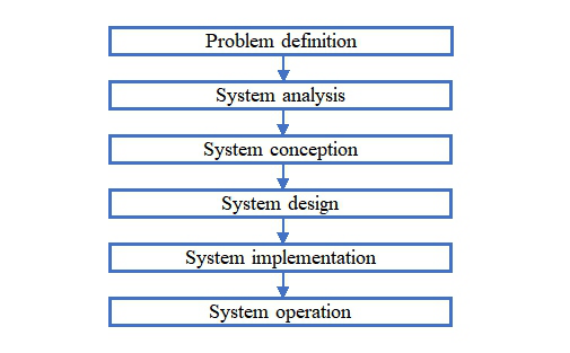
SYSTEM PHASES OF SITE SELECTION FOR THE FINAL REPOSITORY There are different theoretical models for the development of systems, depending on the purpose and environment. The authors Alpar et al. (2014) as well as Stahlknecht and Hasenkamp (2006) present two options. How- ever, when looking at the steps and individual phases, a general concept can be identified. The possible phases of a typical system development are exemplarily described below and outlined in Figure 2.
Figure 2: System development phases.
4 Fritsch and Sträter
In the first phase of system development, there is always a problem and an associated goal (I). In the field of nuclear waste disposal, the problem is high-level radioactive nuclear waste, while in the expansion of power lines, it would be the sufficient energy supply in urban areas. The goals would be successful storage with the best possible protection of people and the environment from radioactive radiation, as well as ensuring power supply in urban areas. This is followed by an analysis of requirements and needs based on a target-actual-comparison (II). On this basis, the sys- tem conception (III) takes place. In this phase, the system is developed and outlined in its basic features. Individual components or relationships within the system are determined through modeling along the requirements. The more novel and complex the project, the greater the uncertainties and potential interdependencies that need to be anticipated. It is also impor- tant to involve stakeholders in this phase. In the case of final disposal, for example, this would be the residents living at a potential site. Once a completed system design (IV) is available, expert reviews, approvals and authorizations follow. For the system implementation (V), it is possible that simplifications are made due to the complexity and the original scope must be ignored. The implicit assumptions about the system behavior are not evaluated transparently, resulting in an incorrect configuration. The design- ers of the containers rely on the geology of the repository because they know that the container will not provide safe containment for long enough. As a result, individual disciplines rely on the safety contributions of other disciplines, which means that the built system does not fulfill the safety requirements. Finally, classic HRA methods can then be used in system operation (VI).
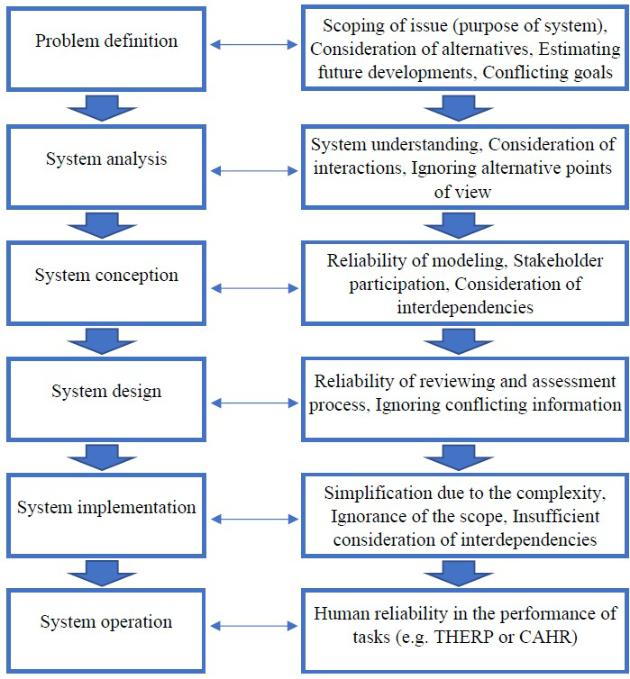
HUMAN RELIABILITY ISSUES Looking at the entire system development, depending on the phase, certain issues dominate from the perspective of human reliability. Based on Figure 2, the following overview illustrates the most important aspects, with fluid transitions and overlaps.
The figure shows that the reliability aspects in the early phases have an impact on the following phases. If the problem definition and needs analysis are not clearly defined at the beginning, solutions are devel- oped that are later at a discrepancy to the initial situation. For the disposal of high-level radioactive waste, this could mean, for example, that storage capacities are inaccurately estimated, and an (unpredictable) larger quantity of radioactive waste has not been adequately anticipated. The amount of waste can change relatively suddenly due to political decisions.
Human Reliability in the German Site Selection for a Nuclear Waste Repository 5
Figure 3: Issues of human reliability by phase.
In terms of the methods that can be used to assess human reliability, estab- lished procedures are particularly available for existing systems. The system analysis and system design phases have so far received less attention in terms of human reliability. In the following, we propose a method for assessing human reliability in these crucial phases. Theses phases are often character- ized by numerous uncertainties and complex issues in large projects. Through modeling, certain aspects are simulated, or processes are simplified. The actions/activities in the modeling or projects are carried out by both teams and individuals. Therefore, the reliability of the models, which form the basis of the later system, depends on the human reliability of the actors. An exam- ple from the disposal of high-level radioactive waste would be the modeling of a specific container concept regarding the safe containment of radionuclides.
Increasing Human Reliability in the Face of Analysis and Design Based on a literature review, factors influencing human reliability in the described phase were determined. Items were then developed and formulated as self- statements in a questionnaire. The response format is a 6-point Likert scale ranging from “completely agree” to “completely disagree”. The target
6 Fritsch and Sträter
group of the questionnaire are people who are involved in system design in complex research or modeling projects. Through their degree of agreement with the statements, participants can assess their disposition regarding the factors. The main categories of the questionnaire are:
Individual biases (e.g. anchoring bias, confirmation bias, law of the instrument).
Collective biases or group effects and bilateral factors (e.g. groupthink, group polarization, obedience to authority).
Influences that arise due to the situation in which a task is carried out (e.g. latent or explicit goals of the client, societal and social goals, personal goals of the researcher).
General conditions (e.g. time pressure, frustration, type and manner of evaluation).
The questionnaire was designed for the system concept of German final disposal. However, it can easily be used in other industries as well.
In its current state of development, the questionnaire aims to measure human reliability in the system design. As a further step, a contribution to improving human reliability is to be achieved by formulating recommenda- tions for action. The recommendations for action are intended to appear automatically in the questionnaire as feedback when participants provide relevant information. This means that a recommendation for action appears automatically if a person makes statements about a certain influencing fac- tor that are considered atypical due to the corresponding characteristics. The recommendations are formulated based on literature.
CONCLUSION AND FUTURE WORKS Based on exemplary phases of system development, we have presented a method that measures human reliability in the design phase. The influencing factors are specially adapted to this. It would make sense for the reliabil- ity of the entire development and the reliability of the system to consider human reliability in all phases. In addition to appropriate methods, this also requires the willingness of people to monitor their own actions. Some of the factors in the described questionnaire are also relevant for the other system phases. This concerns for example groupthink or confirmation bias. These can be classified less clearly in the phase sequence and must therefore be con- sidered fundamentally. For a complete system view, additional possibilities should be created to deal with conflicting goals and to validly investigate (organizational) group decisions.
REFERENCES
Alpar, P., Alt, R., Bensberg, F., Grob, H. L., Weimann, P., & Winter, R. (2014).
Phasenmodelle in der Systementwicklung. In P. Alpar, R. Alt, F. Bensberg, H. L. Grob, P. Weimann, & R. Winter (Eds.), Anwendungsorientierte Wirtschaftsin- formatik: Strategische Planung, Entwicklung und Nutzung von Informationssys- temen (pp. 315–359). Springer Fachmedien. https://doi.org/10.1007/978-3-658- 00521-4_14
Human Reliability in the German Site Selection for a Nuclear Waste Repository 7
Hacker, W., & von der Weth, R. (2012). Denken – Entscheiden – Handeln. In P.
Badke-Schaub, G. Hofinger, & K. Lauche (Eds.), Human Factors: Psychologie sicheren Handelns in Risikobranchen (pp. 83–99). Springer. https://doi.org/10. 1007/978-3-642-19886-1_5 Matthews, G., Davies, D. R., Stammers, R. B., & Westerman, S. J. (2000). Human performance: Cognition, stress, and individual differences. Psychology Press. Schaub, H. (2012). Wahrnehmung, Aufmerksamkeit und≫Situation Awareness
≪(SA). In Human Factors (pp. 63–81). Springer. Schlick, C., Bruder, R., & Luczak, H. (2018). Arbeitswissenschaft. Springer-Verlag. Stahlknecht, P., & Hasenkamp, U. (Eds.). (2006). Systementwicklung. In Arbeitsbuch Wirtschaftsinformatik (pp. 133–221). Springer. https://doi.org/10.1007/3- 540-30034-1_6 StandAG (2017) Gesetz zur Suche und Auswahl eines Standortes für ein Endlager
für hochradioaktive Abfälle. Standortauswahlgesetz vom 5. Mai 2017 (BGBl. I S. 1074), das zuletzt durch Artikel 1 des Gesetzes vom 7. Dezember 2020 (BGBl. I S. 2760) geändert worden ist. Sträter, O. (2005). Cognition and Safety: An integrated approach to systems design and assessment. Ashgate. Sträter, O., Siebert-Adzic, M., & Schäfer, E. (2012). Gesundes Führen für effiziente
Organisationen der Zukunft. In Die Zukunft der Führung (pp. 307–330). Springer. Wentura, D., & Frings, C. (2013). Kognitive Psychologie. Springer Fachmedien. http s://doi.org/10.1007/978-3-531-93125-8 Werth, L., Denzler, M., & Mayer, J. (2020). Sozialpsychologie – Das Individuum im
Human Error, Reliability, Resilience, and Performance
Read this individual research paper free through the original publisher, or explore the full digital proceedings book.
ISBN 978-1-964867-08-3
Explore this ISBN in the AHFE Bookstore ↗Listed in the July 2026 bookstore catalogue; search by ISBN to confirm current availability · Digital book purchase optional