Nicola Corsetto, Francesco Fittipaldi (2024). Five senses: integrated ergonomic/stylistic design for aircraft interiors. In: Ergonomics In Design. AHFE Open Access, vol. 129, pp. 173–181. https://doi.org/10.54941/ahfe1004822
In the reference scenario for the design development of aircraft interiors defined through the use of new digital technologies, there is the related research and development activity functional to the application of an innovative operational methodology, aimed at achieving the best aesthetic/functional configuration of the final product. Specifically, this is done through a synergistic and equal action of modeling software for stylistic design CAS (virtual engineering CAD and ergonomic design in a virtual environment) defined then by a subsequent phase of physical production of carefully selected finished products. The application of the methodological and operational action has made it possible to develop ergonomic and styling furnishing complements for seats and PIS (personal Information System) for tourist class of aircraft with low-range mission profiles, focusing on the realization of interiors elements for passenger aircraft with significant modular and ergonomic features. The objective of the project proposal "five senses" combines the operational path with the study and analysis of the state of the design methodology art currently used by manufacturers of aircraft interiors, achieving the highest standards, with a specialized approach developed in multidisciplinary areas. The synthesis of "Five senses" consints in the development and production of interiors focused on the "centrality" of the passenger, with an ergonomic approach aware of anthropometric issues. This is done taking into account the different physical variations of the world's population, which represent the fundamental "dimensional standards" to consider for a right design with necessary sizing criteria. The core of the project definitely focused on the necessary revisiting of the Sw tool (Ergonomic simulator) characterizing it not only in the context of ergonomic verification of the designed elements, but mostly as a functional aesthetic co-design tool for the redesigned furniture, in this case the armchairs and the upper information panel. The definition and "identification of stylistic features and systematization of ergonomic design requirements" will take place through a process of integration of the factors that concur in "human centered" design, i.e. the structuring basis necessary to set up the ergonomic project, where the preliminary phase (the first technical development of the concept) is obtained, and where the first dimensional, technical, functional and material constraints are placed on the project, functional to the maximum stylistic performance of the interiors. For the definition of volume requirements, habitability studies, visibility studies and reachability analysis, an ergonomic simulator was used as a design tool through the interaction of different specialized software for ergonomic verification and 3D modeling in a virtual environment, with anthropomorphic mannequins in three different dimensional standards of the user populations, in the three representative percentiles ( 5th percentile woman, 50th percentile man and 95th percentile man), implemented then in the 3D CAS models of the armchairs and upper information panels, verifying the degree of postural comfort. This innovative approach proves to be helpful to the functional design processes of the cross-disciplinary and multidisciplinary aptitude of the different specialized contexts for the elements involved in the final production of the "five senses" project. In conclusion, the key contribution of this approach has been to receive "real time" design support during the concept design phases, considering both aesthetic and functional canons while fully respecting the delicate balance between aesthetics and habitability. Currently, the target market demands increasingly evident, and verification activities in the virtual environment have defined functional pre-approval requirements in response of the design aircraft to passenger aircraft habitability standards. To date, performing only ergonomic verifications through virtual simulations and comparing the results with previous studies and musculoskeletal analysis has so far helped designers to establish the possible cause of discomfort associated with product use, however with methodological optimization of the integrated procedure, optimization of the results obtained can hopefully be achieved. The approach illustrated here resulted in a "scientific and objective" approach, redefining an interior design through a new line of aesthetic/functional adaptation, as an "excellent" stylistic/ergonomic interface between the seat, PIS and the user, implemented in the finite elements and assembly of the latter within aircraft and then, ready for market.
In the reference scenario for the design development of aircraft interiors defined with the use of new digital technologies, a functional research and development activity is related to the application of an innovative operational methodology aimed at achieving the best aesthetic/functional configuration of the final product. In the specific case, it was possible to define an innova- tive application methodological process carried out through the collaborative use of CAS stylistic design modeling software, those of virtual CAD engineer- ing, and those of ergonomic design in a virtual environment. In the specific case, this process was elaborated through a synergistic and equal action of the sw/hw tools functional to achieve the research objectives intended for
a subsequent phase of physical production of finished products. The Scope of Intervention will be developed in order to research innovative and novel solutions for the efficient production of innovative and high-end furniture products (customized aircraft interiors), through the application of new and better performing innovative technologies for production systems with ref- erence to additive manufacturing, industrial design and virtual engineering. The objective of this proposal will be to realize stylistically advanced produc- tion, for the “smart factory,” creating a set of production systems adapted to current needs, making the best use of available SW and HD resources, simulating new production cycles through the aid of immersive-type virtual reality. The expected results will not only be stylistic and ergonomic but also of technological and applicative derivation, in fact they will be based on the optimization of the aeronautical process/product also during the design/pro- duction cycle but especially of the subsequent disposal. Therefore, the most important evaluations and considerations will be analyzed from the moment of product conception. Starting from the concept that “the intelligence of the industrial process/product” is oriented in the ability to interpret what hap- pens around it, and consequently adjusts its behaviors, it will be possible to introduce “new internal concepts” through methodological approaches structured by the coordination of the various production phases, converging in a more overall logic of control of the entire process. Ergonomic design in the virtual environment has defined and structured an innovative opera- tional methodological protocol that provides in the synergy and equal action of CAS/CAD modeling and ergonomics software a perfect functional interac- tion for project development. In this direction and considering the desirable future interaction between designers, builders and operators of the aircraft, the activity described below required a challenging and careful methodolog- ical approach, which was elaborated by focusing on problems and situations with increasing attention especially to the ergonomic aspect, related to the usability and accessibility of the interior of the “Five Senses” project. The methodology used was set on the comprehensive and broader management of anthropometric issues; in fact, the extreme percentiles of the air trans- port user population were considered, for all types of passengers. Indeed, the increasing presence of women with various limitations of height, weight, and physical strength has defined a more open approach to the design of seats and their interaction controls. The definition of seats and PIS panels defined the dimensional environment through optimizing the interactions between the human body and everything around it, acting as an interface. It means verifying and ensuring the physical spaces required for the movements of different passengers of aircraft interiors (using anthropometric data), eval- uating the forces (actions and reactions) exerted on the body and psyche (under normal or higher stress conditions), taking into account the posture of the body during different hours of travel, in order to assess the stresses to which the limbs are subjected (bones, muscles, ligaments, etc.). An addi- tional benefit will be obtained by evaluating the elements (PIS panel - Personal Infor-mation System). From an ergonomic point of view, studies for efficient seating arrangements in the passenger area, located in most aircraft, deserve further investigation in order to make positive contributions to active safety,
Five Senses: Integrated Ergonomics/Stylistic Design for Aircraft Interiors 175
which is significantly affected by improved comfort and an arrangement that can reduce the possibility of false movements. Several fields of interest and study have been applied to this research, including:
PIS panels (tilt, position relative to the passenger, etc.);
PIS dashboard elements, making it easier to read the picture of indicators in it;
noise and vibration levels to which passengers are subjected.
THE DESIGN METHODOLOGY The objective of the project proposal “Five Senses” combines the operational path with the study and analysis of the state of the art design methodol- ogy currently used by aircraft interior manufacturers, to achieve the highest standards, with a specialized approach developed in multidisciplinary areas. The synthesis of “Five Senses” consists of the development and production of interiors focused on the “centrality” of the passenger, with an ergonomic approach attentive to anthropometric issues; considering the different phys- ical variations of the world’s population, which represent the fundamental “dimensional standards” to be taken into account for proper design with the necessary sizing criteria. The update of receiving “in real time” both aesthetic and functional updates, while fully respecting the delicate balance between aesthetics and habitability, is very important. Today, the target market demands increasingly obvious updates with reference to design, construc- tion techniques, perception of comfort and on-board services. In addition, the design activities of the previous points defined the pre-approval requirements functional to the perfect compliance of aircraft interior design standards. The focus was on the seating arrangement and type, considering the following requirements: to keep the number of total seats as high as possible; to man- age the modularity of the passenger compartment in order to be able to adapt the vehicle to different types of services; and to keep the habitability space regular, so as to facilitate the passage of users in the aisle. For the design of the PIS paneling, it was appropriate to place the buttons of the differ- ent seats at a certain angle and position to allow proper interaction with passengers without leaving the seats unsafe. The dimensions, positions, inter- face and all other parameters have been unified according to the standards of aeronautical regulations, such as SAE ARP 5765, CS 25.562 certification specifications.
Ergonomic Usability Verification Procedure and Preparation and Setup of the Virtual Model After completing the ergonomic design of the Five Senses interiors, it was pos- sible to proceed with ergonomic testing in the virtual environment. Within the ergonomic simulator, through the interaction of various software specialized in ergonomic design, the anthropomorphic dummy was implemented in the specially made 3D CAS model with the correct three-dimensional modeling parameters to perform all necessary operations.
176 Corsetto and Fittipaldi
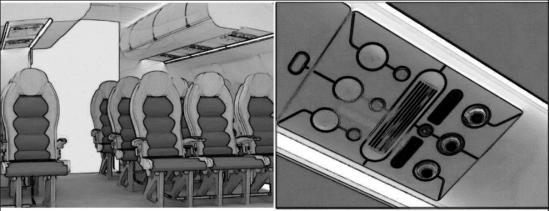
Figure 1: 3D models.
The 3D CAS file was appropriately divided into several layers, each with its own characteristic material, to enable better perception of the Five Sensess concept. Only once the virtual environment was set up with the three- dimensional elaborate was it possible to implement the dummies in the ergonomic database in the agreed percentiles.
Description of Dummies for Ergonomic Testing As a result of the different reflections and the different analyses, the number and methodologies of ergonomic controls within the aviation interior were agreed upon and established by including 3 types of dummies.
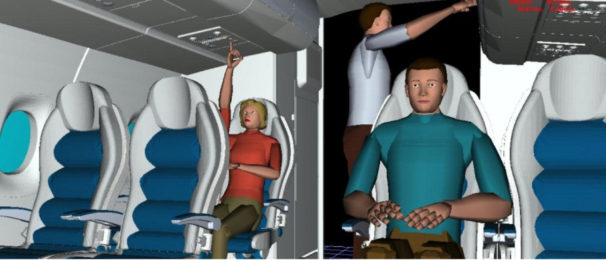
Figure 2: The different percentiles placed in the interior scene.
Specifically, the 3 percentiles identified for testing are as follows:
5th percentile female;
50th percentile male;
95th percentile male.
The choice of the dummies mentioned before, and of the related anthro- pometric measurements, was dictated by a very specific desire: to verify the degree of postural comfort starting from the minimum size up to the maximum, passing through the average. The following graphs show the anthropometric values for the 3 percentiles, as shown in Table 1.
Five Senses: Integrated Ergonomics/Stylistic Design for Aircraft Interiors 177
Table 1. The main 3 percentiles summarized in a table.
Table available in the original PDF paper.
5th Percentile Female 50th Percentile Male 95th Percentile Male Percentile 5
Percentile 50
Percentile 95
Ethnicity European Ethnicity European Ethnicity European Gender female Gender male Gender Male Height (cm) 152,78 Height (cm) 175,49 Height (cm) 186,75 Weight (kg) 49,640 Weight (kg) 77,690 Weight (kg) 98,070
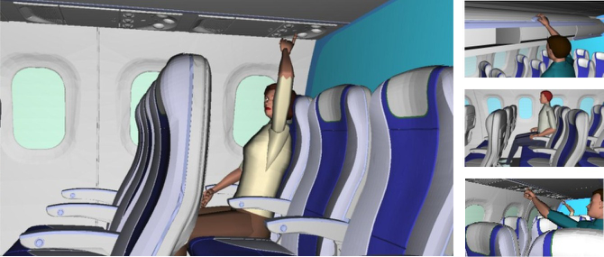
Ergonomic Control of the Passenger Seat and PIS Panel The virtual model of the interior is now ready to be analyzed. The verification was set up to accommodate the 3 dummies on the above seats assuming a posture true to reality: the torso, buttocks, and legs were placed on the seat, while the hands were placed in the different positions for interaction with the PIS panels.
Figure 3: The percentiles on the session with the different tests of PIS use.
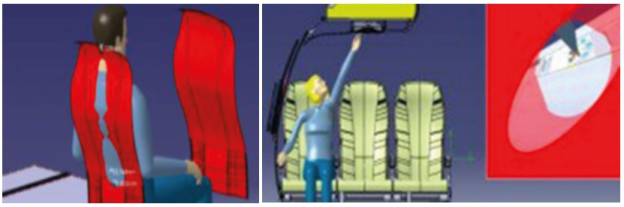
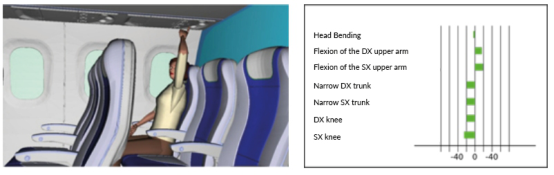
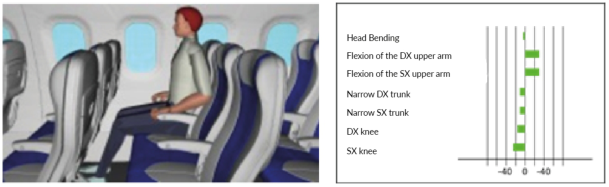
After positioning the dummies in the correct posture, it was possible to check the postural comfort index with a special algorithm then implemented in the specialized comfort assessment software. After this command was exe- cuted, the software produced a report for each of the 3 percentiles showing the comfort values of the individual body parts: the farther the value was from 0 (zero), the greater the degree of perceived discomfort.
Figure 4: The different postural interactions in ergonomic testing.
178 Corsetto and Fittipaldi
The software, in order to facilitate the reading of these reports, assigns 3 different colors to the values in the graph according to the comfort index: green is assigned to high levels of comfort, yellow to situations of slight dis- comfort, and finally, red is assigned to clear conditions of postural discomfort (Fig. 5).
Figure 5: The 5th percentile in ergonomic results for women.
The ergonomic comfort of the various percentiles was analyzed. Through the operating protocol, it was found that the interaction is more comfortable for all three percentiles. Again, as can be seen from the image, all values are marked in green.
Figure 6: The 95th percentile in ergonomic results for men.
Summary of Results This document represents the final summary of intermediate results with ref- erence to the methodological and operational approach for an activity to design an “ergonomic habitat” for the Five Senses project. This activity was configured first as an input and then as an output for the implementation of preliminary design methodologies, restyling, ergonomic design and pho- torealistic rendering, all functional activities for the best configuration of the aircraft interior. The design process then defined, through a complex analysis, the validated inputs and outputs for the subsequent design correction activity, with careful verification of the aesthetic styles of the manufacturer performed and its interior and seat suppliers. Finally, through 3D CAS-CAD modeling, solutions enhancing the usability of postural comfort were proposed in the design of the new ergonomic profile for passenger seats and PIS. In order to enable their fruition, perception and visualization in a virtual environment
Five Senses: Integrated Ergonomics/Stylistic Design for Aircraft Interiors 179
and in photorealism mode, preventive and continuous rendering operations were carried out during the work; these operations are carried out by means of high-definition mode processing. The design process is carried out in oper- ational phases; starting then with the import of the 3D models of the CAS project, which are then introduced into the ergonomic simulator. Ergonomic simulations performed with test reports demonstrate formal-aesthetic consis- tency with ergonomic consistency. The core of the project definitely focused on the necessary revisiting of the Sw (Ergonomic Simulator) tool by charac- terizing it for the scope of ergonomic verification of the designed elements, but in the specific functional aesthetic co-design tool for the redesigned furni- ture and in the specific case the armchairs and the upper information panel. The definition and “identification of stylistic features and systematization of ergonomic design requirements, will take place through a process of inte- gration of the factors that concur in “human centered” design to set up the ergonomic project, where the avamproject that is the first technical develop- ment of the concept is obtained and where the first dimensional, technical, functional and material constraints are placed on the project, functional to the maximum stylistic performance of the interiors.
Morphological and Ergonomic Design of Passenger Seats With the use of virtual dummies, it is possible to analyze a risk assessment of musculoskeletal pathologies caused by the use of the seat system; the sys- tem consists of the interaction between the user and the seat, determining the static posture of the user and influencing the user’s postural comfort in the next step of verification. Therefore, through the interaction of innovative specialized software for ergonomic checks in a virtual environment, it is also possible to verify the usability in terms of postural comfort in the obtained comfort mode. It is then possible to verify the entire male/female user popu- lation characterized by the anthropometric “Gaussian averages” of the users (50th percentile for women and 50th percentile for men).
CONCLUSION
One of the primary Objectives of this work was to verify, through the use of specialized software, the correctness of the design choices made for aircraft interior elements, with an added value of an “ergonomically correct” design. For the ergonomic design-verification of the static posture of this simulation, the results of the studies performed were then implemented in the simula- tor. Specifically, the work is reworked in its integrity and completeness of information to obtain the potential obtained from the previous activity. The methodological procedure involves the subsequent 3D CAS\CAD modeling and specifically the production of 3D CAD files (model in.igs format of the system). The quality of the proposed morphological design is subject to an ergonomic control according to the methods described above. This activity will also be functional for maximum reliability and performance of the pro- cesses of analysis, control, and visualization of the ergonomic simulator. The objective of the subsequent and previous ergonomic design and verification is focused mainly on the design variables that had the greatest influence on
180 Corsetto and Fittipaldi
user discomfort in the design, and then develop a real-time design complete with all ergonomic issues, an innovative approach that proves to be of help to the functional and multidisciplinary design processes of the different special- ized contexts for the elements involved in the final production of the “Five Senses” project. In conclusion, the key contribution of this approach has been to receive “real-time” design support during the concept design phases, considering both aesthetic and functional canons in full respect of the bal- ance between aesthetics and habitability. Today, the target market demands increasingly evident, and verification activities in the virtual environment have defined functional pre-approval requirements in response of the design aircraft to passenger aircraft habitability standards. At present, performing the ergonomic verifications alone by means of virtual simulations and com- paring the results with previous studies and musculoskeletal analyses has helped designers determine the possible cause of discomfort associated with product use, but with methodological optimization of the integrated proce- dure, optimization of the results obtained can hopefully be achieved. The approach illustrated here elaborated a “scientific and objective” approach, redefining an interiors design by means of a new line of aesthetic/functional adaptation, as an “excellent” stylistic/ergonomic interface between the seat, PIS, and the user, implemented in the finite elements and assembly of the elements of this activity within aircraft and ready for market.
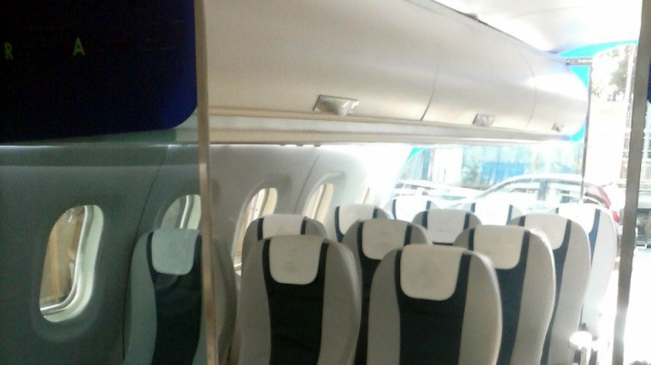
Figure 7: Interior product real model.
REFERENCES
Barone, S., Fittipaldi, F., Lanzotti, A.: Miglioramento del comfort di un nuovo veicolo urbano mediante la progettazione dei parametri in ambiente virtuale. In: Atti della prima conferenza annuale della Rete europea per le statistiche aziendali e industriali, Oslo, 17–18 September (2001). Fittipaldi F., Ergonomia, progettazione e sperimentazione virtuale, Luciano Editore,
Napoli, 2013.
Five Senses: Integrated Ergonomics/Stylistic Design for Aircraft Interiors 181
Fittipaldi F., New concepts for rail design, Luciano Editore, Napoli, 2013. Fittipaldi F., New concepts for urban mobility, Luciano Editore, Napoli, 2013. Fittipaldi F., Ranzo P., Veneziano R., (2019). IBIS project: the Innovative, sustainable and integrated bus. Designing Sustainability for All The LeNS World distribuited Conference, 3–5 April 2019. ISBN:978-88-95651-26-2. Fittipaldi F., Ranzo P., Veneziano R., Ergonomics, Design and Comfort for the Auto-
motive Industry Mollafenari Mah., Türkoca˘gı Cad. 3/1, Mahmutpa¸sa/Istanbul, Turkey, pp. 281–292, ISBN: 978-605-9207-10-6. Fittipaldi F.: Transportation Design, Nuovi Concetti per la Mobilità Urbana, Luciano Editore, Napoli (2012). Fittipaldi F.: Transportation Design, Progettazione e Sperimentazione Concettuale,
Luciano Editore, Napoli (2012). Pheasant, S.: Antropometria dello spazio corporeo, ergonomia e progettazione del lavoro, Taylor & Francis, Londra (1996).
LISTED IN THE AHFE DIGITAL BOOKSTORE CATALOGUE
Explore the complete digital volume
Ergonomics In Design
Read this individual research paper free through the original publisher, or explore the full digital proceedings book.
ISBN 978-1-964867-05-2
Explore this ISBN in the AHFE Bookstore ↗Listed in the July 2026 bookstore catalogue; search by ISBN to confirm current availability · Digital book purchase optional