Eefke Krijnen, FEderica Vannetti, Rita Paradiso (2024). Wearable System for the evaluation of Well-Being in the Workplace. In: Cognitive Computing and Internet of Things. AHFE Open Access, vol. 124, pp. 43–52. https://doi.org/10.54941/ahfe1004702
Healthcare workers experience physically, emotionally stressful situations, are exposed to human suffering, experience pressure from interactions with patients and family members, and are under constant threat of infection, injury and stress. Healthcare workers are at greater risk of developing stress-related mental disorders, such as depression or post-traumatic stress disorder (Braquehais et al., 2023, doi:10.1016/j.mcna.2022.04.004). The COVID-19 pandemic has highlighted the need for healthcare organizations to ensure the well-being of healthcare workers. Indeed, more stressful working hours, the fear of being infected and the need to ensure immediate decision-making have significantly increased the risk of burnout, depression, anxiety and insomnia. In the USA and Europe, a series of regulations have been issued to preserve the health of workers, specific to the workload linked to the various tasks and in the literature work-related stress indices have been evaluated in the healthcare sector, linked to muscle disorders skeletal injuries due to patient handling, for nurses and personal care/assistance workers. However, biomechanical overload and the risk of damage to the musculoskeletal system are only one aspect linked to the health of the worker: the dimension of work stress has a significant role in the general well-being of the worker during his activities and a methodology for the objective assessment of mental and physical workload in work environments.In this study we propose the use of a wearable system (WWS by Smartex) compatible with work activity, to monitor and extract significant information on the workload, due to the physical demand and the physiological response to stress, on a sample of physiotherapists. The system consists of a t-shirt for the continuous detection of a cluster of physiological parameters, that can be stored and processed during work. The system detects an ECG lead via integrated textile electrodes, the respiratory signal through the measurement of thoracic movement, posture, and physical activity recognition, via an Inertial and Magnetic Measurement Unit (IMMU), integrated into the RUSA device, a portable data logger dedicated to the acquisition, processing, storage and/or transmission of data.The RUSA is connected to the garment through a simple plug and can be easily unplugged when necessary. The T-shirt is absolutely similar to a common underwear. The base yarn is composed by antibacterial materials to guarantee a safe and prolonged use. The sensors are made of fibers that are directly woven during the production process to be fully integrated in the garment without discontinuity. The shirts come in male and female version and in several sizes to fit the largest number of users. The data acquired by the RUSA are processed on board to extract the following parameters: Hearth Rate (HR), HR Variability, RR interval, signal quality, Breathing rate, activity classification, activity intensity. The RUSA can save data on a Flash Memory (microSD), transmit data via Bluetooth® 2.1), save and transmit them simultaneously, without losing information in case of interruption of wireless transmission.A pilot study has been performed on 11 physiotherapists, engaged in XX sessions. During the study, the cluster of physiological data have been combined with a set of meta-data related to the work session such as the type of intervention (i.e. neurological rehabilitation, orthopaedic rehabilitation, etc), the level of physical impairment of the patient (according to modified Rankin score and Communicative disability scale), the working place etc.). As well as to the results of NASA questionnaire that has been administrated after each acquisition section to the physiotherapists. Preliminary results on the stress level will be presented, in parallel to evaluate the use of the IMMU platform for the overload of the musculoskeletal system, research on the posture evaluation in the rehabilitation workplace has been performed. The accuracy of a single IMMU to retrieve trunk angles was assessed by comparison with stereophotogrammetry. The results revealed that the IMMU is adequately effective in determining sagittal angles but has limitations in assessing lateral and transverse angles in a natural and uncontrolled environment.
The worker’s safety is a crucial issue and in the last decades, many actions have been taken to guarantee the improvement of work conditions in the respective environment and to prevent accidents and injuries. In literature, work-related stress in the healthcare sector has been reported, in particular work-related musculoskeletal disorders. However, the biomechanical over- load and the risk of muscle-skeletal system damage are only one aspect related to the worker’s health: the job stress dimension has an important role in the global wellness of the worker and there is a lack of methods and approaches useful to objectively evaluate this aspect. In this study we propose a method- ology based on wearable technologies to monitor and extract significant information about workload, due to physical demand and stress physiolog- ical response, on physiotherapists engaged in different types of intervention (i.e. neurological rehabilitation, orthopaedic rehabilitation, etc), considering the patient’s level of physical disability (according to the modified Rankin score and communicative disability scale).
STUDY DESIGN Pilot Study: A feasibility study was designed on a sample of 11 physio- therapists (compatible with the workforce of the IRCCS Don Carlo Gnocchi in Florence. For each of the following sectors of activity, 2 subjects were selected:
1. CODE. 75 - Severe Acquired Brain Injury 2. CODE. 56 and Ex art. 26 - Neurology 3. CODE. 56 - Neurology/Orthopaedics 4. Rehabilitation of Severe Developmental Disabilities 5. OUTPATIENT rehabilitation The study was designed to explore the validity of the method which is based on the acquisition of objective parameters related to the workload, considering a range of different therapeutic interventions, with workloads linked to the mobilization of patients or their lack of collaboration, or to the combination of both. Table 1 shows the summary characteristics of the physiotherapists:
Table 1. Average age, weight and height of the subjects from the pilot study.
Table available in the original PDF paper.
5 Males (46%) 6 Females (54%) 11 Subjects Average age 36 40 38 Average weight (kg) 77 60 67 Average height (cm) 178 167 172
The experimental protocol involves the recording of therapeutic sessions for each subject (the number varies from a minimum of 13 to a maximum of 16 sessions) lasting from 20 minutes to 2 hours. In the first analysis, a calibration was performed on each physiotherapist, to obtain the baseline
Wearable System for the Evaluation of Well-Being in the Workplace 45
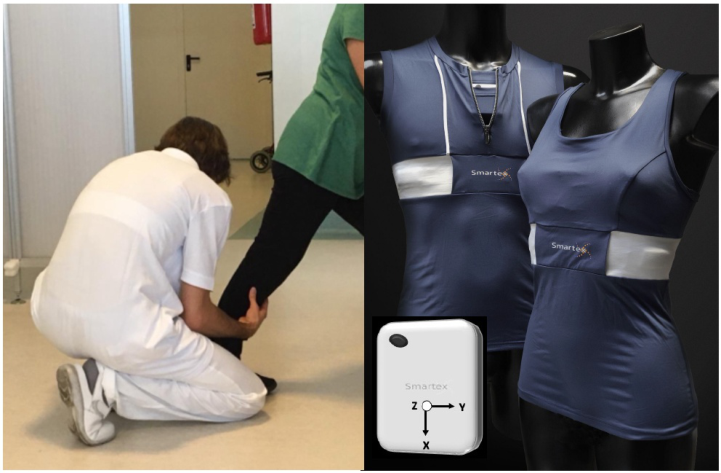
parameters. For each work session, the subject has to wear the WWS shirt, and the RUSA, shown in Figure 1.
Figure 1: On the left, the physiotherapist during a monitoring session, on the right male and female models of WWS with the RUSA device (not to scale) with reference axes.
For individual treatments, it is also asked to report the anthropometric characteristics of the treated patient and the level of motor and cognitive collaboration through the modified Rankin Scale (SRm, van Swieten et al., 1988) and a communicative disability rating scale (SCD), that considers five different levels of disability, from four, the patient is fully collaborative with none communicative impediment, to zero: complete disability, almost absent to any communicative exchange, even with facilitations; not suitable for the interlocutor and not cooperating with the visit and assistance manoeuvres. Furthermore, the therapist has to provide a self-assessment of the perceived stress during the session through NASA Task Load Index questionnaire (Hart and Staveland, 1988). Finally, at the end of the recording of all the planned work sessions, each subject has to fill out a questionnaire relating to the usability of the system (System Usability Scale, SUS) useful for evaluating the user’s experience in a real context.
Accuracy assessment single IMMU to measure trunk inclination: To eval- uate the accuracy of the IMMU angles in comparison to the actual trunk flexion angles stereophotogrammetry was used. Known reference angles were used in a controlled environment. The stereophotogrammetry system was set up in a movement analysis laboratory to capture images of a single subject. The IMMU was firmly attached with tape to the subject’s sternum. Common reference points on the subject were chosen to attach reflective markers, these
places consisted of anatomical landmarks such as the Pelvis, the Pelvic Spine, the Lumbar Spine, the Thoracic Spine, the 7th Cervical Vertebra, and the Shoulders. The subject took on various sagittal inclinations forwards and backwards. Furthermore, the subject performed lateral inclinations as well as transverse rotation. The positions were held for a few seconds and a neutral spine alignment was encouraged. At each trial, the first few seconds con- sisted of a static position to record a calibration. Lastly, a natural trial was conducted where the subject picked up and moved an (imaginary) box to combine these movements. Subsequently, the recorded photogrammetry data was analyzed and body angles were determined. Moreover, the fused IMMU data was processed to retrieve the lateral and sagittal inclination and the transverse rotation angles. Using correlation the data were synchronized in time.
Posture Evaluation Study: Moreover, an experiment was performed to evaluate posture in a controlled work setting. Unsupported trunk flex- ion (International Organization for Standardization, 2019), whether or not executed with a correct spine, between 20
and 60
is unfavourable and not recommended depending on its duration (max. durations varying from 4 to 1 min.). What is more, trunk flexions of more than 60
are never recommended.
Table 2. Details on the subjects who took part in the posture evaluation study.
Table available in the original PDF paper.
Subject [#] Age [y] Height [cm] Weight [kg] Sex [M/F] Notes
1 49 168 62 F - 2 22 170 53 F - 3 52 160 83 F Backpain 4 48 182 97 M Backpain
The subjects for this experiment were four employees at Smartex (see Table 2). They were asked to wear the WWS top, plug the connector into the RUSA, insert the RUSA securely into the front pocket, and connect (by Bluetooth) with the visualisation software. A second RUSA was attached to the subjects’ chests with tape to compare the influence of placement and the amount of constraint due to the pocket. A camera was set up 1.5 m in front of the subjects. The RUSAs were set up to both start streaming using Bluetooth and recording data on SD. The subjects were instructed to take on a neutral standing/sitting position (dependent on the following activity) for a duration of ca. 5 s. The successive instructions for the two activities consisted of:
1) The subject was instructed to pick up a weight of 1 kg in front of them (with a distance of about 20 cm) in the wrong way (using their back muscles instead of also incorporating the leg muscles). The object was lifted to hip height and lowered in the same way. Next, in a recommended way, making more use of their leg muscles. 2) The subject was asked to sit in a chair and go about their workday. At first, they sat with a neutral spine for ca. 5 s. Subsequently, they were asked to take on a natural position while working at their desk. This could also include walking around the office. This activity
Wearable System for the Evaluation of Well-Being in the Workplace 47
was recorded for a prolonged period of ca. 1 h. Each trial was recorded sep- arately. The sagittal, lateral, and transverse angles were plotted against time and compared to video material.
DATA ANALYSIS Pilot Study: Data acquisition concerns different categories of inputs:
a) Automatic Data: corresponds to those data whose processing is per- formed automatically directly at the hardware firmware level and via the software developed for the digital instruments integrated into the plat- form. Some features can be viewed in real-time on a mobile app, and all extracted features are visible on the web application, once data are uploaded to the server. b) Psychophysical stress analysis: extraction of parameters that give an objective, i.e. measured, assessment of the worker’s psychophysical state. Also in this case the data are post-processed and made accessible via a web service once extracted. c) Movement Analysis: detection of incongruous positions, which addresses the validation of an objective method in the quantitative identification of incongruous postures for workers. The data is post-processed and is accessible via digital documentation.
In a future development of the service, the integration of all the information in the automatic sending and accessibility via web service is envisaged.
a) Automatic Data: Given the variety of tasks and possible types of sessions carried out by the staff considered in the study, it was considered useful to monitor basic information on the physiological state of employees during their work. Based on the heart rate, an analysis of the intensity of the activity and cardiac effort is conducted as well as an estimate of energy expenditure. The use of heart rate to classify the intensity of activity and the resulting effect on the human body is a well-known technique in sports medicine or training programs. From the estimate of the individual maximum heart rate, it is possible to define heart rate thresholds that discriminate between the intensity of the training activity and the resulting effects on the human body. In this study, 4 zones were taken into consideration, with the main purpose of monitoring the heart rate during the normal work routine, in order to highlight an anomalous or particular situation of excessive load:
Zone 1. Low heart rate zone: less than 50% of HRMAX
Zone 2. Heart safe zone: 50% - 70% of HRMAX
Zone 3. High intensity: 70% - 90% of HRMAX
Zone 4. Alert zone with intensity greater than 90% of HRMAX The classification used for the study requires an estimate of the subject’s resting heart rate and maximum heart rate. It is possible to estimate the maximum heart rate (HRmax) only in relation to the age of the subject. Studies show that no significant differences in the HRmax equation have been observed between men and women or between sedentary and exercised subjects, so the same age-based equation can be used for various groups of healthy adults to assess their HRmax. A short calibration procedure has been
included in the protocol, it consists of three minutes of rest, in order to acquire the resting heart rate and two minutes of walking (at the subject’s natural speed) to acquire heart rate during normal activity, by combining heart rate signal with anthropometric data the HRmax of each subject is evaluated. An evaluation of energy expenditure is carried out as reported in the literature (Keytel et al., 2005). It is possible to calculate a heart rate threshold, the value of the “Flex Heart Rate” below which energy expenditure is assumed to be equal to resting energy expenditure.
b) Psychophysical stress analysis: For each recording made during a thera- peutic session, the cardiac signal of each physiotherapist is analyzed to extract the parameters that are stress-correlated. This processing is performed using a dedicated IT tool, Kubios HRV®, which allows the analysis of the RR sig- nal (time between two successive beats) extracted from the cardiac signal. The RR signal can be examined both by studying the temporal distribution of the variability of the RR intervals, time domain analysis, and by analysing the power spectrum of heart rate variability, frequency analysis.
c) Movement Analysis: The RUSA integrates an IMMU with 9 degrees of freedom which allows classification of the activity. Also in this case the processed data is sent directly to the server and it is possible to view it as:
Steps and Distance, which shows the number of steps and the distance travelled in metres;
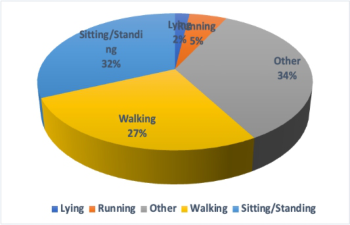
Activity Fragmentation which reports the percentages of time spent in a specific activity/posture throughout the work session. The recognized activities are the following: Lying, Sitting/Standing, Walking, Running, Other.
Posture Evaluation Study: The IMMU is equipped with a triaxial gyro- scope, accelerometer, and magnetometer. Figure 1 shows the reference axes associated with the IMMU inside the RUSA device. These axes have to be aligned with the received signals. The firmware fuses these data and pro- duces the 3D orientation of the RUSA represented as quaternions. All data processing from there on was done using MATLAB (The MathWorks Inc., 2023). The Euler function of MATLAB was used with the rotation sequence ‘YZX’ to convert the retrieved quaternions to Euler Angles. The rotation sequence is the order of rotations about the axes. Gimbal lock is the loss of a degree of freedom in a 3D system. It involves two ‘gimbals’ aligning in parallel which ‘locks’ the system into rotation in a 2D space. This is one of the limits of Euler Angles which should be dealt with. The problem occurs when the middle, second axis rotation, approaches 90
(Geonhui et al., 2022). Thus, it can be mitigated by choosing the following rotation sequence. The sec- ond angle should be the z-angle as rotations of more than 90
about that axis (if the IMMU is positioned on the sternum) in work situations have a low probability. Angles around the x-axis on the other hand can easily increase to ±180
when a subject turns and the rotations about the y-axis are the main direction of interest. The sequence ‘YZX’ is suitable for this application. The quaternions retrieved in the first 3 s were averaged and inverted. Subsequently, all other quaternions were multiplied by the inverse of the neutral quaternion. Then, the Euler function with the rotation sequence
Wearable System for the Evaluation of Well-Being in the Workplace 49
‘YZX’ and rotation type ‘point’ was used to translate the quaternions to Euler angles. This makes sure the IMMU takes all angles with respect to the first neutral position. Lastly, all angles (sagittal, transverse, and lateral) were plotted against time and analysed.
RESULTS AND DISCUSSION
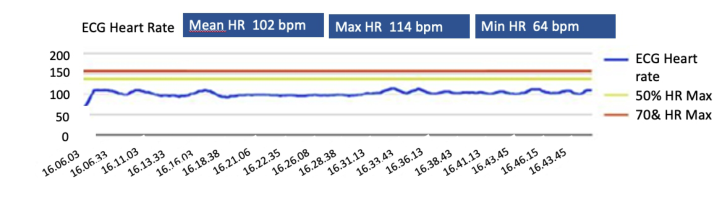
Pilot Study Automatic Data: Figure 2 shows an example of the processed data for heart rate and energy consumption. During the session, the estimated value of the energy consumption was 423.13 Kcal, with rest EE: 1.16 Kcal, Mean EE: 9.62 Kcal, Max EE 16.06 Kcal.
Figure 2: Heart rate and energy consumption for a single session of second recording in a working day for a physiotherapist.
The reported session is the second session recorded by the physiotherapist during the working day. The work session lasted 49 minutes. The heart rate trend shows the absence of workload peaks and the energy consumption is commensurate with the duration of the therapeutic intervention carried out.
These results are confirmed by the activity in Figure 3, only session. 5.27% of the session time was classified as running, with impact on the physical workload.
Figure 3: Activity distribution on a therapeutic fragmentation.
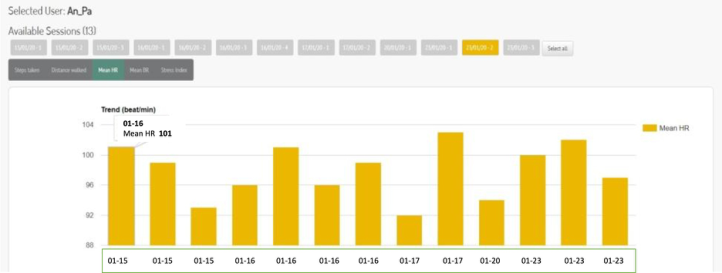
The evolution of the average value of the parameters acquired for each work session can be visualised for the same operator or for different clusters of variables, like type of intervention, group of subjects, acquired parameters,
typical screen is shown in Figure 4, where the trends for the mean HR of the same physiotherapist for all the sessions is reported. The quality of the ECG signal was assessed by considering the percentage of artifacts in the identification of the QRT complex that leads to an error on the RR intervals.
The percentage of corrected artifacts is less than 5% for approximately 78% of a total of 159 recorded sessions.
Figure 4: Mean HR for the same subject on different sessions.
Posture Evaluation Study: Comparison between stereophotogrammetry and IMMU was accurate for sagittal rotations in a natural setting with an R2 value of 0.895, also called the coefficient of determination showing the amount of explained variance. However, the natural setting posed prob- lems for extraction of the lateral and transverse angles (R2 0.222 and 0.579 respectively). All angles were accurate in a controlled situation.
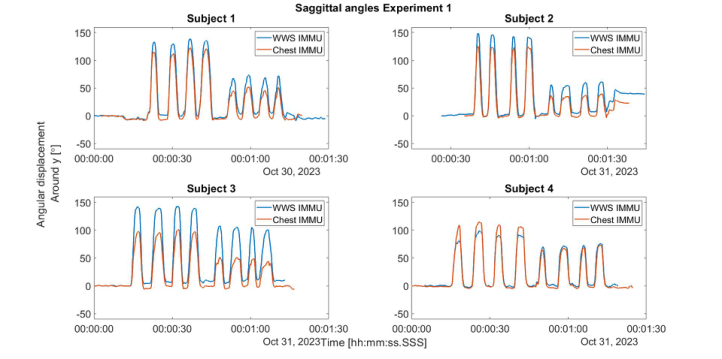
Figure 5: Sagittal angles during experiment 1 (bending and lifting in a wrong way and subsequently in a recommended way). Where orange indicates the IMMU is taped to the chest and blue indicates the IMMU is inserted in the WWS vest pocket.
Wearable System for the Evaluation of Well-Being in the Workplace 51
In Figure 5 a clear difference can be seen between both the recommended and unadvised bending and between the angles acquired by the IMMU taped to the chest and in the WWS pocket. This indicates that the pocket is too spacious making it possible for the IMMU to move around. Furthermore, it is advantageous that we can differentiate between correct and incorrect lifting techniques and angles.
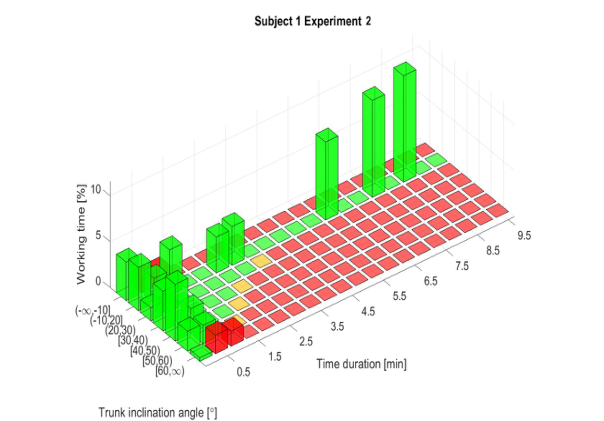
To summarize the sagittal angular displacement data a visual represen- tation was produced which shows the time duration the subject spent in intervals of trunk inclinations (<0
, 0–20
, 20–30
, 30–40
, 40–60
, and >60
) and the percentage of the total working time. The method used for the reduction of IMMU data on trunk flexion is exposure variation analysis (EVA) (Mathiassen et al., 1991) (with appropriate exposure thresholds). The daily posture report of Subject 1 can be seen in Figure 6. From the bar chart, one can quickly recognise the level of risk a worker is involved in during their work activities as well as the time spent in a certain unrecommended position.
Figure 6: Daily posture report for subject 1 experiment 2. On the left horizontal trunk inclination angle intervals are given, on the right horizontal axis, the time duration in that specific position and on the vertical axis the percentage of working time. The amount of ‘risk’ is indicated by colour code according to the ISO guidelines (Inter- national Organization for Standardization, 2019); green is recommended, orange is accepted and red not recommended. Note (-)∞◦should be (-)180◦.
CONCLUSION
The preliminary evaluation of the data obtained along with the Pilot Study has shown that the methodology is compatible with the working environ- mental constraints. Data quality during the recorded sections of the majority of the subjects was reliable, on 78% of the recorded data, less than 5% of
the identified R peaks were artifacts. These results are very encouraging for the extraction of reliable stress-correlated features.
The Posture Evaluation Study showed promising results with accurate sagittal angles and a clear distinction between recommended and unadvised bending techniques. It is advised to improve the vest design by tightening the electronic pocket to ensure less separate movement of the RUSA device. Moreover, clear daily posture reports were produced showing the user’s posture evaluation concisely. Overall, this is a logistic tool with a reliable objective methodology to analyse risks in a work environment.
ACKNOWLEDGMENT
The authors would like to thank Peter Veltink for his helpful feedback and support.
REFERENCES
Braquehais, M. D., & Vargas-Cáceres, S. (2023). Psychiatric Issues Among Health Professionals. The Medical clinics of North America, 107(1), 131–142. https://doi.org/10.1016/j.mcna.2022.04.004 Geonhui, K. and Rose, W. (December, 2022), “How to solve gimbal lock log-
ically?, “MATLAB Answers, https://nl.mathworks.com/matlabcentral/answers/ 1883487-how-to-solve-gimbal-lock-logically (accessed Oct. 04, 2023). Hart, S. and Staveland, L. (1988) Development of NASA-TLX (Task Load Index): Results of Empirical and Theoretical Research. In: Hancock, P. and Meshkati, N., Eds., Human Mental Workload, North Holland, Amsterdam, 139-183. https://doi.org/10.1016/S0166-4115(08)62386-9 Heart rate variability: standards of measurement, physiological interpretation and
clinical use. Task Force of the European Society of Cardiology and the North American Society of Pacing and Electrophysiology. (1996). Circulation, 93(5), 1043–1065. International Organization for Standardization (May, 2019), “UNI ISO 11226:2019 Ergonomics - Evaluation of static working postures,” Switzerland. Keytel, L. R., Goedecke, J. H., Noakes, T. D., H Hiiloskorpi, H., Laukkanen, R., van
der Merwe, L., & Lambert, E. V., (2005) Prediction of energy expenditure from heart rate monitoring during submaximal exercise, Journal of Sports Sciences, 23:3, 289–297, doi: 10.1080/02640410470001730089. Mathiassen, S. E., & Winkel, J. (1991). Quantifying variation in physical load using exposure-vs-time data. Ergonomics, 34(12), 1455–1468. https://doi.org/ 10.1080/00140139108964889 Paradiso, R., & Caldani, L. (2010), “Electronic Textile Platforms for Moni-
toring in a Natural Environment”, Research Journal of Textile and Apparel, Vol. 14, No. 4, pp. 9–21. https://doi.org/10.1108/RJTA-14-04-2010-B002 van Swieten, J. C., Koudstaal, P. J., Visser, M. C., Schouten, H. J., & van Gijn, J.
(1988). Interobserver agreement for the assessment of handicap in stroke patients. Stroke, 19(5), 604–607. https://doi.org/10.1161/01.str.19.5.604 The MathWorks Inc. (2023), “MATLAB version: 8.13.0 (R2023b).” Natick, Massachusetts, United States.
LISTED IN THE AHFE DIGITAL BOOKSTORE CATALOGUE
Explore the complete digital volume
Cognitive Computing and Internet of Things
Read this individual research paper free through the original publisher, or explore the full digital proceedings book.
ISBN 978-1-964867-00-7
Explore this ISBN in the AHFE Bookstore ↗Listed in the July 2026 bookstore catalogue; search by ISBN to confirm current availability · Digital book purchase optional