Hironori Suzuki, Ryuya Seki (2024). Dual Particle Filtering of Intelligent Driver Model Parameters for Indirect Detection of Driving Anomalies. In: Human Interaction and Emerging Technologies (IHIET-AI 2024): Artificial Intelligence and Future Applications. AHFE Open Access, vol. 120, pp. 336–343. https://doi.org/10.54941/ahfe1004584
Abnormal driving behavior, such as excessive speed and reckless and aggressive driving, is recognized as causing more than 50% of fatal accidents. The detection of abnormal driving behavior has a wide range of applications and is expected to be used not only to directly suppress abnormal driving behavior but also to be factored into the price of automobile insurance premiums. This paper proposes a new approach to abnormal driving detection that requires neither in-car cameras nor physiological sensors. Instead, this approach makes full use of an intelligent driver model (IDM) and its parameters, where vehicle acceleration is assumed to indicate abnormal driving behavior. In an experiment using a driving simulator, subjects were asked to text on a mobile phone to collect data on their driving behavior with and without distractions. Numerical analysis showed that IDM parameters estimated by dual particle filtering could accurately detect driving abnormalities without the use of direct driver monitoring systems such as on-board cameras or sensors.
Abnormal driving behavior, such as excessive speed and reckless and aggres- sive driving, are recognized as the cause of more than 50% of fatal accidents (AAA Foundation of Traffic safety, 2009). Laws regulating these behaviors have proven to be effective to a certain extent in reducing abnormal driv- ing behavior. However, it remains difficult to detect latent abnormal driving behavior that even the drivers themselves are unaware of (Ucar et al., 2021). The detection of abnormal driving behavior has a wide range of applications and is expected to be used not only to directly suppress abnormal driving behavior but also to help set automobile insurance premiums (Zhang et al., 2017). Most current driver monitoring systems can be applied to the detection of abnormal driving, but most of them require either in-car cameras for face, eye, and head motion recognition or the use of sensors to evaluate vehicle move- ment (Kashevnik et al., 2021). However, the accuracy of driver monitoring cameras can be degraded by the driver’s eyeglasses or a mask.
Dual Particle Filtering of Intelligent Driver Model Parameters for Indirect Detection 337
For detecting abnormal driving behavior, methods for scoring aggressive driving behavior by linear regression based on vehicle states such as accelera- tion and speed (Li et al., 2015), modelling abnormal states using graph theory (Zhang et al., 2017), determining aggressive driving behavior by machine learning (Matousek et al., 2019), and evaluating abnormal driving behavior by deviation of vehicle states from reference values (Ucar et al., 2021) have also been reported. However, because acceleration and speed data contain a variety of factors, it is difficult to detect abnormal driver behavior from these data alone. In addition, machine learning requires a large amount of training data for parameter identification, so the accuracy of the detection model is highly dependent on the amount of data collected.
This paper proposes a new approach to abnormal driving detection that does not require in-car cameras, physiological sensors, or machine learning. Instead, this approach makes full use of an intelligent driver model (IDM) and focuses on its parameters, with the assumption that abnormal driving behavior is reflected in vehicle acceleration. The acceleration alone is insuffi- cient for driving anomaly detection, but the IDM parameters estimated from the acceleration should contain valuable information related to the driver’s attention state, intention, and sensitivity. Driving simulator experiments were conducted with and without driver distractions, and the performance of the proposed method was evaluated to see if abnormal driving due to distraction could be detected with high accuracy.
METHODOLOGY
IDM The IDM used in this study is a family of social force models that encourage drivers to travel at safe speeds and maintain appropriate vehicle distances so as not to cause rear-end collisions (Kesting et al., 2007). Note here that the IDM is a collision-free model. The formula of the IDM is given by
"
4
2#
D(k) −
1 − vi(k)
Equations and mathematical formulas are available in the original paper PDF.
ab
where a (maximum acceleration), b (comfortable deceleration), V (desired velocity), T (desired safe time headway), and s (minimum stopping distance) are the model parameters and ai (k), vi (k), and di (k) are the acceleration, relative velocity, and headway distance of vehicle i at time k. Vehicle “i – 1” is the preceding vehicle. The five parameters of the IDM contain valuable information on driver characteristics, including anomalies. These parameters change in real time in response to the environment, in particular the move- ment of the preceding vehicle. Online estimation of parameters can accurately identify the characteristics of the driver at any given moment (e.g., 0.1 s).
338 Suzuki and Seki
Parameter Estimation by a Dual Particle Filter (DPF) The proposed approach requires online estimation of IDM parameters using a dual particle filter (DPF), which is recognized as one of the most power- ful tools for state estimation (Haykin, 2001). The state–space model of the particle filter is given by
θk−1, xk−T
+ nk (3)
θk = θk−1 + rk−1 and yk = g where yk=ai (k) and xk=[di (k), vi (k), and vi-1(k)]T are the measurement and input vectors, respectively, and rk and nk are the system and measurement noise vectors, respectively. The nonlinear function g is the IDM itself given by Equations (1) and (2).
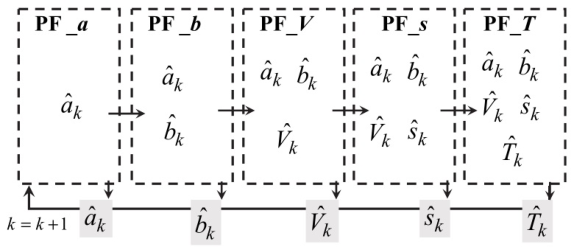
In the DPF, as shown in Figure 1, the parameter vector is separated into five parameters a, b, V, s, and T and for each parameter, a separate particle filter is provided, such as PF_a for a and PF_T for T. As an example, the procedure for PF_a is shown in Table 1. The updated a is fed into PF_b for b estimation, and this process is repeated through PF_T, after which all five variables are fed back into PF_a with time update k=k+1.
Figure 1: Procedure of dual particle filter.Table 1. Procedure of general particle filter for parameter “a”.
Table available in the original PDF paper.
k−1 + ra,k
Generation ea(j)
+ nk
k , bk−1, Vk−1, sk−1, Tk−1, xk−1
Prediction ey(j)
ea(j)
k with prob. ew(1)
Equations and mathematical formulas are available in the original paper PDF.
k ea(j)
k with prob. ew(2)
k ∼
Resampling ba(j)
k ...
Equations and mathematical formulas are available in the original paper PDF.
k
ea(j)
k with prob. ew(M) PM k
k ea(j)
Dual Particle Filtering of Intelligent Driver Model Parameters for Indirect Detection 339
Algorithm for Detecting Driving Anomalies Punzo et al., (2014) concluded that estimating only two of the five parameters is sufficient. The rest are treated as constants. This is called a partial model, whereas in the full model, all five parameters are estimated. We focused on the partial model when developing the algorithm for detecting driving anomalies.
In our experience, the full model perfectly reproduces the driver’s acceler- ation in any situation, as the combination of the five parameters is accurately estimated by the DPF. However, if the partial model fails to reproduce the acceleration, this means that there were anomalies in driving such that the constant three parameters could not reproduce the driver’s acceleration. The deviation between the reproduced and actual acceleration can therefore be treated as the magnitude of a driving anomaly.
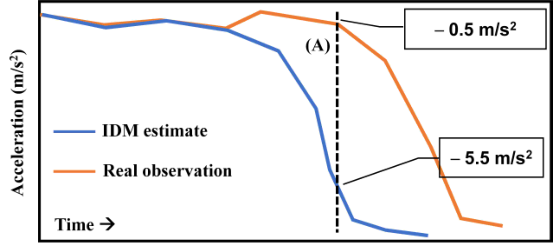
Figure 2 shows an example of the algorithm for detecting abnormal driv- ing. The orange curve is the actual acceleration, whereas the blue one is the acceleration reproduced by the IDM. At time (A), the driver should have decelerated by –5.5 m/s2 to avoid a collision but failed to decelerate suffi- ciently and only decelerated by –0.5 m/s2. This deviation can be treated as the severity of a driving anomaly. If there are no anomalies, even the partial model can completely reproduce the driver’s acceleration as accurately as the full model.
Figure 2: Example of the algorithm for detecting a driving abnormality.
NUMERICAL ANALYSIS Driving Simulator Experiment
The evaluation data used in this study were obtained through a driving sim- ulator experiment approved by the Ethics Committee of the Nippon Institute of Technology. In these experiments, seven participants (referred to as sub- jects 1 to 7) were asked to travel along a straight road 3.5 km long by following another vehicle with a shorter distance than usual. The speed of the preceding vehicle varied from 0 to 20 m/s during the 5-min simulations. In the experiment, the participant was supposed to encounter sudden decel- eration of the preceding vehicle five times between –0.2 G and –0.5 G. The primary task was to follow the vehicle ahead and avoid a collision, while the secondary task was to enter text on a smartphone. After providing informed
340 Suzuki and Seki
consent, seven drivers (mean age and standard deviation of 21.6 and 0.610, respectively) agreed to participate in these experiments.
DPF Setup For the dynamic estimation of IDM parameters, the covariance of system noise was set to 0.1–0.5 and the measurement noise to 0.3. The number of particles was set at 500. The parameters were estimated every 0.1 s.
Distraction Detection by Partial Model
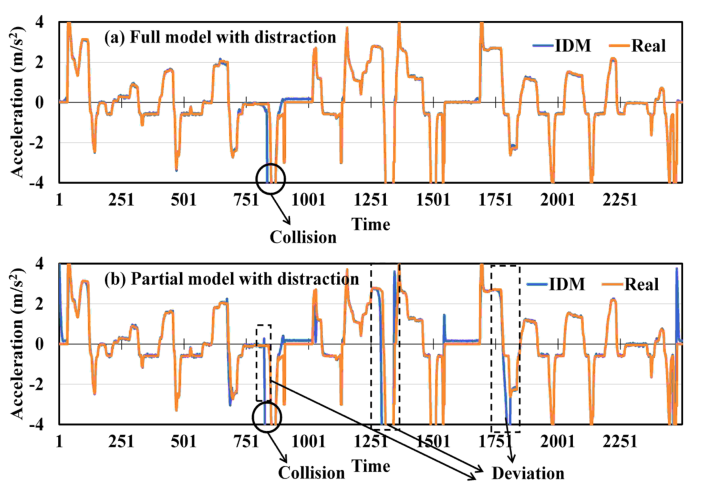
Figure 3 compares acceleration by the full and partial models of subject 2 with distraction. The full model fully reproduces the driver’s acceleration for the entire period, except for a rear-end collision at around time 800. This shows that the IDM performs very well and that the DPF shows an excellent ability to describe the driver’s acceleration behavior.
However, there are deviations between the IDM and the actual accelera- tion where the partial model failed to reproduce the acceleration, especially when the driver decelerated. It is obvious that this deviation was caused by driver distraction. This means that there was abnormal driving such that the three constant parameters of the partial model could not reproduce the acceleration.
Figure 3: Comparison of full and partial models of subject 2 with distraction. The full model (top) reproduced acceleration perfectly, while the partial model (bottom) failed to accurately depict deceleration on several occasions due to driver distraction.
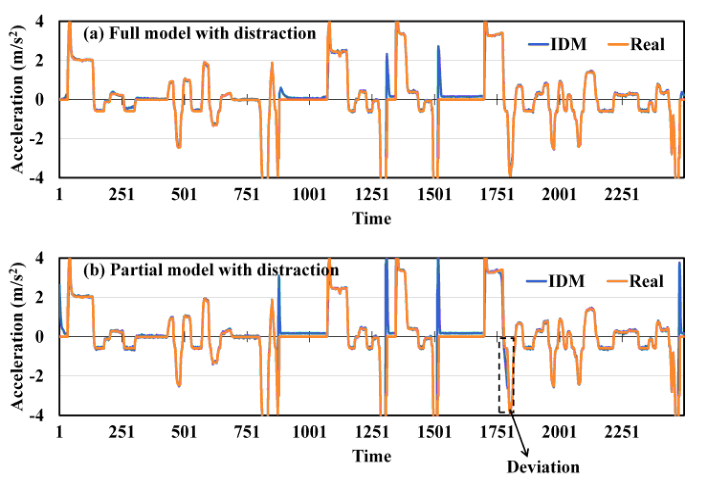
Another example is subject 1 with distraction shown in Figure 4. Both the full and partial models reproduced the accelerations very accurately, except for a slight deviation around time 1751. In other words, the driving of subject
Dual Particle Filtering of Intelligent Driver Model Parameters for Indirect Detection 341
1 did not have an anomaly, even when the subject performed the secondary task of using the smartphone. Clearly, even in distracted situations, it is diffi- cult to identify whether the driver is focused on the primary task. However, it is obvious that the driving of subject 2, who encountered a collision, is more abnormal, hazardous, and distracted than that of subject 1.
Figure 4: Comparison of full and partial models of subject 1 with distraction. Both the full and partial models reproduced the accelerations very accurately, except for a slight deviation around time 1751.
As shown by the comparison of the full and partial models, our proposed approach has the potential to detect driving abnormalities without the use of in-car cameras for face and eye recognition or head motion detection. As a next step, it was necessary to examine whether the deviations in acceleration in the partial model are due to driver distraction rather than simple estimation error. For this purpose, it was necessary to compare the case with and without distraction.
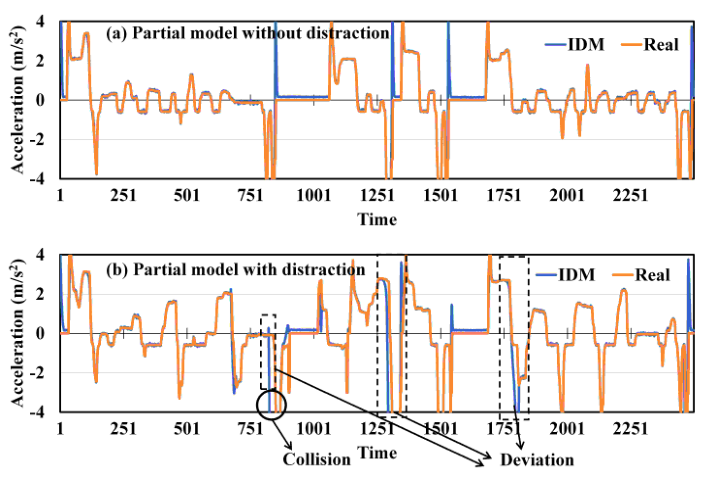
Figure 5 compares the acceleration obtained by the partial model with and without distraction (subject 2). The distraction scenario (bottom) causes deviations, while the no-distraction case (top) reproduces the acceleration perfectly, even in the case of rapid deceleration. In normal driving, where the driver pays attention to the vehicle ahead, the partial model can fully describe the driver’s acceleration. This means that the IDM using the esti- mated parameters is complete and no estimation errors occur. However, once the driver becomes distracted, the partial model with three constant parame- ters cannot describe such abnormal driving, and the effect of the distraction is reflected in the deviation between the reproduced and actual accelerations.
342 Suzuki and Seki
The deviation is therefore not due to errors in the model, but rather to driver distraction.
Figure 5: Comparison of acceleration by partial models with and without distraction (subject 2). In the absence of distraction (top), the partial model perfectly repro- duces the acceleration, but in the distraction scenario (bottom), the partial model can no longer describe such abnormal driving, resulting in deviations, especially in deceleration situations.
CONCLUSION
This study evaluated an IDM estimated by the DPF and used the IDM param- eters to detect driving anomalies. This is a new approach that requires neither in-car cameras nor physiological sensors for driver monitoring. Specifically, abnormal driving is identified indirectly using vehicle controller area network (CAN) data and mathematical models.
A driving simulation experiment was carried out, in which seven par- ticipants were asked to drive down a straight corridor with and without distractions. Numerical results show that a partial model in which three IDM parameters that are assumed to be constant can detect anomalies with high accuracy and sensitivity. The ability to detect abnormal driving using only the vehicle’s CAN data, without the use of on-board cameras, is a major advan- tage of our proposed approach. Further development is needed to compare the proposed approach with conventional methods.
ACKNOWLEDGMENT
This research was supported by the Japan Society for the Promotion of Sci- ence (JSPS) KAKENHI Grant-in-Aid for Scientific Research (C) 23K04310.
Dual Particle Filtering of Intelligent Driver Model Parameters for Indirect Detection 343
REFERENCES
AAA Foundation for Traffic Safety (2009). Aggressive Driving: Research Update.
URL: https://safety.fhwa.dot.gov/speedmgt/ref_mats/fhwasa1304/resources2/38% 20-%20Aggressive%20Driving%202009%20Research%20Update.pdf Haykin, S.ed. (2001). Kalman filtering and Neural Networks, Adaptive and Learning Systems for Signal Processing, Communications, and Control, John Wiley & Sons, Inc. Kashevnik, A., Shchedrin, R., Kaiser, C., and Socker, A. (2021) “Driver Distraction
Detection Methods: A Literature Review and Framework”, IEEE Access Vol. 9, pp. 60063–60076. Kesting, A., Treiber, M., and Helbing, D., “MOBILE: General Lane-Changing Model for Car-Following Models”, Journal of Transportation Research Board Vol. 1999 (Traffic Flow Theory 2006), pp. 86–94 (2007). Li, Y., Miyajima, C., Kitaoka, N., Takeda, K. (2015) “Evaluation Method for Aggres-
siveness of Driving Behavior Using Driver Recorders”, IEEJ Journal If Industry Applications, Vol. 4 (1), pp. 59–66. Matousek, M., EL-Zohairy, M., AlMoomani, A., Kargl, F., Bosch, C. (2019) “Detecting Anomalous Driving Behavior using Neural Networks”, 2019 IEEE intelligent Vehicles Symposium (IV), pp. 2229–2235. Punzo, V., Cliuffo, B., Montanino, M. (2014) “Do We Really Need to Calibrate
All the Parameters? Variance-Based Sensitivity Analysis to Simplify Microscopic Traffic Flow Model”, IEEE Transactions on Intelligent Transport Systems. Ucar, S., How, B., Oguchi, K. (2021) “Abnormal Driving Behavior Detection System”, 2021 IEEE 93rd Vehicle Technology Conference. Zhang, M., Chen, C., Wo, T., Xie, T., Bhuiyan, Md. Z. A., and Lin X. (2017)
“SafeDrive: Online Driving Anomaly Detection from Large-Scale Vehicle Data”, IEEE Transactions on Industrial Informatics, 13 (4).
LISTED IN THE AHFE DIGITAL BOOKSTORE CATALOGUE
Explore the complete digital volume
Human Interaction and Emerging Technologies (IHIET-AI 2024): Artificial Intelligence and Future Applications
Read this individual research paper free through the original publisher, or explore the full digital proceedings book.
ISBN 978-1-958651-96-4
Explore this ISBN in the AHFE Bookstore ↗Listed in the July 2026 bookstore catalogue; search by ISBN to confirm current availability · Digital book purchase optional