Shervin Rezaei, Hamid Naghdbishi (2024). Sustainable Warehouse Optimization: Integrating Industrial Design and IoT. In: Intelligent Human Systems Integration (IHSI 2024): Integrating People and Intelligent Systems. AHFE Open Access, vol. 119, pp. 804–812. https://doi.org/10.54941/ahfe1004545
This paper examines an industrial design project aimed at optimizing the warehouse operations in a food manufacturing plant. A diverse team of experts from various fields collaborated in this project, with the industrial designer playing a pivotal role in the product design process. The problem under investigation in this paper is the need to streamline the complex and time-consuming process of tracking, organizing, and locating product pallets in the factory's storage unit. To address this challenge, an integrated and comprehensive system was implemented in the warehouse, requiring seamless synchronization of multi-purpose devices. Harnessing the power of Internet of Things (IoT) technology was the chosen approach. The proposed solution involves the implementation of an Indoor Positioning System (IPS). IPS accurately locates individuals or objects indoors, where traditional GPS and satellite-based technologies often lack precision. This approach was successfully executed within the warehouse, where devices and products work in harmony toward a common goal. These changes result in improved inventory management, reporting on sales and production needs, and more efficient operations. It also simplifies the task of finding empty spaces for forklift drivers, reducing time wastage and enhancing overall factory and warehouse performance. This project not only aids in optimizing the warehouse section but also contributes to enhancing the overall performance and productivity of the factory.
The past decade has witnessed rapid advancements in industrialization, technology, and communication, collectively contributing to the facilitation and stabilization of human life. This confluence of factors has resulted in significant global population growth, primarily attributed to heightened sus- tainability and reduced mortality rates stemming from technological and developmental progress. Consequently, there is an urgent and pronounced need for infrastructures capable of sustaining this burgeoning population while judiciously managing finite resources. Addressing this imperative may lie in the concept of environmental intelligence, a focus of inquiry in this article.
Although the term “intelligent infrastructure” commonly implies a highly automated and intelligent system, it transcends mere automation. While tech- nologies like automation and artificial intelligence contribute to imbuing
Sustainable Warehouse Optimization: Integrating Industrial Design and IoT 805
infrastructure with intelligence, they do not inherently define it. In essence, smart infrastructure denotes a system capable of fostering sustainable growth, ensuring a high quality of life, and facilitating resource management. From a technical standpoint, smart infrastructure constitutes a network of interconnected elements sharing information and utilizing generated data for autonomous decision-making processes, minimizing human intervention.
In the context of practical research, one exemplar of such intelligent infrastructures is smart warehouses. These warehouses, comprising micro- infrastructures such as product categorization, arrangement methodologies, product types, and production rates, can leverage the Internet of Things (IoT) for seamless communication. IoT facilitates the connection of var- ious sub-infrastructures, employing internet protocols to enable informa- tion exchange and communication among subsystems, thereby enhancing intelligent diagnosis, monitoring, and management.
DEVELOPING HUMAN SYSTEMS INTEGRATION TOOLS TO SUPPORT SYSTEMS DESIGN HSI experts contribute by ensuring that human capabilities and limitations are considered. It has become clear that treating the system as separate from the users results in poor performance and potential failure in the operational setting. Continued growth in technology has not delivered desired results. Systems engineers and others are beginning to understand the role humans play in technology systems. The core challenge is to balance successful hard- ware and software solutions with human friendly implementations. To define the requirements of humans as a fundamental system component, it is essen- tial to understand the inherent capacity of user populations and their typical operational environment (Booher, 2003). A description of a population’s capacity incorporates more than the basic anthropometrics or the cognitive capability of the average member of the user population (Chapanis, 1996).
Literature Review
Smart Warehouse The challenges posed by the substantial volume of products and pack- ages, as well as product diversity in a food manufacturing plant, manifest in issues of warehouse overcrowding and inefficient product placement. Forklift operators grapple with considerations of package weight, opti- mal storage locations, and efficient retrieval processes. Addressing these challenges necessitates the implementation of a smart warehouse – an infras- tructure integrating diverse technologies to streamline warehouse and storage operations.
Drawing inspiration from intelligent parking systems, a smart warehouse can be envisioned as a comparable system. Intelligent parking systems encom- pass various sub-systems, including parking guidance and information sys- tems, transportation-based information systems, intelligent payment systems, electronic parking, and automatic parking systems (Saxena et al., 2018b). The application of similar principles to warehouse management holds the promise
806 Rezaei and Naghdbishi
of efficient and hassle-free operations, aligning with the broader concept of intelligent infrastructure.
In the realm of managing warehouse products and handling materials with forklifts, the convergence of the Internet of Things (IoT) and Indoor Posi- tioning Systems (IPS) has emerged as a revolutionary solution (Shum et al., 2022). In the spectrum of proposed communication protocols, ultrawideband (UWB) has emerged as the preferred choice for indoor and non-line-of-sight environments, effectively addressing challenges like jamming, scattering, and impediments between receivers and transmitters (Santoro et al., 2022).
The utilization of IPS, particularly leveraging UWB technology, has gained substantial momentum in manual and less standardized manufacturing sys- tems. It enables the real-time tracking of the dynamic positions assumed by mobile industrial entities during operational shifts (Pilati et al., 2022). This technology has diverse applications, spanning from monitoring processes to managing safety, covering both in-plant logistics and production. Supervisors in industrial plants can enhance visibility into processes by considering vari- ous perspectives, including overall equipment effectiveness of forklifts, prod- uct throughput times, and avoiding collisions between Automated Guided Vehicles (AGVs) and workers (Rácz-Szabó et al., 2020).
Methodology
In consideration of the IPS system, warehouse conditions, organizational structure, and handling of products, as well as the integration of the Internet of Things (IoT) and industrial design, a comprehensive field study has been initiated to address and provide a solution for IoT in accordance with the storage requirements. The workflow and design journey within the factory have been scrutinized, and a pre-design has been established by integrating forklift parameters, movement procedures, product locations, and the IoT functions assigned to the installed forklift.
During the design phase, the conditions were initially simulated, and its mental map was carefully examined for various services. Additionally, within the research team, different aspects were thoroughly investigated and troubleshot prior to practical implementation.
This methodology, combining meticulous field information, simulation modeling, and mental mapping, ensures the optimal performance of the IPS system in the factory warehouse environment. The proposed solutions and strategies are anticipated to significantly enhance the efficiency and produc- tivity of the warehouses, ultimately improving the overall performance of the entire factory.
Project Challenge Description The management and monitoring of manufactured products within the fac- tory’s storage unit pose a significant challenge that demands meticulous attention and resource allocation. The current process involves a substantial workforce dedicated to tracking, organizing, and scheduling the distribution of products to customers. The operational challenge in product transporta- tion within the storage facility revolves around the reliance on traditional
Sustainable Warehouse Optimization: Integrating Industrial Design and IoT 807
lift-trucks, leading to inefficiencies and errors. Manual monitoring of prod- uct locations is prone to human errors, causing delays and misplacements. Additionally, traditional forklifts lack precision, disrupting the storage layout and hindering timely product distribution.
Scientifically, the absence of integration with advanced technologies, like the Internet of Things (IoT), hampers real-time tracking and analysis. Imple- menting IoT solutions would enhance accuracy, enable predictive analytics for resource allocation, and provide insights into product movement patterns for efficient storage organization.
The challenges arise from manual processes, traditional lift-trucks, and a lack of technological integration. Addressing these issues through advance- ments like IoT and data analytics is crucial for optimizing efficiency and performance in the factory’s storage and distribution processes.
Figure 1: System and causes of disorder.
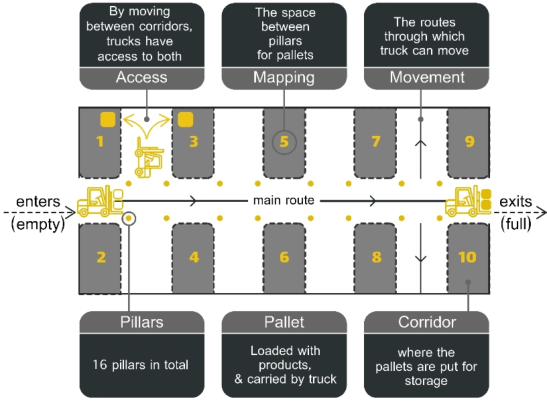
Figure 1 illustrates the intricate process of surveilling and organizing man- ufactured products within the factory storage unit, posing a multifaceted challenge requiring meticulous attention to spatial and temporal distribu- tion. The vertical transportation system, represented by lift trucks, plays a pivotal role in conveying palletized product packages throughout the ware- house. The workflow involves manufacturing, packaging, pallet creation, and transportation, each requiring optimal coordination.
Technically, efficient tracking mandates a sophisticated system enabling real-time monitoring and precise spatial organization. The reliance on lift trucks for transportation adds complexity, necessitating seamless coordina- tion among manufacturing, packaging, and pallet creation processes. The manufacturing process entails creating product units, followed by packaging and strategic pallet stacking for stability during transportation. Lift trucks then transport palletized products to designated areas within the warehouse.
This workflow emphasizes the need for a holistic approach integrating advanced technologies. Implementing cutting-edge solutions, such as IoT devices and sensors, can enhance monitoring precision, ensuring accurate tracking throughout manufacturing and storage. The technical intricacies highlight the requirement for a comprehensive system optimizing spatial organization and temporal coordination, with a focus on lift trucks and moni- toring systems to enhance overall efficiency and reliability in product tracking and distribution.
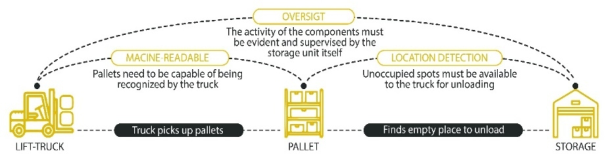
As depicted in Figure 2, the lift truck, equipped with recognition capa- bilities, adeptly identifies pallets and initiates the transportation process. In accordance with the predetermined storage location of the product structure,
808 Rezaei and Naghdbishi
the lift truck navigates to an available space for unloading. The initial section of the truck employs an Internet of Things (IoT) solution, facilitating pallet recognition, and under the supervision of a controller, it oversees the lifting location, route, and storage destination.
Figure 2: IPS.
The integration of IPS and IoT is executed through an electronic board meticulously designed by the industrial design team and subsequently installed on the lift truck. This strategic amalgamation of technologies ensures not only accurate pallet identification but also efficient control over the lifting, routing, and storage processes, ultimately enhancing the overall operational efficiency within indoor environments.
Figure 3: Inside the storage unit.
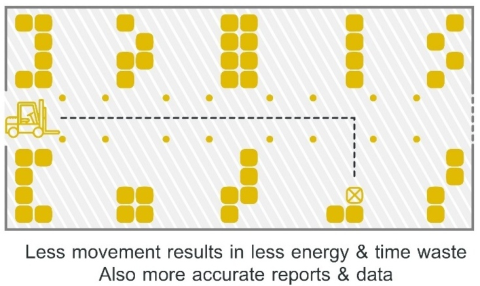
A systematic approach to efficiently locate the target pallet involves visual- izing its position on a map for the driver. Contrastingly, current observations indicate that trucks aimlessly navigate through the storage area in search of the designated pallet. This challenge has been addressed through the develop- ment of a product integrated into the lift truck, enabling it to autonomously determine the optimal path.
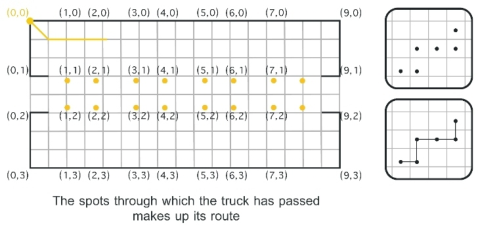
Ensuring the lift truck’s precise identification within its designated storage location is imperative. Consequently, an intricate storage plan network has
Sustainable Warehouse Optimization: Integrating Industrial Design and IoT 809
been devised to establish specific points denoted by their exact coordinates (x, y) within the system. This structured network is visually represented in Figures 3,4 and 5, showcasing the strategic distribution of points to enhance the efficiency of the system in accurately locating and accessing the desired pallet.
Figure 4: The optimal way of accomplishing the task.Figure 5: Tracking the movement of the lift truck.
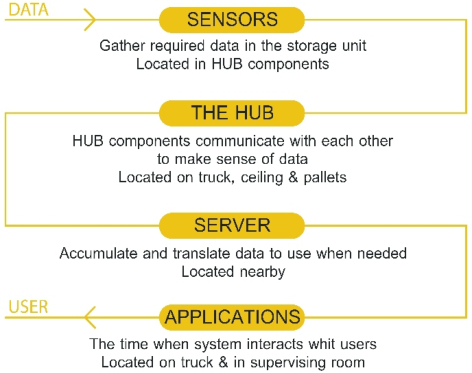
Architecture of the IoT The IoT architecture proposed for warehouse management is designed to streamline data flow from sensors to end-users. The system comprises sen- sors, hubs, servers, and user-facing applications, integrating seamlessly for efficient data collection and processing. Key components and operations include.
Data Gathering Sensors: Capture essential warehouse data, transmitting it to storage units in HUB components.
Data Processing in Hubs Hubs: Central units aggregate and store data, establishing internal com- munication to comprehend information related to lift trucks, cells, and pallets.
810 Rezaei and Naghdbishi
Centralized Data Interpretation Server: The central processing unit interprets aggregated data, transforming raw information into actionable insights, particularly concerning lift trucks, cells, and pallets.
User-Facing Applications Applications: User-centric interfaces enable real-time interaction, strategi- cally positioned in lift trucks and control rooms for monitoring and control.
End User Interaction End User: The ultimate user makes real-time decisions based on interpreted data within lift trucks and control rooms.
Figure 6: Architecture of the IoT.
Analysis of the Impact of Internet of Things (IoT) Implementation on Warehouse Management
Table 1 outlines the transformative effects of integrating Internet of Things (IoT) technologies in warehouse management, focusing on operational effi- ciency, resource utilization, and overall advancements.
Operational Throughput A 58.33% improvement is observed, increasing the rate of operational pro- cesses from 60 to 95 units per hour, attributed to optimized processes facilitated by IoT.
Energy Efficiency A substantial 53.33% improvement is noted, with energy consumption per pallet decreasing from 0.60 kWh to 0.28 kWh due to enhanced pallet tracking efficiency through IoT.
Sustainable Warehouse Optimization: Integrating Industrial Design and IoT 811
Technological Advancement The technological landscape experiences significant advancement, transition- ing from a stagnant state to higher sophistication and efficiency in warehouse management practices with IoT.
Product Tracking Accuracy A 60.00% enhancement is seen in accuracy, transitioning from a low level to high precision in product tracking, a direct result of IoT technology implementation.
Real-Time Inventory Tracking An impressive 80.00% improvement is achieved, eliminating visibility lim- itations and providing instant insights into inventory levels through IoT, facilitating timely decision-making.
Automated Resource Allocation Efficiency in resource allocation improves by 75.00%, transitioning from manual to automated processes with IoT optimization in the warehouse.
Error Minimization A 70.00% improvement is observed in minimizing errors during warehouse operations, attributed to enhanced accuracy and automation in product tracking and retrieval with IoT.
Cost Efficiency A 65.00% improvement is achieved, shifting from moderate to high efficiency in cost, thanks to automated processes and resource optimization introduced by IoT.
Optimized Space Utilization A 70.00% enhancement is noted in warehouse space utilization, transitioning from inefficiency to optimization through IoT-enabled processes.
Table 1. Analysis of the impact of internet of things implementation on warehouse management.
Table available in the original PDF paper.
Improvement (%)
Before IoT Warehouse Management
After IoT Warehouse Management
-
Efficiency 60 units/hr 95 units/hr 58.33% Sustainability 0.60 kWh/pallet 0.28 kWh/pallet 53.33% Development Stagnant Significantly Advanced Accuracy Low High 60.00% Inventory Visibility Limited Real-time 80.00% Resource Optimization Manual Automated 75.00% Error Reduction High Low 70.00% Cost Efficiency Moderate High 65.00% Space Utilization Inefficient Optimized 70.00% Personnel Productivity Average Enhanced 50.00%
812 Rezaei and Naghdbishi
CONCLUSION
The integration of Internet of Things (IoT) technology and industrial design proves highly effective for optimizing warehouse operations, as demonstrated in a food manufacturing plant project. The implementation of an Indoor Positioning System (IPS) showcases the seamless synchronization of multi- purpose devices, addressing complex challenges in warehouse management with precision and efficiency.
Notable improvements in inventory management, sales reporting, and overall operational efficiency underscore the tangible benefits of this inte- grated system. By simplifying tasks like finding empty spaces for forklift drivers, the solution reduces time wastage and significantly enhances both factory and warehouse performance.
The emphasis on sustainability is evident in the enhanced overall produc- tivity of the factory, showcasing the potential for IoT and industrial design to contribute to sustainable practices alongside operational efficiency.
Looking forward, the integration of artificial intelligence (AI) holds promise for substantial advancements. The synergy of IoT, industrial design, and AI opens new possibilities for efficiency, cost reduction, and sustainable design solutions. These interdisciplinary approaches pave the way for inno- vative solutions in the industrial and IoT applications realm as the journey towards optimized warehouse management continues.
ACKNOWLEDGMENT
Our heartfelt thanks to the experts and collaborators in the warehouse opti- mization project for their invaluable insights. Due to data sensitivity, visual elements couldn’t be included.
Appreciation to ChatGPT for enhancing English language and text struc- ture. This acknowledgment highlights collaborative efforts enriching the article.
REFERENCES
Pilati, F., Faccio, M., Gamberi, M., Regattieri, A., 2020. Learning manual assembly through real-time motion capture for operator training with augmented reality. Procedia Manuf. 45, 189–195. Rácz-Szabó, A., Ruppert, T., Bántay, L., Löcklin, A., Jakab, L., Abonyi, J., 2020.
Real-time locating system in production management. Sensors 20 (23), 6766. Santoro, L., Nardello, M., Fontanelli, D., Brunelli, D., Petri, D., 2022. Scalable centimetric tracking system for team sports. In: 2022 IEEE International Workshop on Sport, Technology and Research. STAR, IEEE, pp. 1–6. Saxena, S., Alam, M., & Jabarullah, B. M. (2018b, September). DS-HM model
with DCT-HW features for face recognition. International Journal of Scien- tific Research in Computer Science Applications and Management Studies, 7(5). ISSN 2319–1953. Shum, L. C., Faieghi, R., Borsook, T., Faruk, T., Kassam, S., Nabavi, H., Spasojevic, S., Tung, J., Khan, S. S., Iaboni, A., 2022. Indoor location data for tracking human behaviours: A scoping review. Sensors 22(3), 1220.
LISTED IN THE AHFE DIGITAL BOOKSTORE CATALOGUE
Explore the complete digital volume
Intelligent Human Systems Integration (IHSI 2024): Integrating People and Intelligent Systems
Read this individual research paper free through the original publisher, or explore the full digital proceedings book.
ISBN 978-1-958651-95-7
Explore this ISBN in the AHFE Bookstore ↗Listed in the July 2026 bookstore catalogue; search by ISBN to confirm current availability · Digital book purchase optional