Wenyi Xu, Jinbo Xu, Zhipeng Zhang (2023). A Framework for Metro Spatial Regional Cultural Information Design based on Passengers’ Needs for Cognition. In: Emerging Technologies and Future of Work. AHFE Open Access, vol. 117, pp. 298–306. https://doi.org/10.54941/ahfe1004430
The purpose of this study is to explore a theoretical framework for metro spatial and regional cultural information design based on passengers' need for cognitions. Through the analysis and evaluation of the regional cultural information design in the existing subway system, we find that many subway systems do not make full use of regional cultural resources, and cannot meet the passengers' need for cognitions for relevant regional cultural information in the process of subway travel. Through the correlation study between subway passengers' need for cognitions and regional cultural information, we find that regional cultural information plays a special role in catering to and activating passengers' need for cognitions. Meanwhile, through the investigation, we find that subway passengers' demand for regional cultural information is getting higher and higher, so we put forward a framework for subway regional cultural information design based on passengers' need for cognitions. However, we are also aware that there are still some challenges and room for improvement in practical applications. For example, the mining of regional cultural information needs to be more in-depth, and the selection of information transmission methods and channels needs to be more flexible and diversified to meet the needs and preferences of different passengers. To sum up, this study effectively improves passengers' cognition and understanding of regional culture and enables the application of regional culture information in subway space through the design framework of regional culture information based on passengers' need for cognitions. This research results will help the subway system to provide more comprehensive and rich regional cultural information, and improve passengers' travel experience and satisfaction with the subway system. Future studies can further explore more refined and personalized regional cultural information design methods, express more in-depth regional cultural connotations, and serve more accurate user groups.
As one of the public Spaces with the largest flow of people in the city, subway space bears the heavy responsibility of transmitting public information. As a large-scale public media, how will the subway station transmit information that is more practical for subway users and more meaningful for subway users and city image promotion? It is an important question that we should think
A Framework for Metro Spatial Regional Cultural Information Design 299
and study. The regional cultural information of urban subway aims to cre- ate a unique cultural image with spiritual connotation for the city, transmit the regional culture of urban characteristics to the public, provide passen- gers with a better cultural and artistic experience, and ensure the smooth and efficient subway ride for passengers. At present, there are many problems in the design of regional cultural information of subway space. For example, the regional characteristics of the information are not prominent enough, the visual style is old, the artistic style is redundant, the expression is not expres- sive, the expression is blunt, the use of the scene is not considered enough, and the distribution in each subway station can not create a joint force to shape the urban cultural image. Based on the investigation and evaluation of metro regional cultural information in 12 Chinese cities, including Wuhan, Beijing, Shanghai, Chongqing, Hangzhou and Changsha, it can be summarized into three aspects, namely, expression level, function level and ideographic level (see Table 1).
Table 1. Collection table of current problems of regional cultural information in Chinese metro space (Wenyi Xu et al., 2023).
Table available in the original PDF paper.
Problem layer Concrete problem Presentation layer The visual style is old, the artistic style is miscellaneous, the expression is short, the expression form is stiff, the expression way is single... Functional layer Unable to form effective cognition, unable to give full play to potential functions, reduce the efficiency of other information, form cognitive load, insufficient consideration of use scenarios... Ideographic layer The regional characteristics of the information are not prominent enough, the regional context of the information is not accurately expressed, and the style and content are scattered and cannot form a joint force...
First of all, designers have a shallow understanding of regional culture, which is not systematic and in-depth enough, so they cannot accurately con- vey the cultural connotation of regional information, and such information will also lack urban regional characteristics. Then, the designer is not accurate enough to grasp the characteristics of subway passengers, and does not have a deep understanding of the differences between different groups and their real needs, such as the difference between foreign tourists and local passengers on regional cultural information needs. Meanwhile, the designer lacks insight into specific scenes. Moreover, designers have a limited understanding of the entire information system of subway space, and not a deep understanding of the relationship between different types of information, so the coordina- tion of different types of information relations needs to be improved. Last but not least, due to the restriction of the construction law of urban subway lines, designers cannot take into account the coordinated design of regional cultural information of the entire subway space system, which makes such
information style and content scattered and fails to form an effective joint force to promote the formation of urban regional cultural image.
Subway information mainly serves subway passengers and is based on their cognition. The needs for cognition of subway passengers are closely related to the urban regional cultural information of subway space. The research on the design of urban regional cultural information in subway space based on the needs for cognition of passengers may have a positive effect on improving the design level of regional cultural information in China’s subway.
CONSIDERING THE NEEDS FOR COGNITION OF SUBWAY PASSENGERS IS HELPFUL TO CONSTRUCT BETTER REGIONAL CULTURAL INFORMATION OF SUBWAY HSI In popular sense, needs for cognition refers to people’s curiosity about things, which is the inner power of human cognition of the world. needs for cognition are relatively stable for individuals and can be measured by the needs for cognition scale. However, each individual has different needs for cognition for different information, and the information in the real world is also complex, multi-attribute, and interwoven. Therefore, improving pas- sengers’ needs for cognitions through information design is a good way to improve the cognitive efficiency of information.
For the regional cultural information in the subway, how can it be effectively transmitted to passengers, and at the same time, can it convey harmonious and full inner feelings after being accepted by passengers? We can start from passengers’ needs for cognition for subway spatial informa- tion, and then focus on the relationship between different types of subway spatial information, the form and content of information itself.
The types of information in subway space include traffic information, safety warning information, cultural information, commercial information and so on. For passengers, traffic information is just needed in most cases, so passengers have the highest cognitive demand for such information in most scenarios. In some situations, such as waiting for a bus, the passenger’s atten- tion is liberated and does not need to be called for guiding. At this time, recreational needs for cognition are often generated, and cultural and com- mercial information plays a role in entertaining passengers and alleviating anxiety, so passengers’ needs for cognition for such information will increase.
From the perspective of regional cultural information itself, its function is to transmit cultural and aesthetic values, and to shape the image of urban regional culture. Visually, regional cultural information should bring passen- gers a sense of beauty. The powerful visual effect is to reconcile boredom and boredom to achieve a harmonious feeling. Over-exaggerated shapes and bright colors will break the harmony and backfire.
Interactive regional cultural information will be more interesting. Regional cultural information is often traditional and regional, and combining them with interesting interactive forms can convey a sense of fullness of experience to passengers, stimulate their curiosity, and meet their needs for cognition. Kunming has always had the reputation of “spring City and flower capi- tal”. In order to allow tourists to actively explore and discover the beauty of
A Framework for Metro Spatial Regional Cultural Information Design 301
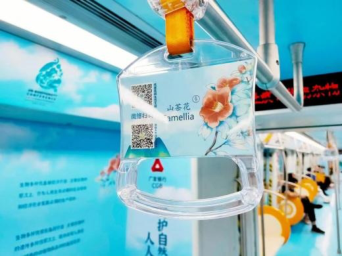
Yunnan and enrich their travel time, Leda Media cooperated with the gold award work “Cloud · Huannan” of the “Colorful Cloud” exploration pro- gram, and used Kivicube’s image AR capability to plant the first of Yunnan’s eight famous flowers - camellia flowers in the subway (see Figure 1), sending out the Spring City invitation to the public.
Figure 1: AR culture information of Yunnan metro (adapted from Wechat public account “Michi Technology”, 2023).
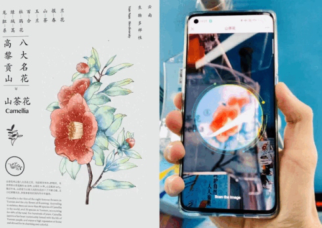
In the “Ecological Civilization” carriage of Metro Line 4, after entering the interactive page through the AR QR code on the handle, scanning any hand-painted pictures of camellia in the carriage can activate the camellia dynamic poster (see Figure 2).
Figure 2: Activate camellia dynamic poster in the train carriage (adapted from Wechat public account “Michi Technology”, 2023).
The camellia on the rail of the subway, from a plant prototype growing on the Gaoligong Mountain, through creative and technological breakthroughs, finally make the unique original ecological style of Yunnan can be presented in the colorful picture of water and sky.
This urban cultural publicity information realizes the dynamic interaction between people and posters through AR augmented reality technology, and also has strong interactive entertainment properties. It promotes Yunnan bio- diversity and the value of biodiversity to human beings to passengers in a
close immersive exploration way, and also conveys to the public that Kun- ming firmly implements the concept of “clear water and green mountains are gold mountains and silver mountains”.
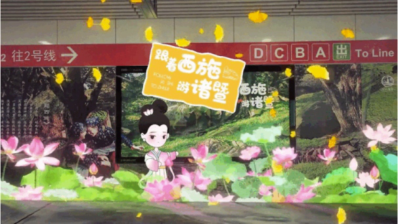
Zhuji City, the hometown of Xishi, will integrate Zhuji Glimpse into Hangzhou subway, and further enhance the popularity of Zhuji cultural tourism by creating online and offline scene experience. The large light box poster lit up in the subway station Outlines the detailed outline of Zhuji’s landscape poems. Open the mobile phone to scan the words “follow Xishi to Zhuji”on the subway poster, and the cartoon version of Xishi comes out with a gentle and bright color of Zhuji to the citizens of Hangzhou (see Figure 3).
Figure 3: AR guidance by “Xishi” (adapted from Wechat public account “Michi Technology”, 2023).
Ginkgo biloba flying, pieces of lotus leaves swing with the wind, Xishi wearing a plain skirt, waving to tourists, inviting you to share the good scenery of Zhuji, good food and good scenery: Xishi hometown, rice fruit town, Xiangreya forest Park, pearl town unique scenery directly to tourists, with the front wall outside the light box to form a large picture, strong into people’s sight.
AR city tourism promotion in subway space has unique characteristics, which creates a super-immersive channel space, presents the city character- istics to passengers in a more vivid, three-dimensional and interactive form, realizes the city-wide exposure of tourism resources and the deepening of brand memory, and also provides passengers with sensory pleasure and the interest of interactive experience.
The shaping of urban regional cultural image is also an important function of regional cultural information. In order to achieve this goal, accurately and efficiently convey the connotation of regional culture is what regional cultural information design should do. In the subway of some cities, the regional cul- tural information design of individual stations is excellent, including beautiful sculptures and magnificent murals. However, there seems to be no connec- tion between each station, and the information seems to be scattered, unable to form a joint force to build the urban regional cultural image in passen- gers’ cognition. However, there are also excellent examples. For example, in Xi’an subway, there are some highly distinctive regional cultural informa- tion designs between stations, which have certain consistency in form and coherence in content.
A Framework for Metro Spatial Regional Cultural Information Design 303
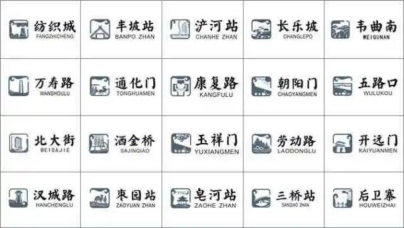
The most cultural design of Xi’an Metro is the logo of “One station, One view”. The name of each subway station in each city is a cultural regional unit, and the origin of their name is closely related to the culture of the region in which they are located. As far as the station name is concerned, many sta- tion names are puzzling, and passengers will be interested in the origin of the station name, but often most of these station names are always just a code for passengers, they have no desire to further understand and shortcut. When the “One station, One view” station logo is attached to the station name, the passengers’ cognition of the station name rises from text to graph- ics. The consistent design of the entire subway system radiates the regional culture into the whole Xi’an subway space, shapes and enhances the over- all cultural atmosphere, and activates passengers’ desire to understand the regional culture of the city. The form of the silhouette is simple and beautiful, the round outline highlights the aesthetic of ink art, and the consistent color is restrained and elegant, full of historical information, which is impressive (see Figure 4).
Figure 4: “One station, One view” station logo (adapted from Wechat public account “Xiao zhi che”, 2023).
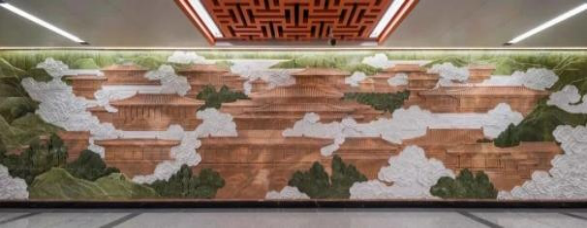
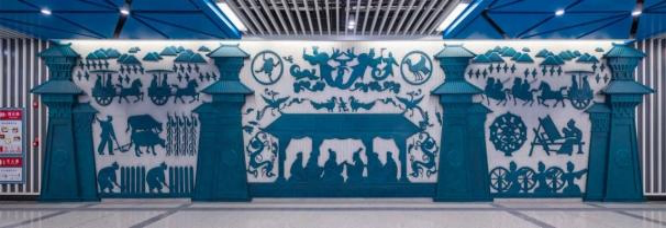
Another cultural characteristic design of Xi’an subway is the exquisite huge cultural wall, which is mostly in the style of rock relief, magnificent and rich, highlighting a grand and primitive aesthetic feeling.
“JIUTIANCHANGHE” (see Figure 5) of Daming Palace North Station designed the restored map of Xuanwu Gate, reflecting the change of the cul- ture of Xuanwu Gate in Sui and Tang dynasties of Xi’an. Daming Palace building with the clouds, reflects the Tang Dynasty’s super high level of architecture.
The “Chinese Culture of the Silk Road” (see Figure 6) at Xiangcun Station combines the cuneiform script of the Mesopotamian Valley with silk and camels as the core expressive elements to show the characteristics of the Silk Road.
In the “Style of Han Dynasty” (see Figure 7) of East Chang’an Street Station, the iconic architectural elements, the roofs of chariots and horses, and the dragon and phoenix patterns are typical characteristics of the Han Dynasty. When the heavy history reappears in front of the eyes, it brings peo- ple not only visual shock, but also touches the cultural context of the Han Dynasty city.
There are also many other sites with similar styles of murals, all of which show the city’s history and culture.
Figure 5: Xi’an subway mural “JIUTIANCHANGHE” (adapted from Wechat public account “QI ye wen hua she qun”, 2023).Figure 6: Xi’an subway mural “Chinese Culture of the Silk Road” (adapted from Wechat public account “QI ye wen hua she qun”, 2023).Figure 7: Xi’an subway mural “Style of Han Dynasty” (adapted from Wechat public account “QI ye wen hua she qun”, 2023).
Every wall at every station has its own historical story. Outline the fresh life mark of the city block, so that passengers can enjoy the details of urban life and understand the charm of the city in the rush of footsteps.
Whether it is the “One station, one scene” station logo, or the beautiful giant cultural wall, they all adopt a consistent form, so that passengers are unconsciously aware of the correlation between each other. When they find that several stations will have a magnificent relief cultural wall, they can not help but wonder what the next station’s cultural wall is like, cognitive curiosity is generated, and the level of needs for cognition also rises. When
A Framework for Metro Spatial Regional Cultural Information Design 305
immersed in the magnificence of this series of relief cultural walls, passen- gers’ cognition of the regional cultural image of Xi’an City is naturally linked with keywords such as a long history, magnificent and profound, and urban regional cultural information can be efficiently and accurately transmitted.
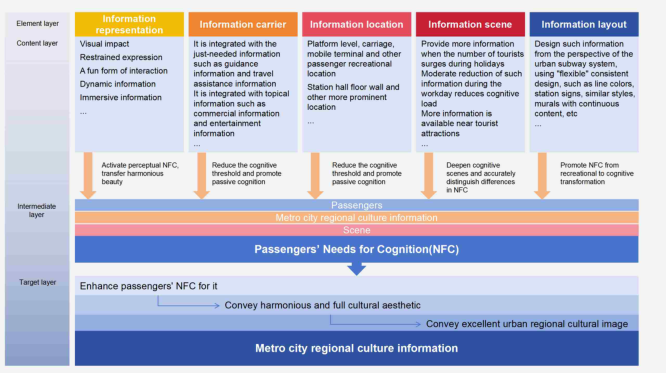
Construction of Metro Regional Cultural Information Design Framework Based on Passengers’ Needs for Cognition (NFC) Based on the above content, we can easily realize the importance of metro passengers’ NFC for metro urban regional cultural information design. Based on passenger NFC, we reverse summarize five aspects of urban regional cultural information design elements, which are respectively information expression, information carrier, information location, information scene and information layout. These five elements act on the NFC of subway passen- gers in their own ways, thus affecting the information to achieve its goal more effectively.
The metro regional culture information design framework based on pas- senger NFC is divided into four layers, which are the element layer, content layer, intermediary layer and target layer (see Figure 8). As shown in the figure, they are constructed based on the consideration of passenger NFC. Through the effect of five different aspects of factors on passenger NFC, the passenger NFC is activated and the threshold of passenger NFC is lowered. Distinguish the NFC in different scenarios, and promote the transformation of NFC from recreational to cognitive. Under the joint action of the five ele- ments, taking passenger NFC as the intermediary layer, the ultimate goal of metro regional cultural information is realized.
Figure 8: Metro regional cultural information design framework based on passenger NFC (Wenyi Xu, 2023).
CONCLUSION
The research on passengers’ need for cognitions can connect subway pas- sengers, subway regional cultural information, and application scenarios, and deeply analyze the problems existing in metro urban regional cultural information, and construct a subway regional cultural information design framework based on passengers’ need for cognitions with hierarchical think- ing, so as to guide and revise the design of metro urban regional cultural information. Urban regional culture is one of the most valuable assets of every city. For the design of urban regional culture information in subway space, we need to further develop more potential of urban regional culture by com- bining passenger and subway scenes and contemporary aesthetic context in the future.
REFERENCES
Ian Leslie. (2017). Curiosity: Sustaining a Never-ending Passion for the Unknown.
Chinese and Foreign Management (Z1), 201. Jin L. (2016). Research on the application of regional cultural characteristics in Wuhan subway art design. Design (19), 139–141. Li Yujia. (2017). Under the action of regional visual symbol of subway advertising
system to explore (a master’s degree thesis, central academy of fine arts). https: //kns.cnki.net/kcms2/article/abstract Long Y T. (2018). Application of regional graphic language in metro visual guidance system. Art Technology (11), 49. Pohlmann Attila, Velasco Franklin & Valencia Andrade Paola. (2023). Overthinking
environmentally friendly? Need for cognition moderates the sustainability sig- nal of natural patterns in biodegradable tableware. Food Quality and Preference. Doi: 10.1016/J. FOODQUAL.2023.104949. Shi Feng. (2018). Research on regional creative design of public art in Xuzhou subway space. Furniture and Interior Decoration (12), 10–11. Doi: 10.16771/j.cn43- 1247/ts.2018.12.002. Tian Tian. (2020). On the feasibility of regional design of Wuxi Metro entrance and exit. Shanxi Architecture and Architecture (21), 111–112. Doi: 10.13719/j.cnki.cn14-1279/tu.2020.21.044. Wei Linhong. (2022). The Spirit of The Times in the Regional cultural Concept
Design of subway stations: A case study of Wuhan subway Station. With time (on) (07), 21–23, Doi: 10.16129 / j.carol carroll nki mysds. 2022.07.046. Zhou Y. (2019). Analysis of subway guidance system based on the func- tion of regional visual symbols. Industrial Engineering Design (01), 46–49. Doi: 10.19798/j.cnki.2096–6946.2019.01.007.
LISTED IN THE AHFE DIGITAL BOOKSTORE CATALOGUE
Explore the complete digital volume
Emerging Technologies and Future of Work
Read this individual research paper free through the original publisher, or explore the full digital proceedings book.
ISBN 978-1-958651-93-3
Explore this ISBN in the AHFE Bookstore ↗Listed in the July 2026 bookstore catalogue; search by ISBN to confirm current availability · Digital book purchase optional