Chao Xu, Jinbo Xu, Zhipeng Zhang (2023). A Framework towards Subway Safety Information Design based on Passenger's Needs for Cognition. In: Emerging Technologies in Healthcare and Medicine. AHFE Open Access, vol. 116, pp. 422–429. https://doi.org/10.54941/ahfe1004397
Subway safety information includes subway safety warning information, subway safety warning information and subway emergency response information. Although different countries and industries in the world have set relevant standards for subway safety information design, it remains to be considered whether it is the subway safety information can meet the needs for cognition of passengers and whether it is suitable for the cognitive characteristics of passengers. Through the methods of literature study and case study, this paper sorts out the emergencies in the subway in recent years and analyzes the passengers 'emergency psychology and emergency behavior in the context of the emergency situation, and finally puts forward a subway safety information design framework for passengers' needs for cognition. Put forward the guidance direction for the subway safety information optimization.
When we take the subway, in addition to relying on the guide and indica- tion information to meet people’s basic travel needs, there are also more important personal and property safety needs to be met. At this time, the safety information in the subway space plays a vital role. Although the sub- way safety information is an essential information in the subway, it is often easy to be ignored by us, resulting in irreversible consequences when the real danger occurs. Especially when the safety awareness of subway passengers is weak, the importance of subway safety information is particularly promi- nent, which determines whether the evacuation of subway passengers can be completed faster and better in the face of subway emergencies.
Subway passengers demand is various, the demand for information in bus situation, different information can meet the different needs of passengers, such as guide information can meet the basic needs of passengers, cultural entertainment information can meet the spiritual needs of passengers, and the subway safety information mainly meet the safety needs of passengers. Therefore, using the kano model in the whole information demand system, we can know that the security information requirements belong to the basic
A Framework Towards Subway Safety Information Design 423
requirements. If satisfied, it will not have a great impact on user satisfaction, but once it cannot be met, it will be a devastating blow. The connota- tion of safety information demand is to make full use of the information resources in the surrounding environment to help passengers can cooper- ate with emergency management personnel faster and better to complete emergency response when encountering emergencies. However, the needs for cognition of passengers and the important factors of whether passengers can perceive, understand and use the subway safety information in the first time, so it is more reasonable to consider the subway service information design with the needs for cognition as the starting point.
Research on the Needs for Cognition of the Passengers Since they were put forward in the 1950s, needs for cognition have been widely used by scholars to study the psychological characteristics of people on the choice of information processing methods and the tendency of cognitive efforts. Because of cognitive demand is a kind of personality characteristics, so most of his research are based on the theory of psychology, with the study of cognitive behavior psychology, a huge cognitive theory network found by many scientists, the study of needs for cognition has gradually become the main content of the user behavior motivation.
In Cao Jin scholars such as the information of cognitive demand perspec- tive analysis of the user research for user cognitive demand research should fully consider situational, people’s personality can affect him in the face of difficulties and need is to make decision-making route, but personality traits is not the main decision factors, in different situations, in the face of different things, the user behavior reaction is very different. For example, a cheerful and lively person’s social needs are very important, but in the cinema, he will give up the desire to socialize with others and enjoy the film as quietly as others. However, it cannot be said that people in the cinema are introverted people. In the situational description of needs for cognition, we need to pay attention to the situational is not the more detailed the better, but should properly summarize and classify the needs for cognition of people in various scenarios, which is also the key content of needs for cognition research. In view of the needs for cognition of subway passengers, the following contents should be considered after fully considering the situation.
Environment: the environment here refers to the generalized environment, which is the cognitive demand situational subway space field of subway pas- sengers, including passengers take the subway time, the particularity of the subway space environment, lighting intensity, the scope of information dis- tribution, the temperature and humidity in the subway, the depth of the underground, the subway space closure, etc.
Stage: Passengers need to go through different stages when taking the subway, such as the preparation stage before taking the subway, including entering the subway station, taking the escalator, conducting a safety check, waiting for the ride, etc. The stages of taking the subway include looking for seats, observing the subway route map, getting off at the station and so on. There are also the later stages of taking the subway: finding exits, taking escalators, leaving the subway station, etc.
Task type: There are different tasks from other vehicles when taking the subway. For example, the guiding task when taking the subway becomes more complex compared to the guiding task on the ground. Because the underground environment is not as bright as the ground environment, and there are no familiar buildings to provide us with directional guidance. There- fore, when taking the subway, we often encounter some complex tasks, including the safety inspection of carrying items, distinguishing the direction of the subway and so on.
In the study of needs for cognition under the interactive scenario, it is nec- essary to first consider the scene that people are in, then analyze and describe the scene, and quantitatively measure the needs for cognition of users. In the following content, it will mention how to modify the cognitive demand table by scenario. In the process of research, different users will have different lev- els of needs for cognition, focusing on which factors cause the differences in the needs for cognition of passengers, and then observe the information search behavior of passengers.
Types and Characteristics of Subway Emergencies As an important part of urban rail transit, due to its special geographical spatial location, the huge flow of people and passengers, and the complex electrical equipment, the subway will cause huge losses to the safety of peo- ple’s lives and property. Therefore, it is necessary to have a clear classification of subway emergencies to help the operation and management departments to make targeted responses.
According to the Emergency Response Law of the People’s Republic of China, which came into force on November 1,2007, an emergency refers to natural disasters, accidents, public health events and social security incidents that occur suddenly, cause or may cause serious social harm, and need to take emergency measures to deal with. According to the above description of emergencies, we can also classify subway emergencies as: natural disas- ter events, production safety events, public health events and social security events (see Table 1).
At present, according to the General Plan for National Public Emergency and the particularity of urban rail transit, the subway emergencies in most cities in China are divided into grade I, grade I, grade I, level I and grade III according to their nature, severity, controllability and impact scope, and each grade has its own emergency plan. Combined with the above description of the types and classification of subway emergencies, subway emergen- cies have an unexpected nature, environmental particularity and disastrous consequences.
Unpredictability: subway emergencies generally occur in people are diffi- cult to predict, such as for general natural disasters we can predict according to scientific prediction tools, but the subway accidents caused by natural disasters generally belong to the secondary accident injury, and we cannot directly because of natural disasters may suspend the operation of rail tran- sit, unless it is known large catastrophic weather. Other such as workers in the production and living of improper operation caused by the accident, crim- inals in imperceptible terrorist attacks when we can not predict in advance,
A Framework Towards Subway Safety Information Design 425
in the history of human rail transit terrorist attacks, explosion than a big column, is because the subway traffic is huge, not to each in and out of the passenger identity check, so the general antisocial members like to choose the subway as the location of the crime.
Environmental particularity: the surrounding environment of subway has the particularity of emergency, which is mainly reflected in two aspects of less reference and closed space. First of all, as an underground rail transit, the subway determines that its geographical location is underground during the construction. Different from when an emergency occurs in the ground space, the underground light is not enough, and there are not so many buildings on the ground to help people identify the direction when they are in danger. Especially now, the layout of the subway space basically maintains the unified style, and it is difficult for people to obtain the location reference from other space elements in addition to the guide information identification. Moreover, there must be some people trapped in the train compartment, which is a relatively narrow closed environment, which will not only create difficulties for people to escape, but also contribute to the spread of some diseases or toxic gases. Moreover, people are more likely to panic in a closed environment and lead to greater mistakes.
Table 1. Summary of subway emergency cases (Chao Xu et al., 2023).
Table available in the original PDF paper.
Cause Time Place Consequence Type of accident Heavy rain caused rain to recharge In July, 2021 Zhengzhou, China Subway natural disaster event Twelve people had died and five others were injured Typhoon Baihe hit traffic on 16
Chinese Taipei
In September, 2001
In April, 1995 Korea’s Daegu
103 people died and 230 were injured
Many branches of the subway were suspended for about six months due to flooding Subway production safety incident
An explosion and fire occurred in the gas leak during the construction In October, 1995 Baku, Azerbaijan Locomotive circuit failure, induce a fire
In August, 2003 London, England
558 people died and 269 people were injured A major power failure accident has occurred
Nearly two-thirds of the London subway service left 250,000 people trapped Subway public health incident
In May, 2009 China Guangzhou
Unknown gas appeared on the construction site In March, 1995 Tokyo, Japan
Three people had died, and many people were poisoned Subway social security incident
The Om truth religion uses the neural “sarin” gas
Twelve people died and more than 5000 were admitted to hospital for poisoning Suicidal explosion events
In March, 2010 Moscow, Russia
40 people died and nearly 100 were injured
Consequences disastrous: daily subway traffic is huge, which leads to once the subway traffic accident will affect all passengers in the rail transit, we according to the consequences of some emergencies can also be seen in the subway emergency can seriously affect people’s life safety and municipal property safety. Sometimes, because of the power failure inside the track, it may affect the travel of hundreds of thousands of people, will cause hun- dreds of casualties because of brake failure, and may cause panic in the whole society due to terrorist attacks. These direct consequences are so make people hard to bear, what’s more, in most cases the subway casualties include evacua- tion caused by unreasonable evacuation, many times in the history of subway stampede, such as March 4,2008, Beijing east single station line 5 transfer line 1 channel, carrying hundreds of passengers level electric escalator suddenly issued abnormal noise, passengers have reverse escape.
Passengers’ Emergency Behavior and Emergency Psychology in Emergencies Passengers in emergencies will produce a variety of behavior patterns, differ- ent behavior will lead to different consequences, investigate the reason in the passengers’ own internal conditions and external environment conditions, we can according to the passenger behavior characteristics of these behav- ior internal causes and external factors, in order to obtain the basis of the subway safety information system framework. In the event of emergency pas- senger psychological reaction is also efficient important factors to complete the evacuation behavior, according to the behavior analysis of the passenger in the emergency event, it can be concluded that the passengers emergency psychology can be roughly divided into panic psychology, herd psychology, impulse psychology, self-protection psychology, rely on psychology, anxiety, psychology, to light psychology, etc. Different groups of people will have dif- ferent behaviors when facing different situations. Most of these behaviors are guided by the psychological state of passengers at that time. If we want to understand the reasons for these emergency behaviors, we need to conduct a detailed analysis of passengers’ emergency psychology. When we still need to further understand the root cause of subway passengers’ emergency psychol- ogy, it is necessary to conduct a detailed study on the people, environment and events in the emergency situation.
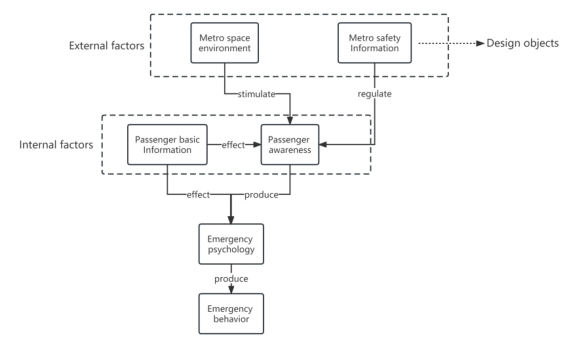
Construction of a Subway Safety Information Framework for Passengers’ Needs for Cognition The emergency behavior of passengers is the appearance we find. The rea- son for some unreasonable emergency behavior of passengers is the different emergency psychology of passengers when they encounter special situations in the subway station. Emergency psychology in psychology influenced by various factors, under the perspective of subway emergency, passenger emer- gency psychology produced by internal factors and external factors, including external factors including the subway space environment and subway safety information, internal factors for passengers cognition and passengers, under the combined action of their formed the passengers different emergency psychology, eventually lead to passenger emergency behavior(see Figure 1).
A Framework Towards Subway Safety Information Design 427
On the basis of the previous article, this summary carries out reverse thinking, starting with the different behaviors of passengers, explore their psycholog- ical characteristics, and finally find the factors affecting the psychology of passengers, and explore the entry point of the design.Subway space environ- ment in external factors includes two parts: regional space environment and emergency incident environment. Compared with the ground, the subway regional space environment has many limitations, such as narrow and tortu- ous roads, the lighting conditions of artificial light source, and certain light intensity requirements. The underground temperature and humidity are dif- ferent from the surface, the lack of reference for passengers to identify the direction, the exit is generally invisible, and other environmental deficien- cies. Emergency emergency environment refers to the subway in the subway emergency internal system environment and atmosphere, the accident envi- ronment will change, such as a fire may be accompanied by smoke, lost passengers line of sight, the explosion around the buildings may change the location, flood occurred on the ground signs submerged underwater, and so on, when the emergency crowd will become anxious congestion, passenger mobility surge, the subway station may produce panic atmosphere. These environmental factors will have a huge stimulation to people’s cognition, thus affecting people’s emergency psychology.At this time, the subway safety information will present its due value in this situation. Improper safety infor- mation will amplify the anxiety of passengers. If the safety information is not timely enough in the emergency event, it will also make the dangerous crowd miss the best time to escape. Reasonable subway safety information can adjust passengers ‘cognition, calm passengers’ uneasy psychological state, draw the latest and shortest evacuation route for passengers, dispel the impul- sive intention of passengers in panic situations, form good cooperation with rescue workers, and jointly help passengers out of difficulties. Some real- time updated dynamic safety emergency information can also be reasonably arranged for evacuation according to the process of the accident, which can give full play to the guiding role of the information. The basic attributes of passengers in the internal factors refer to the general characteristics of passen- gers, such as age, gender, occupation, and education level, which can affect passenger cognition. These attributes are not a single influence passengers for emergency cognition, but a comprehensive effect, such as a middle-aged man for subway safety information cognitive requirements and the number of he take the subway, also with whether he is in his familiar subway station, also with whether he was involved in the subway emergency escape, and his own personality tendency. These comprehensive attributes have become the main internal influencing factors of his cognition in this situation. This kind of influence is innate and not easy to change in the time of accidents, which needs to be made up for by the growth of people in the later stage. The basic attributes of passengers also affect the emergency psychology of passengers at the same time, but this impact is innate, but not decisive, and can be changed through the cognitive change of passengers. The cognition of passengers in subway emergency situations can be divided into two cate- gories: inherent cognition and immediate situational cognition. The inherent cognition of passengers is mainly influenced by the basic attributes of passen- gers, and is related to the experience of passengers. If the passenger is familiar
with the subway station before the accident and has the experience of evacu- ation drill, he is a person with a high cognitive demand to observe the things around in life, then his psychology will be more calm and more rational when the accident comes. The immediate identification of the passengers.
Figure 1: Design framework of subway safety information for passengers’ needs for cognition (Chao Xu, 2005).
CONCLUSION
In all factors affecting the passenger emergency psychology and emergency behavior we design the best direction on the subway safety information, other factors cannot by we artificially to deliberately change, but can indirectly change through the subway safety information, in order to achieve in the subway emergency passengers can more effectively reduce the loss of per- sonnel and property. Subway safety information design has its own design standards in all countries, but whether all the safety information can meet the needs for cognition of users, can help passengers in the emergency arrival of qualified subway safety information.
REFERENCES
Duk Soo Eun. (2008). A Study on the Improvement of Seoul Subway Information Design System. Journal of The Korean Society Design Culture (4). Jennifer Rae Myers. (2019). Effects of Need for cognition Closure and Age on
Medical-Related Beliefs of African Americans. IAFOR Journal of Psychology & the Behavioral Sciences (1). Doi:10.22492/ijpbs.5.1.04. Jingjing Liu & Dong Liu. (2020). Research on the Influencing Factors of Employee Organizational Commitment from the Perspective of Needs for cognition Clo- sure. (eds.) Proceedings of 2020 International Conference on World Trade and Economic Development (WTED 2020) (pp. 67–70). Clausius Scientific Press. Jinhuan Wang, Yan Li, Qing Lin & Chun Jiao. (2018). Research on the Construction
of Subway Information Service Platform Based on Mobile Internet. (eds.) Pro- ceedings of the 2018 Joint International Advanced Engineering and Technology Research Conference (JIAET 2018)(pp.) Atlantis Press.
A Framework Towards Subway Safety Information Design 429
Levshun Dmitry, Kotenko Igor & Chechulin Andrey. (2020). The application of the methodology for secure cyber–physical systems design to improve the semi- natural model of the railway infrastructure. Microprocessors and Microsystems (prepublish). Doi:10.1016/J. MICPRO.2020.103482. Mao Shibo, Wang Di, Tang Chaoying & Dong Pinhua. (2022). Students’ Online
Information Searching Strategies and Their Creative Question Generation: The Moderating Effect of Their Need for cognition Closure. Frontiers in Psychology. Doi:10.3389/FPSYG.2022.877061.
LISTED IN THE AHFE DIGITAL BOOKSTORE CATALOGUE
Explore the complete digital volume
Emerging Technologies in Healthcare and Medicine
Read this individual research paper free through the original publisher, or explore the full digital proceedings book.
ISBN 978-1-958651-92-6
Explore this ISBN in the AHFE Bookstore ↗Listed in the July 2026 bookstore catalogue; search by ISBN to confirm current availability · Digital book purchase optional