Vinzenz Krause, Célia Rousset, Ina Steinmueller (2023). Breaking the Silence: Unveiling the Power of Compassionate Leadership on Employee Silence. In: Emerging Technologies and Future of Work. AHFE Open Access, vol. 117, pp. 260–269. https://doi.org/10.54941/ahfe1004426
The following paper analyzes the effect of compassionate leadership behavior (CLB) on the phenomenon of employee silence in the organizational context. Applying a quantitative approach, the study employs structural equation modeling (SEM) to examine data collected from a n=138 sample of employees across different industries. The findings indicate a significant negative relationship between compassionate leadership behavior and employee silence, suggesting that higher levels of compassionate leadership behavior are associated with decreased instances of employee silence, especially when it comes to quiescent and acquiescent silence. These results indicate that leaders displaying compassionate leadership behavior can reduce silence caused by fear and even have the ability to break silence due to resignation. Additionally, a statistically significant positive association is observed between compassionate leadership behavior and psychological safety, highlighting the role of compassionate leaders in fostering a supportive work environment where employees feel psychologically safe. These findings underscore the importance of compassionate leadership in cultivating a climate that promotes psychological safety within organizations. Lastly, a positive covariation was found between compassionate leader behavior and servant leadership. The analysis conducted using Amos highlighted the correlations between the variables of Servant Leadership and Leader-Member Exchange, as well as between CLB and Leader-Member Exchange, thereby enhancing the overall model. Since this study is the first one connecting both research streams of compassion and silence, this research contributes to the existing literature by providing novel insights into the potential of compassionate leadership to address employee silence and enhance psychological safety in the workplace. The findings have practical implications for leaders and practitioners aiming to create environments encouraging open communication and employee engagement.
In today’s organizational environment, companies are constantly confronted with increasingly complex market trends such as disruptive environments, digitalization (Kornelakis & Petrakaki, 2020), and continuous change. Leadership plays a paramount role in navigating these challenging circum- stances, particularly when individuals face objective threats, are compelled
Breaking the Silence: Unveiling the Power of Compassionate Leadership 261
to abandon familiar approaches, and find themselves amidst confusion and anxiety (Rao & Sutton, 2020). It is imperative for leaders to possess an acute awareness of these circumstances and adeptly navigate their subordinates through the intricacies of these challenging periods. Further, leaders need to encourage and embrace the ideas and various viewpoints of employees to be successful. Indeed, employees are essential to the success of companies, and they are considered as a source of transformation and innovation (De Jong, 2007), providing novel ideas and perspectives, which improve business growth and help to stay competitive (Toner, 2011). The jobholder’s motiva- tions, opinions, and thoughts impact productivity and performance (Barker, 2005) and help the institution stay competitive (Nwabueze & Mileski, 2018). Organizations require their employees to contribute to continuously improv- ing organizational processes through behaviors that enable learning, e.g., voicing new ideas, collaborating, and working with artificial intelligence (Nembhard & Edmondson, 2011; Hsiung, 2012). In this regard, leaders bear the responsibility of fostering a supportive climate that encourages employees to freely express their thoughts and opinions.
However, individuals sometimes intentionally choose to refrain from shar- ing their ideas, opinions, concerns, or suggestions, to someone within the organization with the power to act on them, leading to a form of non- participation. Employee silence is characterized as “the intentional with- holding of any form of genuine expression about the individuals behavioral, cognitive and/or affective evaluations of his/her organizational circumstance to persons who are perceived to be capable of effecting change or redress” (Pinder & Harlos, 2001, p. 334). Coined by Pinder and Harlos (2001), the concept of employee silence has garnered attention within scholarly discourse. Pinder and Harlos (2001) made a significant contribution by rec- ognizing that individual motives alone are not sufficient to explain employee silence and instead identified distinct forms of employee silence: “quiescent silence” and “acquiescent silence.” Quiescent silence is characterized by not only feelings of anxiety but also a solid inclination to leave the organiza- tion, heightened levels of stress, and an awareness of alternative options. Conversely, employees experiencing acquiescent silence exhibit resignation, a diminished intention to quit, and a perception of hopelessness. Building upon this understanding, Van Dyne, Ang, and Botero (2003) expanded the concept of employee silence as a multidimensional construct and introduced the notion of “prosocial silence” as an additional dimension, which involves employees choosing to remain silent out of motives that aim to protect others, preserve relationships, and maintain the status of the group or organiza- tion. Employee silence can transcend individual boundaries and propagate throughout team dynamics, eventually permeating the organizational fab- ric as a collective phenomenon called Organizational Silence (Morrison and Milliken, 2000, p. 706).
To effectively address and mitigate the detrimental consequences associ- ated with employee silence, leadership research aims at discerning the specific needs of employees and at identifying suitable leadership styles capable of effectively countering these effects. Compassionate leadership has gained sig- nificant attention and scholarly interest in recent years due to its potential
positive impact on organizational outcomes and enhanced employee well- being (Dutton et al., 2014; Avramchuk et al., 2013; Eva et al., 2018). Even though there are many different definitions of compassion within the organizational research context, a vast, and steadily growing number of orga- nizational scholars have drawn on the definition of compassion provided by Dutton et al. (2014). Within their model of the “Interpersonal Process of Compassion,” they define compassion as a human experience comprising four key elements: (1) attention to suffering, (2) interpretation or sense- making, (3) empathic concern, and (4) action to alleviate suffering. Initial research in the field of compassionate leadership provided the first evidence that compassion in leadership impacts psychological well-being, employee engagement, and turnover intent (Shuck et al., 2019). According to Fine- man (2000), organizations can be characterized as emotional arenas wherein human suffering is an inescapable occurrence, arising from either personal life circumstances or organizational factors. The profound impact of the current market trends amplified the potential significance of compassionate leader- ship, as it offers a potential remedy to address the unprecedented levels of anxiety, stress, insecurity, and toxicity prevalent in the workforce (Rao & Sut- ton, 2020; Frost, 2003; Moss, 2021). Further, compassionate leadership has the potential to create a supportive and inclusive environment where employ- ees feel valued and empowered to embrace transformation challenges (Dutton et al., 2014). By adopting a compassionate leadership approach, leaders cul- tivate an environment where employees feel safe and supported to express their thoughts, concerns, and ideas. This can allow for the establishment of a secure and nurturing professional atmosphere, wherein employees feel moti- vated to actively participate and are not plagued by feelings of uncertainty and silence.
RESEARCH APPROACH This study employs a mixed method approach to empirically examine the role and relevance of compassionate leadership behavior in the context of employee silence. First, we conducted a systematic literature review to provide an overview of the current state of research on compassion- ate leadership and employee silence by synthesizing and analyzing relevant studies (Cooper, 1988; David & Han, 2004, Randolph, 2009). The find- ings revealed the conceptualization, theoretical underpinnings, measurement tools, antecedents, outcomes, and mechanisms of compassionate leadership and employee silence. Second, we adopted a quantitative approach in form of an electronic survey to investigate a series of hypotheses (see below). The questionnaire encompassed a total of 63 established items, ensuring a thorough exploration of the research variables. The first section focused on the examination of leadership behaviors according to the Compassion- ate Behavior Leadership Index (CBLI), which encompasses a range of six dimensions related to compassionate behavior (Shuck et al., 2019), as well as the Servant Leadership Behavior Scale (SLBS) developed by Sendjaya et al. in 2019. The second section delved into the relationship between the leader and member (Leader-Member Exchange developed by Dansereau,
Breaking the Silence: Unveiling the Power of Compassionate Leadership 263
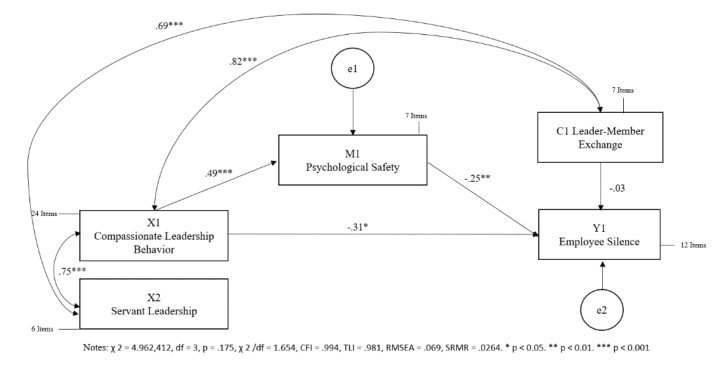
Graen, and Haga in 1975) and the psychological safety climate according to Edmondson (1999) with a total of 7 items. The third section encom- passed a self-assessment of silence behavior in the organizational context developed by Knoll and van Dick (2013), with a total of 12 items. Lastly, the fourth part aimed at collecting pertinent characteristics relating to the surveyed individuals, including demographic factors such as gender, age group, and educational attainment, as well as organizational details concern- ing the companies in which the participants are presently employed, such as industry (7 items). Our study introduces a mediation model to address the limitations of traditional mediation testing guidelines within the context of structural equation modeling (SEM) applications (e.g., Kenny & Judd., 1984). To examine the hypothesized mediating relationship, we incorporated a series of nested model comparisons based on recommendations from pre- vious researchers (Schneider et al., 2005). We also conducted a confirmatory factor analysis (CFA) to encompass the primary constructs of the model. By examining the relationships between manifest variables and constructs, we could evaluate the accuracy and consistency of the measurement instruments (Kline, 2023). The model fit indices are as follows: χ 2 = 4.962, df = 3, p = 0.175, χ 2 /df = 1.654, CFI = 0.994, TLI = 0.981, and RMSEA = 0.069. To ensure the soundness and reliability of our statistical analysis, we assessed the model fit based on established guidelines in the existing literature (West et al., 2012).
THEORETICAL MODEL We derived five hypotheses from the literature addressing existing research gaps. The initial two hypotheses (H1 and H2) are grounded in the concept of compassionate leadership behavior (CLB), assessing both the direct impact of compassionate leadership on Employee Silence (ES) and on Psychological Safety. We then added a mediation analysis to allow a more comprehen- sive and nuanced understanding of the relationship between CLB and ES (H3). Building on the foundational work of Morrison and Milliken (2000), various studies have showed deductively that understanding and nurturing psychological safety within the workplace have significant implications for breaking the Spiral of Silence, enabling employees to confidently express their thoughts and perspectives. Given the intriguing findings of these investiga- tions, it became pertinent to explore the influence of Psychological Safety Climate on Employee Silence at the individual level (H4). Finally, both ser- vant leadership and compassion exhibit a deep sense of care and concern for others, suggesting the potential for these concepts to coexist and complement each other. As Greenleaf (2003) proposed, the servant-leaders’ responsibility lies in promoting the well-being, growth, autonomy, and wisdom of those around them. In this context, the servant-leader should not merely acknowl- edge the suffering of others but also take proactive steps to alleviate it. With our last hypothesis, we aim at filling the existing research gap by scrutinizing the intricacies of compassion in conjunction with the established theoretical framework of servant leadership, thereby building upon the foundations laid by Shuck et al. (2019)
Our hypotheses are summarized as follows: Hypothesis 1: Compassionate Leadership Behavior correlates negatively with Employee Silence.
Hypothesis 2: Compassionate Leadership Behavior correlates positively with a Climate of Psychological Safety.
Hypothesis 3: A high Climate of Psychological Safety mediates the effect of Compassionate Leadership on Employee Silence positively.
Hypothesis 4: A Climate of Psychological Safety correlates negatively with Employee Silence.
Hypotheses 5: Compassionate Leadership and Servant Leadership Covari- ate positively.
RESULTS
All hypotheses could be supported, therefore suggesting that compassion- ate leadership behavior can diminish employee silence. Examining existing research has revealed a consistent pattern: Leaders who demonstrate com- passion tend to cultivate a more vital and engaged following. These findings align closely with our study’s results, indicating that employees who expe- rience compassion from their leaders are less likely to remain silent in the workplace. Secondly, the results of hypothesis H2 demonstrated a signifi- cant positive relationship between compassionate leadership behavior and psychological safety (β = 0.49, p < 0.001). A transformation in an indi- vidual’s psyche and behavior is not solely contingent upon the actions of a leader but also depends on whether the leader’s behavior induces individual psychological changes (Walumbwa & Schaubroeck, 2009). The acquisition of psychological safety is contingent upon a secure and supportive envi- ronment, and compassionate leadership undeniably has the potential to provide employees with psychological safety (Carmeli et al., 2010). Thirdly, the mediating hypotheses H3 could be supported, and the study found out that the relationship between compassionate leadership behavior (CLB) and employee silence (ES) is partially mediated by psychological safety (PS) (β = −,121). This investigation successfully establishes a correlation between CLB and silence behavior, unveiling a psychological mechanism by which an empathetic, human-oriented, compassionate leader motivates followers to diminish silence. Within the framework of social exchange theory and leader-member exchanges, creating a psychologically safe climate is expli- cated by applying reciprocity principles (Yan & Xiao, 2016). Individuals with high psychological safety feel confident in certain risk-taking behaviors (e.g. choosing voice), whereas those with low psychological safety tend to avoid such behaviors (e.g. choosing silence). After the mediation analyses, Hypoth- esis 4 concentrated on the direct effect of PS on ES and could be supported as well (β = −0.25, p < 0.01). Research studies have consistently demonstrated that psychological safety is the primary cognitive factor that promotes voice behavior (Detert & Burris, 2007). Subsequent research endeavors have con- firmed that it also inhibits silence behavior, further enriching the existing body of knowledge. Similarly, this study reinforces the fact that employees with a strong sense of psychological safety feel more comfortable and do not
Breaking the Silence: Unveiling the Power of Compassionate Leadership 265
remain silent. Finally, hypothesis H5 holds to be true (β = 0.75 p < 0.001), and the covariation between SL and CLB has a strong effect. The results were as expected, as the theoretical explanation had already revealed the similarities between the two leadership styles. Research has focused on inte- grating Compassion Leader Behavior into Servant Leadership (Davenport, 2015; Van Dierendonck & Patterson, 2015) rather than establishing Com- passionate Leadership as a distinct leadership style. The findings confirm that these two people-oriented leadership styles are closely interconnected and share a central focus on the employees.
Figure 1: Tested structural equation model (SEM).
Lastly, after the initial interpretation of the results, which focused on the overall construct of Employee Silence, we delved into a more detailed exam- ination of the individual forms of ES to facilitate a better understanding and interpretation of the findings. The observed results primarily highlight a notable effect on two specific forms of ES. Compassionate Leadership Behavior relates negative to Quiescent Silence (β = −0.28, p < 0.01), and Acquiescent Silence (β = −0.50, p < 0.001). These findings are particu- larly intriguing as Quiescent Silence and Acquiescent Silence are considered especially challenging to influence. A seminal study by Pinder and Harlos (2001) underscored the inherent difficulty in overcoming acquiescent silence, which manifests as a passive acceptance of the status quo (resignation). This form of silence necessitates greater support or provocation to be disrupted. Employees who engage in acquiescent silence have relinquished hope for improvement, challenging their motivational capacity. Pinder and Harlos (2001) further supported this perspective, noting in their study that breaking through acquiescent silence proves considerably more arduous than address- ing the other forms of silence. Consequently, the Compassionate Leadership behavior framework holds promising potential for effectively dismantling acquiescent silence and attending to employee motivation through purposeful leadership practices. Knoll and Dick’s (2013) study highlights that Acquies- cent Silence can be attributed to several factors. Firstly, individuals perceive
a lack of receptiveness, indicating a dearth of open ears to listen to their thoughts and concerns (Van Dyne, 2003). Secondly, supervisors exhibit a closed mindset, being unreceptive to suggestions, concerns, or novel ideas put forth by employees. Lastly, a prevailing belief among employees is that their contributions will have no impact, leading to a sense of resignation and dis- engagement. Consequently, the positive impact (reduce the phenomenon of ES) of Compassionate Leadership behavior becomes apparent, as this lead- ership style strives to address the needs of employees and establish a more robust connection by demonstrating sensitivity to their wishes and concerns (Lilius et al., 2008). Compassionate Leadership Behavior, as an influential factor, has the potential to alleviate feelings of futility and despair among employees.
CONCLUSION
By shedding light on compassionate leadership as an evolution of people- oriented leadership, this study contributes to extending the existing body of compassion and silence research, opens an elementary stream in the research literature, and provides applicable insights into how employee silence can be prevented or be reduced. Specifically, the study reveals that compassion is central to supporting leaders as it promotes high-quality relationships that further enhance psychological safety (Amir, 2022), therefore contributing to employee inclusion and the sharing of ideas and opinions. Moreover, our study addresses a challenge identified by silence researchers (Morrison, 2014; Pinder and Harlos, 2001). In certain instances, employees have become fully acquiescent to the prevailing circumstances or have developed a sense of com- plete incapacity to articulate their thoughts. This form of silence becomes deeply entrenched, displaying limited prospects for alteration. Conversely, in other scenarios, employees teeter on the precipice of voicing their opin- ions, suggesting that a minor catalyst, such as a novel occurrence, newly acquired information, a shift in mood, or a temporary inhibition loss, could propel them towards expression. Our findings demonstrate that Compas- sionate Leadership behavior exerts a discernible influence on both enduring manifestations of silence, such as fear-induced silence (referred to as quies- cent silence), and on opportunistic silence that can be more readily assuaged with the aid of catalysts.
The paper has several limitations. The first concern is related to the sam- ple size, which constrains conducting a robust equation model. The second concern pertains to the demographic composition of the participants, particu- larly the disproportionately high representation of individuals aged 25 to 34, accounting for 65.9% of the sample. The limitations provide a framework for further research and highlight gaps that can be filled through additional inves- tigations. Therefore, exploring additional specific factors such as culture, target audience, and industry could yield divergent results and hold immense importance. In a broader sense, it would also be intriguing to include leaders within a study to gain a dual perspective on this dyadic relationship, since not all influencing factors can be adequately captured by solely assessing the follower’s perspective.
Breaking the Silence: Unveiling the Power of Compassionate Leadership 267
The paper has several practical implications. First, our study supports the notion that compassionate leadership behavior, which fosters high-quality leader-member exchange relationships, actively encourages employees not to withhold their opinions and ideas. Therefore, leaders prioritizing compas- sionate practices are likelier to elicit desirable employee behavior. Second, leadership is critical in setting an example and embracing the responsibility of integrating compassionate behavior into the organizational fabric. This approach yields two notable advantages: First, leaders cultivate psychological safety at the team level, fostering an environment where employees feel secure in expressing themselves. Second, leaders exemplify compassionate behav- iors towards their subordinates, encouraging employees to adopt and exhibit compassion. Consequently, this reciprocal process promotes compassionate behavior among team members, extending the influence of Compassionate Leadership beyond the micro level to provide valuable insights at the meso level. To effectively prepare organizations, leaders, and employees for the complexities of future trends, it is essential to ensure the integration of com- passion and a sense of psychological safety at all levels. Finally, our findings suggest that organizations should proactively establish conducive organiza- tional conditions and implement processes that support compassion for its employees and contribute to their well-being rather than relying on remedial strategies to address silence at a later stage. The results underscore the piv- otal role of leaders in cultivating a work environment that is supportive and foster inclusivity, and collaboration.
REFERENCES
Amir, M. T. (2021). Leading with Compassion in Times of Change. Journal of Business and Behavioural Entrepreneurship, 5(2), 99–107. Andermahr, J., & Jermer, B. (2018). Wenn der Funke zündet–Entwicklungsformate und Trainingskonzepte für die digitale Transformation. Digitale Führungskräf- teentwicklung: Konzepte, Impulse und Trainingsformate aus der Praxis, 97–117. Avramchuk, A. S., Manning, M. R., & Carpino, R. A. (2013). Compassion for a
change: a review of research and theory. Research in organizational change and development, 201–232. Barker, M. (2005). Understanding motivation: A review of relevant litera-ture.
Carleton papers. Baron, R. M., & Kenny, D. A. (1986). The moderator–mediator variable distinction in social psychological research: Conceptual, strategic, and statistical considerations. Journal of personality and social psychology, 51(6), 1173. Bollen, K. A. (2000). Modeling strategies: In search of the holy grail. Structural
Equation Modeling, 7(1), 74–81. Boudreau, J. W. (1996). Human resources and organization success. Carmeli, A., Reiter-Palmon, R., & Ziv, E. (2010). Inclusive leadership and employ-ee involvement in creative tasks in the workplace: The mediating role of psycholog- ical safety. Creativity Research Journal, 22(3), 250–260. Cooper, H. M. (1988). Organizing knowledge syntheses: A taxonomy of literature
reviews. Knowledge in society, 1(1), 104. Dansereau Jr, F., Graen, G., & Haga, W. J. (1975). A vertical dyad linkage approach to leadership within formal organizations: A longitudinal investigation of the role making process. Organizational behavior and human performance, 13(1), 46–78.
Davenport, T. O. (2015). How HR plays its role in leadership develop-ment. Strategic HR Review, 14(3), 89–93. David, R. J., & Han, S. K. (2004). A systematic assessment of the empirical support
for transaction cost economics. Strategic management journal, 25(1), 39–58. De Jong, J. P., & Den Hartog, D. N. (2007). How leaders influence employees’ innovative behaviour.European Journal of innovation management,10(1), 41–64. Detert, J. R., & Burris, E. R. (2007). Leadership behavior and employee voice: Is the
door really open? Academy of management journal, 50(4), 869–884. De Zulueta, P. C. (2015). Developing compassionate leadership in health care: an integrative review. Journal of healthcare leadership, 1-10. Dutton, J. E., Workman, K. M., & Hardin, A. E. (2014). Compassion at work. Annu.
Rev. Organ. Psychol. Organ. Behav., 1(1), 277–304. Edmondson, A. C. (1999). Psychological safety and learning behavior in work teams.
Administrative science quarterly, 44(2), 350–383. Eva, N., Sendjaya, S., Prajogo, D., Cavanagh, A., & Robin, M. (2018). Creating strategic fit: Aligning servant leadership with organizational structure and strategy. Personnel Review. Ferch, S. R. (2011). Forgiveness and power in the age of atrocity: Servant leadership
as a way of life. Lexington Books. Fineman, S. (2000). Emotion in organizations. Emotion in Organizations, 1–304. Frost, P. J. (2003). Toxic emotions at work: how compassionate managers handle pain and confict. Harvard Business School Press. Greenleaf, R. K. (2003). The servant-leader within: A transformative path. Paulist
press. Guinot, J., Miralles, S., Rodríguez-Sánchez, A., & Chiva, R. (2020). Do compassionate firms outperform? The role of organizational learning. Employee Relations, 42(3), 717–734. Hsiung, H. H. (2012). Authentic leadership and employee voice behavior: A multi-
level psychological process. Journal of business ethics, 107(3), 349–361. Kahn, W. A. (1990). Psychological conditions of personal engagement and disengagement at work. Academy of management journal, 33(4), 692–724. Kanov, J. M., Maitlis, S., Worline, M. C., Dutton, J. E., Frost, P. J., & Lilius, J. M.
(2004). Compassion in organizational life. American Behavioral Scientist, 47(6), 808–827. Kenny, D. A., & Judd, C. M. (1984). Estimating the nonlinear and interactive effects of latent variables. Psychological bulletin, 96(1), 201. Kish-Gephart, J. J., Detert, J. R., Treviño, L. K., & Edmondson, A. C. (2009). Si-
lenced by fear:: The nature, sources, and consequences of fear at work. Research in organizational behavior, 29, 163–193. Kline, R. B. (2023). Principles and practice of structural equation modeling. Guilford publications. Knoll, M., & Van Dick, R. (2013). Do I hear the whistle…? A first attempt to meas-
ure four forms of employee silence and their correlates. Journal of business ethics, 113, 349–362. Kornelakis, A., & Petrakaki, D. (2020). Embedding employability skills in UK higher education: Between digitalization and marketization. Industry and Higher Education, 34(5), 290–297. Lilius, J. M., Worline, M. C., Maitlis, S., Kanov, J., Dutton, J. E., & Frost,
P. (2008). The contours and consequences of compassion at work. Journal of Organiza-tional Behavior: The International Journal of Industrial, Occupational and Organizational Psychology and Behavior, 29(2), 193–218.
Breaking the Silence: Unveiling the Power of Compassionate Leadership 269
Morrison, E. W., & Milliken, F. J. (2000). Organizational silence: A barrier to change and development in a pluralistic world. Academy of Management review, 25(4), 706–725. Moss, J. (2021). Beyond burned out. Harvard business review, 10. Mumford, M. D., & Licuanan, B. (2004). Leading for innovation: Conclusions,
issues, and directions. The leadership quarterly, 15(1), 163–171. Nembhard, I. M., & Edmondson, A. C. (2011). Psychological safety: A foundation for speaking up, collaboration, and experimentation in organizations. Nwabueze, U., & Mileski, J. (2018). Achieving competitive advantage through ef-
fective communication in a global environment. Journal of International Studies (2071-8330), 11(1). Pentilla, C. (2003). Get Talking, Entrepreneur. https://entm.ag/1sGvKEM Pinder, C., & Harlos, K. (2001). Employee silence: Quiescence und acquiescence as responses to perceived injustice. Research in Personnel and Human Resource Management (20), S. 331–369. Ramachandran, S., Balasubramanian, S., James, W. F., & Al Masaeid, T. (2023).
Whither compassionate leadership? A systematic review. Management Review Quarterly, 1–85. Randolph, J. (2009). A guide to writing the dissertation literature review. Practical assessment, research, and evaluation, 14(1), 13. Rao, H. & Sutton, R. (2020). From a room called fear to a room called hope: a
leadership agenda for troubled times. McKinsey Quarterly Schneider, B., Ehrhart, M. G., Mayer, D. M., Saltz, J. L.., & Niles-Jolly, K.
(2005). Understanding organization-customer links in service settings. Academy of management journal, 48(6), 1017-1032. Sendjaya, S., Eva, N., Butar Butar, I., Robin, M., & Castles, S. (2019). SLBS-6: Val-idation of a short form of the servant leadership behavior scale. Journal of Business Ethics, 156, 941–956. Shuck, B., Alagaraja, M., Immekus, J., Cumberland, D. & Honeycutt-Elliott,
M., (2016). Operationalizing Compassionate Leadership Behavior. Academy of Management Proceedings. Toner, P. (2011). Workforce skills and innovation: An overview of major themes in the literature. Trapp, R. (2019). Why compassion at work can be good for business. Forbes, 66–6 Van Dierendonck, D., & Patterson, K. (2015). Compassionate love as a cornerstone
of servant leadership: An integration of previous theorizing and re-search. Journal of Business Ethics, 128, 119–131. Van Dyne, L. V., Ang, S., & Botero, I. C. (2003). Conceptualizing employee silence and employee voice as multidimensional constructs. Journal of management studies, 40(6), 1359–1392. Walumbwa, F. O., & Schaubroeck, J. (2009). Leader personality traits and employee
voice behavior: mediating roles of ethical leadership and work group psychologi- cal safety. Journal of Applied Psychology, 94, 1275–1286. West, S. G., Taylor, A. B., & Wu, W. (2012). Model fit and model selection in structural equation modeling. Handbook of structural equation modeling, 1, 209–231. Yan, A., & Xiao, Y. (2016). Servant leadership and employee voice behavior: a cross-
level investigation in China. SpringerPlus, 5, 1–11.
LISTED IN THE AHFE DIGITAL BOOKSTORE CATALOGUE
Explore the complete digital volume
Emerging Technologies and Future of Work
Read this individual research paper free through the original publisher, or explore the full digital proceedings book.
ISBN 978-1-958651-93-3
Explore this ISBN in the AHFE Bookstore ↗Listed in the July 2026 bookstore catalogue; search by ISBN to confirm current availability · Digital book purchase optional