Sakura Nemoto, Yasuyuki Hochi, Motoki Mizuno (2025). A Qualitative Study of Leader-Member Exchange Theory and Psychological Safety in High School Baseball Team. In: Human Factors, Business Management and Society. AHFE Open Access, vol. 176, pp. 197–202. https://doi.org/10.54941/ahfe1006317
This study examined the relationship between coaches and players in Japanese high school baseball teams through the framework of Leader-Member Exchange (LMX) theory, with a particular focus on its influence on team psychological safety. With the aim of elucidating specific relational dimensions and behaviors related to trust, communication, and support within the coach-athlete relationship, semi-structured interviews were conducted via Zoom. An interview guide was developed based on the Leader-Member Exchange (LMX) scale (Graen & Uhl-Bien, 1995) and the Psychological Safety scale (Edmondson, 1999), and the interviews were administered accordingly.Participants included four coaches (mean age = 46.3 ± 4.78 years) and sixteen players (mean age = 16.8 ± 1.04 years) from. four championship-level high school baseball teams with proven success in Japan’s highly competitive national high school baseball tournaments. The narrative data obtained were transcribed verbatim and analyzed through the categorization process of the KJ method, yielding 617 data points. These were grouped into 135 sub-categories, then into 23 mid-level categories, and ultimately organized into seven overarching themes: (1) Ideal-Based Actions, (2) Multifaceted Communication, (3) Driving Forces, (4) Achievements and Evaluations, (5) Coaching Competence, (6) Comfort, and (7) Tokenism.Findings suggest that psychological safety fosters trust between coaches and players, enabling open expression of opinions and encouraging players to take on challenges without fear of negative repercussions. High-quality LMX relationships—characterized by mutual trust and respect—further enhance psychological safety by creating a supportive environment in which players feel valued and motivated to contribute.Conversely, traditional coaching styles such as " traditional authoritarian coaching" and the use of "critical language" increase psychological stress and weaken coach-player relationships by discouraging open communication and limiting players' willingness to take initiative.These findings highlight the importance of individualized trust-building by coaches and mutual understanding among players in fostering a psychologically safe team environment. Such an environment contributes to stronger team cohesion, improved performance, and a more positive overall sports experience.Future research should explore how coaching styles can be adapted to enhance psychological safety, optimizing both individual growth and team success.
High school baseball in Japan is deeply rooted in a culture that emphasizes tradition and discipline, with the relationship between coaches and players playing a central role in team dynamics and athletic development. Such an environment fosters commitment and perseverance, but also frequently generates significant psychological pressure. In particular, coaching styles based on rigid hierarchies and traditional authoritarian approaches often restrict psychological safety: players’ abilities to freely express their opinions, take risks, and communicate openly without fear of negative consequences.
Psychological safety, conceptualized by Edmondson (1999), refers to an environment in which team members feel safe expressing opinions and questions openly, without concern for interpersonal risk. Safety plays a critical role in enhancing open communication, mutual trust, and motivation, which are essential elements for team cohesion and sustained performance, particularly in high-performance team contexts. Given that developmental interactions between adult leaders and adolescent athletes occur daily in school sports, understanding psychological safety is significant academically and practically.
This study employs the Leader-Member Exchange (LMX) theory proposed by Graen & Uhl-Bien (1995) to investigate this issue. LMX theory focuses on the quality of dyadic relationships between leaders and members, suggesting that high-quality relationships characterized by mutual trust, respect, and support significantly influence psychological safety. Thus, this theory provides an effective theoretical framework for analyzing how coach-player relationships impact psychological safety.
Although previous research has primarily examined psychological safety within organizational contexts and specific sports teams, few studies have considered it from a relational leadership perspective in highly structured amateur sports characterized by strong traditional values such as Japanese high school baseball. Therefore, the purpose of this study is to clarify how the quality of coach-player relationships influences the formation of psychological safety among players in competitive high school baseball teams in Japan using the framework provided by LMX theory.
METHOD
Participants Participants consisted of four coaches (mean age: 46.3±4.78 years) and 16 players (mean age: 16.8±1.04 years), selected from four high school baseball teams in Japan with experience competing in national high school baseball tournaments. These teams are known for their strong track records in such tournaments.
Procedure The interviews were conducted remotely via Zoom between June 25 and July 17, 2024, in a semi-structured format. Each interview lasted for approximately 40–50 min. Participants were informed about the research objectives, voluntary nature of participation, and confidentiality measures, and informed consent was obtained prior to the interviews.
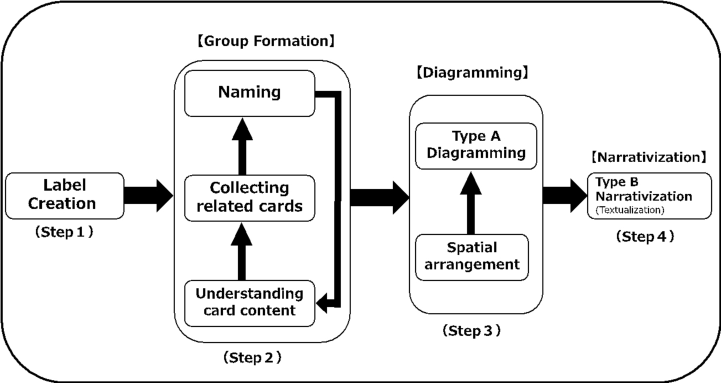
Data Analysis The collected data were analyzed using the KJ method, following the procedure outlined by Kawakita (1985). Figure 1 illustrates this step-by-step process (Figure 1). The analysis was conducted by a team of six members: one full-time lecturer with a Ph.D. in sports and health science, one assistant with a master’s degree in the same field, and four graduate students enrolled in a master’s program in organizational studies. The data were analyzed separately for coaches and players, and the process was carried out over two days.
Analysis Using the KJ Method Based on the transcribed data obtained from the interview survey, group formation was conducted using the KJ method, followed by diagramming and narrativization. These processes were performed according to analytical
A Qualitative Study of Leader-Member Exchange Theory and Psychological Safety 199
procedures described by Kawakita (1985). The symbols used in the diagramming phases are listed in Table 1.
Figure 1: Steps of the KJ method.Table 1: Symbols used for relational mapping in the KJ method.
Table available in the original PDF paper.
A influences B A and B influence each other
A and B are engaged in a dynamic, reciprocal relationship that continuously shapes both sides
A and B exhibit contrasting traits
RESULTS
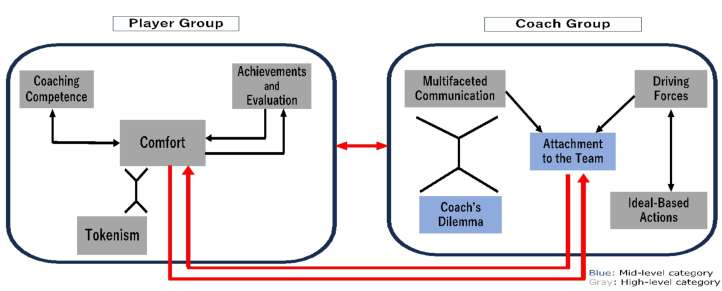
The narrative data obtained were transcribed verbatim and analyzed using the categorization process of the KJ method, yielding 617 data points. These were grouped into 135 subcategories, then into 23 mid-level categories, and ultimately organized into seven overarching themes: (1) Ideal-Based Actions, (2) Multifaceted Communication, (3) Driving Forces, (4) Achievements and Evaluations, (5) Coaching Competence, (6) Comfort, and (7) Tokenism. The following figure illustrates these categories and their relationships as derived from the KJ method.
Figure 2: KJ method visualization: coaches and players.
DISCUSSION
The findings of this study suggest that the quality of the coach-athlete relationship, conceptualized through the framework of LMX theory, plays a critical role in fostering psychological safety within Japanese high school baseball teams. Participants who reported high levels of mutual trust, open communication, and individualized support from their coaches also tended to experience greater comfort in expressing their opinions and proactively engaging in team activities. This trend aligns with previous research suggesting that high-quality LMX relationships contribute to psychological safety and open interpersonal communication (Graen & Uhl-Bien, 1995; Edmondson, 1999).
Moreover, some participants revealed that traditional authoritarian coaching, characterized by unilateral communication, top-down control, and emotional suppression, had a negative impact on psychological safety. This form of guidance is associated with a fear of judgment, hesitation to speak, and emotional withdrawal. These findings are consistent with recent sociological critiques of high school baseball coaching in Japan, which highlight the persistent structural norms that inhibit open dialogue and reinforce obedience over autonomy (Morita, 2024; Kai & Taniguchi, 2012).
By contrast, teams that demonstrated multidimensional and reciprocal communication, both vertical and horizontal, tended to report more cohesive team climates. Coaches engaged in informal dialogue, individualized feedback, and emotional attunement helped reduce hierarchical distance and foster openness. Such multifaceted communication mechanisms appear to buffer the negative effects of rigid structures, contributing to the players’ sense of inclusion and shared purposes.
These dynamics further influence the players’ affective attachment to their teams and motivation. When players perceived relationships with their coaches as respectful and reciprocal, they developed a stronger sense of belonging and a desire to contribute actively. This aligns with previous findings suggesting that relational trust and autonomy- supportive environments enhance intrinsic motivation and team commitment (Kasogabe et al., 2020).
A Qualitative Study of Leader-Member Exchange Theory and Psychological Safety 201
Moreover, the use of the KJ method in this study allowed for the inductive categorization of psychological safety factors based on narrative data, aligning with the original design intentions of the method (Kawakita, 1970, 1985). The clustering of participant experiences into categories such as “Comfort” and “Tokenism” further demonstrates how leadership style and communication culture directly shape the psychological environment of sports teams.
Overall, this study underscores the importance of fostering high-quality relational leadership and inclusive and multidimensional communication practices to support psychological safety and long-term engagement in youth sports.
CONCLUSION
This study investigated how the quality of coach-athlete relationships, as conceptualized through LMX theory, influences the development of psychological safety within Japanese high school baseball teams. Using the KJ method, narrative data from semi-structured interviews were analyzed, resulting in the identification of seven major themes that reflect both supportive and obstructive elements of team dynamics.
The findings revealed that high-quality relational exchanges, characterized by mutual trust, individualized support, and multidimensional communication, contribute significantly to the creation of a psychologically safe environment. In contrast, traditional authoritarian coaching styles have been found to inhibit safety by reinforcing fear and hierarchy. Furthermore, the study highlighted how psychological safety is not only essential for open dialogue but is also closely linked to team cohesion, motivation, and affective commitment.
This study contributes to the growing body of knowledge regarding leadership and psychological safety in youth sports contexts, particularly in culturally and structurally rigid environments. Future studies should consider incorporating quantitative measures to further validate these findings and explore their applicability in different sports and cultural settings.
ACKNOWLEDGMENT
We would like to express our deepest gratitude to the high school baseball coaches and students who provided tremendous cooperation in conducting this study.
REFERENCES
Edmondson, A., 1999. Psychological safety and learning behavior in work teams.
Administrative Science Quarterly, 44(2), pp. 350–383. Graen, G. B. and Uhl-Bien, M., 1995. Relationship-based approach to leadership: Development of leader-member exchange (LMX) theory of leadership over 25 years. The Leadership Quarterly, 6(2), pp. 219–247. Kai, Y. and Taniguchi, Y., 2012. A study on the sport socialization process of. former
high school baseball players. Kyushu Leisure and Recreation Studies, 2, pp. 3–11.
Kasogabe, T., Arai, Y. and Fujii, M., 2020. The influence of tokenism on. career development among male childcare workers. Journal of Childcare Research, 58(1), pp. 81–91. Kawakita, J., 1970. Hassoho: KJ method and design. Tokyo: Chuokoronsha. 6. Kawakita, J., 1985. Zoku Hassoho: Continuing the idea method. Tokyo: Chuokoronsha. Morita, T., 2024. Representations of high school baseball coaches on Twitter: A
sociological analysis. Journal of Sport Sociology, 32(2), pp. 85–99.
LISTED IN THE AHFE DIGITAL BOOKSTORE CATALOGUE
Explore the complete digital volume
Human Factors, Business Management and Society
Read this individual research paper free through the original publisher, or explore the full digital proceedings book.
ISBN 978-1-964867-52-6
Explore this ISBN in the AHFE Bookstore ↗Listed in the July 2026 bookstore catalogue; search by ISBN to confirm current availability · Digital book purchase optional