The roles required of nurses are becoming more diverse and complex, and the number of nurses who feel mentally unwell due to stress is increasing. One of the countermeasures is psychological safety. A workplace with a high level of psychological safety is linked to the revitalization of the organization, such as improved employee engagement and performance. In addition, it is effective in terms of mental health, such as relieving stress for employees. In this study, we examined the relationship between psychological safety and organizational health promotion support for nurses, and examined the organizational climate of health that enhances psychological safety. A web questionnaire was conducted for nurses working in hospitals in Japan, using the items of attributes, health promotion support, and psychological safety. The survey was conducted in March 2022, and the data of 377 people were considered valid responses based on the time required to respond. Respondents were 17.2% male and 82.8% female, with an average age of 43.1±9.6 years and an average of 12.6±8.8 years of service. Psychological safety scores by attribute were highest for those in their 50s, followed by those in their 20s, and those in their 30s and 40s. There was a large gap between executives and staff (F(3.019) = 0.000). Many of the items related to organizational climate of health and health promotion efforts were significantly correlated with psychological safety scores (p<0.05). The items requiring priority improvement were "high interest for health and safety of hospital organizations" and "high interest in creating a healthy working environment for hospital organizations". From the above, it is important to consider how to make the health support system known and how to promote its use so that nurses can continue to work in a healthy and motivated manner. In addition, since the psychological safety of mid-career nurses and, staff nurses without titles such as chief nurse or director of nursing, it is important to consider support specialized for them.
As medical care becomes more sophisticated and responds to the increasingly diverse needs of patients, the roles of nurses have become more diverse and complex. The number of medical institutions where nurses work is expand- ing from hospitals and clinics to visiting nursing stations and nursing care facilities. As nurses’ roles and scope of work expand, an increasing number of them experience mental health problems because of the stress caused by these duties. Over the past few years, the turnover rate for nurses has remained between 10% and 11%; however, recently, the turnover has increased due to the new coronavirus, highlighting the problem of a shortage of nurses (Japan Nursing Association, 2023). Strengthening efforts to prevent nurses from becoming mentally ill or leaving their jobs is an urgent issue.
The Japan Nursing Association has published occupational safety and health guidelines to continuously provide safe and high-quality nursing care and promote the creation of a workplace environment in which people can engage in health promotion (Japan Nursing Association, 2018). Many com- panies are working on health management (Ministry of Economy, Trade and Industry, 2022), viewing employee health management from a busi- ness perspective and strategically implementing health practices. It has been reported that it can revitalize organizations by increasing employee vitality and productivity (Kuribayashi et al., 2018). Recently, an increasing number of medical and social medical corporations have been certified as excel- lent health management corporations. Furthermore, psychological safety (Edmondson, 1999) has attracted attention as a measure for preventing turnover and promoting retention. A workplace with high psychological safety leads to revitalization of the organization, such as improved employee engagement and performance, and has been reported to have beneficial mental health effects such as alleviating employee stress (Miyairi, 2022). Psy- chological safety in medical settings is also related to medical safety (Tatsumi, 2020). By creating a medical environment with high psychological safety, we can expect to improve the health of medical workers, revitalize organizations, and improve medical safety.
Therefore, in this study, we clarify the relationship between organiza- tional culture related to health, such as organizational and individual health awareness and health promotion support, and psychological safety in medical institutions.
METHOD
An online survey was conducted targeting full-time nurses working in hospi- tals in Japan with more than 100 beds. The survey was conducted in March 2022, and valid responses were obtained from 377 people, based on the response time and straight-line cut of responses. The survey included ques- tions about personal attributes, such as age and years of service, health culture indicators (Takahashi et al., 2022), and psychological safety (Edmondson, 1999; Inaba et al., 2021). Ethical approval was obtained from the ethics committee of the institu- tion with which the principal investigator is affiliated. The web survey start screen clearly stated the purpose of the survey and indicated that clicking the response button constituted consent.
RESULT
The attributes of the subjects (Table 1) were: 17.2% were male, 82.8% were female, their average age was 43.1±9.6 years, and their average number of years of employment was 12.6±8.8 years. Sorting psychological safety scores in descending order of age, the participants were in their 50s, 20s, 40s, and 30s, and the years of work were 20 or more, less than 5 years, 10 to 19 years, and 5 to 9 years. There was a significant difference between executives and staff (F (3.019) = 0.000). Additionally, there was a tendency for the scores to be lower when preschool children were present (p < 0.05).
Organizational Climate for Health to Enhance Psychological Safety 381
Table 1. Rate of attributes and correlation with psychological safety (PS).
Table available in the original PDF paper.
Attribute item PS score PS factor n % mean β Gender male 65 17.2% 28.9 0.814 female 312 82.8% 29.8 Age 20's 36 9.5% 30.1 0.069 30's 106 28.1% 29.0 40's 131 34.7% 29.1 over 50's 104 27.6% 30.8
Years of service at their hospital less than 5 years 66 17.5% 30.2 -0.169 5 - 9 years 95 25.2% 28.8 10 - 19 years 142 37.7% 29.4 over 20 years 74 19.6% 30.8 Post staff nurses 268 71.1% 28.8 1.701 *** chief nurses 81 21.5% 31.3 *** manager nurses 28 7.4% 32.5
Number of hospital beds 100 beds 87 23.1% 29.5 0.019 200 beds 86 22.8% 30.0 300 beds 67 17.8% 29.8 400 beds 42 11.1% 29.5 over 500 beds 95 25.2% 29.4 Working hours per week less than 40 hours 82 21.8% 30.2 -0.097 40 - 49 hours 204 54.1% 29.9 50 - 59 hours 56 14.9% 28.6 over 60 hours 35 9.3% 28.5
Presence of preschool children yes 85 22.5% 28.7 * 1.111 no 292 77.5% 29.9 Parental care yes 19 5.0% 29.9 0.615 no 358 95.0% 29.6
***p<.001, **p<.01, *p<.05. R2 0.05 R2 0.02 * ⊿
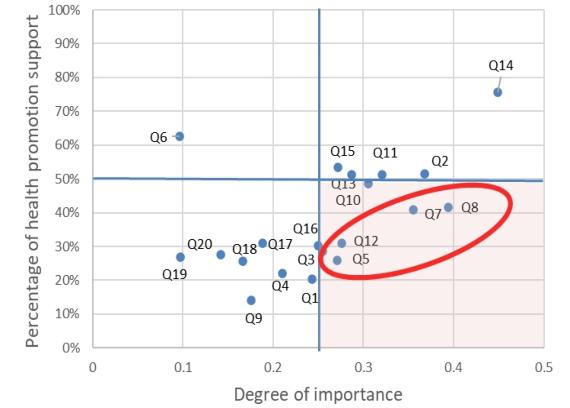
Next, it checked their awareness of health promotion measures at their workplace, and 12.2% of the nurses responded that they fully understood the contents of their health maintenance and promotion policies. “Procedures for dealing with health problems” was understood by 31.8% and “Support sys- tem for returning to work after long leave” by 44.3%. Comparing the scores for known/unknown health promotion measures, the psychological safety scores of the known group were significantly higher for all items (p < 0.01). Health promotion initiative (Table 2) was examined with 10 items regarding support and initiatives from the workplace, 3 items regarding support from superiors and senior nurses, 2 items regarding support from colleagues, and 5 items regarding own efforts. In descending order of the percentage who agreed or strongly agreed with the idea of health promotion, they received support from their workplaces : “Providing a mental support system” and “Regular safety and health discussions,” from their superiors: “Checking the physical condition”and “Supporting participation in health promotion,” and from their colleagues: “Dealing with poor physical condition” and “Con- cern for each other’s health” (Q2, 6, 11, 13–15). Contrariwise, the following forms of support were reported by less than 30%: “Providing health pro- motion programs,” “Providing health information,” “Participation in health promotion plans,” “Reflecting staff opinions in health promotion plans,” and “Introduction of equipment to establish exercise habits” (Q1, 3–5, 9).
Table 2. Rate of health promotion support and correlation with psychological
Table available in the original PDF paper.
Degree of Relationship PS factor Health Promotio with PS r β Support and initiatives from your workplace (the hospital) Q1 Providing health promotion programs 20.4% 0.243 * -0.105 Q2 Providing a mental support system 51.5% 0.368 ** -1.186 *** Q3 Providing health information 28.6% 0.255 ** -0.169 Q4 Participation in health promotion plans 22.0% 0.210 * 0.814 Q5 Reflecting staff opinions in health promotion plans 26.0% 0.271 ** 0.131 Q6 Regular safety and health discussions 62.6% 0.097 0.251 Q7 Concern for staff health 40.8% 0.355 ** -0.358 Q8 Interest to creating a healthy work environment 41.6% 0.394 ** -1.657 *** Q9 Introduction of equipment to establish exercise habits 14.1% 0.176 0.368 Q10 Active participation of management in health promotion initiatives 48.5% 0.305 ** -0.388 Support from your boss or senior nurse Q11 Checking the physical condition of subordinates 51.2% 0.321 ** 0.062 Q12 Communicating the importance of health promotion 31.0% 0.276 ** 0.454 Q13 Supporting participation in health promotion 51.2% 0.287 ** -0.751 Support from colleagues Q14 Dealing with poor physical condition 75.6% 0.449 ** -2.525 *** Q15 Concern for each other's health 53.3% 0.272 ** -0.372 Initiatives to improve own health Q16 Talking about own health improvement efforts 30.2% 0.250 * ー Q17 Encouragement of colleagues' health promotion efforts 31.0% 0.189 ー Q18 Participating in health promotion initiatives with colleagues 25.7% 0.166 ー Q19 Participation in community contribution activities 26.8% 0.098 ー Q20 Participation in hospital exercise promotion activities 27.6% 0.142 ー ***p<.001, **p<.01, *p<.05. R2 0.30
safety (PS).
R2 0.27 *** ⊿
Furthermore, efforts to improve one’s own health (Q16–20) were reported by around 25–30%. Confirming the correlation between efforts to promote health and psychological safety scores, 8 out of 10 workplace items were reported (Q1–5, 7, 8, 10), including provision of support, provision of information, interest, and participation. Finally, the items for support from superiors and colleagues (Q11–15) were all highly relevant. However, the relationship between one’s own health promotion efforts and psychological safety was weak. Therefore, as it is highly related to support from work- places, superiors, and coworkers, we conducted a multiple regression analysis with psychological safety as the dependent variable. “Providing a mental sup- port system” (Q2), “Interest to creating a healthy work environment” (Q8), and “Dealing with poor physical condition” from colleagues (Q14) showed significant values.
Next, we examined the health promotion support that should be rein- forced to increase the psychological safety of the organization through CS portfolio analysis (Figure 1). This analysis makes it possible to prioritize areas that need improvement by clarifying the status of efforts to pro- mote health and the items that are emphasized (items that are strongly related to psychological safety). Health promotion support, which is con- sidered a priority improvement item, was also identified. “Concern for staff health” (Q7) and “Interest in creating a healthy work environment” (Q8) have the highest priority, followed by “Reflecting staff opinions in health promotion plans”(Q5) and “Communicating the importance of health promotion” (Q12).
Organizational Climate for Health to Enhance Psychological Safety 383
Figure 1: CS portfolio analysis of health promotion support.
DISCISSION Trends in Psychological Safety From the Perspective of Attributes
Comparing psychological safety scores based on participants’ attributes, nurses in their 30s and 40s, nurses without a position, and nurses with preschool children felt that their workplace had low psychological safety. Until now, it has been thought that nurses who have only recently joined the profession or are young may lack confidence, be unable to say what they want to say, or find it difficult to speak up. However, the inexperienced nurses in this study had high psychological safety scores. Many hospitals use the pre- ceptor system (one-on-one instruction) as the training style for new nurses, allowing them to feel free to ask the preceptor questions and receive detailed guidance, which was considered as maintaining psychological safety.
Psychological Safety and Health Organizational Climate Although most hospitals have health promotion measures in place, only 10% of nurses were aware of “health maintenance and promotion policies” and only 30% were aware of “procedures for dealing with health problems.” Considering that nurses who perceived psychological safety had significantly higher scores, it is necessary for organizations to proactively disseminate policies and coping procedures. Additionally, although there was a strong relationship between organizational health promotion support from hospi- tals, superiors, and coworkers and psychological safety, there were many support measures that respondents felt were not supported or were not being implemented. It is necessary to improve the organizational climate to raise awareness of health promotion. In particular, “Communicating the impor- tance of health promotion” has a strong impact on psychological safety and
has been cited as an important improvement item. It is desirable to imple- ment measures to promote health in the workplace, such as providing healthy menus. In addition, regarding “Concern for staff health,” which was a high- priority improvement item, it is desirable to incorporate a system in the workplace that allows the physical and mental health status of each nurse to be checked.
Discrepancies Between Organizational and Individual Perceptions This study does not confirm the kind of health promotion and support hospi- tal organizations provide. Depending on the strength of respondents’ health awareness, perceptions of support measures may differ even within the same organization. Therefore, by investigating the health promotion support pro- vided by organizations and the level of awareness of the support measures introduced by hospitals within the same organization, we can understand the characteristics of organizational culture that enhance psychological safety.
CONCLUSION
This study investigated workplace health promotion support and psycholog- ical safety and considered support measures to increase psychological safety as a clue to solving the problems of mental stress and turnover due to the expansion of nurses’ duties and roles. The results of an online survey of reg- ular employees working in hospitals with more than 100 beds revealed a strong relationship between organizational health promotion support and psychological safety. It was surmised that mental support in the workplace, creating a healthy work environment, and how colleagues responded when they felt unwell had an impact on psychological safety. For nurses to continue working with motivation and enthusiasm, it is essential to consider ways to make the system known and promote its use. In addition, because the psy- chological safety of mid-career nurses and nurses with no positions is low, it is important to consider specific support measures for them in order to revitalize organizations.
ACKNOWLEDGMENT
This work was supported by a JSPS KAKENHI Grant-in-Aid for Scientific Research (C) (Grant Number 21K01637). We would like to express our gratitude to everyone involved in this study.
REFERENCES
Edmondson A. (1999) “Psychological Safety and Learning Behavior in Work Teams”.
Administrative Science Quarterly, 44, 350–383. Edmondson A. (2021) The Fearless Organization: Creating Psychological Safety in the Workplace for Learning, Innovation, and Growth (in Japanese). Eiji Press Inc. Inaba, K., Hochi, Y., Iwaasa, T. and Mizuno, M. (2021) “Relationships between
the Psychological Safety, Job Resources, and Work Engagement of Fitness Club Employees”, Juntendo Medical Journal, 67(4), 360–366.
Organizational Climate for Health to Enhance Psychological Safety 385
Japanese Nursing Association. (2018) Occupational safety and health guidelines for nursing professions (in Japanese). Website: https://www.nurse.or.jp/nursing/shur oanz-en/safety/hwp_guideline/index.html. Japanese Nursing Association. (2023) “2022 Hospital Nursing Actual Survey”
Results (in Japanese) Website: https://www.nurse.or.jp/home/assets/20230301_nl 04.pdf. Kuribayashi, K. and Tsukima, S. (2018) “The Current Statement of Health and Productivity Management on Companies”. Japanese Journal of Psychosomatic Medicine, 58 (3), 255–260. Ministry of Economy, Trade and Industry. (2022) Promotion of health manage-
ment (in Japanese). Website: https://www.meti.go.jp/policy/mono_info_service/ healthcare/downloadfiles/kenkokeiei_gaiyo.pdf. Miyairi, S. (2022) “Does the Psychological Safety Promote the Safe Action of the Workplace? –Examination of the Promotion Factor of the Safe Activity and the Activated Index–”. The Bulletin of Kaichi International University, 2, 161–165. Takahashi, Y., Tsuno, Y. and Omori, J. (2022) “Evaluation Index for a Healthy Work-
place Culture in Health and Productivity Management”. Sangyo Eiseigaku Zasshi, 64, 225–237. Tatsumi, Y. (2020) “Attempt to Introduce the Concept of Psychological Safety into the Clinical Setting of Kinki University Hospital”. The Japanese Journal of Quality and Safety in Healthcare, 15(4), 378–382.
LISTED IN THE AHFE DIGITAL BOOKSTORE CATALOGUE
Explore the complete digital volume
Emerging Technologies in Healthcare and Medicine
Read this individual research paper free through the original publisher, or explore the full digital proceedings book.
ISBN 978-1-958651-92-6
Explore this ISBN in the AHFE Bookstore ↗Listed in the July 2026 bookstore catalogue; search by ISBN to confirm current availability · Digital book purchase optional