Kerstin Haring, Claudia Ossola-haring, Andreas Schlageter, Markus Gress-heister, Joachim Woelle (2023). Tiny Titans: Acceptance of In-Vivo Capsule and Micro Robots in Healthcare Innovation. In: Emerging Technologies in Healthcare and Medicine. AHFE Open Access, vol. 116, pp. 65–73. https://doi.org/10.54941/ahfe1004358
This study explores the potential and challenges of using tiny in-vivo robots for medical diagnostics and therapy. While currently experimental and costly, technological advances may soon make them more affordable and essential, given the global shortage of medical specialists. The focus is on patient perspectives, as they are central to both technology acceptance and ethical considerations. The aim is to understand the perceived pros and cons of using in-vivo robots and factors influencing individual willingness to adopt them for medical purposes.
Recent advancements in robotics have ushered in a new era of healthcare pos- sibilities with the development of in-vivo capsules and micro robots. These robotic agents offer unprecedented precision for cellular and molecular- level interventions, paving the way for personalized medicine (Erkoc et al., 2019). However, their widespread adoption hinges on the level of trust and acceptance among patients and healthcare providers. Utilizing an adapted Technology Acceptance Model, this paper investigates the factors affecting attitudes and intentions toward these robotic systems (Pai & Huang, 2011).
BACKGROUND
Human Systems Integration (HSI) is vital for aligning technology with human needs and limitations, as separating the two often leads to operational fail- ures (Booher, 2003). The key challenge is to balance tech solutions with user-friendly implementations, considering not just basic user metrics but also their broader capabilities and environments (Chapanis, 1996). Especially with high-risk, novel technologies like in-vivo robots, user acceptance and
expectations are critical (Haring et al., 2018). Understanding user percep- tions and fears is essential for the effective design and introduction of such technologies.
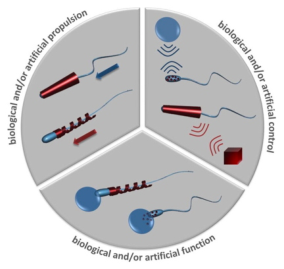
Figure 1: Examples of capsule and micro robots [Schwarz et., al, 2017] licensed under the Creative Commons Attribution-Share Alike 4.0 International license.
The Emergence of In-Vivo Capsules and Micro Robots The first generation of in-vivo robots, capable of navigating the human body, are entering the medical market (Nelson et al., 2022; Nauber et al., 2023). These robots offer targeted drug delivery, minimally invasive surgeries, and remote monitoring, improving upon traditional methods that can have more side effects (Jan et al., 2019). They also enable quicker recovery and lower complication risks due to their minimally invasive nature (Haidegger et al., 2022). Useful for chronic condition monitoring and post-surgery healing, their development is fuelled by advances in biocompatible materials and imaging technology (Ipsen et al., 2021). They also contribute to the grow- ing field of personalized medicine, delivering tailored therapies with fewer side effects (Garcia et al., 2021). However, technical, ethical, and societal challenges remain for their widespread adoption.
Safety and Ethical Considerations Safety and ethical concerns are pivotal for the public acceptance of in-vivo capsules and micro robots (Leenes et al., 2017). Key issues include long- term effects like biocompatibility and degradation, potential for unintended consequences, and data privacy. In this study description, capsule robots were ingested and excreted through the digestive tract, while micro robots were injected and excreted through urination. Data security concerns arise due to the sensitive nature of the information collected. Ethical consider- ations extend to informed consent and the risk of exacerbating healthcare inequalities due to the likely high cost of these technologies.
Addressing these safety and ethical issues is not just a regulatory require- ment but a moral imperative. It calls for comprehensive studies, transpar- ent data sharing, ethical guidelines, and user involvement in responsible development.
Tiny Titans: Acceptance of In-Vivo Capsule and Micro Robots in Healthcare Innovation 67
METHODOLOGY
In our study, approved by the University of Denver’s Institutional Review Board (IRB), we employed a mixed-method approach to investigate percep- tions of capsule and micro robots in medical therapy. We launched a survey via Amazon Mechanical Turk, recruiting 80 participants to answer questions about their demographics, worldviews, general trust in robots, and prefer- ences in medical treatments. Using Qualtric’s survey flow, participants were then randomly assigned to one of two conditions: the capsule robot or the micro robot. In each condition, participants were shown an image of the respective robot along with a brief explanation of its capabilities and how it interacts with the human body. We employed a mixed-methods approach and asked participants to rate statements on a scale from zero to ten and answer open-ended questions about the potential advantages and disadvan- tages of the robot they were assigned to. This design allowed us to gain a broad understanding of the general perception and trust toward these types of robots.
RESULTS
Demographics 80 participants were recruited online, and all participants completed the survey. Checks were performed ensuring that all participants answered the open-ended questions. The average age was M = 39.6 years (range from 26 to 76, SD = 8.61). Genders were reported as 51 Male, 27 Female, 1 non-binary/third gender, and 1 participant preferred not to say. 39 par- ticipants were randomly assigned to the capsule robot condition and 41 participants were in the micro robot condition. Conditions were balanced for age (M = 41.5; M = 37.7) and gender (Male, female, other 25,13,1 and 26,14,1). Participants were also asked to indicate their primary national identity as well as other national identities. Participants self-reported their primary national identity as mostly USA (48), followed by India (27) and five reported another. Few added a secondary national identity with 4 for Asian, sand 1 for British, Russian, Italian, and Cambodia.
Worldview and Religion Participants were asked to rate the strength of their religion(s) and spiritual worldviews. Several answers were possible. If participants left a particu- lar worldview unanswered, it was coded as zero. This shows that nearly 70% participants consider themselves as spiritual and 60% as “Christian”, followed by atheist and agnostic.
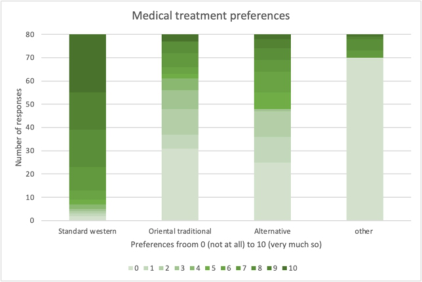
Medical Treatment Preferences Participants were asked to rate their preferences for medical treatment and therapies on a scale from 0 to 10. Figure 2 shows a strong tendency towards standard western medicine that includes high-tech medicine. More than half of the participants also do not reject oriental (e.g., Ayurveda; traditional Chi- nese medicine; traditional Japanese medicine) medicine or alternative (e.g.,
herbalism, homeopathy, energy therapies) approaches. For completeness, participants had a choice of other approaches and mentioned siddha, yoga, and prayer (one each).
Figure 2: Distributions of participants’ medical treatment preferences rated from 0 (not at all) to 10 (very much so) with multiple answers possible.
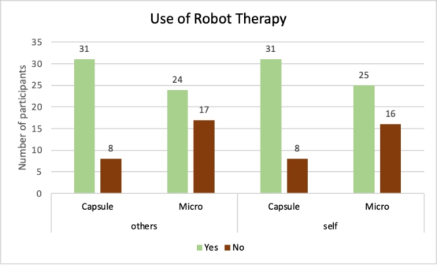
Use of Robot Therapy: Capsule vs Micro Robots Participants in each condition were asked if they would recommend others to use the respective kind of robot therapy, and if they would be using it them- selves. The results in Figure 3. showed significant differences in the counts of each answer to the question. The proportions of people encouraging and not encouraging the use of robot therapy for others significantly differed for capsule and micro robot, showing that significantly more people encourage the use of capsule robots for others (X2(1, N = 80) =4.07, p=.04). A similar but weaker close to significant effect was found for the use of robot therapy on participants themselves (X2(1, N = 80) =3.26, p=.07). For these results, it must be considered that answer options were a binary forced choice and did not allow for nuanced answers.
Figure 3: Participants’ answers if they would recommend robot therapy for others and if they would use it themselves, for capsule and for micro robots.
Tiny Titans: Acceptance of In-Vivo Capsule and Micro Robots in Healthcare Innovation 69
(DIS)-Advantages of Robot Therapy: Capsule vs Micro
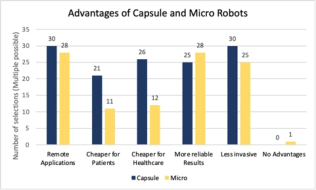
Figure 4: Participants’ answer counts to a given set of possible advantages and disadvantages of capsule and micro robots. Multiple answers were possible.
Participants were asked about the advantages and disadvantages of the respective robots in their list. This was conducted by having them choose from a list of possible options where several answers were possible, followed by an open-ended question to catch what was not captured in the partic- ipants’ option. A chi-square test showed no significant differences in the proportions of all advantages or disadvantages between capsule and micro robots for the selections provided (Figure 4).
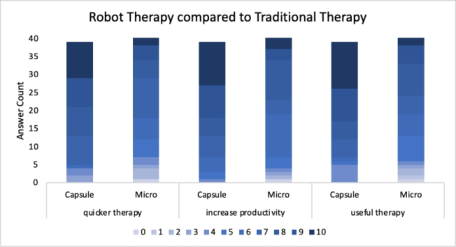
Robot Therapy Compared to Traditional Medicine Participants were asked what benefits of (the respective) robot therapy they perceived compared to traditional medicine and therapy (any medicine or therapy). A chi-square test showed that there are no significant differences between the perception of benefits for the items “better performance”, “eas- ier therapy”, and “easier for me” of the robot therapy (Figure 5). However, significant differences were found for “quicker therapy” (X2(1, N = 80) =19.14, p=.04), “increase productivity” (X2(1, N = 80) =16.81, p=.07), and “useful therapy” (X2(1, N = 80) =14.14, p=.007).
Figure 5: Participants’ significantly different ratings of capsule and micro robots’ ben- efits compared to traditional therapy showing the perception of capsule robots being rated higher than micro robots. Higher ratings are shaded darker.
Results for Micro Robots: Advantages Participants were asked in an open-ended question about the potential advan- tages of micro robots in medical diagnosis and therapy. The responses showed that nearly 20% (8 out of 41) of interviewees believe that micro robots can provide better and more accurate results compared to traditional methods. Another 20% of respondents think that micro robots can access areas too small or delicate for human intervention, like the blood or brain. About 17% (7 out of 41) feel that micro robots are less invasive, which aligns with the belief that less invasive procedures could lead to quicker healing and shorter hospital stays. In fact, 4 interviewees specifically mentioned the potential for reduced hospital stays. Around 15% (6 out of 41) expect quicker results, particularly in the identification of serious conditions like cancer. A smaller number of respondents expect more comprehensive data from micro robot examinations, with one hoping for predictive insights into potential future diseases. One respondent criticized the growing specialization in medicine, arguing that it leads doctors to focus only on the diseased parts of the body, neglecting holistic patient care. Interestingly, 3 interviewees did not see any advantages in using micro robots for medical purposes.
Results for Micro Robots: Disadvantages Participants were asked in an open-ended question about the potential advan- tages of micro robots in medical diagnosis and therapy. 10 interviewees (24%) expressed concerns about both the cost and time involved, particu- larly in interpreting results. 9 respondents (22%) were sceptical about the level of research and testing of micro robots, fearing they may not be techni- cally reliable. 6 interviewees (15%) worried about the risk of contamination and the body rejecting the foreign object. 5 respondents thought that the use of micro robots could be restricted due to limitations like travel pathways or data capacity. 4 interviewees feared the risk of false or misinterpreted data, possibly due to a lack of trust in healthcare providers’ technological literacy. 3 respondents were concerned about trust, potentially fearing that doctors may place too much faith in the technology at the expense of patient care. 1 respondent felt that the use of micro robots could lead doctors to focus more on diseases than on holistic patient care, echoing a sentiment also expressed in the positive aspects of micro robots.
DISCUSSION
The feedback from 39 participants who were randomly assigned to the cap- sule robot condition indicates a general trust in these medical robots for their reliability, minimally invasive nature, and potential for remote application (as corroborated by Figure 4). While some participants expressed concerns about higher costs and limited availability, both for individual patients and the healthcare system at large, the majority saw more advantages in using capsule robots for both therapeutic and diagnostic applications. These attitudes may be influenced by the predominantly open-minded American society, which tends to favour standard Western medicine incorporating high-tech solutions (as shown in Figure 2).
Tiny Titans: Acceptance of In-Vivo Capsule and Micro Robots in Healthcare Innovation 71
It’s important to highlight that even though there’s a strong affinity for high-tech medicine and numerous perceived advantages of robotic technol- ogy, participants also reported various concerns for capsule robots. These include the potential for internal damage, malfunction or loss of the device, toxicity, and environmental impact. While some of these fears may not be as pertinent in actual clinical settings, they could significantly influence patient willingness to undergo robotic therapy. As such, transparent communication with patients about the conditions and outcomes of the therapy is crucial. Future research will extend to other countries to explore additional fears and concerns related to robotic therapy.
The micro robots open ended comments suggest a lack of trust in the cur- rent state of medical practice and the belief that robots, being at the forefront of research, could offer more precise diagnoses. It also reflects a belief that micro robots are better for delicate operations as human doctors may lack the fine motor skills required. At the same time, some participants did not see any advantage for micro robots, suggesting scepticisms towards the technol- ogy. The results further suggests that there is room for improvement in the speed of current diagnostic methods facilitated by micro robots. These find- ings indicate a range of opinions but generally point to a belief that micro robots could offer improvements in accuracy, accessibility, and efficiency in medical diagnostics and treatments.
Cost seemed to be mentioned as a common disadvantage. This sentiment may be influenced by the American healthcare system and could vary in coun- tries with different insurance models. There were also concerns related to the technology, which could stem from a general mistrust of rapidly advancing technology in healthcare. These concerns could be influenced by experiences or reports related to hygiene and organ rejection. These findings indicate a range of concerns, from practical and financial to ethical and psychological, that could influence the public’s acceptance of micro robots in healthcare.
The successful integration and adoption of in-vivo capsules and micro robots in healthcare settings depend on several critical factors. First, gain- ing the trust and confidence of both patients and medical professionals is essential. From the results, it seems clear that future users understand the potential of in vivo robot technology, but not the technology itself yet. This could be increased by providing transparent information about the bene- fits, safety measures, and ethical considerations of these robotic technologies. Additionally, conducting user research about their perceived risks and provid- ing detailed risk assessments can address concerns and increase acceptance of in-vivo robots. Moreover, the acceptance of in-vivo capsules and micro robots may vary across different cultural and socioeconomic contexts. Understand- ing these variations and tailoring communication strategies accordingly will contribute to wider adoption and early user acceptance.
LIMITATIONS AND FUTURE WORK This study was conducted online via Amazon MTurk which has been crit- icized prior for the quality of some responses (Ahler et al., 2019). Broader research with the using different platforms and in-person surveys of medical
professionals and potential users would validate the results better. The ini- tial survey calls for further research to explore the acceptance of capsule and micro robots in different countries and cultures. The selection criteria for additional countries include economic strength, education access, cultural differences, age demographics, technological advancement, and social fac- tors. Germany, Japan, India, and Brazil have been chosen for further study, each with its own linguistic adaptation of the survey to avoid educational biases. Economic indicators like GDP and scientific publications suggest that these countries are significant players in the global landscape. Demographi- cally, Japan has the oldest population, while India has the youngest. Cultural dimensions, such as power distance and context, also vary among these countries, potentially influencing attitudes and acceptance toward robotic therapy.
CONCLUSION
This study explores the potential and challenges of in-vivo robotic technology in healthcare, emphasizing the critical role of patient perspectives for technol- ogy acceptance and ethical considerations. While there is optimism about the technology’s capabilities for precision and personalized medicine, concerns about safety, ethics, and cost persist. The study highlights the need for Human Systems Integration (HSI) and transparent communication to bridge the gap between the technology’s potential and public understanding. It also points to cultural and socioeconomic factors as influencers in technology acceptance, suggesting the need for future research to include diverse global perspectives as the technology evolves.
REFERENCES
Ahler, D. J., Roush, C. E., & Sood, G. (2019). The micro-task market for lemons: Data quality on Amazon’s Mechanical Turk. Political Science Research and Methods, 1–20. Booher, Harold, ed. (2003). Handbook of human systems integration. New Jersey:
Wiley. Booher, H. R., Minninger, J. (2003) “Human systems integration in army systems acquisition”, in: Handbook of human systems integration, Booher, Harold (Ed.). pp. 663–698. Chapanis, A. (1996). Human factors in systems engineering. Wiley Series in Systems
Engineering and Management. Andrew Sage, series editor. Hoboken, NJ: Wiley. Erkoc, P., Yasa, I. C., Ceylan, H., Yasa, O., Alapan, Y., & Sitti, M. (2019).
Mobile microrobots for active therapeutic delivery. Advanced Therapeutics, 2(1), 1800064. Garcia, L., Kerns, G., O’Reilley, K., Okesanjo, O., Lozano, J., Narendran, J.,... & Golecki, H. M. (2021). The role of soft robotic micromachines in the future of medical devices and personalized medicine. Micromachines, 13(1), 28. Haring, K. S., Watanabe, K., Velonaki, M., Tossell, C. C., & Finomore, V. (2018).
FFAB—The form function attribution bias in human–robot interaction. IEEE Transactions on Cognitive and Developmental Systems, 10(4), 843–851.
Tiny Titans: Acceptance of In-Vivo Capsule and Micro Robots in Healthcare Innovation 73
Haidegger, T., Speidel, S., Stoyanov, D., & Satava, R. M. (2022). Robot-assisted minimally invasive surgery—Surgical robotics in the data age. Proceedings of the IEEE, 110(7), 835–846. Ipsen, S., Wulff, D., Kuhlemann, I., Schweikard, A., & Ernst, F. (2021). Towards
automated ultrasound imaging—robotic image acquisition in liver and prostate for long-term motion monitoring. Physics in Medicine & Biology, 66(9), 094002. Jang, D., Jeong, J., Song, H., & Chung, S. K. (2019). Targeted drug delivery technology using untethered microrobots: A review. Journal of Micromechanics and Microengineering, 29(5), 053002. Leenes, R., Palmerini, E., Koops, B. J., Bertolini, A., Salvini, P., & Lucivero, F. (2017).
Regulatory challenges of robotics: some guidelines for addressing legal and ethical issues. Law, Innovation and Technology, 9(1), 1–44. Nelson, B. J., Gervasoni, S., Chiu, P. W., Zhang, L., & Zemmar, A. (2022). Magnetically actuated medical robots: An in vivo perspective. Proceedings of the IEEE, 110(7), 1028–1037. Nauber, R., Goudu, S. R., Goeckenjan, M., Bornhäuser, M., Ribeiro, C., & Medina-
Sánchez, M. (2023). Medical microrobots in reproductive medicine from the bench to the clinic. Nature Communications, 14(1), 728. Pai, F. Y., & Huang, K. I. (2011). Applying the technology acceptance model to the introduction of healthcare information systems. Technological forecasting and social change, 78(4), 650–660. Schwarz, L., Medina-Sánchez, M., & Schmidt, O. G. (2017). Hybrid biomicromo-
tors. Applied Physics Reviews, 4(3).
LISTED IN THE AHFE DIGITAL BOOKSTORE CATALOGUE
Explore the complete digital volume
Emerging Technologies in Healthcare and Medicine
Read this individual research paper free through the original publisher, or explore the full digital proceedings book.
ISBN 978-1-958651-92-6
Explore this ISBN in the AHFE Bookstore ↗Listed in the July 2026 bookstore catalogue; search by ISBN to confirm current availability · Digital book purchase optional