Paola Palmitesta, Margherita bracci, Francesco Currò, Stefano guidi, Enrica marchigiani, Oronzo parlangeli (2024). Design a robot that is able to…: Gender stereotypes in children’s imagination of robots. In: Human Factors in Robots, Drones and Unmanned Systems. AHFE Open Access, vol. 138, pp. 75–82. https://doi.org/10.54941/ahfe1005010
Gender stereotypes not only affect relationships between humans but can also be activated in interactions with technologies. This is especially true when technologies take on anthropomorphic or even humanoid aspects, as is the case with many robots. How much gender stereotypes in interactions with robots are already active in children is still a matter of debate. Above all, it can be noted that studies on this issue have been conducted by asking for evaluative judgments with reference to existing robots, whether these were real, simulated, or only represented through images. This approach may have introduced an evaluative bias due to the design of the robots themselves by their manufacturers. Therefore, it appeared necessary to conduct a study in which children were asked to design, more specifically to draw, a robot that was able to perform either a more stereotypically female or a male task.Method and ProcedureParticipantsSixty children (28 girls, 46.6%) aged 11 to 13 years participated in the study. MethodThe study was carried out at school under the presence of the teachers and two researchers. During a first phase, the children were asked to individually draw a robot able to perform either the task of shoveling the snow (stereotypically a male task) or decorating a house (stereotypically a female task). They were told that the aim of this activity was to provide help to designers in implementing such robots. The children had no time limits to complete the drawings.In a second phase, after having drawn the robots and still in the classroom, children were asked to fill out a printed questionnaire with the aim to collect some general personal information (age, gender and class attended) and further data on the robots (gender, age, anthropomorphic characteristics, and the materials the robot was made of).ResultsChildren drew equally (45%) robots that they said were neither male nor female, or that were male. Only 6 (10%) female robots were drawn.This result is not related to whether children chose to draw robots to decorate the house or to shoveling the snow. In fact, drawings related to these two tasks were produced in almost the same percentage: 32 robots for decorating the house (53.33%) and 28 robots for shoveling the snow (46.67%).It is worth noting that the 6 female robots were all drawn by girls and that the male children drew male robots in greater numbers (N = 18) ((2) = 8.81, p < .02).In relation to the level of anthropomorphism, the results suggest that the children wanted to draw robots scarcely resembling human beings: they were almost all made of metal (N = 55; 91.67%), only 15 (25%) had anything resembling a face, and those with an actual face were only 3 (5%).ConclusionFor children, gender stereotypes in reference to robots seem to refer mainly to the fact that these technologies are considered masculine or gender-neutral regardless of their anthropomorphic characteristics.
Gender stereotypes not only affect relationships between humans but can also be activated in interactions with technologies. This is especially true when technologies take on anthropomorphic or even humanoid aspects, as is the case with many robots (Bernotat et al., 2017; Reich-Stiebert and Eyssel, 2017; Guidi et al., 2022; Parlangeli et al., 2023).
How much gender stereotypes in interactions with robots are already active in children is still an issue under scrutiny (Kahn et al., 2012; Song-Nichols and Young, 2020; Okanda and Taniguchi, 2021). Above all, it can be noted that studies on this issue have been conducted by asking for evaluative judgments with reference to existing robots, whether these were real, simulated, or only represented through images. This approach may have introduced an evaluative bias due to the design of the robots themselves by their manufacturers (Perugia et al., 2022). Therefore, it appeared necessary to conduct a study in which children were asked to design, more specifically to draw, a robot that was able to perform either a more stereotypically female or a male task (Parlangeli et al., 2023).
The use of drawings to bring out children’s knowledge and interpretations of specific events, phenomena or objects has a tradition in psychological investi- gation. Attempts have been made to relate drawing productions to cognitive development. As early as 1971, Lowenfeld and Brittain (1971) identified five stages in the development of capacities in which the progression of motor skills and of symbolic representation and abstraction are emphasized. The first stage is that which essentially sees scribble production and refers to chil- dren aged 2–4 years. This is followed by the Preschemic development stages (4 to 7 years), the Schematic development stage (7 to 9 years), and the Dawn- ing Realism Stage (9 to 11 years). The development of drawing skills ends at 12 to 14 years with the Pseudo-realistic Stage (Lowenfeld and Brittain, 1971). In recent years, various areas of interest in children’s drawings have been considered with reference to this developmental pathway, but these are mainly related to natural events (Barraza, 1999), social (Picker and Berry, 2000) or affective relationships (Cox and Moore, 1994; Burkitt, Barret and Davis, 2009).
Studies on how children draw robots are rather scarce. A study was conducted with 64 pre-school children (Seçim et al., 2021). The children were between 5 and 6 years old and were invited to participate in a preschool robotics workshop. The workshop lasted eight weeks during which the children were also asked to make drawings of robots. Specifically, the aim of the study was to explore children’s opinions in relation to edu- cational robots. Comparisons between the drawings made at the beginning of the workshop and those at the end showed that there is no change in the amount of body parts present, but the size of the robots seems to become larger. In addition, the metal parts also seem to become more numerous (Seçim et al., 2021).
Recently, Giang et al. (2023) also analysed children’s drawings in order to gain access to their mental representations in reference to robots. In the study, 104 children between the ages of 7 and 12 were involved. The children’s task was to answer questions in which they were asked to draw robots, to say what these robots could do and also to state how much they wanted to become sci- entists. Their drawings were then analysed on the basis of six descriptors with a binary possibility of occurrence (Yes/No) that were related to whether the robots were humanoid, or like animals, or had limbs or wheels. The results showed that about 74% of the robots had humanoid characteristics. Interest- ingly, the authors of this study (Giang et al., 2023) obtained different results from a previous study (Sciutti et al., 2014) in which younger children seemed to have a more humanoid conception of robots. Finally, it should be noted that in the study by Giang et al. (2023), no descriptors in relation to the gender of robots and related stereotypes were considered.
THE STUDY According to Tabitha (2023), the execution of complex tasks, for which we have no immediate solutions, implies a higher mental effort. This - with refer- ence to Kahneman’s theory (2011) - leads to the mental path of least resistance
Design a Robot That Is Able to…: Gender Stereotypes in Children’s Imagination of Robots 77
which implies reference to what we already have in our memory. Therefore, asking children to draw robots that do not exist, that they have most likely never seen, may lead to the emergence of already elaborated stereotypes with reference to the gender and physical characteristics of robots.
Research Questions RQ.1 - Robot’s gender. Do children draw robots with stereotypically male or female characteristics? RQ.1.1 - Is there a significant difference between the genders regarding the job role of the robot? RQ.1.2 - Is there a significant difference in the robot’s gender representation attributable to the children’s gender? RQ.2 - Anthropomorphism. Do children draw robots with humanoid char- acteristics such as faces, arms and limbs? What materials do children imagine robots to be made of? RQ.3 - Age. Does age affect how children depict robots in terms of job roles, level of anthropomorphism, and gender?
METHOD AND PARTICIPANTS Participants
Sixty children (28 girls, 46.6%) aged 11 to 13 years participated in the study. In the sample there were 30 sixth-graders pupils (F = 13, M =17), 15 seventh- graders (F = 5, M =10) and 15 eighth-graders (F = 10, M = 5).
Method
The research was carried out in a school in Siena - the A.B. Sabin school - during January 2023, under the presence of the teachers and two researchers. Three classes were involved in this explorative study: the sixth, the seventh and the eighth grade classes.
The study consisted of two phases: first drawing a robot and then filling in a short questionnaire.
During the first phase, the children were asked to individually draw a robot able to either shovelling the snow (stereotypically a male task) or decorating a house (stereotypically a female task) (Parlangeli et al., 2023). They were told that the aim of this activity was to provide help to designers in implementing such robots. The children had no time limits to complete the drawings and they were free to choose which robots to draw. Also, they were free to design the robot in colour or black and white.
In the second phase, children were still in the classroom, and they were asked to fill in a printed questionnaire with the aim to collect some general personal information (such as age, gender and class attended) and further data on some aspects of the robots, such as gender (if any), age, anthropo- morphic characteristics. Three questions in particular were aimed at making explicit the level of anthropomorphism of the robot (1. Does it have a face that looks like a person? 2. Does it have arms and hands?). There were four possible answers to both questions: “yes / no / something similar / other”.
The third question on anthropomorphism was “Does the robot have legs or wheels to move? In this case children could answer according to three differ- ent choices: 1) legs, 2) wheels or 3) other (specifying). The questionnaire also included an open question about the material the robot was made of.
Finally, one question was related to the degree of similarity between the robot and human beings on a seven-point Likert scale from 1 = not at all and 7 = very much.
The drawings have been examined by five researchers for classifying them in relation to colour and the level of anthropomorphism. In the case of colour, the drawings were classified in binary code, assigning “0” to black and white drawings and “1” to coloured drawings.
With respect to anthropomorphism, considering whether the robot had a face, eyes, mouth, arms, a trunk and legs, the five researchers assigned to the drawings a value of “0”, “1” or “2”, respectively for i) no anthropomorphic features, ii) at least two or three of these features, and iii) more than three. The anthropomorphism datum considered for the subsequent statistical analysis was the mode of the five ratings. The pattern of the aforementioned drawing classification was inspired by a former study by Giang et al. (2023).
Authorization for pupils’ participation in the study was obtained by send- ing informed consent to the schools and the parents or carer of the children with request for signature.
The study had been approved by the Ethics Committee for research in the Human and Social Sciences of the University of Siena.
RESULTS
Children drew equally (45%) robots that they said were neither male nor female or that were male; only 6 (10%) female robots were drawn.
This result is unrelated to whether children drew robots to decorate the house or shovel the snow. In fact, drawings related to these two tasks were produced in almost the same percentage: 32 robots for decorating the home (53.3%) and 28 robots for shovelling the snow (46.7%).
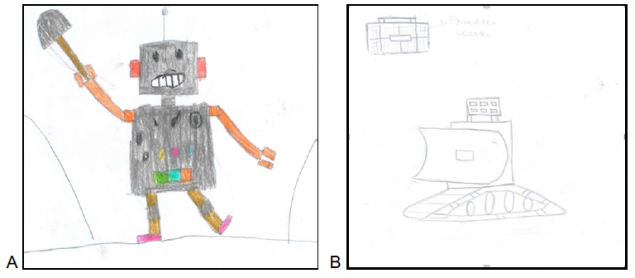
Figure 1: Two examples of robots suitable for “Shovelling snow”: Robot A, male, drawn by a sixth-grader (male) student and Robot B, neither male nor female, designed by an eighth-grader (male) student.
Design a Robot That Is Able to…: Gender Stereotypes in Children’s Imagination of Robots 79
It is worth noting that the six female robots were all drawn by girls and that male children drew male robots in more significant numbers (N = 18; χ2(2) = 8.81, p < 0.02). By grouping the drawings for the colour (coloured and black and white) and comparing the colour with the robot’s gender, results highlight a statistically significant difference (χ2(2) = 6.17, p = 0.046). Male and female robots are more frequently coloured (N = 22 (81.5%) and N = 5 (83.3%), respectively), while neutral robots are equally divided in coloured and black and white drawings (N = 14 coloured and N = 13 black and white), see (Figure 1).
Concerning the level of anthropomorphism, the results suggest that the children aimed to draw robots that relatively resemble human beings but maintained peculiar mechanical features. In the description of the robots, children reported they were almost all made of metal (N = 55; 91.7%); 23 (38.3%) had anything resembling a face, and those with an actual face were only 3 (5%); only 15 (25.0%) had anything resembling arms, while those with actual arms were 34 (56.7%); 23 (38.3%) had legs and 26 (43.3%) had wheels. However, following an evaluation of the drawings taking into consid- eration the degree of anthropomorphism based on the presence of elements such as eyes, mouth, neck, torso, arms, and legs, the results show that in the majority of the drawings, robots with medium and high degree of anthropo- morphism are depicted. In particular, in 19 drawings (31.7%) at least two of these elements are present, while in 24 drawings three or more elements are present (40.0%). Moreover, 25 (42.0%) children drew a robot with a human- inspired face, 33 (55.0%) delineated a robot with arms, and 22 (37.0%) had legs. The number of robots with arms or something similar is prevalent in engendered robots (in males 85.1%; in females 100.0%). Otherwise, robots with no gender characteristics, in lower number have been drawn with limbs 74.0% (χ2(6) = 16.22, p = 0.013). The robots drawn for decorating the house have arms and hands more than those drawn for shovelling the snow (64.7% vs 35.3%) (χ2(2) = 8.98, p = 0.030). We found no relation between coloured drawings and the level of anthropomorphism.
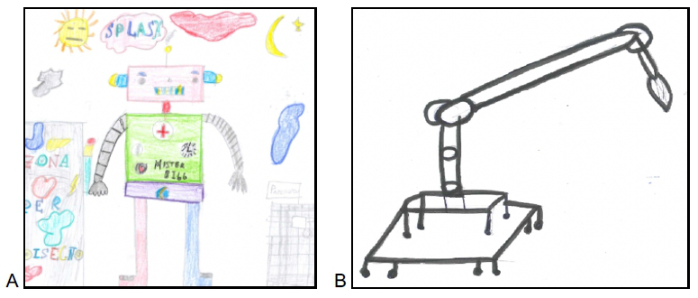
Figure 2: Two examples of robots suitable for “decorating a house”: Robot A, male, drawn by a sixth-grader (female) student and Robot B, neither male nor female, designed by a eighth-grader (male) student.
A significant difference is found in the choice of role for the robots between children of different age (χ2(2) = 19.69, p < 0.001). In particular, chil- dren in sixth grade choose mainly robots for decorating the house (N = 23, 76.7%), while eighth-graders preferred to draw robots for shovelling the snow (N = 14, 93.3%). Furthermore, if we consider robot’s gender, the results show a significant difference between classes (χ2(4) = 13.52, p = 0.009). Specifically, children in the sixth and seventh classes drew more male robots (respectively 50.0% and 66.7%); otherwise, in the eighth classes, they drew robots with no gender characteristics (80.0%) (see Figure 2).
Relatively to robots with arms, results show a statistically significant dif- ference between classes (χ2(6) = 16.71, p = 0.001), with a prevalence of robots with arms in the sixth and seventh classes (66.7% both). The same difference is found for legs or wheels (χ2(4) = 14.71, p = 0.005). More- over, students in the sixth and seventh classes attribute legs to the robots (respectively, N = 14 (46.7%) and N = 9 (60.0%)), while eighth-class stu- dents mostly drew robots with wheels (N = 12 (80.0%)). Comparing the colour of the drawings, younger students drew coloured robots more than older students (χ2(2) = 22.86; p < 0.001).
CONCLUSION
Trying to obtain scientific evidence through the analysis of images reviewed by evaluators, such as when having images of already-existing robots, can suffer from various distorting effects (Parlangeli and Roncato, 2010; Perugia et al., 2022). On the other hand, even trying to have one’s ideas realized through drawings may suffer from less than mature production skills and the difficulty of translating one’s intentions into drawings. This could, for example, occur if one wanted to make explicit that the technology drawn has thoughts or even feelings (Kahn et al., 2012; Parlangeli et al., 2014; Gray et al., 2014). The method used in this study, however sought to combine both the expressive freedom of drawing and the explication of underlying intentions through a written verbal account made later.
We were thus able to highlight that there is evidence of a bias that leads to drawing robots that are essentially male or gender-neutral (Okanda and Taniguchi, 2021), this regardless of whether the roles for which they were drawn were stereotypically more male or female (RQ.1; RQ.1.1). It is also worth noting that the few robots that were reported to be female were all drawn by girls (RQ.1.2). This result lends support to the similarity attraction hypothesis (Ozogul et al., 2013).
The intention to design anthropomorphic robots is not dominant (RQ.2). In fact, the robots essentially have mechanical characteristics, are made of metal, and many have wheels. The drawings, however in many cases repre- sent something similar to human beings. This may highlight a tendency to represent, even technologies, as human-like agents. This tendency seems to fade with age, probably due to a cognitive evolution (Lowenfeld and Brittain, 1971) that also leads to a more abstract representation of what is technologi- cal and is different, therefore, from what is human and animate (RQ.3). This evolution as age increases is seen in several other aspects of the drawings:
Design a Robot That Is Able to…: Gender Stereotypes in Children’s Imagination of Robots 81
the shift from female to male roles, the decrease of robots with a gender, the increasingly black and white drawings (Sciutti et al., 2014).
Overall, it appears that over the course of the age range considered, chil- dren go through a pathway that leads them to be less constrained by the reference to gender stereotypes. This path, however, as seen in studies con- ducted on adults, seems never to end (Parlangeli et al., 2023). Therefore, it remains one of the main educational goals to carefully consider gender stereotypes in reference to technologies in order to avoid discriminatory behaviour.
ACKNOWLEDGMENT
The authors would like to thank all students as well as their teachers for participating in this study.
The study was partially realized with funds from the PNRR (project THE: spoke M_9.2.1) and PRIN (project FROB, 2022).
REFERENCES
Barraza, L. (1999). Children’s drawings about the environment. Environmental Education Research, 5(1), pp. 49–66. https://doi.org/10.1080/1350462990050103 Bernotat, J., Eyssel, F. and Sachse, J. (2017). Shape it – The influence of robot body
shape on gender perception in robots. In: Kheddar, A., et al., eds. Social Robotics. ICSR 2017. Lecture Notes in Computer Science, (vol. 10652). Cham: Springer. https://doi.org/10.1007/978-3-319-70022-9_8 Burkitt, E., Barrett, M. and Davis, A. (2009). Effects of different emotion terms on the size and colour of children’s drawings. International Journal of Art Therapy, 14(2), pp. 74–84. https://doi.org/10.1080/17454830701529567 Cox, M. V. and Moore, R. (1994). Children’s depictions of different views of the human figure. Educational Psychology 14(4), pp. 427–436. https://doi.org/10.1080/0144341940140405 Giang, C., Addimando, L., Botturi, L., Negrini, L., Giusti, A. and Piatti, A. (2023).
Have you ever seen a robot? An analysis of children’s drawings between tech- nology and science fiction. Journal of STEM Educational Research, 6, pp. 1–20. https://doi.org/10.1007/s41979-023-00098-6 Guidi, S., Boor, L., van der Bij, L., Foppen, R., Rikmenspoel, O., Perugia, G.
(2022). Ambivalent Stereotypes Towards Gendered Robots: The (Im) mutability of Bias Towards Female and Neutral Robots, in: Cavallo, F., Cabibihan, J.-J., Fiorini, L., Sorrentino, A., He, H., Liu, X., Matsumoto, Y., Ge, S. S. (Eds.), Social Robotics, Lecture Notes in Computer Science. Springer Nature Switzerland, Cham, pp. 615–626. https://doi.org/10.1007/978-3-031-24670-8_54 Gray, K., Young, L. and Waytz, A. (2012). Mind Perception is the Essence of Morality. Psychological Inquiry 23(2), pp. 101–124. https://doi.org/10.1080/1047840X .2012.651387 Kahn, P. H., Kanda, T., Ishiguro, H., Freier, N., Severson, R. L., et al. (2012).
“Robovie, you’ll have to go into the closet now”: children’s social and moral rela- tionships with a humanoid robot. Developmental Psychology, 48(2), pp. 303–314. https://doi.org/10.1037/a0027033 Kahneman, D. (2011). Thinking, Fast and Slow. London: Penguin Books. Lowenfeld, V. and Brittain, L. W. (1971). Creative and Mental Growıh, 5th press, New York: Macmillan.
Okanda, M. and Taniguchi, K. (2021). Is a robot a boy? Japanese children’s and adults’ gender-attribute bias toward robots and its implications for education on gender stereotypes. Cognitive Development, 58, 101044. https://doi.org/10.1016/ j.cogdev.2021.101044 Ozogul, G., Johnson, A. M., Atkinson, R. K. and Reisslein, M. (2013). Investi-
gating the impact of pedagogical agent gender matching and learner choice on learning outcomes and perceptions. Computers & Education, 67, pp. 36–50. https://doi.org/10.1016/j.compedu.2013.02.006 Parlangeli, O., Caratozzolo, M. C., and Guidi, S. (2014). Multitasking and mentalizing machines: How the workload can have influence on the system com- prehension. In: Harris, D., ed. Lecture Notes in Computer Science 8532 LNAI, pp.50–58. https://doi.org/10.1007/978-3-319-07515-0_6 Parlangeli O., Palmitesta P., Bracci M., Marchigiani E. and Guidi S. (2023). Gender
role stereotypes at work in humanoid robots, Behaviour & Information Technol- ogy., 42(3), pp. 316–327. https://doi.org/10.1080/0144929X.2022.2150565 Parlangeli, O., Roncato, S. (2010). Draughtsmen at work. Percep- tion, 39(2), pp. 255–259. https://doi.org/10.1068/p6500 Perugia, G., Guidi, S., Bicchi, M. and Parlangeli, O. (2022). The shape of our bias: Perceived age and gender in the humanoid robots of the ABOT database. In: 2022 17th ACM/IEEE International Conference on Human-Robot Interaction (HRI), pp. 110–119. IEEE. https://doi.org/10.1109/HRI53351.2022.9889366 Picker, S. H. and Berry, J. S. (2000). Investigating pupil’ images of mathematicians.
Educational Studies in Mathematics, 43(1), pp. 65–94. https://doi.org/10.1023/A: 1017523230758 Reich-Stiebert, N. and Eyssel, F. (2017). (Ir) relevance of gender? On the influence of gender stereotypes on learning with a robot. In: Proceedings of the 2017 ACM/IEEE international conference on human-robot interaction, pp. 166–176. https://doi.org/10.1145/2909824.3020242 Sciutti, A., Rea, F. and Sandini, G. (2014). When you are young, (robot’s) looks mat-
ter. Developmental changes in the desired properties of a robot friend. In: Proceed- ings of the 23rd IEEE international symposium on robot and human interactive communication. pp. 567–573. https://doi.org/10.1109/ROMAN.2014.6926313 Seçim, E. S., Durmu¸so˘glu, M. C. and Çiftçio˘glu, M. (2021). Investigating pre-school children’s perspectives of robots through their robot drawings. International Jour- nal of Computer Science Education in Schools, 4(4), pp. 59–83. https://doi.org/10. 21585/ijcses.v4i4.112 Song-Nichols, K. and Young, A. (2020). Gendered Robots Can Change Children’s
Gender Stereotyping. In: Proceedings of CogSci2020, pp. 2480–2485. Tabitha T. (2023). The draw-and-tell-your-story method to understand consumption stereotypes in children, in: Advances in Consumer Research, 51.
LISTED IN THE AHFE DIGITAL BOOKSTORE CATALOGUE
Explore the complete digital volume
Human Factors in Robots, Drones and Unmanned Systems
Read this individual research paper free through the original publisher, or explore the full digital proceedings book.
ISBN 978-1-964867-14-4
Explore this ISBN in the AHFE Bookstore ↗Listed in the July 2026 bookstore catalogue; search by ISBN to confirm current availability · Digital book purchase optional