Ian Gonsher, Adriana Salazar, Shrey Mehta, Samantha Shulman, Nicholas Gaitanis, Arshiya Khosla, Denise Danielle Tamesis, Jillian Sun (2023). The Smart Cane Project: Integrating Screen Interfaces and Physiological Sensors into Mobility Devices. In: Emerging Technologies in Healthcare and Medicine. AHFE Open Access, vol. 116, pp. 294–305. https://doi.org/10.54941/ahfe1004383
Integrating sensors and screen interfaces directly into mobility devices offers individuals living with mobility issues, and medical providers, the opportunity to monitor health data and offer patient-specific therapeutic feedback in real time. This paper presents a series of prototypes that were developed in order to assess how these features can be optimally integrated into common mobility devices such as the walking cane. The early prototypes explored strategies for mounting a smartphone to a cane, as a low-cost strategy for improving mobility and reducing isolation by making use of smartphone apps for wayfinding, gait tracking, and video-conferencing. The later prototypes focused on the non-invasive integration of physiological sensors, in particular a pulse oximeter, to provide instantaneous physiological data to both the user and healthcare providers. Through a process of prototyping and critique, and integrating feedback from users, we developed an iterative series of designs that explore new strategies for affordable and easily accessible assistive technology. We conclude with a discussion of how these design strategies might be further developed and combined in order to provide more opportunities for seniors living with mobility issues to age in place.
Supporting mobility is essential for enhancing physical and mental health in seniors (Sen and Prybutok, 2021; Musselwhite et al., 2018). Mobil- ity is crucial to “aging in place,” which can be defined as an “approach to meeting the needs of the older person, supporting them to live inde- pendently, or with some assistance, for as long as possible (Horner and Boldy, 2008).” This project explores design strategies in which mobility aids, such as the conventional walking cane, might be updated to increase mobil- ity, decrease isolation, and maintain overall health. These design strategies place sensors on the cane to measure physiological data in real time, inte- grate unobtrusive visual interfaces onto the cane that can give users real
The Smart Cane Project: Integrating Screen Interfaces and Physiological Sensors 295
time biofeedback, and offer support for wayfinding and interaction with others.
Our design process was characterized by the exploration of two divergent but complementary strategies for integrating these new technologies into the cane design. The first series of prototypes focused on integrating a smart- phone onto the cane by means of an adjustable mount. Without altering the performance of the cane, this mount allows users to easily access apps on their phone that might collect physiological data, such as data related to gait speed and pace, as well as providing apps that offer affordances for wayfinding and video-conferencing to increase confident mobility and reduce isolation.
While the use of a smartphone-integrated cane may be appropriate and useful at rest, users reported their concern that small text and visual dis- tractions might produce hazards while in motion. It is important to note that these features were seen as useful when attention could be safely concentrated and may even be highly optimal for users with full cognitive ability.
Building off this feedback, the second series of prototypes abandoned the use of a mounted smartphone in favor of an embedded pulse oximeter sen- sor integrated directly into the handle of the cane, with a much simpler screen interface. The pulse oximeter confirmed that useful biofeedback in real time could be used by both remote healthcare providers to better under- stand physiological changes and attune therapeutic interventions, and by the users themselves to observe their own health.
PRECEDENT WORK The walking cane is one of the oldest assistive technologies. Oedipus’s famous answer to the riddle of the sphinx attests to its antiquity. Its basic function for offering extra support has been remarkably unchanged over the centuries. However, in recent years, there have been attempts to update this ancient device by adding sensors and feedback to its design.
For all its simplicity, the cane is remarkably versatile in its application. In addition to mobility support for individuals with weak lower extremities or muscular impairments, the cane has been used extensively by the visually impaired to help with wayfinding (Agrawal et al., 2022; Hung et al., 2018). In recent years, there have been attempts to update this application with the addition of integrated sensors and haptic feedback, giving visually impaired users more sensitivity to the world around them (Wahab et al., 2011; Nazri et al., 2020).
Other approaches to the integration of sensors and feedback have been investigated as well. Some prototypes have explored the use of sensors to provide fall detection (Chen, 2015), giving healthcare professionals real time alerts about possible emergencies. Moreover, others have investigated the use of gait tracking and tremor detection (Wu, 2010). Finally, some groups have also explored how these advanced assistive technologies might be able to share their data with healthcare professionals by means of Bluetooth and wi-fi connection (Adebiyi et al., 2020; Wang et al., 2020). In this study, we present the incorporation of such design innovations and assess the feasibility,
reliability, and significance of these features based on up-to-date feedback from patients and medical professionals.
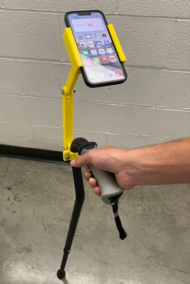
PROTOTYPING SMARTPHONE INTEGRATION To begin our investigation, an off-the-shelf smart phone and standard walk- ing cane were used to improve mobility and reduce isolation, concurrently enhancing physical and mental health in seniors. Integrating these features can be readily used for videoconferencing with family members or healthcare providers, wayfinding using GPS applications, and uploading of sensor data from the smartphone to medical providers. Sensors within the phone can collect data and provide real-time feedback, illustrating frequency of falls, changes in gait, and steps walked. With the fusion of useful digital appli- cations to an elderly patient’s daily walking device, the Smart Cane aims to improve kinesthetic confidence and reduce social isolation by connecting patients with their families and medical providers on-the-move. By the end of this design process, we developed a design that is inexpensive and intuitive, but can also serve as a developmental model for the further improvement of human factors and ergonomic considerations.
Design Specifications
Figure 1, Figure 2, and Figure 3 represent early iterations of the smartphone- integrated cane prototype, featuring a close-fitting and balanced attachment mount. However, early user testing raised concerns regarding the necessity of splitting attention between safe walking and viewing a screen. This risk can be somewhat mitigated by allowing for the screen to be adjusted and brought closer to the eyes and face. Strategically mounting the smartphone above the cane’s handle allows the device to fit within the user’s natural navigational field of vision, thereby improving spatial awareness and spinal posture. Equally important, the height adjustability option also enhances user autonomy and viewing comfortability.
Figure 1: Smartphone attachment mount.
The Smart Cane Project: Integrating Screen Interfaces and Physiological Sensors 297
Figure 2-3: User videoconferencing while walking.
Testing Methodology & Participant Feedback In collaboration with PACE Organization of Rhode Island (Health Services for the Elderly), our team collected user feedback (n = 5, age > 60 years, normal to mildly affected cognition) that addresses the following design and functional inquiries:
1. Using phone applications such as FaceTime and Zoom, does this proto- type encourage and enhance meaningful connections with other seniors? If so, how? If not, what improvements should be considered to further enhance this desired sense of connection? 2. Using phone applications such as Google Maps, does this prototype help in navigating one’s environment? Do users feel more confident and secure when leaving the house? 3. Is this prototype straightforward and intuitive to use? Does the visual interface make simple tasks as convenient as possible (i.e., is the screen big enough to be seen from this distance?) 4. What overarching design and user practicality improvements should be considered when moving towards future prototypes?
The PACE RI patient participants were requested to perform a set of tasks (i.e., using the Smart Cane stationary vs. mobile), using the smartphone- integrated prototype and the standard walking cane. Through these straight- forward tests, we observed how patients reacted to and interacted with the new differences in form-factor and functionality brought to the traditional cane.
Regarding the modified structure of the smartphone-integrated prototype, it was notable that the patient population of PACE RI would have a challeng- ing adjustment period. When using the standard walking cane, participants typically resort to balancing their canes on waist-level furniture, including the arm of a chair or a table surface, while transitioning between standing and sitting states. Attaching the smartphone mount above the cane’s handle pro- duces an asymmetrical weight distribution along the shaft of the cane. This introduces the possibility of unintentionally dropping the Smart Cane from a surface, thereby introducing a slew of unwanted risks. These risks include
sending false information to healthcare providers, damaging the smartphone itself, or agitating the patient. Further communication with PACE RI medical providers advised that this issue may be relieved by utilizing canes with four or more legs. Not only will this improve the stability of the prototype, but it will additionally remove the need to balance the handle against a surface.
Following these structural observations, the participants’ behavioral inter- actions with the prototype were noted. Participants stated that they were able to clearly see the phone while using the cane in the standing position. However, it was observed that patients shifted their focus away from walk- ing while using the prototype. For example, when responding to FaceTime calls from fellow seniors, participants stopped walking and shifted their eyes toward the screen, only continuing to walk when verbally reminded to do so. Due to the risk of injuries posed by interruptions in spatial awareness while moving, PACE RI professionals prefer a more covert integration of technology and even compared the smartphone design to “texting and driv- ing.” Overall, this feedback disagrees with the goals of improving navigation and social isolation simultaneously but stresses the importance of tailoring the Smart Cane towards an optimal geriatric patient niche. Although this iteration of the Smart Cane may not be the most effective for patients with attention impairments, the modular design can still be explored with patients who solely live with a physical/mobile injury and have retained proficiency with technology.
Based on the feedback collected on the first iteration of the Smart Cane, it became clear that the intended practicality of the smartphone itself needed to be reconsidered and refined. For instance, the smartphone attachment mount may be best reserved for convenient transportation while patients are moving. This can be especially advantageous for individuals with diminished strength or dexterity to hold an object for an extended period of time. Moreover, uti- lizing the walking cane as a small, portable storage unit may even lessen patients’ mental stress of having to carry multiple objects when traveling beyond their homes. Finally, both participants and medical providers raised concerns about the risk of phone applications significantly distracting the patient and leading to more injury. To relieve this, the smartphone may rather be optimally used to provide real-time biometric data, such as gait speed, and function in conjunction with additional sensors to store other kinesthetic vitals, such as grip strength. Ultimately, through an abundance of user testing in tandem with verbal feedback from healthcare providers, it became clear the user population’s comfortability and familiarity with technology must be considered throughout the development of future prototypes.
PROTOTYPING PULSE OXIMETER DATA COLLECTION After reflecting upon the safety concerns of attaching the phone directly onto the cane and its varying purposes, it became apparent that other critical approaches are necessary to form a more focused user experience. Thus, in the second phase of our design process, we focused on integrating sensors directly into the cane’s handle, aiming to provide real-time biofeedback to patients
The Smart Cane Project: Integrating Screen Interfaces and Physiological Sensors 299
and healthcare providers while eliminating the need for a modular attach- ment. The integrated sensor was a pulse oximeter, enabling non-invasive and continuous monitoring of vital signs such as oxygen saturation levels and heart rate. Pulse oximetry functions by shining light at specific wavelengths through bodily tissue to quantify levels of deoxygenated and oxygenated hemoglobin (Klaus et al., 2022). The resulting saturation (SpO2 %) value provides critical information to ensure normal blood oxygen levels (SpO2 between 94% and 100%) or the onset of abnormal respiration (Beasley et al., 2017). Especially in pre-hospital and emergency care settings, the SpO2% must be continuously monitored to maintain stable physiological vitals or respond to rapid decompensation of health (i.e., hypoxemia or serious falls).
During the development of this prototype, it was crucial to acknowledge the effect movement has on the human physiology, specifically on measure- ments such as oxygen saturation and heart rate. As the body transitions from rest to movement (ranging from brisk walking to strenuous exercise), the heart works faster to supply oxygen-rich blood to the body parts and corresponding muscles that are necessary to complete the movement. Conse- quently, the blood oxygen levels are expected to drop slightly in the initial period of movement (Ascha et al., 2018). In response to this, the body increases one’s respiratory rate to consistently maintain a normal SpO2 %, which should be at or above 90% as reported by several studies (Carmichael and Fetters, 2021). While heavy movement can affect pulse oximeter read- ings, an effect commonly referred to as motion artefact, this is not anticipated to be a significant obstacle for the Smart Cane, considering that the tar- get demographic is most likely to only engage in daily, patterned walking. Therefore, the pulse oximeter on the Smart Cane can still closely monitor the SpO2 % and heart rate of users; abnormally low recordings can alarm med- ical providers of shortness of breath, syncope, or further clinical emergency (Myatt, 2017).
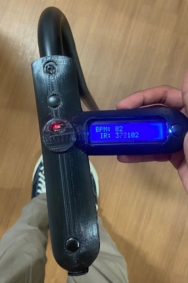
Design Specifications The 3D printed handle serves as the central component of our sensor- integrated prototype and is attached where a standard handle would exist. Its hollow structure houses various subcomponents that enable the intended functionality for seamless data collection. Inside the ergonomically designed handle, an Arduino Nano is connected to a pulse oximeter and a screen. The Arduino Nano acts as the control unit, processing the data from the pulse oximeter and facilitating communication with the mobile application. The small screen, strategically placed within the side piece of the handle away from where a hand would block it, allows users to view brief but crucial infor- mation while consistently maintaining a solid grip. The comfortable handle shell design also incorporates intentional cutouts to ensure visibility of the screen and undisturbed data collection by the pulse oximeter. This Smart Cane prototype is intuitively designed to be reliable and resilient, ensuring consistent and accurate data collection whilst mitigating the risk of fragility or complexity hindering the user experience.
Figure 4: Cane handle with pulse oximeter and data screen.
Figure 5-6: User walking test.
Alternative to the smartphone-integrate prototype, the sensor-integrated prototype offers several advantages. Eliminating the smartphone mount reduces the overall weight and potential imbalance of the cane, making it safer and more comfortable for users. Furthermore, monitoring vital signs during physical activity is crucial, especially for aging individuals with health conditions; thus, integrating a pulse oximeter directly into a device special- ized in movement and walking capabilities is a logical choice. Ergonomic considerations focused on the integration of the sensor in a discoverable yet unobtrusive and comfortable manner. The pulse oximeter allows users and healthcare providers to assess general well-being, gain insight into real time physiological changes when the user is active, and help healthcare providers make informed treatment recommendations.
Testing Methodology & Participant Feedback For the second prototype of Smart Cane, our team returned to PACE RI to collect user feedback (n = 5, age > 60 years, normal to mildly affected cognition) that addresses the new design specifications and functionalities. The following inquiries were answered by physical therapists and senior patients:
The Smart Cane Project: Integrating Screen Interfaces and Physiological Sensors 301
1. Please provide first impressions of the sensor-integrated prototype. 2. What are notable advantages and disadvantages specifically compared to the smart-phone integrated prototype? For the targeted user scenario, is this an optimal means of collecting and displaying health vitals? 3. Is the prototype straightforward and intuitive to use? Is the device’s functionality easily integrable into patients’ daily habits? 4. Does this prototype enhance patient mobility, both within and beyond the home environment? 5. What design and user practicality improvements should be considered?
After conversing with the physical therapy staff, the sensor-integrated prototype was tested by current senior patients at PACE RI. By request- ing patients to embark on a short, distraction-free walk, we observed how patients interacted with the new ergonomics and data collection features of the Smart Cane.
The redesigned ergonomics of the sensor-integrated prototype yielded sig- nificantly greater reception from physical therapists and elderly patients. Upon initial grasp of the modified handle, it was evident that maintaining a largely familiar walking cane structure enhanced reflex and comfortability. It was mentioned that the risk of the cane falling over when unused can never be fully eliminated. Alternatively, the Smart Cane functionality can also be established in the standard rolling walker, alleviating one’s stress to always keep the cane upright. For patients with strong enough upper extremities, however, this prototype’s structure should only require minimal acclima- tion. To address the placement of the emergency button and pulse oximetry sensor, participants did not report major difficulties in locating either, indi- cating a quick learning curve. However, after further use and consideration of potential emergency situations, PACE RI representatives and patients noted that the spatial location of the emergency button at the back of the handle may be too far of a reach for one’s thumb. In future prototypes, the emer- gency button may be optimally placed closer to the natural positions of the index or middle fingers, such that the button can be pushed swiftly in times of distress. Finally, regarding the pulse oximeter, participants advised that increased accuracy of recordings is more likely to be achieved if the sensor was placed on the underside of the Smart Cane’s handle, using the forefin- ger rather than the thumb. Physical therapists added that the same biological vitals (i.e., SpO2 and heart rate readings) can still be obtained through con- tact with the user palm. This palmar sensor placement increases effective skin surface area, while removing the requirement of sufficient strength and fine motor skills of the thumb to apply consistent pressure on the pulse oximeter over long periods of traveling.
In addition to evaluating the ergonomic modification of the handle, the participants responded to the updated sensor functionality. When asked about the advantages and disadvantages regarding the inclusion of sensors as opposed to a smartphone, physical therapists appreciated the covert- ness of the integrated sensor. This is especially beneficial for elderly users because passive data collection reduces the risk of an uncomfortable expe- rience. Achieving impactful functionality as discreetly as possible is likely
to be accepted by a greater population of users, especially those unfamiliar with various technologies. Nevertheless, PACE RI representatives reinforced feedback given during the first iteration of prototyping, reporting that the smartphone concept is feasible for technologically adept users. Users were in favor of moving the sensor to the underside of the handle, such that all fingers could remain in the normal gripping position without impacting the reliabil- ity and frequency of pulse oximetry measurements. Lastly, the users’ interac- tions with the small data display screen were noted. Users reported a slight shift in attention towards the changing values on the screen while completing initial rounds of walking. However, after briefly describing the purpose of the screen, attention was once again fully directed to walking safely. This exer- cise stresses the importance of thoroughly educating users of the Smart Cane’s functionality during early stages of usage to ensure long-term adoption of the technology.
DISCUSSION
Despite the benefits demonstrated in these prototypes, there are several areas for improvement in the development of the Smart Cane. Regarding hard- ware, a softer, more adaptable material should be considered for enhanced grip and comfort during prolonged use. The handle can also be improved with additional sensors, such as an accelerometer and gyroscope, providing more angles to analyze user health and physiological changes. It would also be beneficial to incorporate an easily accessible emergency button in the case of acute emergencies, triggering immediate alerts to caregivers. Regarding software, improving and streamlining data processing is important to facil- itate easier data analysis. For example, the sensors can be programmed to automatically alert medical providers if physiological measures are critically abnormal relative to a patient’s usual vitals.
Moreover, it would be beneficial to consider how medical technologies reduce sporadic measurements during user movement. Sports physicians can monitor individuals’ SpO2 % and heart rate through extraneous activities; therefore, such calibrated sensors are also likely to accurately respond to the movement of elderly users. Additionally, a more complex screen could be tested to display additional information, such as trends, alerts, or personal- ized recommendations based on the collected data. However, it is important to consider the potential safety issues that may arise from distraction due to increased visual complexity.
Throughout this project, we separately explored the integration of the smartphone and physiological sensors into the conventional design of the cane. Users reported advantages and disadvantages to both designs. The smartphone design offers a wide range of applications: collection of real-time health data, accessible wayfinding and video-conferencing apps that connect users to their community, and proximity to easily accessible methods for sum- moning first responders in emergency situations. The smartphone-integrated Smart Cane fundamentally offers low-cost strategy for adding serviceable fea- tures to a mobility aid, thereby building confidence for active and explorative movement.
The Smart Cane Project: Integrating Screen Interfaces and Physiological Sensors 303
However, for geriatric patients, commonly categorized as 65 years of age or older, medical concerns range widely and are likely to affect multiple sys- tems simultaneously. Over time, the persistence, or worsening, of these issues can lead to cognitive decline. Therefore, the smartphone design may not be appropriate for users who can be distracted when walking or otherwise suffer from cognitive issues (i.e., those with dementia). Consequently, this encour- aged us to pivot to an approach that integrated sensors and feedback directly into the cane itself.
The choice of integrating a pulse oximeter into the handle offered an opportunity to validate this approach. We learned that this was a straight- forward and effective way to both collect real-time physiological data, and to give the user and medical team immediate biofeedback. These data can be incorporated into therapeutic interventions where both healthcare provider and patient work together to set goals, monitor progress, and adapt as nec- essary. While this approach doesn’t contain the versatility of the smartphone, it does allow for discreet, and targeted biofeedback that fits easily into the familiar user experience of using a walking cane.
In future work, we’d like to explore the synthesis of these complementary strategies. The integration of the smartphone into the cane can be extremely useful for users who may have mobility challenges, but don’t suffer from cog- nitive decline. Guidelines for use, such as only using the smartphone when at rest, could also offer design strategies worth further consideration. The integration of other sensors and feedback, beyond the pulse oximeter, is also worth advancing to produce a more robust description of health during daily movement or active exercise. Notable metrics to consider include fall detec- tion, gait tracking, grip strength, and more. With harmonized collaboration of distinct features, both parties can better understand and respond to user- specific physiological data during stable conditions and situations of acute distress or analyze data retrospectively.
As we continue to develop the Smart Cane project, we hope to improve the usefulness of the integrated sensors in the cane by using the smartphone to collect, share, and visualize these health metrics, both to the users themselves, and with medical team networks at a distance.
ACKNOWLEDGMENT
The Smart Cane project team would like to sincerely thank the following rep- resentatives and patients from PACE Organization of Rhode Island (Health Services for the Elderly) for their time and feedback throughout our design and development (2022-2023): Melissa Simonian (Rehabilitation and Nutri- tion Services Manager), Jenny Donahue (Physical Therapy), Cheryl Gaucher (Physical Therapy), Kerry T. (Patient), and Chester P. (Patient). We’d also like to acknowledge the contributions of Mason Lee, Celina Ye, Andrew Chirstenson, Daniel Hu, Iris Huang, Whitney Hannallah, and Bohan Xu, as well as Dr. Kimani C. Toussaint, Jr. for many useful discussions. The authors acknowledge partial support from the National Science Foundation (Award Number: 2124312).
REFERENCES
Adebiyi, M. O., Abdulrasaq, S. and Olugbara, O. (2022) Abnormal gait and tremor detection in the elderly ambulatory behavior... Available at: https://pdfs.semantics cholar.org/29f0/125462a345321a3da452b2bcaa2bcbc366c8.pdf (Accessed: 10 July 2023). Agrawal, S., Hayes, B. and West, M. E. (2022) A novel perceptive robotic cane with haptic navigation for enabling... Available at: https: //www.semanticscholar.org/paper/A-Novel-Perceptive-Robotic-Cane-with-H aptic-for-in-Agrawal-West/013f66658ff6103fb85633903c4fe2ad2f178113 (Accessed: 10 July 2023). Ascha, M. et al. (2018) Pulse oximetry and arterial oxygen saturation during car-
diopulmonary exercise testing, Medicine and science in sports and exercise. Avail- able at: https://www.ncbi.nlm.nih.gov/pmc/articles/PMC6138536/ (Accessed: 12 July 2023). Beasley R., Chien J., Douglas J., Eastlake L., Farah C., King G., Moore R., Pilcher J., Richards M., Smith S., Walters H. (2017) Target oxygen saturation range: 92- 96% versus 94-98, Respirology (Carlton, Vic.). Available at: https://pubmed.ncb i.nlm.nih.gov/27587269/ (Accessed: 14 July 2023). Bluethmann, S. et al. (2023) Exploring the acceptability of the ‘Smart Cane’ to sup-
port mobility in older cancer survivors and older adults: A mixed methods study, Penn State. Available at: https://pure.psu.edu/en/publications/exploring-the-accep tability-of-the-smart-cane-to-support-mobility (Accessed: 10 July 2023). Carmichael, J. and Fetters, K. A. (2021) The normal oximeter levels while exercising | Livestrong, LIVESTRONG. COM. Available at: https://www.livestrong.com /article/491433-the-normal-oximeter-levels-while-exercising/ (Accessed: 12 July 2023). Chen, P. et al. (2015) A smart safety cane for human fall detection - semantic scholar.
Available at: https://www.semanticscholar.org/paper/A-smart-safety-cane-for-hu man-fall-detection-Chen-Li/d25b98b164e6e33bad52b59c4495b4d0550880af (Accessed: 09 July 2023). Dubowsky, S. et al. (2020) Pamm - a robotic aid to the elderly for mobility assistance and... Available at: https://www.semanticscholar.org/paper/PAMM -a-robotic-aid-to-the-elderly-for-mobility-and-Dubowsky-G%C3%A9not/ 5506f1b2c3495f31a3337c7428ec9b124a358268 (Accessed: 10 July 2023). Horner, B., Boldy, D. P. (2008) The benefit and burden of ‘ageing-in-place’ in an
aged Care Community, Australian health review: a publication of the Australian Hospital Association. Available at: https://pubmed.ncbi.nlm.nih.gov/18447827/ (Accessed: 10 July 2023). Hung, D. N. et al. (1970) Design and implementation of smart cane for visually impaired people, SpringerLink. Available at: https://link.springer.com/chapter/10. 1007/978-981-10-4361-1_41 (Accessed: 10 July 2023). Klaus, D., Modi, P. and Simon, L. V. (2022) Pulse oximetry, National Center
for Biotechnology Information. Available at: https://pubmed.ncbi.nlm.nih.gov/ 29262014/ (Accessed: 10 July 2023). Musselwhite, C., Holland, C. and Walker, I. (2018) The role of trans- port and mobility in the health of older people, Aston Research Explorer. Available at: https://research.aston.ac.uk/en/publications/the-role-of-transport- and-mobility-in-the-health-of-older-people (Accessed: 11 July 2023). Myatt, R. (2017) Pulse oximetry: What the nurse needs to know, Nursing standard (Royal College of Nursing (Great Britain): 1987). Available at: https://pubmed.n cbi.nlm.nih.gov/28351240/ (Accessed: 14 July 2023).
The Smart Cane Project: Integrating Screen Interfaces and Physiological Sensors 305
Nazri, N. M. A. et al. (2020) Smart cane for visually impaired with obstacle, water detection and GPS. Available at: https://www.semanticscholar.org/ paper/Smart-Cane-for-Visually-Impaired-with-Obstacle%2C-and-Nazri-Fauzi/ 4a91ec1bc343fffdbabffc35234792f8babce525 (Accessed: 10 July 2023). Sen, K. and Prybutok, G. (2021) A quality mobility program reduces elderly social
isolation. Available at: https://www.semanticscholar.org/paper/A-Quality-Mobi lity-Program-Reduces-Elderly-Social-Sen-Prybutok/1b4313a1b5cb6563b5624a 1248a7678551ac8caa (Accessed: 11 July 2023). Wahab, M. H. A. et al. (2011) Smart cane: Assistive cane for visually-impaired people, arXiv.org. Available at: https://arxiv.org/abs/1110.5156 (Accessed: 10 July 2023). Wang, T., Grobler, R. and Monacelli, E. (2020) Eval cane: An IOT based Smart Cane
for the evaluation of walking gait... Available at: https://www.semanticscholar .org/paper/EVAL-Cane%3A-An-IoT-based-Smart-Cane-for-the-of-Gait-Wang- Grobler/fabf2df8a24a1fd4106678ed27a6339daa56c718/figure/0 (Accessed: 10 July 2023). Wu, W. et al. (2010) The SmartCane system: An assistive device for geriatrics.
proceedings of the ICST 3rd International Conference on Body Area Networks, UCLA MII. Available at: https://mii.ucla.edu/publication/the-smartcane-system- an-assistive-device-for-geriatrics-proceedings-of-the-icst-3rd-international-conf erence-on-body-area-networks/ (Accessed: 10 July 2023).
LISTED IN THE AHFE DIGITAL BOOKSTORE CATALOGUE
Explore the complete digital volume
Emerging Technologies in Healthcare and Medicine
Read this individual research paper free through the original publisher, or explore the full digital proceedings book.
ISBN 978-1-958651-92-6
Explore this ISBN in the AHFE Bookstore ↗Listed in the July 2026 bookstore catalogue; search by ISBN to confirm current availability · Digital book purchase optional