Clemens Faller, Britta Weissert (2023). Addressing of human factors in the digital transformation of the automotive industry. In: Application of Emerging Technologies. AHFE Open Access, vol. 115, pp. 331–338. https://doi.org/10.54941/ahfe1004330
In many regions in Germany, including the so-called "Bergisches Land", the automotive industry has a far above-average significance in terms of employment and value added - this means that the region and the industry are also affected in a special way by the changes that are currently occurring in large numbers and at high speed. These changes have a major impact on the people in Germany, many of whom are directly or indirectly dependent on the automotive industry. Tightening environmental requirements, the increasing digitalization of products and processes, and the growing (de)globalization trends outline the spectrum of challenges facing companies. The different ways in which the subregions are affected by the changes in the automotive (supplier) industry and in the context of the mobility revolution are leading to heterogeneous transformation patterns. The central challenges are a shortage of skilled workers and the supply of companies with skilled workers as well as a lack of (digital) skills. The key to a successful transformation is an action-oriented knowledge intensification.The paper represents the TRAIBER (in engl. DRIVER) project, which has been running for a year at Bochum University of Applied Sciences together with many industry and university partners. The goal of the project is to establish a network under the umbrella of a "living" regional transformation strategy in which all relevant actors learn with and from each other in a participation-oriented process. The transformation strategy to be developed brings together the results of extensive analyses of developments in the region and in its environment (market, competition) with the results of intensive stocktaking of transformation in companies in the region. It forms the "parenthesis" of the project and guides the activities and measures for initiating and implementing the transformation process in the companies and organizations.Tailored to the specific needs of the regional actors, offers for competence development are (further) developed and tested - from the industrial level (adaptation of apprenticeships) to mixed forms ("dual studies") and higher education. In addition, a variety of formats are to be used to enable the players to successfully manage the changes to their business models associated with the transformation, the necessary organizational development measures and the transition to new value networks (higher-level knowledge process). Action-oriented knowledge transfer at the company level is central to a successful transformation process; the transformation competencies of company stakeholders are built up and (further) developed through in-depth application and testing of transformation tools.The result is a modular transformation kit that provides suitable solutions for the various patterns of involvement in the form of courses, methods, guidelines, etc. and is anchored in the region through intensive networking.The project thus represents an important factor in supporting human in the digital transformation of development, products and production processes in the automotive industry.
In many parts of Germany, including the “Bergisches Land”region, where the project “TrAIBer - Transformation of the Automotive Industry in the region Bergisches Land” is located, the automotive industry has a far above-average importance in terms of employment and value creation - thus the region and the industry are also affected in a special way by the changes that are currently occurring in large numbers and at high speed. Tightening ecological require- ments, the increasing digitization of products and processes, and the growing (de)globalization trends outline the spectrum of challenges facing companies. The different ways in which the subregions are affected by the changes in the automotive (supplier) industry and in the context of the mobility revolution are leading to heterogeneous transformation patterns. The key challenges are a shortage of skilled workers and the supply of companies with skilled work- ers as well as a lack of (digital) skills. The key to successful transformation is action-oriented knowledge intensification.
INITIAL SITUATION The impulses for change that are having an impact on the automotive (sup- plier) industry are currently occurring in clusters and at high speed. These
include ecological requirements (e.g., electromobility, tightening of emissions trading, discussion about plastic as a material) and their indirect conse- quences (e.g., changes in platforms, new design freedoms, changes in the depth of value added at OEMs). Digitization impulses are leading to signifi- cant changes - both in the product (networking, autonomous driving, increase in the importance of digital building blocks for product differentiation versus ‘mechanical differentiation’) and further in production (challenges to internal IT landscapes, application of modern systems (ERP or MES), establishment of a ‘digital twin’). In addition, there are transformation impulses from glob- alization - currently strongly characterized by uncertainties in global value chains (interference pattern chip crisis, supply chain resilience, political influ- ence patterns on raw material and trade issues).For the region studied in the project, the importance of the automotive industry is above average in terms of its overall contribution to employment and value creation.
Even if the region is less dominated by companies with products directly related to combustion engines, there are still discernible indirect impacts. For example, component groups are being eliminated due to (major) changes in OEM platforms, or suppliers are losing the ability to integrate their products as before due to the integration and disintegration of modules. In addition, the increasing digitization of products is leading to a situation in important industries in the region where the previous core competencies in the elec- tromechanical area are becoming significantly less important and are being replaced by software and networking competencies, which also require a very different business model. Impulses from ecological requirements as well as strategic considerations for securing supply chains are also leading to strong growth prospects for the companies, which, however, cannot be tapped easily in view of the technologies to be mastered in the future and the availability of skilled workers in the region.
The business landscape in the region is predominantly characterized by small and medium-sized enterprises, which are distinguished by a previously strong position in niches that offered good development prospects over a longer period of time.
Against this backdrop, transformation in the region requires a great deal of movement (some of which has to be relearned), which must be oriented to the different patterns in order to be effective. In most cases, human factors such as knowledge, motivation and willingness to change play a decisive role as the key to grasping and mastering the transformation requirements. There are good starting points for this in the region, e.g., through the dense uni- versity landscape, well-functioning regional networks with strong corporate involvement, and relevant education and training institutions - these actors are covered by the consortium partners in this project.
OBJECTIVE The overarching objective of the transformation network is to establish and develop a sustainable, learning transformation arena that brings together the various actors at and across the different levels of the innovation ecosystem “Automotive / Mobility” in a continuous learning process. The project aims
Addressing of Human Factors in the Digital Transformation of the Automotive Industry 333
to contribute to the further development of the region’s capabilities through knowledge intensification and, in particular, to expand the action-oriented knowledge base for addressing the transformation challenges. In order to achieve this objective, an inter- and transdisciplinary approach is pursued, linking not only the actors of the (regional) innovation system, but also differ- ent perspectives and approaches from different fields. An approach is pursued that allows the identification of actors and steering options in the context of long-term social change and the evaluation of the effectiveness of measures over a longer period of time.
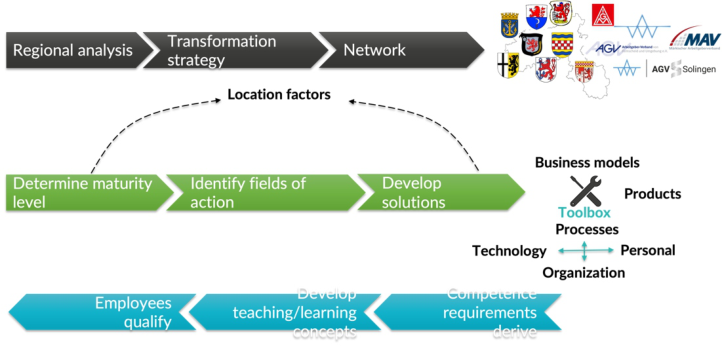
As a frame of reference for the development and establishment of the regional transformation network, the approach of “transition management” is used, which links the design and management of vertically integrated service and process chains with the organization of diverse interactions between business, science, state and civil society (Plamper 2006) and in this sense can also be interpreted as a strategy or instrument for sustain- able regional development. Transition management is a forward-looking form of a multilevel governance model that uses “visions” to be jointly developed as a starting point for formulating long-term innovation and trans- formation strategies. The structures and processes of the governance model itself must be managed in order to create sufficient “governance capacity” (Knill/Lehmkuhl 2002:43f.). The transition management approach puts such meta-management at the centre and is also “compatible” with the “philoso- phy” of real laboratories, which bring together different actors and open up the option of different development and transformation paths. The transition management approach for the TrAIBer project is shown in Figure 1.
Figure 1: Target system and work packages in the project.
The aim is to generate transformation knowledge and test measures for initiating learning processes and building competencies at all levels of the (regional) innovation system. The outlined process is intended to address not only technical issues, but rather socio-economic issues up to and including aspects of legal framework conditions, etc.
Cross-company knowledge transfer systems play an important role - espe- cially in the transfer of the solutions found - in order to adapt the skills of employees to the needs of the transformation and thus increase their moti- vation. These are particularly significant for SMEs, which are dependent, for example, on an inter-company organization of training and continuing education. In addition to classic instruments for training and continuing edu- cation, which are to be developed, for example, with a view to curricula (e.g., digitalization competence for mechatronics engineers, AI knowledge in electrical engineering studies) and instrument use (e.g., testing VR glasses, production labs), the (further) development of (as low-threshold as possible) forms that are directly cross-company (such as arcades) is important in order to enable access and knowledge development, especially among SMEs. These activities on site and in inter-company transfer are the starting point for an action-oriented implementation of a transformation strategy for the region, taking into account the region-specific industry development, the relevant, user-oriented knowledge about the market and competitive situation, and the funding environment.
METHODICAL PROCEDURE OF THE DEVELOPED MATURITY MODEL The aim of the maturity model developed and the training courses based on it that are still to be developed is to enable companies to successfully manage the change process initiated by this project. The SMEs addressed are to be picked up at very different levels, particularly with regard to their transformation toward the use of digitization and AI.
A maturity model is “a sequence of maturity levels for a class of objects and thereby describes an anticipated, desired, or typical development path of these objects in successive, discrete ranks, beginning with an initial stage and ending with complete maturity” (Becker et al., 2009).
With the help of these maturity models, the processes and work meth- ods for the implementation of a product manufacture or development can be described. Their aim is to evaluate the processes and assess their qual- ity. Through this evaluation the possibility of a constant improvement and restructuring measures is given.
Digital transformation describes the changes to processes such as strategy, business models and organization in a company that are brought about by the use of digital technologies. Digital transformation serves not only to secure the future and competitiveness of the company, but also to increase it. To remain competitive, companies must review their processes and organization and continually adapt to the new digital reality. The process is reviewed using a maturity model, the result of which enables the company to actively shape a change or transformation.
The individual fields of action of the TrAIBeR maturity model were devel- oped from the analysis of existing models, a literature analysis and expert interviews. The determination of the digital maturity of a field of action is defined by 5 maturity criteria, i.e., implementation, activities or capabilities that exist in a company. The maturity criteria differ in the individual fields
Addressing of Human Factors in the Digital Transformation of the Automotive Industry 335
of action, but are always present in 5 gradations. In the following, the fields of action are listed:
Strategy
Management Systems
Products & Functionalities
Production & Intralogistics
Organization
Personnel
Suppliers & Raw Materials
Customers
Cooperation & Network
Promotional opportunities
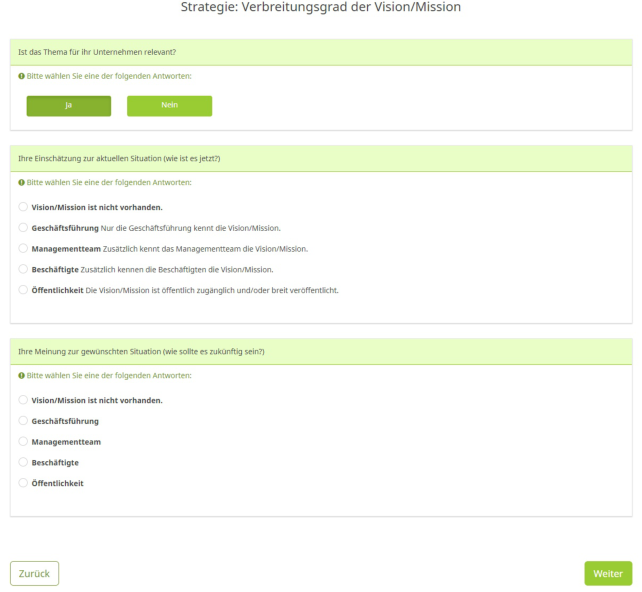
Figure 2: Web based self-assessment tool.
The questionnaire comprises a total of 76 questions in the above- mentioned fields of action. The implementation is web-based and can thus be carried out by various stakeholders in the companies. For each individual category from the fields of action, there is a query about the relevance, since not all companies are affected by all aspects and not all stakeholders in the companies have something to say about all points (see Figure 2).
The assessment on the current situation (how is it now?) is made in five gradations, which indicate the degree of fulfilment of the criteria, which
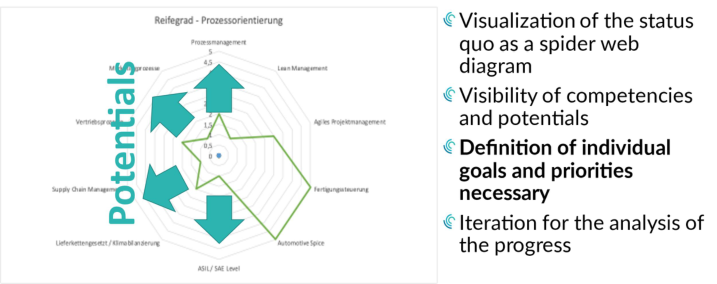
are provided with a descriptive text. Likewise, participants must select the desired target state from these assessment levels, as not all companies aim for the highest level of fulfilment due to resource constraints. The results of the assessment are visualized in spider diagrams for all categories as shown in Figure 3.
Figure 3: Maturity model assessment result visualization.
Realization of a Tool Box for the Implementation of the Transformation Instruments Now that the maturity model has been developed and is being used in the project, the transformation tools are being developed. For this purpose, a “tool box” with transformation modules differentiated e.g., according to patterns of affectedness and specific initial situation is being developed.
Typical transformation modules are, for example, innovative learning and change impulses that specifically address technologies such as IoT, Industry 4.0 and model-based systems engineering. On a higher level, these mod- ules are supported via gamification methods and increase motivation and willingness to act in a way that is appropriate for the target group. In addi- tion, the participants are enabled to carry out an independent and objective sustainability assessment of the current situation of their own company in the future. In the product innovation module, participants train options for action for sustainable product and process innovation in their own concrete company context. The modules are supplemented by guides on behavioural and situational prevention, which provide companies with recommendations on how to reduce avoidable stress and how to train employees with regard to unavoidable stress (e.g., in the form of anti-stress training). Modules for involving employees in the change process can promote trust in the change measure and thus job satisfaction and organizational commitment. Managers play a central role with regard to organizational change. They are often facil- itators who pass on the content of the change from the upper management levels to the employees. Failure to convey change visions can result in demoti- vation and employee actions that sabotage or counteract the change. For this reason, it is important to convince managers themselves of the value of change measures and to train them in how to communicate the content to employees.
Addressing of Human Factors in the Digital Transformation of the Automotive Industry 337
For this reason, managers should be trained in how to communicate visions of change.
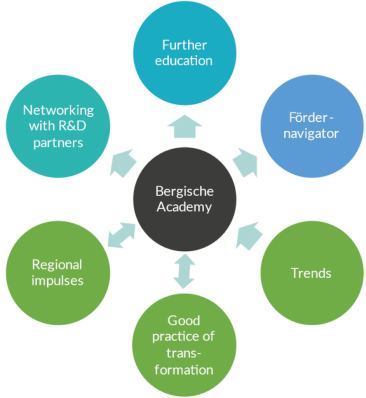
The complete toolbox for the development of the companies to successfully mastering the transition process is offered after the project by the academy “Bergische Akademie”, which foundation is the central result of the project. The offer structure of the academy is shown in Figure 4.
Figure 4: Offer to companies to master the transition process.
CONCLUSION
With the TrAIBer project, we are developing a system for making the changes in the areas of digitization and climate change, which have a decisive influ- ence on the automotive industry, manageable for companies by developing a transformation strategy. An important core of the project is the develop- ment of a maturity model and further training courses to make the employees involved ready for the transformation.
FUNDING NOTICE The Federal Ministry of Economics and Climate Protection of the Federal Republic of Germany is funding TRAIBER.NRW within the framework of the funding announcement “Transformation Strategies for Regions in the Automotive and Supplier Industry” with EUR 4.1 million until mid-2025.
REFERENCES
Becker, Jörg; Knackstedt, Ralf; Pöppelbuß, Jens (2009): Entwicklung von Reifegradmodellen für das IT-Management. Wirtschaftsinformatik: Vol. 51, No. 3. Springer. PISSN: 1861–8936. pp. 249–260.
Knill, Christoph & Lehmkuhl, Dirk. (2002). The national impact of European Union regulatory policy: Three Europeanization mechanisms. European Journal of Political Research - EUR J POLIT RES. 41. 255–280. 10.1111/1475-6765.00012. Ralf Kleinfeld, Harald Plamper, Andreas Huber (Hrsg.); Regional Gover- nance: Regional Governance: Steuerung, Koordination und Kommunikation in regionalen Netzwerken als neue Formen des Regierens, V&R unipress; 1. Edition (1. Oktober 2006), ISBN 978–3899713060.
LISTED IN THE AHFE DIGITAL BOOKSTORE CATALOGUE
Explore the complete digital volume
Application of Emerging Technologies
Read this individual research paper free through the original publisher, or explore the full digital proceedings book.
ISBN 978-1-958651-91-9
Explore this ISBN in the AHFE Bookstore ↗Listed in the July 2026 bookstore catalogue; search by ISBN to confirm current availability · Digital book purchase optional