Takahiro Asaeda, Munenaga Koda (2023). Effects of Imaging Cooking Behaviors on Cooking Intentions of University Students living alone. In: The Human Side of Service Engineering. AHFE Open Access, vol. 108, pp. 205–215. https://doi.org/10.54941/ahfe1003122
Factors that promote cooking behavior for the purpose of health promotion have been examined. Against this background, the present study examined whether imagining oneself cooking improves cooking intention and cooking efficacy in 24 college students (11 female, 13 male, M=21.25±2.27 years old) who lived alone by using a hypothetical situation method. The experiment consisted of reading a description of a situation in which the participants were asked to make a decision about whether or not to cook, and answering a questionnaire about their intention and efficacy after performing the task. The experimental group was asked to read the description of the scene and to describe what they imagined in the scene. The control group was asked to read the scene descriptions, convert the characters to katakana, and write them down from the opposite direction. The results showed that there was no significant difference in intention and efficacy between the experimental and control groups, but there was a moderate effect size, indicating a tendency to arouse intention and efficacy. In the future, it is expected to be verified as a simple motivational strategy by comparing it with the case of presenting only instructional stimuli.
Human Factors Engineering involves understanding the need for compreh- ensive cooking behavior is thought to promote healthy eating, and research has been conducted on the relationship between cooking frequency and the degree of belief in the feasibility of cooking (hereafter referred to as cooking efficacy when limited to cooking, and efficacy when targeting the feasibility of the behavior in general) and cooking intention (Lahne, Wolfson, & Trubek, 2017; Lavelle et al., 2017). And the study by Lavelle et al. (2017) conducted a video-based cooking practice with mothers and examined whether con- fidence and intention to cook were aroused immediately after the practice. However, if cooking intentions change depending on the situation, such as the time of day when the meal is prepared and the mood of the moment, it is unclear whether the intentions measured in Lavelle et al. (2017) are also aroused in situations other than the cooking practice at the time of the study.
Therefore, it is necessary to examine the factors that commonly lead to the arousal of intentions in different situations.
By the way, episodic future thinking is a cognitive function that evokes intentions across situations. Episodic future thinking is defined as thinking about a possible future situation and imagining that situation in concrete terms (Schacter et al., 2008). Gaesser & Schacter (2014) and Toyoda et al. (2021) reported that having participants imagine helping others evoked their intention to help others.
Furthermore, Oguni et al. (2020), who also examined the effect of imagining helping behavior on helping intention, reported that helping ima- gination improves helping efficacy. This is consistent with the work of Bandura (1977), who showed that efficacy is associated with increased beh- avioral intention. Therefore, it is thought that the arousal of behavioral intention by imagination occurs for all behaviors, and that imagination can also lead to the arousal of the intention to cook.
In addition, Toyoda et al. (2021) pointed out that the desire to reduce the negative feelings that arise from empathizing with the helped person may have aroused the intention to help. However, in cooking for oneself, the pre- sence of others is not assumed. Therefore, it would be beneficial to examine the effect of imagining oneself cooking on the intention to cook, in order to examine whether the motivational effect of imagining can be obtained not only for others but also for oneself.
In this study, we follow the procedure of a previous study (Toyoda et al., 2021) to examine whether cooking intention and efficacy are improved by imagining oneself performing the cooking task. In addition, in order to con- firm whether the measured intentions are intentions that assume action, we examine whether there is a positive correlation between cooking intention and cooking efficacy. The three hypotheses are as follows.
1. Cooking intention will be higher when one imagines cooking than when one does not. 2. Cooking efficacy, which influences intention, will be higher when parti- cipants imagine cooking than when they do not. 3. Cooking intention and cooking efficacy were highly correlated to the same extent.
Method
Duration The experimental period was from December 20, 2021, to January 21, 2022.
Participants In this study, 42 university students in Tokushima Prefecture were screened to exclude those who were not likely to cook in their daily lives and those whose positive attitude toward cooking could arouse their intentions without being influenced by the procedures of imagining. Screening items included type of residence (living alone or living together), cooking experience, availability of a kitchen, diagnosis or treatment history of mental illness, attitude toward
Effects of Imaging Cooking Behaviors on Cooking Intentions of University Students 207
cooking, confidence in cooking, subjective economic status, and an e-mail address used to guide participation in the experiment.
The attitude toward cooking was asked in a 7-syllable question format, “How much did you think about cooking for yourself after you entered col- lege?” The respondents were asked the question “How much did you think about cooking for yourself after entering college?” The confidence in coo- king was measured by a 7-point scale from “1: not at all” to “7: very much”. The respondents were asked to answer “1: not at all confident” to “7: very confident” using a 7-choice scale.
However, the following h supplementary explanation is given here as follows. “Cooking refers to the preparation of fresh foods such as meat, vegetables, and grains. It is not the same as reheating a meal or leftovers that have already been prepared.” In addition, the subjective economic status was indicated by the item “Do you have enough money at present?” using a 7-point scale from “1: I can’t afford it at all” to “7: I can afford it very much”. The subjects were excluded if they had a roommate, lacked a kitchen, cooking utensils, and cooking experience, had a history of mental illness dia- gnosis and treatment, and answered “1” or “7” to the above items using the 7-point scale. Those who met these screening criteria were individually e-mailed and scheduled. As a result, 24 university students (11 females and 13 males, M = 21.25±2.27 years old) who lived alone participated in the experiment. Specifically, 12 were in the experimental group (5 females and 7 males, M = 20.92 ± 1.56 years) and 12 were in the control group (5 females and 7 males, M = 21.58 ± 2.84 years).
Experimental Stimulus Fifteen university students (4 females, 11 males) were interviewed about the events when they thought of cooking or when they did cooking, and the situations that were extracted by combining the responses with each other were expressed in simple and clear sentences. The created textual stimuli were then used in a survey of 12 university students (7 female, 5 male) under the title of “Survey of attitudes toward cooking”, in which they were asked about their “experience (yes/no)”, “ease of imagining (1: not at all to 7: can imagine very well)”, “need for cooking (1: not at all to 7: can imagine very well)”, and “need to cook (1: not at all to 7: can imagine very well)”. The final stimuli were determined after a preliminary survey in which participants were asked about their cooking intentions (1: never thought of doing it to 7: thought of doing it very much).
The first method of selection was to exclude those that selected “no” in the “experience” category. Next, based on the need to vividly imagine the experimental stimuli in this study, we excluded those with a mean value of less than 4.5 for “ease of imagining” due to the need to perform an imaginative task. As for the rating of “cooking intention”, we excluded scenes with a mean value of 5.0 or higher in order to exclude scenes with an excessively high rating, in line with the purpose of the experiment. As a result, eight scenes were selected as experimental stimuli. From the eight experimental stimuli, two scenes that showed values relatively close to the selection criteria were used for the practice trials. The eight experimental stimuli were as follows.
208 Asaeda and Koda
“I looked at the clock and it was time for lunch or dinner. So I looked in the refrigerator and found that there were enough ingredients.” (Scene 1), “I saw a recipe on a social networking site, video, or recipe site for a dish that you used to think looked good.” (Scene 2), “I thought about eating something, but I am tired of the food I always eat.” (Scene 3), “I casually opened the refri- gerator and found some food that was about to expire.” (Scene 4), “When I was thinking about what to eat, I wanted a taste of my mother’s cooking (a nostalgic taste).” (Scene 5), “I was worried about my stomach’s skid. So I loo- ked in the refrigerator and found enough food.” (Scene 6), “I have no plans for the day, but I don’t want to spend money on food.” (Scene 7), “Mr. ____ (can be a close friend, a lover, or a younger family member) is coming to stay at my house today, and I am thinking about what to do for dinner.” (scene 8), and the two experimental stimuli are as follows: “I suddenly became curi- ous about a dish that I had eaten at a restaurant before and remembered as being very tasty, and how it was made.” (Exercise 1), “I have finished my eve- ning errands and wanted to go to a restaurant to get something that would give me energy. But all the stores are closed except for the grocery store.” (Exercise 2).
Measurement Face Sheet Respondents were asked their gender, age, grade, whether or not they have a meal plan (the “Co-op Cafeteria Usage Subscription System,” which requires advance application), and how long (in months) they have been cooking for themselves since entering university. No significant differences were found in all items.
Cooking Intention To measure the intention to cook, we used a 7-point scale from “1: I didn’t think about cooking at all” to “7: I thought about cooking very much”, referring to Toyoda et al. (2021).
Cooking Efficacy To measure cooking efficacy, using a 7-point scale from “1: I didn’t think I could cook at all” to “7: I thought I could cook very well” with reference to Oguni, et al. (2020).
Procedure Outline of the process from recruitment to participation in the experiment The experimental period was from December 20, 2021, to January 21, 2022.
A poster titled “Investigation of Decision-Making in Eating Situations among Unaccompanied University Students” was displayed at the univer- sity and distributed during breaks before and after lectures, and through a nepotistic method. Candidates who met the screening criteria were then indi- vidually sent an e-mail inviting them to cooperate in the study. As soon as
Effects of Imaging Cooking Behaviors on Cooking Intentions of University Students 209
consent was obtained, the schedule was arranged and the experiment was conducted individually in the laboratory.
Obtaining Consent First, we explained the content of the experiment to the subjects who came to the room. At that time, we explained to the subject that this was an experiment to examine the decision-making process regarding meals among university students who lived alone.
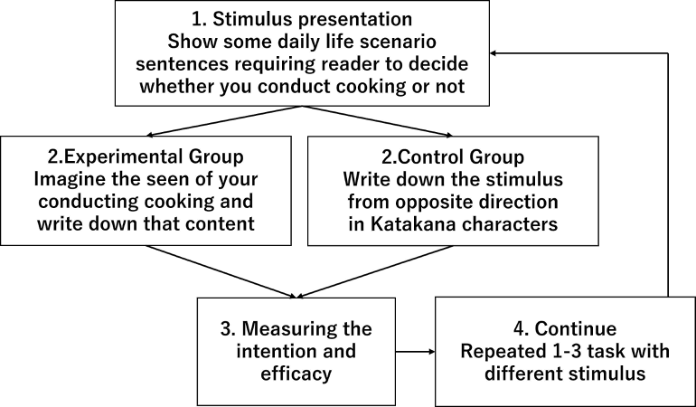
Experiment The procedure for this experiment was based on that of Toyoda et al. (2021). First, the experimental stimuli were presented in writing, and the experimen- tal group was asked to imagine the situation and describe what came to their minds on a form.
Specifically, the experimental group was first given a face sheet and a booklet containing the instructions for the task, the stimulus text, and the questions. One page of the booklet contained the instructional text, the expe- rimental stimuli, and the experimental task, and the next page contained the questions based on the task. The next page contained the questions based on the task. Next, the participants were asked to respond to the face sheet before the presentation of the stimuli. The teaching leading up to the pre- sentation of the stimuli in the experimental group was as follows, “This is a situation in which you are asked to decide whether or not to cook. Imagine that you are cooking in the above situation, and describe what you would do in the box below as best you can”. The subject was then asked to read the experimental stimuli. The subjects were then asked to read the experimental stimuli and imagine that they were cooking in 150 seconds. During the task, the subjects were asked to write down their imagination in bullet points in the box below the stimulus text (Figure 1).
At the end of the task time, the participants were instructed to move on to the next page and were asked to respond to the indicators within 65 seconds. These procedures were repeated 8 times, with the order of stimulus pre- sentation randomly assigned among participants after they understood the procedures.
The control group was asked to write the descriptions of the experimental stimuli in katakana, following Toyoda et al. (2021). Other than the above, the structure of the booklet and the experimental procedures were the same as those used in the experimental group, except for the task content instru- ctions. The instructions for the task were “Please rewrite all the letters of the following sentences in katakana, starting from the back and working down to the bottom square.
This experiment was also conducted using a teleconferencing system (Zoom) for 2 subjects (7 females and 5 males) between January 13 and Janu- ary 16, 2022, because of difficulties in conducting face-to-face experiments in the laboratory due to the spread of novel coronavirus infection or at the request of the subjects. A Google Form was used instead of a booklet for this purpose. The form was composed of different pages, each containing a
210 Asaeda and Koda
Figure 1: Task flow of the experiment.
confirmation of consent to participate in the experiment, a face sheet, experi- mental stimuli, and a questionnaire regarding cooking intentions. The tasks were carried out by typing on a laptop computer.
Ethical Considerations In conducting the research, ethical considerations were taken into account with respect to (1) adherence to the principles of the Declaration of Helsinki, (2) respect for the dignity of the participants, (3) prior full explanation and informed consent, (4) thorough protection of personal information, (5) conducting socially beneficial research that contributes to the intellectual foundation, health and welfare of mankind, (6) giving priority to guarante- eing the human rights of the participants to scientific or social benefits, and (7) ensuring appropriateness and transparency of the research.
This study was conducted with the approval of the Research Ethics Review Committee of the Graduate School of Decision Science and Technology, The University of Tokushima (approval date: December 20, 2021, receipt number: 259).
RESULT
There were no deficiencies in the experimental procedures for the 24 partici- pants. Therefore, all 24 participants were included in the analysis.
First, a χ2 test was conducted to compare the equality of gender, grade level, and percentage of meal plan users in the two groups. The results showed that there were no significant differences in gender (χ2(1) = 0.00, p = 0.00), grade (χ2(5) = 2.00, p = 0.85), and meal plan users (χ2(1) = 1.51, p = 0.21). The mean age of the two groups and the mean duration of self-catering were also compared. The results showed no significant differences in age
Effects of Imaging Cooking Behaviors on Cooking Intentions of University Students 211
Equation reproduced from the original PDF.
To examine the influence of the cooking imagery on the cooking intention, the mean (SD) of the cooking intention for each textual stimulus was calcu- lated. The mean +1 SD of “1”, “4”, “5”, and “8” exceeded the maximum rating value of 7, and thus, we judged that a ceiling effect had occurred in these 8 scenes and excluded them from the analysis. As a result, the cooking intention score was calculated as the mean value of the cooking intention for the four scenes (“2”, “3”, “5”, and “7”). The mean value of the cooking efficacy was also calculated and used as the cooking efficacy score (Table 2).
Table 1. Basic attributes of the participants.
Table available in the original PDF paper.
Equation reproduced from the original PDF.
Control Group (n=12) Sex (number) n.s. Female 5 5 Male 7 7
To examine the effect of the experimental manipulation (imagination) on cooking intention and cooking efficacy, a difference of means test (t-test) was conducted with group type as the independent variable and cooking intention and cooking efficacy scores as the dependent variables.
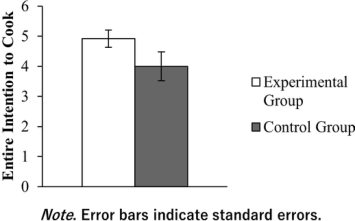
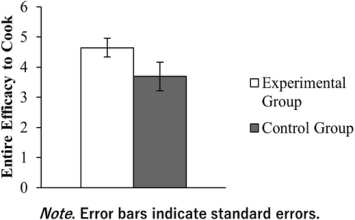
The results showed that there were no significant differences in either cooking intention (t(22) = 1.64, p = 0.11, d = 0.65) or cooking efficacy (t(22) = 1.71, p = 0.10, d = 0.67). However, both effect sizes were moderate (Cohen, 1969) (Figures 2; Figure 3).
To examine the relationship between cooking intention and cooking effi- cacy, correlation coefficients between cooking intention and cooking efficacy were calculated within groups. The results showed a significant strong posi- tive correlation between cooking intention scores and cooking efficacy scores (experimental group: r = 0.74, p < .01; experimental group: r = 0.87, p < .01).
Discussion
In this study, we examined whether imagining oneself cooking improves coo- king intention and efficacy. In addition, in order to confirm whether the measured intentions were intentions that anticipated actions, we examined whether there was a positive correlation between cooking intentions and cooking efficacy.
Although the results showed no significant differences in intention and effi- cacy, the effect sizes were moderate in both cases. Therefore, it was suggested that the experimental procedure could have a certain influence on cooking intention and efficacy.
Figure 2: Comparison of cooking.Figure 3: Comparison of cooking efficacy.
Effects of Imaging Cooking Behaviors on Cooking Intentions of University Students 213
The correlation coefficient between cooking intention and cooking efficacy was calculated for each group, and a strong positive correlation was found for both groups. This indicates that the intention measured in this study was strongly related to self-efficacy, which predicts the occurrence of the behavior.
As described above, the present study showed that cooking intention and cooking efficacy tended to be enhanced by imagining, and hypotheses 1 and 2 were partially supported. Hypothesis 3 was supported by the strong correlation between cooking intention and cooking efficacy. Therefore, the hypothesis that cooking intention is aroused by imagining cooking behavior is partially supported.
Next, we discuss the reasons for the arousal of cooking intentions in this study (Table 3). In this study, it is thought that efficacy or positive emotions, rather than negative emotions, influenced the arousal of intentions. This is because the cooking behavior in this study was a behavior performed for the sake of oneself. Toyoda et al. (2021) reported that helping intention is aroused by the desire to reduce negative emotions aroused by understanding others’ emotions. However, the cooking behavior targeted in this study were situations in which the participants themselves felt hungry and mealtimes. Therefore, understanding of others’ emotions was not required, and negative emotions were not aroused. In addition, Lavelle et al. (2017) and Oguni et al. (2020) showed that efficacy affects intention, which is consistent with the results of this study. Therefore, it is thought that the cooking efficacy led to the arousal of cooking intention in the present study. In addition, Lavelle et al. (2017) reported that positive affect affects the intention to cook again, which suggests that positive affect also affects intention. However, the present study did not measure emotional indices, so further discussion is needed.
Next, we address three limitations of this study. The first issue is the small sample size. Although this study showed that the imaginative procedure may
Table 3. Comparison of previous studies.
Table available in the original PDF paper.
214 Asaeda and Koda
have affected the dependent variable, there were no significant differences. In the future, it will be necessary to ensure the influence of the experimental procedures with a sufficient sample size.
Second, the study did not examine emotional indices. In the present study, the possibility was mentioned that efficacy, rather than motivation to reduce negative emotions, may have led to the arousal of cooking inten- tion. However, unlike Lavelle et al. (2017), which pointed out a relationship between positive emotions and cooking intention, this study did not measure emotional intensity (Table 3). Therefore, it is necessary to measure emotions and examine the process of evoking intentions in detail in the future.
Third, it is not possible to examine which of the components of the image affected the results. In this study, we conducted an experiment in which par- ticipants read an instructional text and performed a task. The experimental group was asked to imagine a scene of cooking, while the control group was asked to write the stimulus sentence in katakana from the opposite direction. These procedures were designed on the assumption that imagining consists of setting a linguistic goal and retrieving related episodic memories (Schacter et al., 2008). However, while both verbal goal setting and imagining were conducted in the experimental group, both were not conducted in the con- trol group, and we cannot rule out the possibility that only verbal goal setting or memories affected the results. In the future, it will be necessary to compare the results with those of a procedure that does not involve imagining, such as administering a questionnaire immediately after giving only instructions or asking the participants to recall past scenes instead of imagining.
Finally, we discuss the prospects of this study. This study showed that 150-second descriptions of imaginative actions may evoke intentions even in actions performed for oneself. In the future, it is expected to examine its effectiveness as a simple motivational strategy.
ACKNOWLEDGMENT
We appreciate Associate Professor Hideki Tsumura of the Graduate School of Technology, Industrial and Social Sciences, Tokushima University, for his advice on the overall research. Next, we would like to acknowledge all the subjects who gave up their valuable time to participate in the experiments. Finally, this research was supported by JSPS KAKENHI Grant Number 20K14187.
REFERENCES
Bandura, A. (1977). Self-efficacy: Toward a Unifying Theory of BehaviouralChange. Psychological Review, 84, 191–215. https://doi.org/10.1016/0146-6402(78) 90002-4. Cohen. (1969). Statistical Power Analysis for the Behavioural Science. New York:
Academic Press. Gaesser, B., & Schacter, D. L. (2014). Episodic simulation and episodic memory can incr-ease intentions to help others. Proceedings of the National Academy of Sci- ences of the United States of America, 111, 4415–4420. https://doi.org/10.1073/ pnas.1402461111.
Effects of Imaging Cooking Behaviors on Cooking Intentions of University Students 215
Lahne, J., Wolfson, J. A., & Trubek, A. B. (2017). Development of the Cooking and Food Provisioning Action Scale (CAFPAS): A new measurement tool for individual cooking practice. Food Quality and Preference, 62, 96–105. https://doi.org/10. 1016/j.foodqual.2017.06.022. Lavelle, F., Hollywood, L., Caraher, M., McGowan, L., Spence, M., Surgenor, D.,
McCloat, A., Mooney, E., Raats, M., & Dean, M. (2017). Increasing intention to cook from basic ingredients: A randomized controlled study. Appetite, 116, 502–510. https://doi.org/10.1016/j.appet.2017.05.024. Oguni, R., Kobayasi, M., Otake, K. (2020). Enjo kodo no sozo wa enjo ito wo takaeru [Imaging helping behavior increasing intention to help]. THE JAPANESE JOURNAL OF PERSONALITY, 29, 20–22. https://doi.org/10.2132/personality. 29.1.7. Schacter, D. L., Addis, D. R., & Buckner, R. L. (2008). Episodic simulation of future
events: concepts, data, and applications. Annals of the New York Academy of Sciences, 1124, 39–60. https://doi.org/10.1196/annals.1440.001. Toyoda, Y., Kobayashi, M., Otake, K. (2021) Enjo sozo ga- enjo ito ni oyobosu eikyo-irasuto Shigeki to bunnsho Shigeki no hikaku-[Effect of imaging helping to intention to help-comparison between illustration stimulus and sentence stimulus- ]. Shinnrigaku kennkyu, 92.111–121. https://doi.org/10.4992/jjpsy.92.20002.
LISTED IN THE AHFE DIGITAL BOOKSTORE CATALOGUE
Explore the complete digital volume
The Human Side of Service Engineering
Read this individual research paper free through the original publisher, or explore the full digital proceedings book.
ISBN 978-1-958651-84-1
Explore this ISBN in the AHFE Bookstore ↗Listed in the July 2026 bookstore catalogue; search by ISBN to confirm current availability · Digital book purchase optional