Ahn Dung Ngô, Tony Venditti, Phuong Tran Nguyen Duy (2023). On the Development of Protective Devices for Bending Press. In: Safety Management and Human Factors. AHFE Open Access, vol. 105, pp. 16–23. https://doi.org/10.54941/ahfe1003065
Brake presses are machines which are widely found in the manufacturing industry. They enable metal sheets and plates to be bent in multiple ways so as to shape a wide variety of parts. The very principle by which these machines function creates a pinch and crushing zone for operators notably as far as their hands and fingers are concerned. This paper recounts research projects conducted in the last 30 years at École de Technologie Supérieure (ETS). Historically, the first publication described the state of the situation in the 1990s in terms of safety of brake presses found in the transport equipment and machine manufacturing industry in Quebec. It was found that a small percentage of the brake presses surveyed were properly equipped with adequate safety devices. The research report showed a number of problematic situations arising in industry such as complex shapes (for example, cones, tubes, boxes with multiples bends) which render use of protective devices available at the time difficult and even unfeasible. To address the issue of the low prevalence of protective devices on brake presses, a study on the feasibility and applicability of light curtains on these machines was conducted. It was shown that the mode of operation of the light curtain as well as the geometry of the work-pieces were crucial factors which determined the feasibility of light curtains as effective protective devices on brake presses. Difficulties in using these devices in certain cases were uncovered. To alleviate these difficulties, a further research project sought to develop more flexible protective device on brake press. The concept was based on computer vision. A bracelet was to be worn by the operator. A system of cameras captured images of the operator’s hands and a computer algorithm calculated in real time the position of the hand with respect to a defined hazard zone. From the risk assessment and reduction viewpoint, a risk evaluation methodology based on fuzzy numbers was developed to address the issue of lack of reliability both machine and human-related in assessing probability of occurrence of hazardous events. A risk reduction methodology was also proposed helping to identify action priorities in an analytical way.
On the Development of Protective Devices for Bending Presses 17
INTRODUCTION
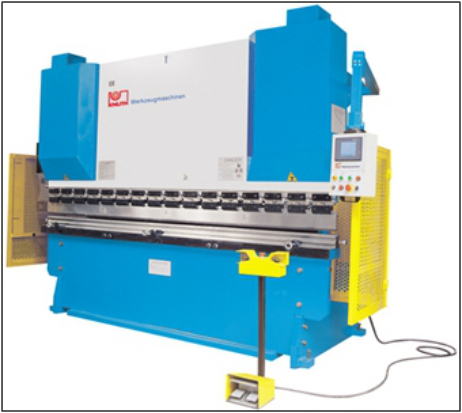
A press brake is a machine designed and intended to carry out various work on sheet metal including bending. Figure 1 shows a typical press brake. The protection of workers who use press brakes is however considered difficult, due to the varied types of parts geometry and characteristics of these machines and the multiplicity of their conditions of use. Furthermore, during operati- ons, the operator’s hands are close to the danger zone. The risk of crushing hands is significant and results in many serious accidents. The type of work- pieces (their geometry) is an important factor in brake press safety, as the studies by Venditti (2005) and by (From Ngô et al. (1998)) Various prote- ctive devices have been available for press brake applications such as notably, two-hand controls, safety light curtains and laser sensing system.
This paper presents a survey of research conducted in the last 30 years at École de Technologie Supérieure (ETS) in the field of brake press safety.
Figure 1: A hydraulic press-brake. (From http://www.directindustry.com.)
IRSST RESEARCH ON BRAKE PRESSES IN THE TRANSPORT EQUIPMENT AND MACHINE MANUFACTURING SECTOR Ngô et al. (1998) published a study, funded by the Research Institute on Occupational Health and Safety of Quebec, IRSST, which described the cha- racteristics of 107 bending presses surveyed in manufacturing plants in the transport equipment and machine manufacturing industry in the 1990s. A salient conclusion reached by the research was to the effect that 84 % of the presses surveyed did not have a protective device guarding the point of ope- ration. Other deficiencies were also observed. Furthermore, it was observed that accessories are sometimes used and that those can supplement safety devices and enhance the safety of the operators.
The research showed also insightful examples of human error situations occurring in the use of brake presses. Furthermore, certain operations such as forming cones, tubes, sheet metal parts with multiple bends or involving thick, large metal plates pose particular risks and often make available safety devices ineffective. The research highlighted also the importance of appro- priate tooling which can reduce the number of bending strokes required to form a workpiece, which leads to a reduction in the exposure of the worker to risk.
FEASIBILITY OF A LIGHT CURTAIN AS A PROTECTIVE DEVICE ON A BENDING PRESS It has been seen that bending press present crushing hazards and that, the- refore, occupational laws and regulations demand protective devices be installed on these machines. Specific safety standards describe possible prote- ctive devices for bending presses. Among these, there are safety light curtains (see Figure 1). The basic principle behind this means of protection is to insert a light curtain between the operator and the hazardous area of the machine in question. This barrier is designed to be able to detect the presence of a part of the human body and generate a stop signal to the machine.
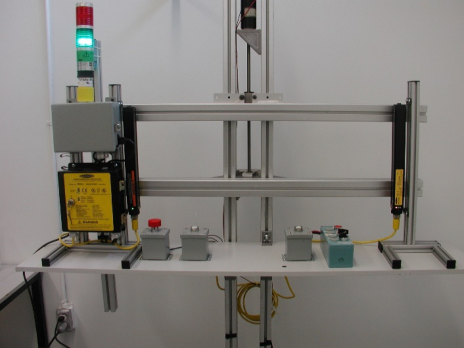
The applicability of these devices has been investigated in a research con- ducted by Venditti (2005). For this purpose, a test bench simulating the closing motion of a brake press (with no risk of injury to the investigator) was built and equipped with an actual safety light curtain (see Figure 2). A series of workpieces (made of cardboard) representing increasingly complex sheet-metal shapes of various sizes were bent on the test bench.
It emerged from that study that the feasibility of light curtains as safety devices in brake press operation depend on two important factors:
- the mode of operation of the device such as: the light curtain is always active, it is automatically muted when the closing gap is down to a safe ope- ning (as defined by safety standards), or a portion (fixed or variable) of the sensing field is muted and,
Figure 2: Test bench with safety light curtain.
On the Development of Protective Devices for Bending Presses 19
- in a crucial way, on the type of bends that must be made to complete the given workpiece. The results of the study described the range of workpieces that can be completed on a brake press. Interestingly, it was found that some complex bends could be completed on a light curtain provided that the right sequence of bends is followed. Other complex bends however were found to be infeasible with the safety device.
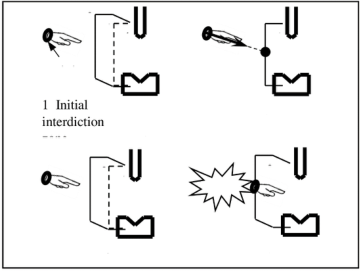
TOWARDS THE DEVELOPMENT OF A MORE FLEXIBLE PROTECTIVE DEVICE It has been shown that traditional methods of protection on bending pres- ses such as light curtain render the bending of certain workpieces difficult, if not impossible. In order to overcome these disadvantages a research work was undertaken with the purpose of developing a new principle, primarily aimed at improving existing protective systems for hydraulic press-brakes. The new system must have the ability to recognize situations in which it is not necessary to stop the machines, which is lacking in the actual protective systems. The validity of the principle for such a system was proven by Tran et al. (2006). The new concept is based on the determination of the direction of movement of one or several markers (termed “inspected point(s)”) on the worker’s hand. In the experimental work performed at ETS, these inspection points were actually light-emitting beads on a bracelet worn by the experi- menter or placed on a mechanical hand (see Figure 4). A test bench similar to the one shown in Figure 2 was used. A set of cameras are then used to determine the location in space of the marker. The images are then transfer- red and processed by a computer using an algorithm written in Matlab. This also allowed the velocity of the worker’s hand to be computed.
This system was thus designed to have the ability to eliminate machine stoppage in cases which are not actually dangerous, and also to create a protective zone capable of changing the protection volume according to the velocity of the inspected point, in order to stop the machine appropriately, in cases of increased speed of the inspected point towards the area defined as the danger zone.
This novel protective system for press-brakes was thus designed with three important characteristics.
- the ability to recognize cases in which the movement of the worker’s hand actually poses danger, based on the direction of the velocity of the inspected point.
- by using the velocity vector of the movement of the inspected point in a dangerous direction, it can determine the necessary dimensions of the prote- ctive zone, to make this zone more suitable. The magnitude of the velocity vector of the inspected point is the second factor taken into consideration.
- the system can make a decision to stop the machine automatically, based on the relation between the position of the inspected point and the outline of the protective zone.
The proposed protective system was shown to be feasible. Putting the system in practice would necessitate improvement of the computational
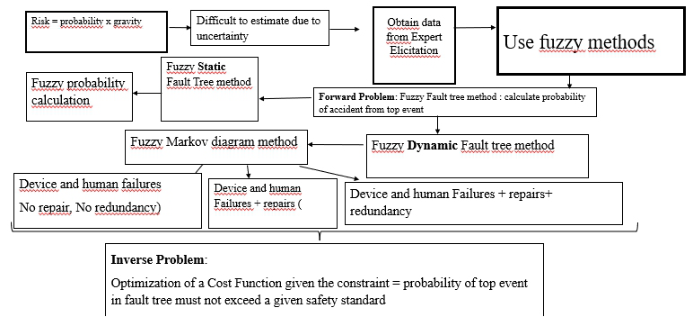
Figure 3: Operational principle of the proposed system.Figure 4: Overview of risk assessment and reduction methodology.Table 1. Forward dynamic problem summary.
Table available in the original PDF paper.
processing time and manufacturing a glove on which a light-emitting bracelet or emitting spheres could be attached.
On the Development of Protective Devices for Bending Presses 21
Table 2. Inverse dynamic (optimization) problem summary.
Table available in the original PDF paper.
SYSTEMS SAFETY APPROACH TO BRAKE PRESS SAFETY We have seen that the operation of brake presses, involves various important risks for the operators and that existing point-of-operation protective devices have been studied and new ones developed.
Health and safety laws require that an employer conduct risk assessment and reduction for all processes and equipment such as the operation of press brakes. Many methods have been developed to that end, but Venditti (2020) developed a methodology based on fuzzy logic and numbers to assess proba- bilities of hazardous occurrences and to optimize the risk reduction measures to be taken.
The risk assessment was performed using Fault Tree Analysis yielding fuzzy number probabilities estimates. The risk reduction methods were found by solving an optimization problem based on a fault tree. The model uses fuzzy numbers throughout. Figure 5 summarizes the logic behind the methodology that was developed.
The probability component of risk is to be estimated. Data is often scarce and surrounded with uncertainty. To deal with these difficulties fuzzy logic and numbers as well as Expert Elicitation methods were used using actual (albeit limited) collected field data. Two types of probability estimates were performed: 1) on a so-called static forward problem where in a fault tree the order in which contributing events leading to an accident (the top event in the tree) don’t follow a time sequence and 2) on a so-called dynamic forward problem where the sequence in which events occur matters. This problem was handled with Markov diagrams. Three case studies were considered involving three parameters:
1) occurrence of safety device and human failures; 2) occurrence of device and human failures as well repair rate of device and of human failure (such as worker retraining);
3) like 2) but with redundancy in the work system, both in terms of safety devices and of presence of a second operator.
The risk reduction optimization problem (so-named Inverse Dynamic Pro- blem) was considered next. The methodology consisted in developing a cost function based on two components. The first reflects the cost of achieving a given level of reliability (both machine and human-related) while the second part reflects the costs of accidents or failures which can still occur. This cost function is subject to a constraint which is expressed as “ the probability of the top event considered must be ≤a given safety standard”.
The study demonstrated that the calculations required by the proposed methodology were achievable. A summary of the calculations for the different cases is presented in Figures 6 and 7. The reader is referred to Venditti (2020) for details. However, a description of the variables involved in the model will help in gaining a better sense of the methodology:
Failure rates for both device and human failure were estimated from Expert Elicitation and the data gathered form this process was combined with fuzzy logic methodology to produce the final values;
The model includes the concept of repair rate, borrowed from the field of reliability, and also applies it to human failure in a novel way: re-training following a human error is expressed as a failure rate. These variables are expressed as fuzzy numbers but do not come from an elicitation process. They are assumed values from the judgement of the author.
Since the model aims at calculating probabilities, the failure and repair rates are related to probabilities using reliability theory.
Further work is planned to validate the results, such as more exten- sive Expert Elicitation studies. As well, human reliability data needs to be gathered and developed further through experiment.
CONCLUSION
The development of protective device for brake presses was reviewed. Field studies showed that in the 1990’s brake presses were often un protected despite the fact that serious hazards and risks were observed and documented. Safety on brake presses was shown to depend on may factors in addition to guarding such as type of pieces being bent, the tooling used Safety standards were developed and possible protective devices were identified. Their appli- cability however needed to be investigated further. In one study, light curtains were thus investigated on test bench simulating a brake press. Applicability was shown to depend on the geometry of the piece-part to be bent and on the functioning mode of the light curtain. A need for more flexible prote- ctive devices lead to the development of a computer-vision based protective system. In one research project, such a system was developed and tested in the laboratory which consisted of a protective device worn by the operator and whose presence was detected by a computer-vision system. Feasibility was demonstrated but practical application awaits more powerful and fast computer processing.
On the Development of Protective Devices for Bending Presses 23
The safety of a brake press operation was further investigated by taking a safety systems approach. Risk assessment methods using fault trees and fuzzy numbers were applied. A method to assess the cost of safety was developed along with a method to optimize that cost under safety objectives to be met.
ACKNOWLEDGMENT
The authors would like to acknowledge ETS.
REFERENCES
A. D. Ngo, Y. Beauchamp, P. Le-Huy, S. N. Sean, and C. Kauffmann, 1997. “La sécurité dans l’utilisation de machine dangereuse : Les presses-plieuse dans le secteur de la fabrication d’équipement de transport et de machines,” Rapport de recherche IRSST. Tran, N. D. P. (2009) Development of a flexible protective system. Ph. D. Thesis. ETS. Venditti, A. (2005) Évaluation de la faisabilité d’un rideau optique comme dispositif
de protection sur une presse plieuse. Master’s thesis. ETS. Venditti, A. (2020) System Safety Analysis of a Brake Press Using Fuzzy Methodology.
Ph. D. Thesis. ETS. Venditti, T, Tran, N. P. D, Ngô, A. D., 2017 Dynamic Fuzzy Safety Analysis of An Industrial System 2017 8th International Conference on Applied Human Factors and Ergonomics (AHFE) Los Angeles, California, USA July 19th to 21st. Venditti, T, Tran, N. P. D, Ngô, A. D., 2018 Expert elicitation methodology in the
risk analysis of an industrial machine 9th International Conference on Applied Human Factors and Ergonomics (AHFE) Orlando, Florida, USA July 21st to 25th 2018. Venditti, T, Tran, N. P. D, Ngô, A. D., 2018 System Safety Analysis of an Industrial Process Using Fuzzy Methodology 4th International Conference on Fuzzy Systems and Data Mining (FSDM2018), Bangkok, Thailand November 16-19, 2018.
LISTED IN THE AHFE DIGITAL BOOKSTORE CATALOGUE
Explore the complete digital volume
Safety Management and Human Factors
Read this individual research paper free through the original publisher, or explore the full digital proceedings book.
ISBN 978-1-958651-81-0
Explore this ISBN in the AHFE Bookstore ↗Listed in the July 2026 bookstore catalogue; search by ISBN to confirm current availability · Digital book purchase optional