Yusuf Tansel Ic, Zeki Anıl Adıgüzel, Baran Azizoğlu, Alparslan Eren Keskin, Minesu Köksal, Berat Subutay Özbek (2023). Optimization of Machined Product Quality in The Milling Process of Inconel High-Tech Material. In: Production Management and Process Control. AHFE Open Access, vol. 104, pp. 71–79. https://doi.org/10.54941/ahfe1003054
Today, Inconel 601 materials are used in special areas and frequently processed in the aerospace industry. Due to the high specific expectation of sectors, the manufacturing quality of Inconel 601 material is crucial. There are some studies in the literature related to the optimization of milling process parameters such as cutting speed, feed rate, and depth of cut to reach high-quality characteristics depending on the quality expectations. We aimed to optimize the surface roughness, manufacturing lead time, and energy consumption that will occur during the milling process of the Inconel 601 workpiece. Spindle speed, depth of cut, and feed rate of the cutting tool parameters and their levels are used as parameters (factors) in the design of the experimental study. Then the ANOVA tables are obtained. Furthermore, regression equations of the quality characteristics are determined. Finally, a multi-response optimization study is proposed to optimize parameter levels considering to achieve the maximum quality level of the machined part.
Material processing methods are divided into two groups, conventio- nal manufacturing methods, and unconventional manufacturing methods. Conventional methods are those that remove the material as a result of physical contact. As a result of this method, significant wear problems are inevitable.
One of the traditional manufacturing methods applied for the processing of the material in the relevant sectors is the milling process. During this pro- cess, using the relevant parameters, quality responses have been tried to be optimized.
Many studies were presented on this subject in the literature. During the literature search, it has been observed that in many studies on the subject, only one quality characteristic is concerned with optimization. The feed rate of the cutting tool, the spindle speed, and the depth of cut parameters tried to optimize the problems that arise during processing, such as surface qua- lity (roughness), surface hardness, and energy consumption. This study is
concerned with the multiple quality characteristics, unlike many studies in the literature.
Inconel 601 is a commonly used high-technology material (superalloy) and is one of the most widely used nickel alloy materials. Inconel 601 contains a high amount of nickel element. Generally, the nickel content is around 60 percent. In addition, this material has a chromium element of approximately 24 percent and is mainly composed of nickel and chromium elements (Special Metals, 2023).
Inconel 601 material is used in industrial heaters, heat treatment furnaces, furnace parts where the temperature is very high; exhaust tips, resistance heater parts, and many places where the temperature is very high. Another area where Inconel 601 material is used most frequently is jet engines and airline vehicle parts (Defence metal, 2020).
It is aimed to minimize the surface problems that will occur during the milling process, which is one of the traditional manufacturing methods of the material named Inconel 601, and the energy to be used while processing. During the milling of the part mentioned in the study, surface problems and excessive energy use may occur as a result of the inefficient use of parame- ters such as the spindle speed, feed rate of the cutting tool, and depth of the cut. This issue reduces processing efficiency and negatively affects the performance expected from the product.
Within the scope of this study, consider the spindle speed, cutting depth, and feed rate parameters by determining the most suitable machining para- meters in the milling process of Inconel 601 material; we optimized the responses, such as surface quality (roughness), surface hardness, and energy consumption. In the study, efforts are made to respond directly to industry needs. We processed the part on the DOOSAN Mynx 7500/50 model CNC machine tool located in PI Machinery Co.
LITERATURE SURVEY The summary table of the literature review is given in Table 1. Table 1 sum- marizes the parameters and responses used in the studies. Our study is different from the published works in the literature. We investigated four original responses that tried to be optimized. In this respect, the study will contribute to the literature.
EXPERIMENTAL DESIGN There are many experimental design methods in the literature. The fractional factorial design methodology is used in this paper, which includes the effects of measurable factors with the least margin of error and the most effective. The main factor effects and their interaction effects are estimated using the fractional factorial design. The fractional factorial designs are quite frequen- tly used to simultaneously investigate the main effects and interaction effects of two or more factors on the quality characteristics.
Three parameters (factors) are used in this paper: A: Spindle speed (rpm)- 1115(low) and 1750 (high),
Optimization of Machined Product Quality in the Milling Process 73
Table 1. Literature summary.
Table available in the original PDF paper.
Autor(s) Prameter Response Tool life Choudhury and El-Baradie (1998) Spindle speed, feed rate, cutting depth
Surface roughness
Coelho et al. (2004) Spindle speed, feed rate, cutting depth
Surface roughness
Öktem et al. (2005) Spindle speed, feed rate, cutting depth
Cutting force, surface roughness
Altın et al. (2006) Spindle speed, feed rate, cutting depth
Cutting force, surface roughness
Pawade et al. (2007) Spindle speed, feed rate, cutting depth
Surface roughness
Nalbant et al. (2007) Spindle speed, feed rate, cutting depth Ta¸slıyan et al. (2007) Spindle speed, feed rate, cutting depth
Tool life
Cutting force, power requirement Thakur et al.(2009) Spindle speed, feed rate, cutting depth Surface roughness Che Haron et al. (2011)
Spindle speed, feed rate, cutting depth
Surface roughness
Kasım et al. (2013) Spindle speed, feed rate, cutting depth
Surface roughness
Lohithaksha et al (2013)
Cutting depth, feed rate, spindle speed
Cutting force, surface roughness
Altın (2014) Spindle speed, feed rate, cutting depth
Cutting force, surface roughness
Amini et al. (2014) Spindle speed, feed rate, cutting depth Vinod et al. (2016) Spindle speed, feed rate Tool life, surface roughness Kaynak (2017) Spindle speed, feed rate, cutting depth
hardness
Cutting force, power requirement Zhou et al. (2017) Spindle speed, feed rate, cutting depth Cutting force, tool life Tamang et al. (2018) Spindle speed, feed rate, cutting depth
B: Feed rate (mm/rev)- 24 and 50, C: Depth of cut (mm)- 1 and 3. On the other hand, four different responses are optimized in the study (Table 2). In this study, the experimental design is created as 2ˆ(3-1) = 4 x (2 repetitions) = 8 experiments using the fractional factorial design.
The Inconel 601 workpiece is processed on the CNC machine tool accor- ding to the experimental plan created by MINITAB software. Then, the surface roughness and machined surface hardness values are measured, and the results are obtained for each experiment (Table 2). The energy consum- ption response is calculated using the experimental results. As a result of the ANOVA analysis with the help of the MINITAB, effective parameters-related regression equations are obtained: Y1= −5.59055E −04A −0.0969231B −0.142500
Equation reproduced from the original PDF.
C + 0.922764(R −Sq(adj)=%45.84) (2) Y3 = −0.00086614A −0.0480769B −0.475000
Optimization of Machined Product Quality in the Milling Process 75
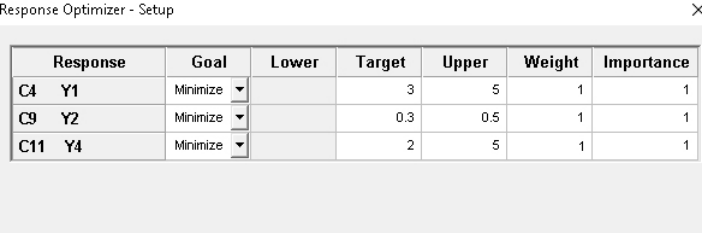
OPTIMIZATION AND CONCLUSION A multi-objective optimization study is carried out using the regression functions of Y1, Y2, and Y4 responses. The response weights are assigned in the Response Optimizer tool for the “All Objectives Are Equal Weighted Scenario” (Scenario 1), as in Figure 1.
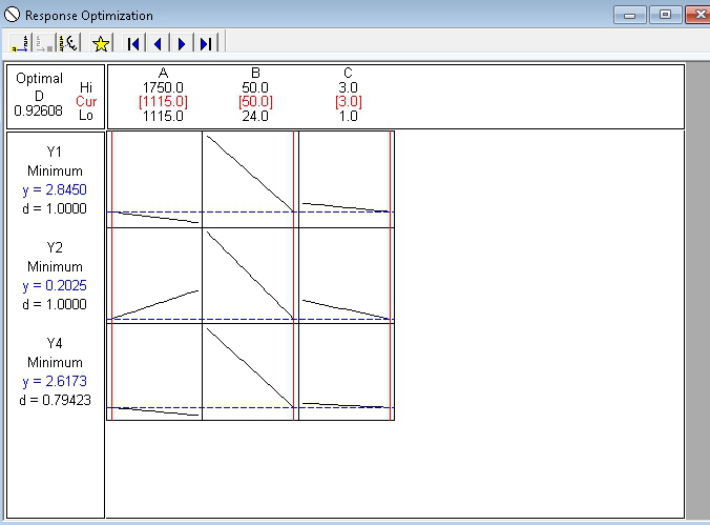
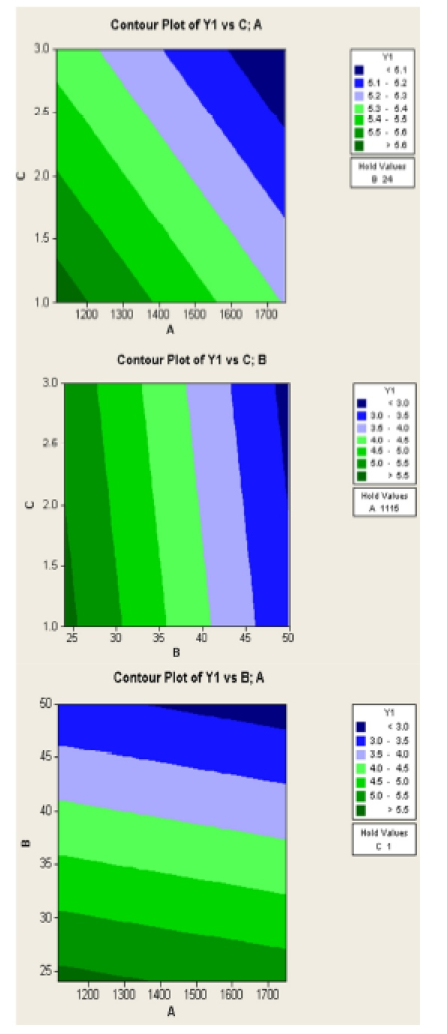
The optimization result is obtained (Figure 2). Accordingly, the best values are found as 1115rpm for A, 50mm/min for B, and 3mm for C. In addition, the results from the surface graphs are analysed. Therefore, the Y1 response is optimal at the upper levels of A, B, and C (Figure 3).
The results obtained in this study are analysed (Table 3) and reported in this section. The best parameter values according to the scenarios are given in Table 4. As we can see from Table 4, the feed rate (B) parameter is equal
Figure 1: Weight assignment for three responses in scenario 1.Figure 2: Response optimizer result for scenario 1.Figure 3: Response optimizer result: Contour plot example for scenario 1.
to 50 mm/min (high level) in all scenarios, and it does not influence the dif- ferent weight preferences. So, in future studies, this value can be assigned as a low level, and a new high-level value could be determined. On the other hand, spindle speed and depth of cut parameters are sensitive to response weight changes, and they reflect different results in the response expectation
Optimization of Machined Product Quality in the Milling Process 77
Parameters Scenario 1 Scenario 2 Scenario 3 Scenario 4 A (rpm) 1115 1549.4737 1150 1496.52 B (mm/min) 50 50 50 50 C (mm) 3 3 3 2.75
related to the weight values. If we expect different surface roughness, manu- facturing lead time, and energy consumption expectations from the Inconel 601 material milling process, we can set some new target values and optimize parameter values according to the selected target values.
Based on the regression functions obtained, it is observed that the changes in the parameter values used did not affect the Y3 (surface hardness) response. So, the optimal parameter levels are determined for responses Y1, Y2, and Y4 using the response optimizer tool in the MINITAB program.
ACKNOWLEDGMENT
The authors would like to acknowledge PI machinery Co. for machining the Inconel 600 material in their factory.
REFERENCES
Altın, A. (2014). Optimization of Turning Machining Parameters in Inconel 600 Super Alloy. Journal of Engineering and Architecture of Gazi University. Vol. 28, Issue 4. Altın, A., Gökkaya, H., Nalbant, M., (2006). The Effect of Cutting Speed in
Machine Parameters on the Machinability of Inconel 718 Superalloys. Journal of Engineering and Architecture of Gazi University Vol. 21, No. 3, 581–586. Amini, S., Fatemi, M. H., & Atefi, R. (2014). High Speed Turning of Inconel 718 Using Ceramic and Carbide Cutting Tools. Arab J Sci Eng 39:2323–2330. Aytaç, A., & Aztekin, K. (2019). Investigation of the Factors Affecting the Machi-
nability of Inconel 718 Alloy in Turning by Ceramic Tool with Taguchi Method. Science Journal of Turkish Military Academy, Vol. 29, Issue 2, 229–246. Che Haron, C. H., Ghani, J. A., Kasim, M. S., Soon, T. K., Ibrahim, G. A., & Sulaiman, M. A. (2011). Surface Integrity of Inconel 718 under MQL condi- tion. Advanced Materials Research Vols. 150–151, 1667–1672. Choudhury, I. A., & El-Baradie, M. A. (1998). Machining nickel base superalloys:
Coelho, R. T., Silva, L. R., Braghini Jr, A., & Bezerra, A. A. (2004). Some effects of cutting edge preparation and geometric modifications when turning INCO- NEL 718 (TM) at high cutting speeds. Journal of Materials Processing Technology 148(1), 147-153 Danish, M., Aslantas, K., Hascelik, A., Rubaiee, S., Gupta, M. K., Yildirim, M.
B.,... & Mahfouz, A. B. (2022). An experimental investigation on effects of coo- ling/lubrication conditions in micro milling of additively manufactured Inconel 718. Tribology International, 173, 107620. Defence Metal Website: defence metal/inconel-718/ ˙Istanbul, Aralık 19, 2020. Ji, H., Gupta, M. K., Song, Q., Cai, W., Zheng, T., Zhao, Y.,... & Pimenov, D. Y.
(2021). Microstructure and machinability evaluation in micro milling of selective laser melted Inconel 718 alloy. Journal of Materials Research and Technology, 14, 348–362. Kasim, M. S., Hafiz, M. S. A., Ghani, J. A., Haron, C. H. C., Izamshah, R., Sundi, S.
A.,... & Othman, I. S. (2019). Investigation of surface topology in ball nose end milling process of Inconel 718, Wear 426–427, 1318–1326. Kasim, M. S., Haron, C. C., Ghani, J. A., & Sulaiman, M. A. (2013). Prediction Surface Roughness in High-Speed Milling of Inconel 718 under MQL Using Rsm Method. Middle-East Journal of Scientific Research 13(3): 264–272. Kaynak, Y. (2014). Evaluation of machining performance in cryogenic machining
of Inconel 718 and comparison with dry and MQL machining, Int J Adv Manuf Technol 72:919–933. Lohithaksha M Maiyara, Dr. R. Ramanujamb, K. Venkatesanc, Dr. J. Jeraldd (2013).
Optimization of Machining Parameters for End Milling of Inconel 718 Super Alloy Using Taguchi Based Grey Relational Analysis. Procedia Engineering 64, 1276–1282. Nalbant, M., Altın, A., & Gökkaya, H. (2007). The effect of coating material and geometry of cutting tool and cutting speed on machinability properties of Inconel 718 super alloys Science Direct, Materials and Design 28: 1719–1724. Öktem, H., Özçelik, B., Kurtaran, H. (2005). Inconel 718 in Frezelenmesi Sonu-
cunda Olu¸san Yüzey Pürüzlülü˘günün Yapay Sinir A˘glarıyla Belirlenmesi, Makine Tasarım ve ˙Imalat Dergisi, Vol. 7, Issue 1, 19 (In Turkish). Pawade, R. S., Joshi, S. S., Brahmankar, P. K., & Rahman, M., (2007). An investigation of cutting forces and surface damage in high-speed turning of Inconel 718. Journal of Materials Processing Technology 192–193, 139–146. Pereira, W. H., Delijaicov, S. (2019). Surface integrity of Inconel 718 turned
under cryogenic conditions at high cutting speeds. The International Journal of Advanced Manufacturing Technology vol. 104, 2163–2177. Special Metals Website (2023): chrome-extension://efaidnbmnnnibpcajpcglcl efindmkaj/https://www.specialmetals.com/documents/technical- bulletins/inconel/inconel-alloy-601.pdf. Tamang, S. K., Chandrasekaran, M., & Sahoo, A. K. (2018). Sustainable machining: an experimental investigation and optimization of machining Inconel 825 with dry and MQL approach. Journal of the Brazilian Society of Mechanical Sciences and Engineering, 40(8), 1–18. Ta¸sliyan, A., Acarer, M., ¸Seker, U., Gökkaya, H., & Demir, B. (2007). The effect
of Cutting Parameters on Cutting Force During the Processing of Inconel 718 Superalloy. J. Fac. Eng. Arch. Gazi Univ. Vol. 22, No 1, 1–5. Thakur, D. G., Ramamoorthy, B., & Vijayaraghavan, L. (2009). Machinability investigation of Inconel 718 in high-speed turning, Int J Adv Manuf Technol 45:421–429.
Optimization of Machined Product Quality in the Milling Process 79
Thirumalai, R., Seenivasan, M., & Panneerselvam, K. (2021). Experimental investigation and multi response optimization of turning process parameters for Inconel 718 using TOPSIS approach. Materials Today: Proceedings, 45, 467–472. Thrinadh, J., Mohapatra, A., Datta, S., & Masanta, M. (2019). Machining behavior
of Inconel 718 superalloy: Effects of cutting speed and depth of cut https://doi.or g/10.1016/j.matpr.2019.10.128 2214-7853/ 2019 Elsevier Ltd. Vinod, A. R., Srinivasa, C. K., Keshavamurthy, R., & Shashikumar, P. V. (2016).
A novel technique for reducing lead-time and energy consumption in fabrication of Inconel-625 parts by laser-based metal deposition process. Rapid Prototyping Journal. Waghmode, S. P., & Dabade, U. A. (2019). Optimization of process parameters during turning of Inconel 625. Zhou, J., Ren, J., & Tian, W. (2017). Grey-RBF-FA method to optimize surface inte-
grity for inclined end milling Inconel 718. The International Journal of Advanced Manufacturing Technology, 91(9), 2975–2993.
LISTED IN THE AHFE DIGITAL BOOKSTORE CATALOGUE
Explore the complete digital volume
Production Management and Process Control
Read this individual research paper free through the original publisher, or explore the full digital proceedings book.
ISBN 978-1-958651-80-3
Explore this ISBN in the AHFE Bookstore ↗Listed in the July 2026 bookstore catalogue; search by ISBN to confirm current availability · Digital book purchase optional