Junchun Chen, Jian Peng (2023). Artistic Characteristics and Multi-value of Huayao Cross-stitch from the Perspective of Cultural Ecology. In: Human Factors for Apparel and Textile Engineering. AHFE Open Access, vol. 86, pp. 79–90. https://doi.org/10.54941/ahfe1003643
Huayao cross-stitch is a traditional handicraft with distinctive regional characteristics in China. Aesthetically appealing with rich cultural implications, Huayao cross-stitch has been listed in the first national list of intangible cultural heritage of China since 2006. With the rapid development of cultural consumption globally, the innovative design and industrial transformation potential have made traditional handicrafts highly-valued resources, and the analysis of cultural representation and multi-value of traditional handicrafts is the basis of cultural reuse. From the perspective of cultural ecology, the current study aims to summarize the spatial organization mode of Huayao cross-stitch patterns and conduct a deep analysis of the concepts and beliefs represented in Huayao cross-stitch by examining 70 samples of cross-stitch skirt pieces collected from the composition and semantics of patterns. The study then analyzes the basis of multi-value of the Huayao cross-stitch from both aesthetic and cultural dimensions, providing a research basis for the innovation and regeneration of Huayao’s cross-stitch, through which its value can be seen in contemporary times as well as in the future.
Huayao is an ancient and legendary ethnic group living in the Xuefeng Mountains in the north of Longhui County, Hunan Province, China. It is a place where unique ethnic customs and cultural resources can be found. Huayao cross-stitch is a unique kind of folk handicraft owned by Huayao women. Its formation, development and changes are influenced by the cul- tural and ecological elements of Huayao ethnic group, such as geopolitics, historical circumstances, tradition and customs. It is an artistic product bearing the memory, customs and wishes of this ethnic group and is estheti- cally appealing with rich cultural and social implications. Since 2006 when Huayao cross-stitch was listed in China’s first national list of intangible cul- tural heritage, the research and development on Huayao cross-stitch gains in popularity among all circles. However, it is very likely to bring great risks to the cultural resources and natural and cultural environment which Huayao cross-stitch is based if there is a lack of understanding of the values and connotations embodied in Huayao cross-stitch culture. Therefore, from
the perspective of cultural ecology, this paper elaborates on the artistic cha- racteristics and muti-value of Huayao cross-stitch culture in its interactive relationship with the environmental system, providing a basis for further research on its inheritance and innovation.
CULTURAL ECOLOGY AND THE STUDY ON HUAYAO CROSS-STITCH The theory of “cultural ecology” was formed in the 1950s (Steward, 1972), and it is an interdisciplinary discipline of culturology and ecology (Deng, 2003). It takes culture as its core, which analyzes cultural problems by using viewpoints, research methods and thinking modes from ecology, and exami- nes the living style of culture from the interaction between culture and its ecosystem, so as to explain culture ecologically and integrally. Early cultural ecology was mainly a research field within anthropology. Since the 1970s, the development of cultural ecology has been basically mature, and its research field was beyond the limitation of a single discipline and expanded into new multidisciplinary research. With the deepening of the concept of intangible cultural heritage protection from “rescue protection” to “original ecolo- gical protection”, “active protection”, “productive protection”, “holistic protection” and “systematic protection” based on ecological environmental elements such as the regional natural environment, lifestyle, interpersonal structure, customs and habits, people have increasingly realized the interde- pendency between intangible cultural heritage and its ecological environment. “Ecology” has become the theoretical guidance for the updated concept of intangible cultural heritage protection.
The existing research on Huayao cross-stitch mainly focuses on the prote- ction of historical material (Liu, 2016), folk culture (Yu, 2010) (Mi, 2014), artistic characteristics (Shen and Shu, 2012) (Meng, 2014), and innovative design (Yang et al. 2018)(Luo, 2009) (Ruan, 2014). Relatively few studies have looked at Huayao cross-stitch culture from a macro perspective, and even fewer studies have probed into it from a systematic perspective of cultu- ral ecology. The vitality of traditional handicrafts exists in the environment that breeds them, and they are integrated with the cultural and ecological environment in behavior, emotion and spirit. Therefore, understanding and studying Huayao cross-stitch culture in the cultural ecosystem is a feasible way to maintain its active inheritance and sustainable development.
ANALYSIS OF FORMAL REPRESENTATION OF HUAYAO CROSS-STITCH Clothing With Huayao Cross-Stitch
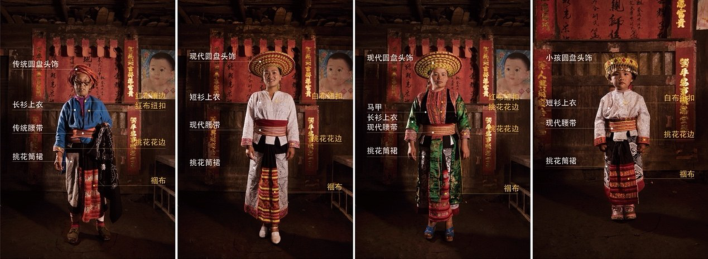
The traditional costumes of Huayao are colorful, exquisite, exotic and com- plicated. The Huayao women put their pursuit of a better life into the costumes they wear, which fully shows their taste and wisdom. Through its unique style and craftsmanship, Huayao clothing illustrates its ecological relevance with the historical environment and cultural customs of the ethnic group. Huayao Clothing runs through Huayao people’s whole life from birth, adulthood, engagement, marriage, childbirth and finally funeral. It carries the life mission of Huayao people and is an indispensable and important part of their life. Fig. 1 shows the long dress, short dress, full dress and children’s
Artistic Characteristics and Multi-Value of Huayao Cross-Stitch 81
Figure 1: Huayao traditional clothing.
dress in Huayao’s clothing. Huayao cross-stitch is mainly applied to the tube skirts, belts, straps, headbands, lapels and cuffs of Huayao women’s clothing.
Huayao clothing is an essential material carrier of cross-stitch which must be attached to the clothing itself to be seen. Cross-stitch enriches the decora- tive and aesthetic properties of the clothing as well as enables the clothing to go beyond the material category to the spiritual category. It can be seen that Huayao clothing is inseparable from cross-stitch.
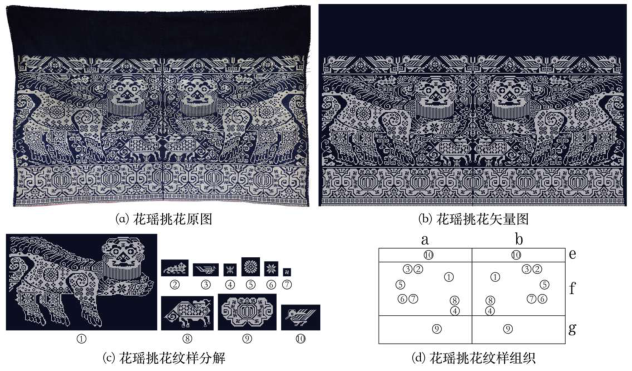
Vector Decomposition and Organizational Form of Huayao Cross-Stitch Patterns Among the traditional Huayao clothing, the tube skirts (called “Dun” in Yao language) are the largest with the highest density of cross-stitch patterns. Therefore, the cross-stitch patterns on the tube skirts are the most exquisite part of Huayao clothing and also the distinctive feature that distinguishes Huayao traditional clothing from those from other ethnic groups. Some of the existing cross-stitch skirts are damaged and incomplete due to old age or deformed due to the influence of the shooting angle during digital acquisi- tion. In order to restore the original appearance of the cross-stitch patterns to the maximum extent with an attempt to decompose, analyze and process the patterns more visually, this study employed an AI image processing software to carry out vectorization drawing on the photos of 70 cross-stitch skirt sam- ples and strictly maintain the overlap between the digital stitching and the stitching of the original photo during the drawing, so as to ensure the accu- rate restoration of the physical patterns of cross-stitch and provide accurate and objective visual forms of cross-stitch for the study. Take the pair lion in the Huayao cross-stitch patterns as an example, as shown in Fig 2: Fig. 2 (a) is the original photo of the cross-stitch skirt, Fig. 2 (b) is the vector drawing of the cross-stitch skirt, Fig. 2 (c) is the pattern decomposition diagram of the cross-stitch skirt, and Fig. 2 (d) is the pattern organization diagram of the cross-stitch skirt.
For the pattern organization (FIG. 2 (d), e, f and g show a three-stage com- position, and a and b are symmetrical to each other. In section e, bird pattern (10 ⃝) constitutes a symmetric two-dimension continuity. The main pattern( 1⃝) in section f is a lion in a posture with a side body and a front face. Lions
82 Chen and Peng
Figure 2: The pattern decomposition and organization of the original and vector graphics of Huayao cross-stitch patterns.
are a source material commonly seen in the cross-stitch patterns of Huayao, which implies the wish of Huayao people to ward off evil spirits and embrace wealth, honor and auspice. The lion is depicted on the side, with its head tur- ned to the front and its tail curled downward. A side body and a front face is an angle commonly used in cross-stitch to represent animals. Although it is the side body, the limbs of the lion are fully displayed in the picture, which reflects Huayao woman’s concept of “completeness”. The main body pattern which is the lion pattern ( 1⃝) is in a single layer nested by pattern “Beiganyue” ( 5⃝), octagonal pattern( 6⃝) and other patterns. The filling pat- terns include the pattern “Tiger” ( 2⃝), pattern “Phoenix bird” ( 3⃝), pattern “Shou” ( 4⃝), pattern “Wan” ( 7⃝), and pattern “Unicorn” ( 8⃝). In section g, the pattern “Yongyou” ( 9⃝) forms a scattered two-dimension continuity and there are patterns “Wan” nested in a single layer.
In this study, the collected cross-stitch skirt patterns are analyzed one by one from four aspects: pattern composition, type, semantics and organiza- tion, and the spatial organization mode of Huayao cross-stitch patterns is extracted and summarized, as shown in Tab. 1.
THE BELIEF SYSTEM OF HUAYAO CROSS-STITCH “Praise of Strength” of Historical Legends
Immortals and spirits are symbols of strength in the mortal realm. Immortals and fairy tales have been passed down from generation to generation, influ- encing the lives of generations subtly. (Zhang, 1999) The tortuous history and harsh living environment of the Huayao ethnic group have bred a strong desire and worship for strength. Huayao people’s yearning for strength is reflected in the Huayao cross-stitch, and this strength is regarded as their inner resources. On the one hand, the use of miraculous patterns in Huayao cross-stitch expresses a desire for power by Huayao people. For example,
Artistic Characteristics and Multi-Value of Huayao Cross-Stitch 83
Table 1. Spatial organization of Huayao cross-stitch patterns.
Table available in the original PDF paper.
Organization Organization Illustration Organization Introduction Organization Type Subtype
Sectional organiza- tion
One section The picture is not divided and the whole picture is organized with patterns. Two sections
The picture is divided horizontally into two parts, and each part is organized with patterns. Three sections
The picture is divided horizontally into three parts, and each part is organized with patterns. Several Sections
The picture is divided horizontally into several parts, and each part is organized with patterns.
Suitable Patterns
Separate organiza- tion
After being processed and deformed, the pattern material is organized within a certain outer contour line, which can be divided into geometric outer contour and free outer contour Free patterns
No outer contour limit with free modeling Equality The quantity and shape of the left and right sides of the central axis are arranged equally.
Symmetric organiza- tion balance The left and right sides of the central axis are different but with equal volume.
Scattered continuity
two- dimension continuity
It is formed by repeating a unit pattern continuously towards the left and right or up and down.
Symmetric continuity
It is formed by a group of symmetrical patterns that are repeated continuously from left and right or up and down
Scattered continuity
Four- dimension continuity
It is formed by repeating a unit pattern continuously from up to down and then from left to right.
Connected continuity
It is formed by repeating a unit pattern continuously from up to down and then left to right and they are is interconnected with each other.
Single-layer Nesting style nesting
A single-layer pattern is nested within the pattern
multi-layer nesting
Multiple layers of patterns are nested within the pattern. There is another layer of pattern nested inside the pattern
84 Chen and Peng
patterns such as “dragon”and “phoenix”which integrate outstanding chara- cteristics of animals are often seen in Huayao cross-stitch patterns. Primitive human beings have regarded them as totems and treated them as protectors with a mysterious power to repel disasters and avoid harm. The Huayao peo- ple have also inherited such a pattern which represents supernatural strength. They regarded the dragon and phoenix as immortal beings in the cross-stitch patterns, symbolizing the human spirit that is powerful, enterprising and resolute. For example, ancient trees and rocks are often seen around Yao Village and Huayao people worship those trees and rocks for generations. They believe that those trees and rocks have an aura of strength that can protect Yao village and people there. As a result, ancient trees and rocks are well-preserved by Huayao people. On the other hand, the images of strength in Huayao cross-stitch mainly are reflected in the legendary stories of heroes in the Huayao ethnic group. For example, the patterns of “Longqiu defending the enemy” and “Emperor Pan ascending the palace” in Huayao cross-stitch eulogize the divine power of the heroes or ancestors of Huayao.
“Life Expression” of Nature Worship When human beings know little about nature, they feel scared and confu- sed to meet unpredictable and irresistible natural phenomena such as wind, snow, lightning, birth, aging, illness and death. Therefore, they transform their fear and confusion into the concept of animism and entrust the spirit of survival and fertility to the divine power of all things. During this process, a psychological state of worship has developed with which people hope to get the great power to conquer nature, beasts and disasters to obtain the spiri- tual power so as to obtain comfort and hope in reality. The Huayao people gradually formed their own unique understanding of nature and visualized various immortals in nature for worship during the years of interdependence with the natural environment.
As a kind of nature worship, fertility worship is an ancient custom of pri- mitive people. It is a celebration and yearning for the reproduction ability of the biological world. It is also a cultural phenomenon that relies on the nature and the demand for self-reliance. In the eyes of Huayao people, the snake is an animal with very strong vitality. Because the snake head is like the shape of men’s penis, the snake is used as a metaphor for male genitalia, which implies the worship of men’s penis. Therefore, in the eyes of Huayao people, the worship of snake by Huayao women is actually the worship of male geni- talia. In Huayao, due to the lush branches and strong fertility of ancient trees, the Huayao people will also put their expectation of the nation’s fertility on the worship of trees. At the same time, there are lots of shapes of big trees in Huayao cross-stitch patterns, and snakes and trees are often combined to reflect the Huayao people’s prayer for the nation’s everlasting fertility. Ano- ther example is the fish shape in the cross-stitch patterns. The fish belly has many roes inside and its shape is similar to the female vulva. Huayao people regard the fish or double fish as the symbol of the worship of female vulva and embroider such images on the tube skirts, so as to express good wishes of prosperity, fertility and fortune. In addition, in Huayao, there are many
Artistic Characteristics and Multi-Value of Huayao Cross-Stitch 85
other patterns that contain fertility worship, such as bamboo, Dazi flowers, birds, snakes, Huoshi stars, mice, pregnant animals and so on.
“Completeness Orientation” of Belief in Auspiciousness Different national cultures give birth to different national concepts, among which, the concept of auspiciousness is the pure pursuit and wish formed by people in long social experiences. This concept regards certain things as auspicious signs and believes that these things can make people safe, happy, auspicious, joyous, and trouble-free. The patterns symbolizing strength and fertility mentioned above also have auspicious connotations. In Hua- yao cross-stitch culture, each piece of Huayao cross-stitch tells a period of Huayao women’s pursuit for a better life. The national values shared by Huayao people and their life vision of harvest and reproduction of offspring are both reflected in Huayao cross-stitch patterns. From the content of its symbol, Huayao cross-stitch can be divided into three categories: the first category is the wish to chase blessings and avoid disasters, such as pattern “Bagua”, ppattern “Shou”, pattern “Bull’s Eye” and pattern “Bigui”; The second category is the yearning for auspiciousness, such as the pattern “Pan- chang”, pattern “Wan”, pattern “persimmon calyx” and pattern “ancient trees”. The third category is the expectation of harvest and celebration, such as pattern “Beiganyue”, pattern “fish”.
MULTI-VALUE OF HUAYAO CROSS-STITCH CULTURE Aesthetic and Artistic Value of Multi-Dimensional Integration
1. The Formal Beauty of Patterns. First of all, the formal beauty of Huayao cross-stitch patterns is reflected in the beauty of “authenticity and simplicity” of patterns and shapes. Laozi, the founder of philosophical and religious Taoism, once said: “exquisite skill looks simple and clumsy”, which fits an aesthetic concept of encouraging well-founded simplicity and naturalness but rejecting excessive embellish- ment and over-pursuit of the exquisite. “Zhuo” (literally means clumsy) is a natural expression of inner emotions that conforms to the laws of nature and is free from excessive embellishment. It is a kind of natural beauty that embo- dies China’s aesthetic view of highlighting the naturalness and avoiding the over-reliance on skills. The creation of cross-stitch patterns of Huayao should be free and spontaneous, and they themselves can choose what and how to embroider wherever they want. Their embroideries are not restricted by rules and regulations. The shapes are bold and exaggerated, and the natural esse- nce of the objects and the inner feelings of the craftsmen are integrated and expressed through embroideries, which reflects the creator’s freedom, purity, simplify and naturalness.
Secondly, the pattern organization of Huayao cross-stitch reflects the beauty of “completeness and rhythm”. Since ancient times in China, the concept of “completeness” has been highly valued, especially in the com- position of traditional patterns to convey a vision of happiness and beauty.
86 Chen and Peng
Huayao people’s pursuit of completeness is conveyed in the pattern organiza- tion of Huayao cross-stitch, which is the psychological embodiment of their active reconciliation and adaptation to life. Huayao cross-stitch patterns are composed of main patterns, filling patterns and connecting patterns. Filling patterns and connecting patterns not only have the function of enriching the semantics of the whole picture, but also play the role of filling the whole pat- terns, making the overall composition complete and full, leaving no blanks. “Rhythm” means changes of thyme; rhythmic change constitutes rhythm. In the pattern organization of Huayao cross-stitch, in order to fill the blanks of the picture, pattern organization forms such as two-dimension continuity and four-dimension continuity are often used. Certain regular repeated unit patterns give people a visually distinct sense of rhythm and beauty.
Thirdly, Huayao cross-stitch has the “dynamic and static” beauty of visual effects. Huayao cross-stitch is based on natural things full of vitality and strength, and its dynamic beauty is conveyed in the movement and vitality of the cross-stitch patterns. In Huayao cross-stitch patterns, the changes of animal and human patterns, the dynamic gestures, and the undulating and winding shapes of plant patterns are the true life of all things perceived by Huayao women, which is the embodiment and expression of the vitality of nature. In addition, a large number of techniques such as repetition, deforma- tion and exaggeration are used in the cross-stitch patterns of Huayao, which also creates a strong sense of movement in the vision. On the other hand, the symmetry of quantity and form can reflect the static state and stability, which is a typical form of “static” beauty. In the cross-stitch patterns of Huayao, symmetry is a commonly used pattern organization form, which makes the pattern present a static order in the dynamic vitality of free configuration, and the mutual contrast and supplement of the dynamic and static make the balance between them artistically appealing.
2. The Behavioral Beauty of Traditional Activities Behavioral beauty is neither a tangible substance, nor a skill or art inherited by individuals, but a behavioral expression that carries the logic mode and emotional identity of an ethnic group. It is generated and developed from practical activities, and has a social purpose and function. The behavioral beauty of Huayao cross-stitch runs through the social activities of the Hua- yao ethnic group: in the wedding ceremonies, the wedding clothes are made by the two families jointly. The behavioral beauty is reflected in the internal unity between the two families and the good wish for the newlyweds to have a happy marriage and the prosperity of their children. The traditional comme- morative festivals are platforms for Huayao people to display and exchange cross-stitch skills and sell cross-stitch products. Young people also regard them as an excellent opportunity to find their sweethearts. The behavioral beauty of Huayao cross-stitch is reflected in the process of people participa- ting in social activities, which strengthens the intimacy and cohesion among community members. In the birth ceremony, the tiger head hats, bibs, back straps and diapers prepared by the elders for the children are embroidered with various flower and bird patterns, through which the behavioral beauty is reflected in the wishes and expectations of the elders for the children. In the
Artistic Characteristics and Multi-Value of Huayao Cross-Stitch 87
transmission of Huayao’s cross-stitch art, the emotional connection between family and community members is promoted through inheritance way of kin- ship and geography, and the behavioral beauty is reflected in the harmonious coexistence of ethnic group members.
3. The Spiritual Beauty of Conceptual Culture Lei Kuiyuan once said: “design is the art that can talk. Besides the beauty of image and form, there is also a kind of allegorical beauty, metaphor beauty, language beauty”. Huayao women embroider what they see, hear and feel fre- ely and casually in their cross-stitch works without working out a draft, and Huayao cross-stitch becomes the carrier of romance, imagination and wishes of Huayao people. Through cross-stitch, Huayao women show their emoti- ons, record their lives, express their aspirations and narrate their history. The creation is free and unrestrained, through which the unique ideas of Huayao women in thinking about and understanding the world are manifested. The craftsmanship, patterns and connotations of Huayao cross-stitch all reflect the national personality of Huayao which is optimistic, straightforward and imaginative. They also show the spiritual beauty of naturalness, simplicity, romance and freedom.
On the other hand, the history of continuous struggle and migration of Huayao people has prompted them to constantly cope with various harsh external environments, and they have shown their spiritual qualities such as perseverance and bravery in coping with many life-and-death matters. The visual display form and semantics of Huayao cross-cross patterns reflect the national spirit and emotion formed by Huayao people in the long history. They not only reflect the yearning for a better life of Huayao people, but also demonstrate the national mentality of Huayao people, which is opti- mistic, open-minded and hard-working, and express the beauty of Huayao people’s spirit of self-reliance and endeavor.
Socio-Cultural Value of System Construction
1. Ethnic Identity Based on Cultural Characteristics “Ethnic group” refers to a group with certain characteristics, and cultural factors are of great significance to the maintenance of ethnic boundaries. Due to their unique and shared origin myths and historical backgrounds, ethnic groups form different “ethnic symbols” or “ethnic boundary marks”, such as religion, custom, language, clothing and other cultural characteristics, which are very important to the identification of ethnic identity. Among them, clo- thing style is regarded as the most explicit single indicator of ethnic identity (Lan, 2003). “Huayao” is named because of its colorful traditional costumes, which deeply reflect Huayao’s ethnic consciousness and are also an impor- tant symbol of Huayao people’s self-existence and continuity (Xie, 2014). For the Huayao people, Huayao clothing has long gone beyond its physical function of protecting against cold weather and covering the body. It also contains the ethnic identity and spirit of the Huayao nation apart from its material representation. It is the ethnic symbol representing the national spi- rit and will of the Huayao people, and a deeper symbol of the ethnic group
88 Chen and Peng
culturally and psychologically, which plays a role in enhancing the cohe- sion and national identity of the Huayao people. The most representative craftsmanship in Huayao is cross-stitch which fully reflects the customary concept and shared understanding among Huayao ethnic groups. The inhe- ritance and recurrence of its cultural forms also continuously contribute to the maintenance and consolidation of the cultural identity within the Huayao ethnic group.
2. Integrated Diversity of Cultural Composition The original ecological culture of human beings is as important as the biologi- cal genetic diversity in the biological world (Fang, 2001). In the era of global economic integration, life around the world is becoming increasingly similar, and the uniqueness of culture is also being assimilated and obliterated sub- tly. Traditional culture contains the accumulated information and wisdom of all ethnic groups, and its role and status are increasingly highlighted in the competition of comprehensive national strength. It also serves as an impor- tant support for economic and social development, as well as people’s eager demand for spiritual and cultural life. Local culture is an important part of Chinese culture and contains huge cultural capital. To protect the diversity of local culture is to protect the diversity of Chinese culture (Suo, 2018). The skill, spiritual connotation and external form of Huayao cross-stitch have distinctive local cultural ecological characteristics, which are irrepla- ceable contents in the diversity structure of Chinese culture. Its existence and continuation are undoubtedly indispensable cultural forms to maintain cultural diversity, and provide a multi-integrated cultural form of “harmony but difference” for the construction system of Chinese culture.
3. The System Value of Cultural Ecological Balance Traditional handicrafts play an important role in life, production, folk activi- ties, ceremonies, and music events. They have distinct characteristics of “life and culture” and are rooted in the “cultural space” in which they are located. Only in this space can handicrafts become prosperous and flourishing. Simi- larly, as a carrier of folk culture, traditional handicrafts are interdependent with people, things and objects in cultural space, and play a positive role in the construction of cultural space and the balance of cultural ecology. (Wang, 2016) Huayao cross-stitch is an integral part of Huayao people’s produ- ction, life and spiritual emotions. It contains rich ecological relations among people, nature, society and history, which are not only reflected but also maintained and promoted through the production of Huayao cross-stitch, thus maintaining the region’s ecological integrity.
4. Value-added Creative Industries Empowered by Culture First of all, handicrafts, as a kind of creative art, are formed in the long practice of production and life, and provide life support for the craftsmen in the form of the exchange of goods, which demonstrates natural econo- mic attributes. Handicrafts are not only passive objects to be protected, but also goods that are processed into circulation through their ideology, nationa- lism, local pride, romantic ideas, etc (Bella, 2007). Handicrafts have profound
Artistic Characteristics and Multi-Value of Huayao Cross-Stitch 89
industrial advantages and economic value due to the characteristics of low investment, less pollution, low energy consumption and high culturally added value, which in return are of great practical significance to people’s livelih- ood economy and even rural construction. Secondly, handicrafts, due to their inherent differences, contain huge cultural capital and are full of vibrant cul- tural expansion, provide important cultural genes for cultural reproduction, and are the cultural supplement of industrial mass production. Therefore, the cultural connotation and value of Huayao cross-stitch culture should be fur- ther explored so that it can be effectively transformed into a unique cultural symbol to contribute to the development of the cultural industry and its appli- cation scenarios can be expanded with various cultural formats, providing value-added differentiation for the increasingly assimilated mass production.
CONCLUSION
Huayao cross-stitch culture is born from the natural and social environment of Huayao characterized by its unique geography, economy, local culture, and national belief. Its cultural forms are bound to reflect the corresponding aesthetic connotations and bear unique social and cultural values. From the perspective of cultural ecology, this paper firstly analyzes and summarizes the formal representation of Huayao cross-stitch skirt patterns collected, then discusses the concept and belief system under the material form of Huayao cross-stitch, and finally conducts an in-depth analysis of its multi-value basis. Activating the spontaneous initiative of craftsmen is the key to the protection and innovation of cultural heritage. Sufficient cognition and consensus on the characteristics and value system of Huayao cross-stitch are not only the basis for the protection and cultural innovation of Huayao cross-stitch, but also enable intangible heritage handicrafts to gain the cultural identity of craftsmen and make them spontaneously participate in the historical trend of inheritance and innovation of intangible culture.
REFERENCES
Bella, D. (2007). Culture on Display—The Production of Contemporay. Beijing.
Peking University Press. Deng, X. R. (2003). On Cultural Ecology and Its Research Significance. Journal of Central China Normal University: Humanities and Social Sciences Edition, 42(1), 93–97. Fang, L. L. (2001). The Decrease of Cultural Ecology. Journal of Peking University:
Humanities and Social Sciences, 38(3), 9. Lan, L. L. (2003). On the Concept of Ethnic Groups and Theories of Ethnicity. Journal of Guangxi University for Nationalities: Philosophy and Social Scienc Edition, 25(3), 6. Liu, Q. H. (2016) Huayao Daughter Box. Hunan. Hunan Fine Arts Publishing House. Luo, Y. (2009). The Relationship between Traditional Handicraft of Huayaotiaohua
and Modern Graphic Design. Zhuangshi. Meng, Y. (2014) Decorative Feature of Tight Skirt With Cross-Stitch in Xiaoshajiang of Hunan. Zhuangshi, (7), 2. Mi, L. (2014). The History, Culture and Society of the Huayao Nationality. Beijing.
China Social Sciences Press.
90 Chen and Peng
Ruan, J. J. (2014) Research on innovation and application of cross-stitch patterns of Huayao in Longhui. (Doctoral dissertation, Hunan Normal University). Shen, L., SHU, Y. Z. (2012) The wonderful art in the boudoir——Interpretation of
the cross-stitch pattern of Huayao women’s clothing in Xiaoshajiang, Longhui, Hunan. National Art Research, (4), 6. Steward, J. H. (1972). Theory of culture change: The methodology of multilinear evolution. America. University of Illinois Press. Suo, X. X. (2018). Re-understanding the value of local culture under the strategy of
rural revitalization. Guizhou Social Sciences (1), 7. Wang X. (2016) Traditional Handicrafts Reproduction Study. Xi’an Academy of Fine Arts. Xie, F. (2014). Clothing Structure of Cross-Stitch Dress of Hua Yao and Transition
and Inheritance of Its Skill. Journal of Silk, 51(12), 7. Yang, Y. Y., Ji, T., Zhang, D. D. (2018). Design and Application of Traditional Culture in Children’s Educational Games: Taking the Logic Huayao Design Practice as an Examp. Zhuangshi (12), 4. Yu, M. H. (2010). Walking into Huayao——Research on Huayao Folk Culture.
Henan. Henan People’s Publishing House. Zhang, D. Y. (1999). Collected Works of Zhang Daoyi. Anhui. Anhui Education Press.
LISTED IN THE AHFE DIGITAL BOOKSTORE CATALOGUE
Explore the complete digital volume
Human Factors for Apparel and Textile Engineering
Read this individual research paper free through the original publisher, or explore the full digital proceedings book.
ISBN 978-1-958651-62-9
Explore this ISBN in the AHFE Bookstore ↗Listed in the July 2026 bookstore catalogue; search by ISBN to confirm current availability · Digital book purchase optional