Jurga Kucinskiene, Egle Brezgyte, Gintaras Kucinskas, Marina Weck (2023). The Role of Open Science in Open Innovation Environment:The Case of Knowledge Management Model. In: Human Factors, Business Management and Society. AHFE Open Access, vol. 97, pp. 67–77. https://doi.org/10.54941/ahfe1003883
This article aims to contribute to a better understanding of the role of open science and its impact on knowledge management in the open innovation environment. The main premise of open innovation in the Europe Commission’s vision for Europe is to open the innovation process to all stakeholders from academia, business, government, and society. Owing to that, knowledge may create investment opportunities for innovative products and services as well as competitiveness in new markets. Open science is a relatively new approach to the scientific process, which is based on collaboration and advanced ways of spreading knowledge by using digital technologies and new tools. Open Science affects the entire process expanding its boundaries and permitting knowledge to be widely and quickly shared as well as easily updated. The idea is to make a profound change in science and research - moving from the traditional and well-established practice of disseminating research results in academic journals, seminars, and conferences to open sharing of the acquired knowledge and bringing it closer to the earlier stages of the innovation process. Open Science also involves a shift towards more open knowledge management in the open innovation environment. To ensure that knowledge management should be based on the principles of open science. This requires considerations of such critical factors as relevance, authenticity, and security of data sources while using the readily available results of open science. This article analyses the proposed open knowledge management framework reflecting on the impact of open sciences principles.
In the European Commission’s vision for Europe, the principal goal of open innovation is to encourage all stakeholders from academia, business, govern- ment, and society at large to participate in the innovation process (European Commission Directorate-General for Research and Innovation, 2016). In this way, knowledge can create investment opportunities for innovative products and services, enhancing competitiveness in new markets. Open science is a relatively new approach based on collaboration and advanced methods of knowledge dissemination employing digital technologies and tools (European Commission Directorate-General for Research and Innovation, 2016). Open science enhances the process of innovation by expanding its boundaries and enabling knowledge to be widely and rapidly shared and easily updated.
For academics and practitioners alike, open science and open data promote research transparency, collaboration, and innovation, with practical applica- tions in multiple fields. The term open data refers to data that are freely available for anyone to access, use, and share; this “self-service” data access promotes transparency, improves decision-making, and fosters innovation (Bellec, 2022). According to the FAIR principles (2016), open data must be findable, accessible, interoperable, and reusable. This approach is motivated mainly by economic and social factors (Jetzek, Avital and Bjorn-Andersen, 2014; Kamariotou and Kitsios, 2017; Kitsios and Kamariotou, 2018; Kitsios and Kamariotou, 2018; Kitsios and Kamariotou, 2017; Kitsios and Kamario- tou, 2019). The open data held by governments or companies offer economic benefits for developers, citizens, and private sector organizations, including access to relevant data for start-ups when developing or improving applicati- ons and services. The social benefits of open data include support for policy and bureaucratic reform and enhanced transparency and accountability.
Globally, governments and enterprises have realized the value of open con- tent; since 2009, international organizations including UNESCO, the World Bank, G8, the European Commission, and others have introduced policies to promote open content (Wang, 2017). In some countries, open content policy now forms part of the national strategy. In business, Tesla initiated the “open patent”trend in 2014. All of these initiatives have significantly impacted open innovation and knowledge environments (Wang, 2017).
Open science marks a profound transition from established practices for research dissemination through academic journals, seminars, and confere- nces, bringing knowledge sharing closer to the early stages of the innovation process. In this open innovation environment, knowledge management is based on the principles of open science, including relevance, authenticity, data security, and ready access to research results.
The present article analyzes the proposed open knowledge management framework and the impact of open science principles. To contribute to the existing literature on open innovation, open science, and open data in know- ledge management, we examine how organizations can effectively manage and utilize information to drive open innovation and improve decision- making. This article explores the potential benefits and challenges of such a framework and offers insights and recommendations for adopting open knowledge management practices.
OPEN SCIENCE The European Union (EU) aims to incorporate open science into daily pra- ctice as the “new normal.” As one of the European Research Area’s key implementation standards, researchers are encouraged to publish their results at the earliest stage of the research process, making data accessible and avai- lable in a customized format for sharing and reuse (Tautkeviˇcien˙e et al., 2022). According to EU policy, scientific publications and data should meet the needs and interests of researchers and should be formatted for machine reading and use. Open access should facilitate knowledge crea- tion and higher-quality research, enhancing transparency, reliability, speed of
The Role of Open Science in Open Innovation Environment 69
response, and economic growth and innovation (Tautkeviˇcien˙e et al., 2022; Directive (EU), 2019).
Digitalization has had a profound effect on scientific research, making it more open, interdisciplinary, and collaborative, with an increased focus on delivering impactful outcomes. The shift toward more open cross-disciplinary research reflects the changing nature of knowledge creation and dissemina- tion in the digital age. New technologies and tools for collaboration play a key role in the implementation of open science by applying the principles of openness throughout the research process. Scientific research and innova- tion are changing (Tautkeviˇcien˙e et al., 2022) as the range of research tasks and associated skills increases. The accumulated research and data do not necessarily address the complex challenges faced by contemporary society, and there is an increasing need for interdisciplinary research based on data sharing, public engagement, and new methods. Increasingly, scientific know- ledge, data, and tools are shared beyond the confines of scientific publications (Tautkeviˇcien˙e et al., 2022).
EU member states are required to support access to research data through national “open access” policies and relevant actions to make publicly funded research data “open by default,”in line with the FAIR principles (2016) (Dire- ctive (EU), 2019). In that context, concerns regarding intellectual property rights, personal data protection and confidentiality, security, and legitimate commercial interests must be taken into account, based on the principle of “as open as possible, as closed as necessary” (Directive (EU), 2019). These open access policies apply to any organization that performs or funds research (Directive (EU), 2019).
The key principle of open science is to make research outcomes (including methods, data, and results) more publicly accessible to promote collabora- tion and scientific advance. In EU countries, the principles of open science inform documents like the Latvian Open Science Strategy 2021–2027 (2022) and Finland’s Declaration for Open Science and Research 2020–2025 (2020). These documents highlight the growing recognition and adoption of open sci- ence as an approach to scientific research and discovery. By making scientific information (including scientific publications and research data) freely avai- lable to the public, researchers, policy makers, and other interested parties, open science aims to promote greater public involvement in scientific rese- arch (Latvian Open Science Strategy 2021–2027, 2022). The Finnish vision declares that open science and research should be “integrated in researchers’ everyday work and support not only the effectiveness of research outputs but also the quality of research” (Declaration for Open Science and Research 2020–2025 in Finland, 2020, p. 1). According to these and other similar documents, the key benefits of open science include improved quality and integrity of science (based on wider evaluation and validation of research results, accelerating discovery, promo- ting academic integrity, and resolving current and global issues); expanded accessibility and opportunities to reuse research data and results (increa- sing the efficiency of research processes and reducing costs); strengthening researchers’ data management skills and promoting the digitalization of science; promoting international cooperation among scientists; promoting
knowledge transfer and commercialization of research results (making data available to companies for the development of new products and services); increased public involvement in research processes (including the creation and use of research data, improved public awareness and interest in scie- nce, and increased social value, as equal access to research-based knowledge, open science, and research practices can help to advance equality within the research community and in society at large).
OPEN INNOVATION Open innovation was defined by Henry Chesbrough (2006, p. 1) as the “use of purposive inflows and outflows of knowledge to accelerate inter- nal innovation.” This original notion of open innovation referred largely to the transfer of knowledge, expertise, and resources from one company or research institution to another. This assumes that firms can and should exploit external as well as internal ideas and paths to the market in seeking to improve their performance (Chesborough, 2006): not all the smart peo- ple work for us, we need to work with smart people inside and outside our company; external R&D can create significant value; internal R&D is nee- ded to claim some portion of that value; if we make the best use of internal and external ideas, we will win; external R&D can create significant value; internal R&D is needed to claim some portion of that value.
The concept of open innovation also implies a shift from linear transa- ctions between two parties to a more complex, dynamic, and increasingly interconnected collaboration within an innovation environment. An open innovation environment can be defined as a network of diverse market and non-market actors that actively exchange knowledge and experience to drive innovation and create value. These environments are characteri- zed by open flows of knowledge into and out of the network. Innovation efforts typically focus on the challenges faced by society and progress, social and environmental development, and sustainable economic growth (Hajric, 2018). The key characteristic of the open innovation paradigm is openness, which refers to the permeability of organizational boundaries and the associated flow of knowledge. This voluntary exchange of knowledge aims to increase productivity and profits (Užien˙e, 2015). In an open innovation environ- ment, knowledge sources include suppliers, universities, end users, and even competitors, and this diversity of sources contributes to the richness and effectiveness of the open innovation environment.
OPEN DATA AND OPEN KNOWLEDGE MANAGEMENT In open innovation environments, open knowledge management models sup- plement and complement existing knowledge management models. Open knowledge is both a knowledge attribution and a knowledge governance mechanism (Wang, 2017). Open knowledge generated in open innovation environments abides by existing intellectual property frameworks; as a public knowledge resource, it supports reuse, revision, remixing, and redistribution
The Role of Open Science in Open Innovation Environment 71
(Wang, 2017). The open knowledge management model is dynamic, and strategy choices change with the environment. As open innovation environ- ments increase the openness attribute, generating new patterns of knowledge, new knowledge governance mechanisms and management models also evolve (Wang, 2017). Knowledge management involves several forms of understan- ding (Hajric, 2018): where knowledge exists and in what forms; what the organization needs to know; how to promote a culture that is conducive to learning, sharing, and creating knowledge; how to make the right know- ledge available to the right people at the right time; how best to generate or acquire relevant new knowledge; and how to manage all of these factors to enhance performance in light of the organization’s strategic goals (as well as short-term opportunities and threats).
The knowledge management system must support the flexible collection of reliable information and enable various users (or participants) to view the data, linking functionalities and logically related items for the effective coordination of integral activities and the systematic collection and use of information. Competent data management is not an end in itself but a key conduit to knowledge discovery and innovation and the subsequent integration and reuse of data and knowledge by the community following publication (Wilkinson et al., 2016). The many and varied stakeholders who would benefit if the barriers to open science can be overcome (Wilkinson et al., 2016) include researchers who are willing to share, take credit for, and reuse each other’s data and interpretations; professional data publishers offe- ring relevant services; software and tool developers offering data analysis and processing services (e.g., reusable workflows); funding agencies (private and public) that are increasingly concerned about long-term data management; and the data science community, which captures, integrates, and analyzes new and existing data to facilitate discovery.
When properly analyzed and organized, data that can be understood and interpreted become information. When interpreting data, one makes judgments (based on experience, observation, culture, and education) that generate contextual meaning; in other words, a person interprets data by using their own knowledge to make sense of the information and assign mea- ning (Liew, 2007; Liew, 2013). Once the user understands this information and can identify the features and/or suggestions needed to solve operational or system problems, it becomes knowledge. The information input that pro- duces knowledge is always grounded in experience, which in turn depends on human interaction (Terán-Bustamante, 2021). From this perspective, know- ledge is information that has been understood, evaluated, and appropriated by the user (Zins, 2007).
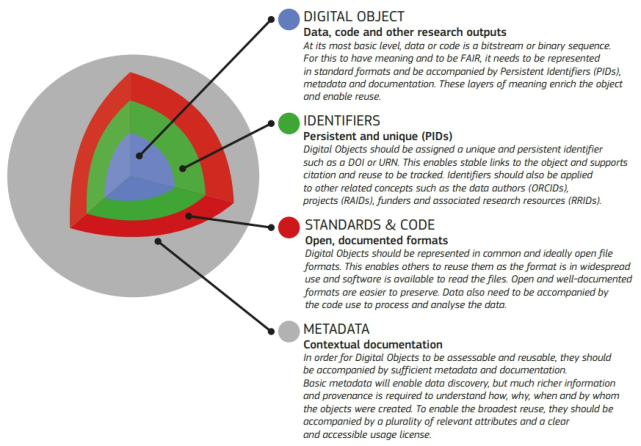
The data used in open innovation environments must satisfy the FAIR principles (FAIR principles, 2016; European Commission, 2018) (Figure 1): (F) Findable.
The data must be described with full metadata and registered or indexed in a searchable resource (e.g., a research data repository). Digital objects must have an internationally recognizable identifier that is unique and perma- nent (persistent identifier). (A) Accessible. There should be an authorization mechanism or a specific protocol for accessing data (especially for sensitive
Figure 1: Model for FAIR digital objects: required elements to make data findable, accessible, interoperable, and reusable (European commission, 2018).
research data in biomedicine). Metadata should also be provided if the data are no longer available. (I) Interoperable. Widely used formats and stan- dards should be used for data and metadata representation, including clear references to help trace the interrelationships between different data, data sets, and research results. (R) Reusable. Rich metadata, documentation, and information regarding reuse conditions should be provided.
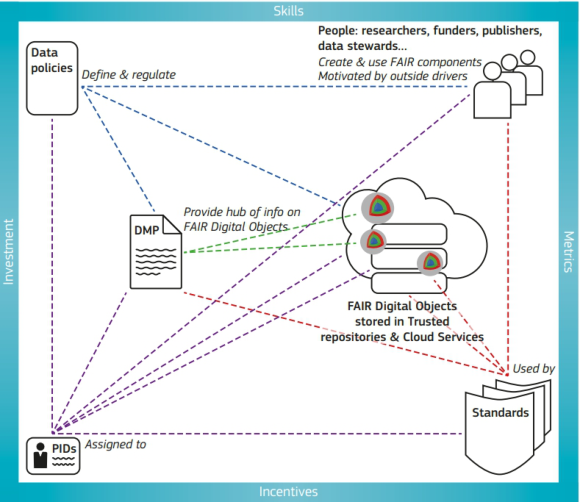
Open data must follow the “open by default” principle, which provides that any nondisclosure must be justified. Reasons for nondisclosure might include the legal or ethical impossibility of disclosing sensitive data or the significant costs associated with the dissemination of a very large data set (Figure 2).
Open data requirements for organizations may vary by location and context. However, the following general requirements typically apply to organizations that publish their data:
Publication: Data must be publicly available and easily accessible online.
Representation of individual data elements: Data must be represented as individual records or entries that can be read and used individually.
Data format: Data must be provided in an open format (e.g., CSV, JSON, XML) that can be easily read and used by other applications.
Data quality: Data must be accurate and up-to-date.
Responsible person: A responsible person or organizational contact details must be provided for data-related matters.
Licenses: These must specify how the data can be used and distributed.
Machine-readable: The data must be viewable and readable by a computer for ease of processing and analysis.
The Role of Open Science in Open Innovation Environment 73
Figure 2: Components of the FAIR ecosystem (European commission, 2018).
Permanent accessibility: Data must be permanently accessible (now and in the future) for analysis and use.
Reusability: Data must be formatted to support new perspectives and analyses in other projects and contexts.
As these requirements may also vary according to the specific category of data released by a public or private sector organization, it is advisable to check local regulations and standards.
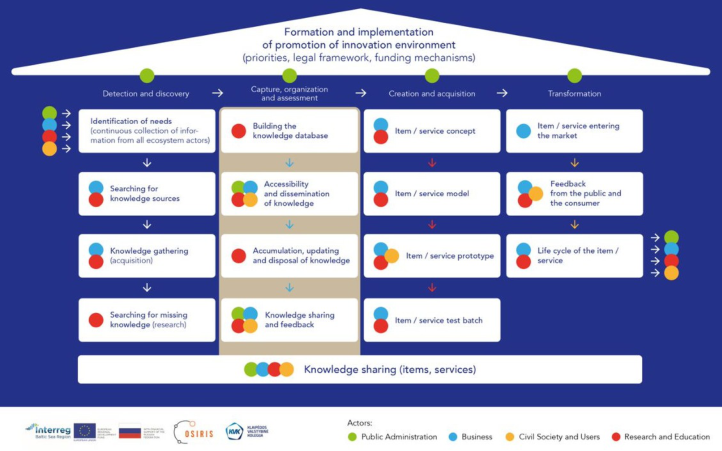
Within the frame of the Interreg BSR OSIRIS project (OSIRIS, 2022), was developed an integrated knowledge management model (KMM), which was built following the same logic as house drawing before construction (Figure 3).
Although surrounded by other operating systems and the international environment, the KMM is essentially a roadmap (Urbanaviˇcius et al., 2021). The path is influenced by public administration systems, especially those that formulate and implement innovation policies. Public administration provisi- ons create the conditions for innovation and its emergence. The hypothetical KMM was based on a 16-phase process involving 70 steps that might work in practice or fail to be used by organizations seeking to bring fast-growing products to the market (Urbanaviˇcius, 2021).
This process roadmap is also a risk management tool that seeks to maxi- mize the likelihood of high product growth potential by tracing paths and outcomes. The KMM is strongly influenced by public administration provi- sions that formulate and implement innovation policy but do not themselves create innovative products.
Figure 3: Example of a KMM in an open innovation environment.
This model implements open innovation by means of three elements: 1) knowledge sharing at all stages and between all actors; 2) repeated reuse of acquired and implicit knowledge of product development; and 3) part of this knowledge, together with other knowledge about innovation, is stored in a comprehensive innovation database using “capture, arrangement, and assessment” technologies.
The proposed KMM was tested at Whatagraph to assess the company’s practices for developing and updating its products. Whatagraph is a software- as-a-service (SaaS) platform used by marketing professionals to monitor their performance (Whatagraph, 2022). Whatagraph’s product is digital and easily scalable and has proved its worth during the company’s consistent growth in recent years. Whatagraph practices open innovation by sharing and co-creating its sales model and product development strategies with par- tners from other startups at international conferences and in the UnicornsLT association.
In one case study employing comparative analysis, the researchers pre- pared 17 open questions and rephrased them for use in an open interview. Analysis of the collected data produced the following findings.
While all 16 stages of the KMM process were tested by Whatagraph in developing their product, not all of the 70 steps could be applied to a software business. Exceptions to the KMM’s logic relate to issues of applicability. The KMM confirmed the universality of the step-by-step logic, but application of each stage’s content to software business terms and processes revealed some shortcomings. The company’s sequence of stages did not match the KMM; for example, “Product concept development”(stage 10 in the model) was used by Whatagraph in stage 3. The company has adopted the “working backwards method” used by Amazon (as described in the book Working Backwards:
The Role of Open Science in Open Innovation Environment 75
Insights, Stories, Secrets from Inside Amazon) (2021), which influences the content of stage 2. The KMM is very dependent on an open innovation environment that includes the country’s strategic priorities for Research and Experimental Development areas, legal frameworks, funding mechanisms, and taxation policy. These elements are vital for traditional business, but star- tups depend mostly on venture capital, which was not included in the KMM. The KMM focuses on technological innovation that is hard to build and the- refore requires the involvement of research and education institutions. While the technological framework might not be new to SaaS businesses, the Wha- tagraph case confirmed that the main source of innovation is the constant focus on customer needs.
The focus on evolving customer needs and the rapid response required differentiates smaller innovation cycles (updates) from bigger innovations (upgrades). The KMM is not appropriate for smaller innovations because it would slow the business down. In the KMM, the “Capture, organization, and assessment of knowledge” stage (which researchers expected to be dif- ficult to implement) was perfectly integrated with the data, thanks mainly to Whatagraph’s modern project management software. This highlights the need for more integrated knowledge transformation support than the KMM provides.
The Whatagraph approach to innovation and product development reve- aled opportunities for future KMM development and adoption, especially in the company’s base SaaS business. On the other hand, the research revealed the KMM’s strength in relation to the product development pro- cess and the selection of appropriate KMM elements for the main path to product realization. Further research is needed to enhance this KMM for open innovation, and open science based on open data can help in this regard.
CONCLUSION
Knowledge transformed into science increases in value as it is more widely disseminated, and it seems clear that open access to scientific production expands open knowledge by increasing the scope of the challenges addres- sed, documenting facts, and reducing the temporal and economic barriers to accessing research results. The philosophy of open access, which origina- ted in the free software movement, has had a profound impact on digital information, especially in educational and cultural contexts. A significant qualitative step has already been taken toward open science, which is sup- ported by government institutions like the European Union and has been integrated into national strategic documents for eventual transfer to open innovation in the manufacturing sector.
The proposed open knowledge management framework reflects the impact of open science principles in enabling organizations to manage and utilize open data and information to drive open innovation and improve decision- making.
ACKNOWLEDGMENT
This work was supported by the European Commission (OSIRIS Interreg BSR Project—Supporting the Smart Specialization Approach in the Silver Economy to Increase Regional Innovation Capacity and Sustainable Gro- wth, duration 2019–2021, https://www.osiris-smartsilvereconomy.eu). This publication reflects the views of the authors alone; the Commission cannot be held responsible for any use made of the information contained herein.
REFERENCES
Bellec, A. C. (2022). Strategies to Reaching the Right People with Open Data— Examples from Cities Around the World. https://www.opendatasoft.com/en/blog /strategies-reaching-right-people-open-data-example-cities-around-world/ Chesbrough, H. (2006). Open Innovation: A New Paradigm for Understanding,
Open Innovation: Researching a New Paradigm 1–12. Declaration for Open Science and Research 2020–2025 in Finland (2020). https: //edition.fi/tsv/catalog/view/79/29/192-1 Directive (EU) 2019/1024 of the European Parliament and of the Council of 20 June
2019 on Open Data and the Reuse of Public-Sector Information (recast) (OJ L 172, 26.6.2019, pp. 56–83). European Commission Directorate-General for Research and Innovation (2016).
Open Innovation, Open Science, Open to The World: A Vision for Europe. Publications Office. https://data.europa.eu/doi/10.2777/061652 European Commission Directorate-General for Research and Innovation (2018).
Turning FAIR into Reality: Final Report and Action Plan from The European Commission Expert Group on FAIR Data. Publications Office. https://data.eur opa.eu/doi/10.2777/1524 FAIR principles (2016). https://www.go-fair.org/fair-principles/ Jetzek, T., Avital, M. and Bjorn-Andersen, N. (2014). Data-driven Innovation Through Open Government Data. Journal of Theoretical and Applied Electronic Commerce Research Volume 9, pp. 100–120. Hajric, E. (2018). A Theoretical and Practical Guide for Knowledge Management in
Your Organization. https://www.coursehero.com/file/44877187/Knowledge-Ma nagementpdf/ Kamariotou, M. and Kitsios, F. (2017). Open Data Hackathons: A Strategy to Increase Innovation in the City, Proceedings of International Con- ference for Entrepreneurship, Innovation and Regional Development (ICEIRD 2017), Thessaloniki, Greece, pp. 231–238. Kitsios, F. and Kamariotou, M. (2018). Open Data Hackathons: An Innovative Strategy to Enhance Entrepreneurial Intention, International Journal of Innovation Science, vol. 10, pp. 519–538. Kitsios, F. and Kamariotou, M. (2018). “Open Data Hackathons and Innovation:
Strategic Planning, Implementation and Evaluation of Civic Applications”, Pro- ceedings of 11th International Conference for Entrepreneurship, Innovation and Regional Development (ICEIRD 2018), Doha, Qatar. Kitsios, F. and Kamariotou, M. (2017). “From Apps to Startups: Success Factors for New Entries in Open Data Ecosystem”, in: Global Opportunities for Entrepre- neurial Growth: Coopetition and Knowledge Dynamics within and across Firms, Sindakis, S. and Theodorou, P. (Eds.), pp. 337–354. Kitsios, F. and Kamariotou, M. (2019). “Open Data Value Network and Busi-
ness Models: Opportunities and Challenges”, IEEE 21st Conference on Business Informatics (CBI). https://doi.org/10.1109/CBI.2019.00040.
The Role of Open Science in Open Innovation Environment 77
Latvian Open Science Strategy 2021–2027 (2022). https://www.izm.gov.lv/en/articl e/latvian-open-science-strategy-2021-2027-now-english?utm_source=https%3A %2F%2Fwww.google.com%2F Liew, A. (2013). DIKIW: Data, Information, Knowledge, Intelligence, Wisdom, and
Their Interrelationships. Business Management Dynamics Volume 2, 49. Liew, A. (2007). Data, Information, Knowledge, and Their Interrelationships.
Journal of Knowledge Management Practice Volume 7, 2. OSIRIS (2022). https://osiris-smartsilvereconomy.eu/ Tautkeviˇcien˙e, G., Gribauskien˙e, A., Kepalien˙e, F., Kiršien˙e, J., Kupˇcinskas, L., Medzvieckait˙e, G., Petrauskait˙e, R. and Umbrasait˙e, J. (2022). Atvirosios pri- eigos prie mokslo publikaciju˛ ir duomenu˛ gairiu˛ taikymo praktikos ir pasiektos pažangos ivertinimas [Assessing Practices and Progress in Applying Open Access to Scientific Publications and Data Guidelines]. https://www.lmt.lt/lt/doclib/wak j1omienmt1ct479xhqn5by9ht26dy Terán-Bustamante, A., Martínez-Velasco, A. and Dávila-Aragón, G. (2021). Know-
ledge Management for Open Innovation: Bayesian Networks Through Machine Learning. Journal of Open Innovation: Technology, Market, and Complexity [Online] Volume 7 No. 1, 40. https://doi.org/10.3390/joitmc7010040 Urbanaviˇcius, D., Kuˇcinskien˙e, J., Galdikien˙e, N. and Brezgyt˙e, E. (2021). Žiniu˛ valdymo modelis sveikatos technologiju˛ ir biotechnologiju˛ atviru˛ju˛ inovaciju˛ eko- sistemoje [Knowledge Management Model in the Health Technologies and Biote- chnologies Open Innovation Ecosystem], Darnios Aplinkos Vystymas Volume 18, No. 1, 143–152. https://doi.org/10.52320/dav.v18i1.177 Užien˙e, L. (2015). Open Innovation, Knowledge Flows and Intellectual Capital, Pro-
cedia Social and Behavioral Sciences Volume 213, 1057–1062. https://doi.org/10. 1016/j.sbspro.2015.11.525. Wang, Z. (2017) Open Knowledge Management Model in Open Innovation Environment. Paper presented at IFLA WLIC 2017, Wrocław, Poland. https://library. ifla.org/id/eprint/1719/1/S04-2017-wang-en.pdf Whatagraph (2022). https://whatagraph.com/ Wilkinson, M., Dumontier, M., Aalbersberg, I. et al. (2016). The FAIR Gui-
ding Principles for Scientific Data Management and Stewardship, Scientific Data 3:160018. https://doi.org/10.1038/sdata.2016.18 Zins, C. (2007). Conceptual Approaches for Defining Data, Information, and Knowledge, Journal of the American Society for Information Science and Technology Volume 58, 479–493. https://doi.org/10.1002/asi.2050
LISTED IN THE AHFE DIGITAL BOOKSTORE CATALOGUE
Explore the complete digital volume
Human Factors, Business Management and Society
Read this individual research paper free through the original publisher, or explore the full digital proceedings book.
ISBN 978-1-958651-73-5
Explore this ISBN in the AHFE Bookstore ↗Listed in the July 2026 bookstore catalogue; search by ISBN to confirm current availability · Digital book purchase optional