Reiner Suikat, Nils Carstengerdes, Yves Guenther, Sebastian Schier, Dag Kjenstad, Michael Sinen (2023). Handling disruptions in Total Airport Management using what-if enabled systems. In: Human Factors in Transportation. AHFE Open Access, vol. 95, pp. 578–588. https://doi.org/10.54941/ahfe1003843
Total Airport Management (TAM) is an operational concept that brings together the main stakeholders at an airport to collaboratively develop a plan for the airport operations, the so-called Airport Operations Plan (AOP). This AOP contains scheduled and targeted times as well as resource plans for all flight operations related events such as on- or off-block times, runway scheduling, ground handling resource planning, etc. In case of a disruptive event at the airport the stakeholders will collaboratively develop a strategy on how to best solve the issues such that the impact on operations overall is minimized. Such disruptive events could for example be related to weather, strikes, or security incidents.The flight related processes, e.g. stand/gate planning, turnaround planning, runway assignments, flight scheduling are forming a closely-knit process network. Each of these processes is under the control of one of the stakeholders, and therefore it is very difficult for them to predict the effect of any decision they might take on the overall operations. This necessitates a process on how to analyze the effects of different stakeholder options on the overall operation before actually taking a decision and activating it in the AOP. This process is called a what-if process and is seen as a vital enabler for an efficient and successful TAM. In the context of the SESAR TAM projects an operational concept for performance-based airport management in case of meteorologically caused disruptions has been developed along with tool prototypes to support the operators with what-if functionality. In the latest TAM project (PJ04) this concept has been validated to reach Technology Readiness Level (TRL) 6 (prototype in operational environment) and both performance and human factors benefits of the approach have been demonstrated with a validation exercise taking place in the Airport Control and Operations Center Simulator (ACCES) at DLR in Braunschweig with operational experts from Oslo Gardermoen airport. In this validation exercise the stakeholders were confronted with a forecasted winter weather situation typical for the airport, where de-icing and runway cleaning is required. The weather forecast and actual weather conditions during the exercise were based on real recorded data and a newly developed MET alerting service provided de-icing and snow alerts with increased accuracy as the actual time of the event approached. The first section of the paper will address the operational concept with a focus on the use of the what-if functionality. Then a brief description of the newly developed tools is given, explaining processes and essential tools enabling effective what-if analysis, the prediction algorithm required to perform what-if analysis and the graphical user interface for the interaction between stakeholders and tools. Next the validation exercise will be described, followed by a presentation of the results, which clearly show benefits both in airport performance as well as the human factors situation awareness, workload, trust, teamwork and usability. Especially the human factors related results, which have been obtained both from standard and bespoke questionnaires, will be explained in detail. The results obtained from the exercise are very promising and suggestions for future research will be provided to conclude the paper.
Airports are an essential part of the air transportation system with high opti- mization potential due to the various interdependencies and interconnections of the conducted processes. Flight related processes as well as passenger and baggage processes need to be precisely timed, but are owned by indepen- dent stakeholders (airspace users, airport authorities, air navigation service providers, ground handling). Currently, each stakeholder plans his actions according to his individual goals and plans, but mostly without considera- tion of intentions and actions of other airport stakeholders (Papenfuss et al., 2017). In the context of the SESAR TAM (Single European Sky ATM Rese- arch, Total Airport Management) projects an operational concept for
Handling Disruptions in Total Airport Management Using What-If Enabled Systems 579
performance-based airport management in case of meteorologically caused disruptions has been developed (Piekert et al., 2021) along with tool prototy- pes to support the operators with what-if functionality. This concept has been validated to reach Technology Readiness Level (TRL) 6 (prototype in opera- tional environment). Both, performance and human factors benefits of the approach have been demonstrated with a validation exercise taking place in the Airport and Control Center Simulator (ACCES) at DLR in Braunschweig with operational experts from Oslo Gardermoen Airport.
The first section of the paper addresses the operational concept with a focus on the use of the what-if functionality. Then a brief description of the newly developed tools is given, explaining processes and essential tools ena- bling effective what-if analysis, the prediction required to perform what-if analysis and the graphical user interface for the interaction between stake- holders and tools. Next the validation exercise is described, followed by a presentation of the results, which clearly show benefits both in airport performance and the human factors situation awareness, workload, trust, teamwork and usability. Especially the human factors related results, which have been obtained both from standard and bespoke questionnaires, are explained in detail.
OPERATIONAL CONCEPT The TAM approach provides a solution for more efficient resource utilization and a holistic airport management system for airside and landside processes. To ensure the overall quality of an airport’s services to customers and the air transportation network, TAM focuses on the planning and execution phases of the operating day using the most accurate information available.
Total Airport Management brings together the main stakeholders at an airport to collaboratively develop a plan for the airport operations (Gün- ther et al., 2006, Spies et al., 2008), the so-called Airport Operations Plan (AOP). The AOP is usually being filled by the main airport stakeholders, as the AOP contains different information from different areas of the airport. The AOP contains among others scheduled, target, and actual times for all flight operations related events such as on- or off-block times, runway sche- duling, ground handling and the availability of key resources at the airport. In case of a disruptive event at the airport, the stakeholders will collaboratively develop a strategy on how to best solve the potential issues due to the event such that the overall impact on flights and operations is minimized. Such disruptive events could for example be related to weather, strikes, or secu- rity incidents. This collaborative planning process typically takes place in a centralized location, the Airport Operations Center (APOC), and an APOC supervisor is selected to coordinate the process.
The flight related processes, e.g. stand/gate planning, turnaround planning, runway assignments, and flight scheduling are forming a closely-knit process network. Each of these processes is under the control of one of the stakehol- ders, and changes in one process are very likely to have an effect on the other processes. Therefore, it is very difficult for each of them to predict the overall
effect of any individual decision. This necessitates a process where the sta- keholders can collaboratively plan and analyze the effects of their individual planning options on the overall operation before taking a final decision and activating it in the AOP. This process of trying things out is called a what-if process (Suikat et al., 2020) and is seen as a vital enabler for an efficient and successful TAM.
What-if analysis in this context should be provided as a transversal service, meaning that a what-if analysis is required spanning all relevant processes and being available to all involved stakeholders. This ensures that everyone involved in the decision-making has the same view on how airport operati- ons will evolve given the anticipated weather conditions and also the actions planned by the stakeholders. The what-if process therefore will use the most recent information from the AOP as a starting point and provide a predi- ction of airport operations considering both external predicted data such as weather and also counter-measures planned by individual stakeholders. This prediction covering actions by all stakeholders is called a “global what-if”, as it covers not only the actions and operations of one stakeholder, but all considered processes at the same time.
Such a global what-if will be initiated by the supervisor when a criti- cal situation is expected. It is a structured process about the balancing of Demand and Capacity, where the order in which the individual stakeholders make their entries is pre-determined. The stakeholder whose potential actions are expected to have the largest effect in the particular situation starts with the adjustment of, for example, capacity reduction. In addition, during this process, individual stakeholders can use “local what-if” analyses to deter- mine their best options, where they can adjust the parameters relevant to them repeatedly in order to be able to correctly assess the effects on their operations.
This structured sequence of inputs enables knock-on effects on other sta- keholders to become visible. After all stakeholders have adjusted their own parameters, an initial plan has been created that contains the planned acti- ons of each stakeholder to counteract the expected disturbances. The what-if process also computes updated flight plans showing the improvement in ope- rational performance indicators due to this plan. The plan also includes the recovery phase following the event.
This first estimate of the impact of the expected weather on operations can already be used, for example, to reschedule the deployment of personnel or to organize additional staff and equipment. Airlines can also already consider which flights should be prioritized or which flights can be canceled with the least negative impact.
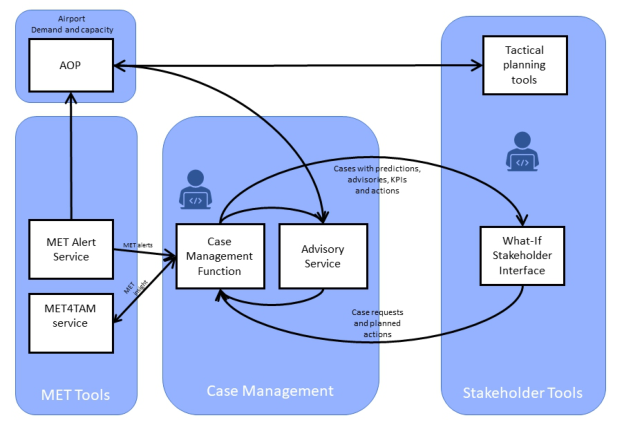
SYSTEM SETUP FOR AIRPORT PERFORMANCE MANAGEMENT ENHANCED BY WHAT-IF ANALYSIS In the course of the TAM project, a tool suite has been developed to imple- ment the operational concept described above. The tool suite consists of four main blocks as shown in Figure 1. The AOP provides the central data sto- rage for all relevant data for all stakeholders. This central data storage is a
Handling Disruptions in Total Airport Management Using What-If Enabled Systems 581
Figure 1: System architecture.
core element of the TAM concept, as it ensures that all stakeholders work on one single set of data and all relevant data are available to all stakeholders. The other three blocks, alerting functions, case management functions and stakeholder tools, are described in more detail below.
MET Alerting Functions Today, the effects of adverse weather impact are not directly transferred to airport operations. Most meteorological (MET) information is based on non- graphical representations in the form of text-based messages. The key to dealing with adverse weather conditions is to have solid, reliable and timely information about the current situation and how it will evolve over time. The MET Alert Service provides this information in two ways: First, this infor- mation is provided in the form of processed warnings and alerts via a newly defined System Wide Information Management (SWIM) service. Secondly, these warnings and alerts, as well as additional weather information, are shown directly to the APOC stakeholders on a dedicated display.
This approach aims to mitigate the impact of adverse weather conditions on operations by creating a common situation awareness among all stakeh- olders regarding ongoing and predicted MET events according to predefined characteristics negotiated and approved by the stakeholders. TAFs (Termi- nal Aerodrome Forecasts) and METAR (Meteorological Aerodrome Report) are replaced by the alerting system providing a unified alert level across all stakeholders.
An important aspect is the monitoring of different types of relevant meteorological phenomena with respect to predefined operational thresholds.
Case Management In order to realize the operational concept, the system must allow the stake- holders to collaboratively plan and analyze alternative cases. Each individual consists of the parameters describing the situation, traffic data, a potential action plan by the stakeholders to best meet the situation, and a set of Key Performance Indicators (KPIs) such as resilience, cancellations, delays and allocated staff used to compare the alternatives before implementing the best alternative.
The Case Management Function is the system component which allows cases to be created, activated, stored and compared. Hence, it is the key com- ponent to make the overall system “what-if enabled” which is required to allow for prescriptive analytics to collaboratively identify the optimal course of actions to be implemented. Cases are organized in a hierarchical manner, similar to how branches are organized in version control systems in software engineering. Hence, whenever alternative approaches are identified during the refinement of a case, sub-cases can temporarily be created for separate exploration.
The Advisory Service propagates the effect of the set of decisions in each case by means of microsimulation. The input to a simulation is the demand taken from the AOP and the capacities for key resources. The output is the resulting flow through the airport along with KPIs, e.g., representing a pre- diction of the performance with respect to overall punctuality, number of cancellations, resilience, environmental impact, and costs associated with the case. The Advisory Service is triggered from the Case Management Function each time a case has been modified to ensure that the stored case is always ready to be retrieved and updated on the stakeholder tools.
Stakeholder Tools The stakeholder tools consist of two parts: The planning tools and the user interface to the what-if system.
As a basis, each stakeholder is provided with a set of common planning tools depending on his tasks (e.g. stand allocation planner, pre-departure sequencer, weather information display, airline rotation planner). These tools are part of DLR’s Airport Management Simulation Platform which is descri- bed in (Schier, Timmermann et al., 2016). The design of the distinct tools is published in (Schier, Pett et al., 2016). Comparable planning tools are available on operational airport management working positions today.
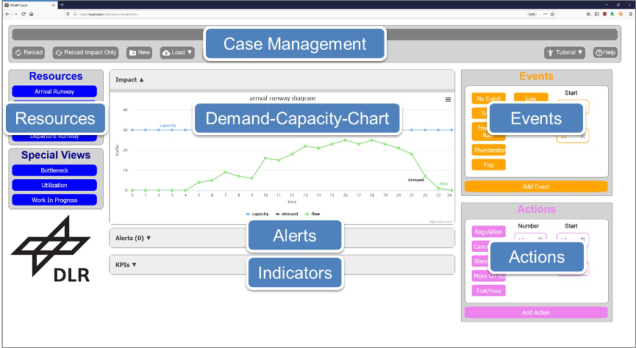
The user interface to the what-if system is not available on today’s working positions. It enables the stakeholders to create and update what-if cases as well as to analyse the outcomes of the cases. Therefore, the interface consists of seven sections as shown in Figure 2.
The Case Management section in the upper section of the interface pro- vides the users with a list of the available cases and the possibility to create, delete and select a case. Each case contains demand and capacity data based on the AOP and potential stakeholder decisions as well as the resulting pre- dicted flow data and KPI values as described in the previous section. The left-hand Resources list allows the users to view the data of a distinct resource
Handling Disruptions in Total Airport Management Using What-If Enabled Systems 583
Figure 2: What-if user interface.
from the selected case. This data is presented in the central Demand-Capacity- Chart. Beside hourly values for demand and capacity, the chart shows a flow value, which is the result of the prediction engine calculations. With this value, the stakeholders can determine the impact of a certain event on the airport. In the right-hand Events and Actions part of the GUI the stakehol- ders can define and vary the underlying weather or other events making up the case as well as the potential actions they are investigating. Last but not least, the Alerts list and the Performance Indicators fields in the center bottom of the interface enable the user to get a quick insight into the challenges of the selected case and to compare multiple cases. Each time the demand exceeds the capacity or the flow drops below the demand, an alert is generated by which the users can judge quickly how severe the airport is disrupted in the selected case. Using the KPI comparison window8, users can compare multi- ple cases on the basis of KPIs such as accumulated delay and costs, allowing them to select the best available option.
VALIDATION EXERCISE The operational concept described above has been validated in a human-in-the-loop simulation exercise taking place in the ACCES simu- lator in Braunschweig. The exercise participants were operational experts from Oslo Gardermoen Airport (APOC Supervisor, Ground Handlers, Stand/Gate planner and Air Navigation Service Provider) and from two airlines.
In this validation exercise the stakeholders were confronted with a fore- casted winter weather situation typical for the airport, where de-icing and runway cleaning is required. The weather forecast and actual weather condi- tions during the exercise were based on real recorded data, and the newly developed MET alerting service provided de-icing and snow alerts with increased accuracy as the actual time of the event approached.
An airport process simulation of Oslo Gardermoen airport was fed with real traffic data taken from a pre-Covid day with considerable traffic volume. Weather data as well as corresponding forecast data was also recorded on a winter day in 2019. On that day temperatures were around freezing and precipitation was forecast, however, it was uncertain whether there would be snow or icy rain the following day. The MET alerting tools provided a number of MET alerts for the considered simulation time, indicating the need for runway snow removal and also de-icing.
The exercise participants then had the task to plan ahead for the day of operations and to minimize the effect of the severe weather conditions. Three simulation scenarios were performed: A baseline scenario that was based on today’s Airport Collaborative Decision Making (EUROCONTROL, 2017) procedures without the availability of the new tools above, a solution 1 scenario utilizing the new MET alerting tools and meteorological impact assessment capabilities of the new tools, and finally a solution 2 scenario with full availability of the new tools and procedures, where the participants could use the tools to analyse the impact of their planned actions on the overall operations before actually activating them.
RESULTS
In this section, we will present some key results from the validation exe- rcise. These are grouped in results addressing operational performance and results addressing human factors. For a more detailed presentation the reader is referred to (Pansa, DLR, Thales 2023).
On the operational performance side, the off-block delay (+/−15 min criterion) of all flights on the scenario day was reduced from 29% of delayed flights in the baseline run to 9% in the solution run.
While the simulation setup did not allow to directly measure fuel consum- ption, the simulation did allow to take a look at waiting times with engine on. This could be at the runway holding point or when waiting for a stand to become free. There was a significant reduction in engine-on waiting times in the solution 2 run, which is correlated to the reduction in delays (less waiting for a stand to become free), cumulated from 1574 min in the baseline run down to 135 min in the solution 2 run.
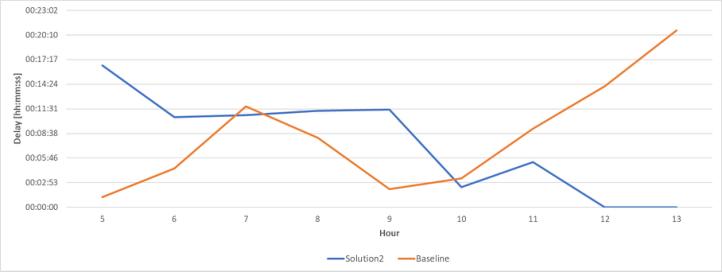
The recovery time indicates when normal operation is reached again after a disturbance (see Figure 3). Depending on the disturbance, different para- meters can be used for a comparison in order to draw conclusions about the recovery time. For the trials, the off-block delay was evaluated over time. The delay figure over time clearly shows that the delay related to each hour in Solution 2 was slightly higher than the delay in the baseline before and during the weather-related restrictions. After the restrictions were lifted, however, the delay in Solution 2 dropped to almost zero, while it continued to increase in the baseline.
A significant part of the validation was to capture different human factors aspects. This was achieved by applying both standard and bespoke questi- onnaires after each exercise run, following the cross-legged design approach introduced in Piekert et al. (2023). Some of the results are presented here.
Handling Disruptions in Total Airport Management Using What-If Enabled Systems 585
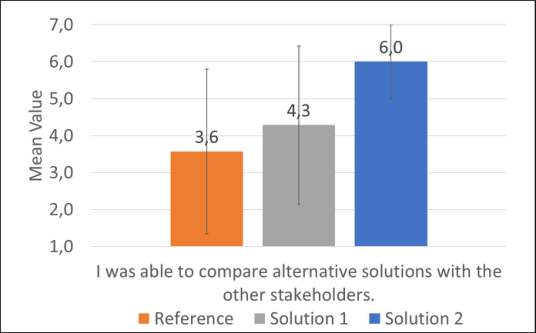
Figure 3: Recovery time - average off-block delay.Figure 4: Bespoke questions - stakeholders are able to compare the effect of different candidate solutions and select the one with the best overall performance (y-axis scale: 1 never/strongly disagree … 7 always/strongly agree).
The benefits of the what-if system were confirmed by stakeholders. It was shown that the comparison of different solution versions and the opportunity to choose the most suitable solution from a performance point of view was best possible in Solution 2 (see Figure 4).
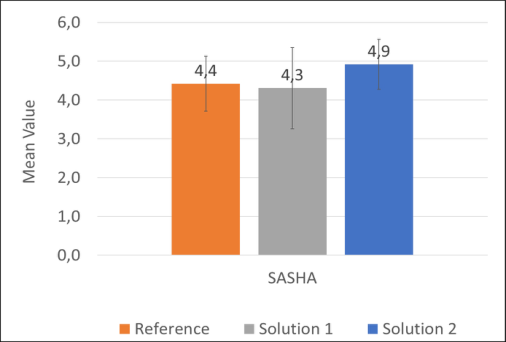
With the enhanced features of the what-if tool in Solution 2, there was a risk that situation awareness would deteriorate if too much informa- tion led to more confusion instead of more clarity. However, the eva- luation of the level of situation awareness did not confirm this concern (see Figure 5).
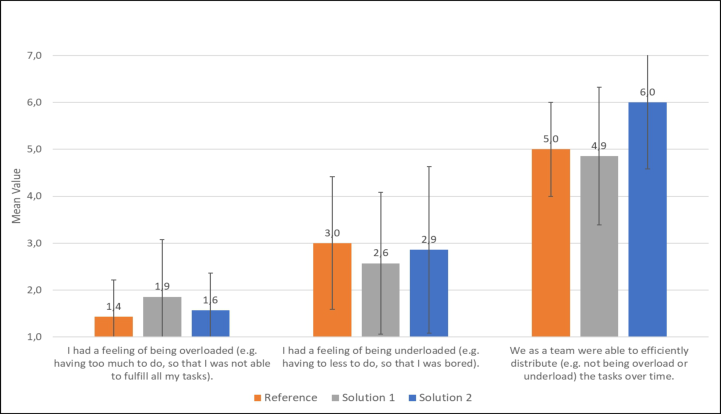
However, it also showed that despite the advanced capabilities in Solu- tion 2 and more information to analyse, the workload was not negatively impacted compared to the baseline (see Figure 6).
The questions about team communication indicate that the means and modalities of communication provided in the scenarios were adequate, with no need for additional means or modalities.
Figure 5: SASHA1 (APOC adaption) - level of situational awareness is not lower in the solution than in the reference scenario (y-axis scale: 0 never … 6 always).Figure 6: Bespoke questions - the level of workload (induced by cognitive and/or physical task demands) is acceptable (y-axis scale: 1 never/strongly disagree … 7 always/strongly agree).
CONCLUSION
In this paper, we have described how what-if enabled systems can support airport stakeholders in dealing with adverse weather situations. A validation with operational experts from several Oslo airport stakeholders in a realistic simulation environment has demonstrated that significant operational impro- vements during and after the disruption were achieved when using the what-if analysis to predict the effect of the disruption and of individual stakeholders’ planned actions on the overall operation. A key result of the validation is
1Situation Awareness for SHAPE (Solutions for Human Automation Partnerships in European ATM)
Handling Disruptions in Total Airport Management Using What-If Enabled Systems 587
that using these new procedures and tools does not have a negative impact on workload. While using the new systems requires additional steps in the nego- tiation process, it simplifies the evaluation of the effect of planned actions, which is a very difficult task without such systems. The ease with which diffe- rent candidate solutions can be compared in their effect on overall operations contributes significantly to the positive result, it increases the team situation awareness of the stakeholders and helps them in choosing a solution that optimizes operational performance in the desired way.
ACKNOWLEDGMENT
This project has received funding from the SESAR Joint Undertaking (JU) under grant agreement No 874472. The JU receives support from the Euro- pean Union’s Horizon 2020 research and innovation program and the SESAR JU members other than the Union.
The content presented in this paper reflects only the authors’ view and the JU is not responsible for any use that may be made of the information it contains.
REFERENCES
EUROCONTROL (2017). Airport Collaborative Decision Making (A-CDM) Implementation Manual, 5th Edition. EUROCONTROL, Brussels, Belgium. Günther, Y., Inard, A., Werther, B., Bonnier, M., Spieß, G., Marsden, A., Temme,
M., Böhme, D., Lane, R., Niederstrasser, H. (2006). Total Airport Mangagement: Operational Concept & Logical Architecture. DLR, Eurocontrol, Braunschweig, Bretigny (2006). Pansa, DLR, Thales (2023) PJ04-W2-29.2 Validation Report. In: PJ04-29.2a data pack, to be published, SESAR SJU, 2023, Brussels. Papenfuß, A., Carstengerdes, N., Schier, S., Günther, Y. (2017) What to say when:
Guidelines for Decision Making. An evaluation of a concept for cooperation in an APOC. In: Proceedings of the 12th USA/Europe Air Traffic Management Research and Development Seminar, ATM 2017. Twelfth USA/Europe Air Traffic Manage- ment Research and Development Seminar (ATM2017), 26.-30.06.2017, Seattle, USA. Piekert, F., Carstengerdes, N., Suikat, R., Schier, S. (2021). Dealing with Adverse Weather Conditions by Enhanced Collaborative Decision Making in a TAM APOC. In: Electronic Navigation Research Institute (eds) Air Traffic Management and Systems IV. EIWAC 2019. Lecture Notes in Electrical Engineering, vol. 731. Springer, Singapore. https://doi.org/10.1007/978-981-33-4669-7_8 Piekert, F., Carstengerdes, N., Schier-Morgenthal, S., Günther, Y. & Suikat, R. 2023.
Metrics to Evaluate Multi-Stakeholder Decision-Making Processes – a Critical Discussion. AHFE 2023. San Francisco, USA. Schier, S., Timmermann, F., Pett, T. (2016). Airport Management in the Box – a human-in.the-loop simulation for ACDM and airport management. Deutscher Luft- und Raumfahrt Kongress 2016, Braunschweig, Germany. Schier, S., Pett, T., Mohr, O., Yeo, S. (2016) Design and Evaluation of User Inter-
faces for an Airport Management Simulation. In: Scopus. AIAA Modeling and Simulation Conference, 13.-17. June 2016, Washington, D. C., USA.
Spies, G., Piekert, F., Marsden, A., Suikat, R., Meier, C., Eriksen, P. (2008) Operational Concept for an Airport Operations Center to enable Total Air- port Management. 26th Inter-national Congress of the Aeronautical Sciences, Anchorage, Alaska, USA. Suikat, R., Schier-Morgenthal, S., Carstengerdes, N., Günther, Y., Lorenz, S., Piekert,
F. (2020). “What-if Analysis in Total Airport Management”. In: Stanton, N. (eds) Advances in Human Aspects of Transportation. AHFE 2020. Advances in Intelli- gent Systems and Computing, vol. 1212. Springer, Cham. https://doi.org/10.1007/ 978-3-030-50943-9_65
LISTED IN THE AHFE DIGITAL BOOKSTORE CATALOGUE
Explore the complete digital volume
Human Factors in Transportation
Read this individual research paper free through the original publisher, or explore the full digital proceedings book.
ISBN 978-1-958651-71-1
Explore this ISBN in the AHFE Bookstore ↗Listed in the July 2026 bookstore catalogue; search by ISBN to confirm current availability · Digital book purchase optional