Yawen Zhang (2023). Optimization of the Animation Produce Process Utilizing the Game Engine. In: Human Factors in Communication of Design. AHFE Open Access, vol. 90, pp. 166–175. https://doi.org/10.54941/ahfe1003708
With the increasing demands of audiences, animated films are required to achieve higher quality. The traditional production process frame has an extreme slow development since the advent of the first 3D animated film in 1995, which leads to a continuously increasing requirement of both human labor and hardware. Nowadays, with the optimization and iteration of game engines, their application in animation has become more and more extensive. Utilizing game engines to optimize the traditional pipeline is a feasible approach, not only for industry, but for education field and independent artists. This paper elaborated the three processes: Pre-production, Production and Post-production, through comparative analysis of the pipeline of traditional 3D animation films and the engine 3D animation films with representative practical works. The study shows that game engines provided a revolutionary way in all these stages of animation production, more than 50% of detailed processes are remarkably simplified. This work described optimizations in different phases, generalized this pipeline systematically, then discussed challenges and opportunities of this innovation. The results of this study could be adopted by creators, especially independent artists to product animated films with relatively lower costs and higher flexibility.
Since last century, both the visual effects and production efficiency of 3D animation have steadily improved through the generation after generation development of technology and pipeline. The emergence of game engines and their integration into the animated film industry became a remarkable inno- vation in this decade. The game engines’ real-time graphics rendering effect has been continuously improved which could surprisingly achieve the tradi- tional offline rendering effects. Compared with traditional approaches, the convenience and efficiency of real-time rendering make game engine an opti- onal platform for animation production and is becoming a new trend in both industry and academia.
The traditional 3D animation production linear pipeline has complex and cumbersome rendering process which has high requirements for labor costs and production funds. The animation using game engines as the deve- lopment platform for production is called engine animation. The engine animation effectively simplifies the pipeline of animation and reduces pro- duction costs due to the advantages of game engines’ real-time rendering
Optimization of the Animation Produce Process Utilizing the Game Engine 167
technology and real-time modification capability. As increasing commercial animation companies around the world begin to enter the “Engine Era”, ope- rating and optimizing engine animation pipeline has become a challenge faced by many creators. The following chapters compare traditional 3D animated film “Ice Age” with the first completely Unreal Engine rendered animation “Zafari”, and discuss optimizations of the 3D animation pipeline brought by game engines. The game engine will participate in different stages of the production process, innovatively replacing or assisting traditional tools, and achieve breakthroughs that make the entire pipeline more intensive. More- over, by introducing the concept of game engine, the animation production process can be optimized with gamification thinking. In addition, creators may overly rely on efficient game engine technology instead of paying enough attention to plot expression and visual effect presentation. Thus, it is a com- mon problem for the artistic core to compromise with technical approaches. Therefore, how to maintain the balance between technology and art through optimization is also a highlight of this research.
Benefits of Engine Animation First of all, efficiency is a huge advantage in engine animation production pipeline because of real-time rendering technology. It is mainly presented in two aspects. For one, it saves rendering time and cost. Unlike the time- consuming offline rendering approach of traditional 3D animation, real-time rendering can be described as “what you see is what you get”, which greatly reduces rendering time and saves budget of production. For another, the cost of modifications and iterations are also significantly reduced. By utilizing real-time rendering function, creators can preview final effects of finished films, so they can find problems and modify them in time and get immedi- ate feedback after modifications. On the other hand, the offline rendering approach is much more complicated. The modified video sequences must be re-rendered if creators want to make some changes after rendering phase.
Secondly, the game engine itself has strong graphics and lighting calcula- tion functions. The fine rendering of scenes can not only show real effects of created entities under various lights, but also express imagined virtual scenes in a realistic way. With the help of game engines, many lighting operations have become more intelligent instead of repeated adjustments.
Finally, using game engines can bring breakthroughs of 3D animation in interactive, panoramic, stereoscopic and other aspects. The game engines allow the audiences to perceive innovative narratives, plot trends and visual experience in 3D animated films. Scene construction in engine animation is usually more comprehensive and more versatile, while the same process needs to base on the storyboard in traditional pipeline. With these advantages men- tioned above, creators can try many shootings, interactions and audio-visual languages that are difficult to achieve before.
Drawbacks of Engine Animation Although engine production pipeline has many advantages, its drawbacks are also obvious. First, the game engines cannot fully cover the whole process
168 Zhang
of production. For example, modeling, texture, and some detailed character animation works still need to be completed with 3D software such as Maya and Substance Painter, which requires relatively high capabilities for creators. In addition to being able to use game engines proficiently, it is also necessary to use multiple software in different phases.
Secondly, as the physics systems for cloth and hair in game engines are still in the early stages of development, real-time rendering solution still has some flaws in quality and the rendering effect is far inferior to that of traditional offline rendering.
Thirdly, in terms of compatibility between different software, engine pipe- line cannot be perfect by now. For example, some texture maps in Substance Painter can only be restored to about 70% in Unreal Engine, and baked shadows cannot be recognized by some engines. As the advancement of technology and hardware, the quality gap between traditional and real-time solutions is constantly decreasing, but undeniably it still exists.
OPTIMAZITION ANALYSIS OF 3D ENGINE ANIMATION PRODUCTION PROCESS The traditional 3D animation process has a mature system which consi- sts of three major stages: pre-production, production and post-production. Pre-production works include script-writing, art design and storyboard. Production stage mainly consists of asset preparation, animatic and level construction and compositing. Post-production part includes rendering, com- positing, editing and after effects. After game engines became the production development platform, the previous pipeline faced iterations. Base on tra- ditional linear process, engine animation production pipeline retains its framework and modifies it in many details. The detailed processes in each part are interspersed with each other, and some works can be carried out simultaneously to maximize efficiency, which creates more integration and cooperation. This chapter will compare traditional pipeline produced anima- tion “Ice Age” with the first completely Unreal Engine rendered animation “Zafari”, and analyze optimizations of using game engines to produce 3D animation from the three stages.
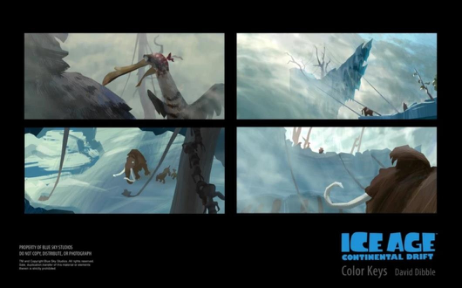
Pre-Production: Technology Drives Inspiration After reasonable material selection, the forward-looking pre-production work can efficiently save costs and time for the next two stages. Specifically, game engines can be introduced into pre-production, and the real-time rende- ring function of game engines can be used to assist in scene construction and camera scheduling, thus stimulating creativity and multi-angle thinking of designers. For example, creatively introduce the engine workflow to visual concept design process and use the global lighting and real-time rendering functions as design aids. Using the real-time rendering function, designers can quickly utilize public resources to test visual effects, constantly obtain inspi- ration, and define the assumptions and concepts of the film. In “Ice Age”, the artist spends a lot of time to design colorkey of the film which is a group of paintings of the same scene as a series separately for the daytime, dusk, and
Optimization of the Animation Produce Process Utilizing the Game Engine 169
Figure 1: Colorkey of “Ice Age”.
night. (Figure 1). In this step, color atmosphere of the film is established. Only based on these complete and detailed works, the lighting and compositing process of subsequent stages can proceed smoothly. This step is much easier in the pre-production of “Zafari”. After building the entire jungle scene, they can switch the scene to night by modifying lights or add some physical par- ticles to simulate rainy version in game engines. So that the creators can get the colokey in such a convenient way.
In terms of storyboard and shooting design, unlike the complicated shoo- ting design process of traditional approaches, game engine’s high-degree-of- freedom virtual scene construction can also provide inspiration and improve efficiency for artists. After finishing the shooting script, the game engine is used directly to make the layout or to simulate the camera movements in advance. The reference shootings can be exported from the engine with sati- sfying results. If artists need to modify the camera position, they can also get real-time feedback. The team “Zafari” often takes advantages of this, the lead creator Dozoretz said: “What I’d really love to do is make adjustments to camera position a bit. I’d love to be able to move the camera a little bit to the right, say, so there’s an out-of-focus foreground leaf that makes the com- position better. That’s the kind of stuff that can happen right now.” Through the game engines’ real-time interactive capabilities, artists can accurately find the required scheduling in the scene, which make the shooting design become easier and more efficient.
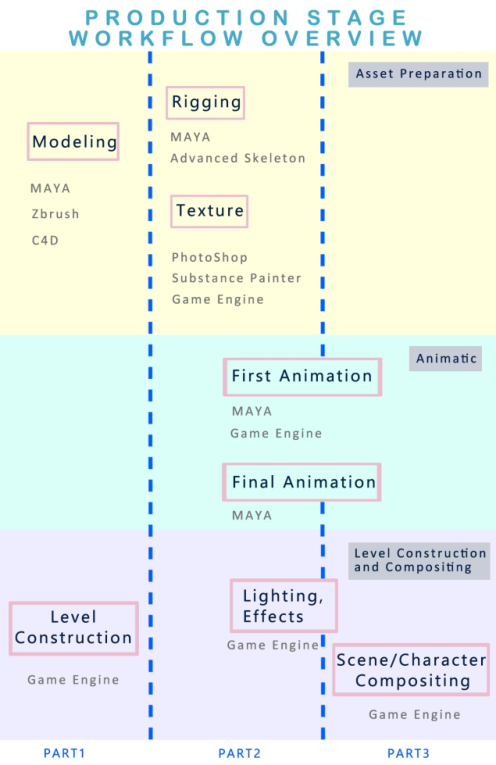
Production: Multi-Process Connection and Optimization Application The production phase of engine animation pipeline is quite different from that of traditional one. Generally speaking, the most significant difference is that the engine pipeline adopts the multi-process connection approach. The connection of multiple processes represents a high degree of compounding and intensification in production phase. The production phase can be divi- ded in three parts as asset preparation, animatic and level construction and compositing. Although the three parts of the workflow use different software and tools, there are technical supports and mutual overlapping work cycles between each other. Finally, multi-process connection of all these workflows
170 Zhang
Figure 2: The production workflow of engine animation.
is implemented in the game engine (Figure 2). With the game engine, creators can choose to use various tools according to their advantages to complete detailed operations. Therefore, the game engine becomes an integration plat- form between workflows and tools, which greatly improves the quality and efficiency of the production phase.
The tediousness and repetition of traditional 3D animation linear pipeline are shown in disclosed workflow of “Ice Age”. To complete each indepen- dent shooting, animators must follow the process of layout→blocking→ first animation→final animation. Lighting artists cannot intervene in this workflow before the whole process is completed. Furthermore, it is difficult for creators in different departments to communicate with each other, which could generate information gaps. The “Zafari”team adopts a combination of traditional process and the game engine to optimize this pipeline. Modeling and animatic take place in Maya, and then the game engine is used in scene
Optimization of the Animation Produce Process Utilizing the Game Engine 171
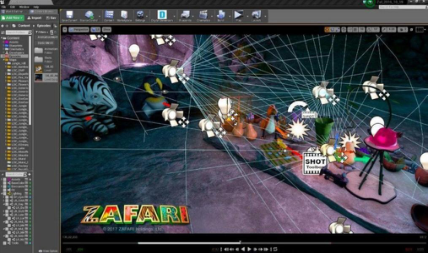
Figure 3: Implementation of real-time lighting in “Zafari”.
compositing. When assets are completed to about 50%, the team can start to build large-scale scenes, set lights and add effects with the assets (Figure 3). In this way, the entire lighting and rendering process is greatly advanced and shortened, and it is possible to enter the post-production at once when the animatic is finished. This is not only efficiency improving, but more impor- tantly, a two-way feedback is formed. If some mistakes need to be repaired or some optimization could be done during the scene compositing, the modi- fications are relatively easy to implement. Through direct communications between animators and the lighting artists, they may get better results by making adjustments in details.
Post-Production: Enhanced Efficiency and Flexibility The most obvious advantage brought by real-time rendering technology in the post-production phase is that the video sequences are no longer depending on the rendering farm. Traditional CPU multi-channel rendering takes seve- ral minutes for each frame, while “Zafari” can complete 3 frames per second on average by using real-time rendering. Multi-channel rendering has two main aims: (1) Reduce modification costs by channel compositing. (2) Use post-production software to add after effects. For example, the shooting of the squirrel being shocked by a lightning in “Ice Age” was produced in this process. Firstly, the layered sequence was rendered in separated channels, and then the lightning effects were added by post-production software (Figure 4). Because of the reduction in modification costs brought about by the improve- ment of rendering efficiency, the engine workflow basically achieves real-time modification, and most of the required special effects are directly completed
Figure 4: Post-production workflow in “Ice Age”.
172 Zhang
in the engine by blueprint effects, basically no compositing is required, and the shots can be directly entered into editing after rendering. However, relying on less modification costs brought about by the improvement of rendering efficiency, the game engine pipeline basically achieves real-time modification. Most of the required effects are directly completed in the engine by blueprint function, and these sequences can be directly entered into the editing after rendering without compositing.
Another advantage is that the flexibility of editing is greatly improved in engine pipeline. Based on a complete scene construction, new cameras can be created and new shootings can be added according to the needs of the story in game engine. However, in traditional pipeline, the video sequence can only be deleted and spliced. Therefore, using engine pipeline instead of traditional one is switching from doing subtraction to doing addition. The real-time audio function in game engines also helps a lot. In the traditional animation approach, the productions of video and sound design are always separated, thus it is technically difficult to modify the music or sound effects in real time during the production of animation. Taking advantages of the real-time audio function in game engines breaks this shackle. Through the optimized workflow, the whole post-production phase (include video and voice) can be cut to less than 5 days for every episode in average, which is a dramatic improvement compared with the traditional offline rendering approaches.
PRACTICAL VALUE ANALYSIS OF ENGINE ANIMATION PIPELINE OPTIMIZATION Compound Intensification of Workflow
As mentioned in the previous section, the optimization of the animation produce process by the engine shows a high degree of compound intensi- fication of the workflow. Such intensification does not mean the absence of necessary processes, but the adoption of strategic planning for process optimization. Through specific requirements, the high-efficiency, stereosco- pic and immersive advantages of the engine are used to set integration and parallel implementation between different processes so as to ensure quality.
In pre-production stage, the massive public resource and the real-time ren- dering function of game engines are used to assist and inspire the designers. Through high-flexibility engine level construction, creators can explore mul- tiple camera perspectives and simulate camera movements to support the advancement of the storyboard design process. In production phase, the multi-line parallel feature is more obvious. First of all, it is the same as tra- ditional linear pipeline: after modeling, texture drawing and rigging can be carried out at the same time, besides adjustments can be smoothly updated in time during subsequent work. Scene construction and layout are almost simultaneously conducted. This process achieves cross-stage integration and modification, which can go through pre-production and production steps. Post-production is carried out in a more integrated, real-time rendering- based environment. Lighting, rendering, and even part of editing process
Optimization of the Animation Produce Process Utilizing the Game Engine 173
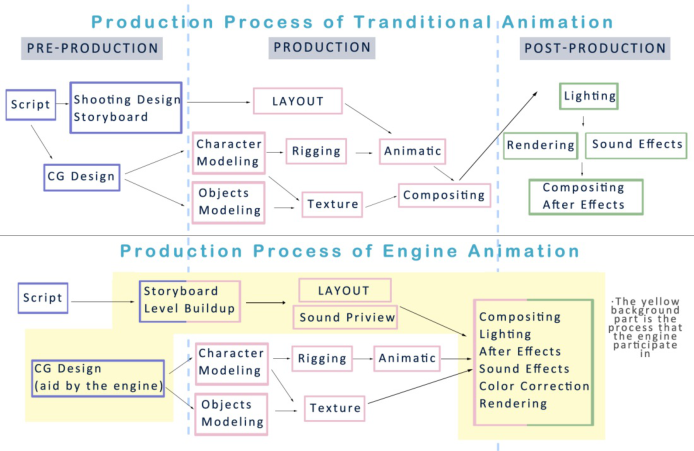
Figure 5: Comparison flow chart of traditional animation pipeline and engine animation pipeline.
can all be incorporated in this process. Comparing horizontally with tradi- tional animation produce pipeline, the optimized engine animation pipeline undoubtedly demonstrates this compound intensification (Figure 5).
Achieve Integration of Technology and Art in Multiple Dimensions Animation films produced by the game engine as a platform often have a rational aesthetic style. The game engine is involved in every major stage of production, which leads to an intuitive impact on the aesthetic style of films. In traditional 3D animation production, the artistic concept setting of a work often depends on the artists’ own inclination and experience. The game engine has real-time lighting effects based on the real-time rendering function. This type of lighting effects gives the “rational” art style, which becomes the mainstream in the engine animation process. Moreover, the performance of texture in the engine is calculated by simulating the real texture and lighting of the real physical world. In addition, there are many special effect blueprints in the game engine and it is suitable for making futuristic and technological effects. Therefore, animation works produced by the game engines tends to be more realistic.
Contemporary films gradually show special attention to video games and related technologies. Film makers who have grown up with the developing video games not only use many same tools as game production (CGI ima- ges, digital 3D, etc.), but also gradually infiltrate some game concepts into the creation. This bought the trend of gamification in technology, story and vision, which makes a new internality appear in the context of cross-media and convergence media to the film industry. Hence, a narrative style known as “integration of film and game” appears, which is another characteristic
174 Zhang
of engine films. This means that 3D animation films utilizing game engines will contain many properties of interactive game, breaking down the “wall” between these two representations step by step.
In terms of narrative style, animation focuses on plot and narrative, and the audience of most film and television animations often experience the story from the perspective of a third party. On the contrary, the game focuses on interactivity. Players often experience it from the first perspective, go through levels one by one, make different interactive choices, and achieve different endings. Generally speaking, animated films have strong narrative features, while games pay more attention to interactivity, immersion and experience. The animation produced by the engine can put the audience in the perspe- ctive of subjective immersion in the narrative mode of traditional animation, and add interactive links to achieve the effect of narrative, interactive and immersive experience at the same time.
Diversity of Artistic Expressions With changes to production tools, creators have more options. The flexibi- lity and interactivity provided by game engines also allow/enable the same work to be expressed in different forms. Using the engine, it is possible to use the same assets, scenes and scripts to produce VR movies or AR works. By experimenting with different forms of expression, creators can learn new techniques and explore the ceiling of works. For the audience, compared with the traditional forms, using the VR environment can bring them a variety of sensory experiences other than audio-visual experience. For example, the cre- ative team “Zafari” proposes that they can adapt the entire story into a game by using the existing scenes. On iPad, players can experience the scenes of episodes in real time and even modify the characters. Nowadays, such cases boost in the industry. Animation films can be expressed in various forms: VR, AR, games and other forms. The audience has a more novel-narrative perspective and immersive experience, which also allows the creators to have a broader perspective of expression and can show the core value of the art work from different angles.
CONCLUSION
Engine animation is a frontier hot spot and new direction of the animation industry in recent years, the functions of game engines have also been con- tinuously optimized and improved with technological iterations. Using the game engine as a platform provides more new possibilities that worth explo- ring in the innovation and optimization of 3D animation production process. Undoubtedly, real-time and interactive features will make this nonlinear pipeline more competitive.
During artistic creation, the most important thing for optimization of the pipeline is to make artistic core and technologies complement each other. The way to apply technical experience to practice and create better animation films requires efficient utilization of new technologies while playing streng- ths and circumventing weaknesses to ensure creativities and visual effects. Creators need to use dialectical thinking to balance the relationship between
Optimization of the Animation Produce Process Utilizing the Game Engine 175
art and technology in their creation of works, in order to truly use technology to accomplish artistic creation.
REFERENCES
3D Animation Internships, (Jul 17, 2021). Ice Age Dawn of the Dinosaurs | Compa- rison Animation Reel | Jeff Gabor | https://www.youtube.com/watch?v=wXv-3v uaNEg Ba˛k, A. and Wojciechowska, M. (2019). Using the game engine in the animation production process. In Asian Conference on Intelligent Information and Database Systems (pp. 209–220). Failes, I. (2017). Upcoming Animated Series “Zafari” Is Being Rendered Completely
With The Unreal Game Engine https://www.cartoonbrew.com/tools/upcoming-a nimated-series-zafarirendered-completely-unreal-game-engine-153123.html Fritsch, D. and Kada, M., (2004). Visualisation using game engines. Archiwum ISPRS, 35(5), pp. 1–5. Karnchanapayap, G., (2019). VR Animation: The New Transformation of Story-
telling. In 2019 IEEE 2nd Workshop on Animation in Virtual and Augmented Environments (ANIVAE) (pp. 1–4). IEEE. Liwei, Xia. (2018). The Analysis of Pros and Cons of Game Engine Application in 3D Animation. Contemporary Cinema, 2018(08), pp. 168–170. Nurym, N., Sambetova, R., Azybaev, M. and Kerimbayev, N. (2020), August. Virtual
Reality and Using the Unity 3D Platform for Android Games. In 2020 IEEE 10th International Conference on Intelligent Systems (IS), pp. 539–544. Thomason, K. and Cavaleri, R. V., (2002). 3D layout and propagation of environmental phenomena for Ice Age. In ACM SIGGRAPH 2002 conference abstracts and applications (p. 136).
LISTED IN THE AHFE DIGITAL BOOKSTORE CATALOGUE
Explore the complete digital volume
Human Factors in Communication of Design
Read this individual research paper free through the original publisher, or explore the full digital proceedings book.
ISBN 978-1-958651-66-7
Explore this ISBN in the AHFE Bookstore ↗Listed in the July 2026 bookstore catalogue; search by ISBN to confirm current availability · Digital book purchase optional