Qian Mao, Zihan Li, Chengxi Huang, Hailiang Wang (2023). An exploratory user study on the design of smart walking aids for community-dwelling older adults. In: Human Factors in Aging and Special Needs. AHFE Open Access, vol. 88, pp. 59–67. https://doi.org/10.54941/ahfe1003662
Population aging has increasingly become an issue of concern globally. Aging inevitably reduces older adults’ physical capacity (e.g., mobility) and further affects their ability to live independently or perform daily activities. Walking aids (e.g., canes) are generally used as assistive devices to provide physical support and reduce fall risk in daily activities. Given the rapid development of artificial intelligence algorithms and hardware computing capability, smart walking aids with functions like fall alert, health monitoring, and positioning have become promising in elderly care. However, it remains unclear whether community-dwelling older adults are ready for smart walking aids. The present study aims to explore community-dwelling older adults’ attitudes and perceptions of smart walking aids, especially on the functions of fall alert, health monitoring, pill reminder, positioning, and topography detection. The results are expected to guide future designs of smart walking aids to increase users’ well-being in daily life. A convenience sampling method was applied to collect data via an online questionnaire for demographic information, attitudes, and design expectations toward smart walking aids. Chi-square tests and binary logistic regression models were used to analyze the associations among demographics, attitudes, and design expectations. The data were collected from 264 valid respondents (148 males and 116 females; 60.5±7.4 years). The results showed safety assurance, sturdy products, and additional intelligent functions were the most expected design elements in smart walking aids. Community-dwelling older adults preferred three intelligent functions: fall alert, health monitoring, and positioning. However, complex operations would resist users from adopting smart walking aids, showing the importance of usability in future designs. No significant group differences were found in purchase preference and attitudes toward smart walking aids among gender (p > 0.06), education (p > 0.35), and living arrangement (p > 0.06). The results of binary logistic regressions showed that individuals with a user history of smart walking aids are about ten times more likely to buy smart walking aids than those with no user history (p = 0.025, OR = 10.376). Older adults aged 71-80 preferred smart walking aids over other age groups (p = 0.048). Individuals aged 61-70 years are more interested in the intelligent functions of fall alert (p = 0.002) and health monitoring (p = 0.021). Community-dwelling older adults showed positive attitudes to smart walking aids with functions such as fall alerts, health monitoring, and positioning to support their independence in their daily lives. User-centered designs are crucially needed to speed up the successful implementation of smart walking aids in the community.
The increasing global aging makes it imperative to address the health issues of older adults (McMaughan et al., 2020). The physical functions of older adults decline with age, inevitably affecting their life quality (Yusif et al., 2016). Walking aids play an important role in maintaining older adults’ mobility, stability, ambulation, and independence by providing weight support, which helps to mitigate the influence of declined physical functions (Cetin et al., 2010). Traditional walking aids, such as crutches, frames, prostheses, and manual wheelchairs, are mostly passive and rely on users’ strength to drive their limbs (Laufer, 2004). Although traditional walking aids are lightweight in structure and simple to use, they do not provide active support when users are deprived of assistance (Tyson, 1994).
With the rapid development of robotics and sensors in recent decades, the integration of robotics with assistive walking tools has become a popular area of research to help people with limited mobility (Dabir et al., 2018). A wide variety of smart walking aids provide natural gait patterns with lateral stability, weight support, and capabilities such as fall prevention, obstacle avoidance, and interaction (Ye et al., 2012). For example, smart wheelchairs are designed for patients with muscle weakness, spinal cord injury, or total incapacity, helping patients to walk with minimal physical exertion required for daily life (Page et al., 2017). Wearable exoskeletons are designed for patients with lower limb weakness or walking disorders, which can achieve similar functions such as, lower limb bone support, joint- controlled flexion and extension movement, and human-like gait walking control (Pons, 2008). Smart crutches are multifunctional walking aids that integrate lighting, first aid medication storage, fall warning systems, cushi- ons and weight support, navigation, and intelligent route planning (Shi and Zhang, 2022). However, above smart walking aids are normally heavy and expensive for most users (Ntakolia et al., 2022). Moreover, previous designs of smart walking aids have focused little on assessing performance for spe- cific users, such as ease of use and wear (Oladele et al., 2021). Due to the lack of user-centered design, it is unclear whether community-dwelling older people are ready to use smart walking aids. Therefore, the present explora- tory user study aims to assess the attitudes and perceptions toward smart walking aids in community-dwelling older adults. A user-centered strategy can thus be adopted to help in the design and application of future smart walking aids.
METHODS
QUESTIONNAIRE DESIGN A convenience sampling method was applied to collect data via a profes- sional Web-based survey platform (www.wjx.com), which has been widely utilized in academia (Zhang, 2022). This exploratory user study question- naire consisted of two sections: six demographic items and eleven questions regarding attitudes and design expectations of smart walking aids. In detail, the demographic items included age, gender, education level, income, living
An Exploratory User Study on the Design of Smart Walking Aids 61
arrangement, and health status. The second section was about the questi- ons for attitudes and design expectations, including purchase attitudes, user experiences, design expectations, and attitudes toward the intelligent functi- ons of smart walking aids. In details, the purchase attitudes consisted of the purchase preferences and the purchase price. The user experiences inclu- ded two questions reflecting the user history and the disadvantages of smart walking aids. Moreover, there were two items in the design expectations: based on previous studies about smart walking aids (Yan et al., 2020, Zhao et al., 2020), one question was designed to explore the design elements affe- cting the purchase behavior intention of smart walking aids; the other was adopted to determine the most three expected intelligent functions among fall alerts, health monitoring, positioning, pill reminder and topography detection. Finally, a five-point Likert scale was used to explore attitudes tow- ard the usefulness of the five intelligent functions (1 = strongly disagree; 5 = strongly agree). The questionnaire was exposed to two experts to verify the questions’ clarity and the content’s validity. After a comprehensive examination and preliminary assessment, the experts suggested that the questionnaire was sui- table for community-dwelling older adults and the responses could provide detailed answers to the intended research questions.
DATA ANALYSIS Descriptive statistics were conducted on the variables related to the demo- graphics, attitudes, and design expectations to explore the preferred design elements and intelligent functions of smart walking aids in older adults. The Chi-square tests were further performed to identify the group differe- nce in variables concerning attitudes toward the purchase and intelligent functions among variables of demographic and user history. Binary logistic regression models were then applied to variables with at least a statistical significance of p < 0.05 in the Chi-square tests to identify the effect of demo- graphic and user history on attitudes toward the purchase and intelligent functions.
Given the sample size of participants and quality assurance of the data, original data were transferred into new data based on the data characteri- stics and numbers (Cox and Cox, 2017). For example, the age data were transferred into ordinal data to enhance the explanation of the results. Because of the uneven data distribution, the dependent variables with more than two classes were transferred into new variables with two categories. All statistical analyses were performed with GraphPad Prism 9 (GraphPad Software Inc.; San Diego, CA, USA) and IBM SPSS v26 (SPSS Inc.; Chi- cago, IL, USA). A significance level of p = 0.05 was set in the statistical analysis.
RESULTS AND DISCUSSION
A total of 264 community-dwelling older adults (mean age: 60.5 ± 7.4 years; female = 116) were included in this study. Among all participants, 73% were educated with secondary education (including diplomas and certificates) or
above. Most participants lived with family members or alone, accounting for 82.1% and 12.5%, respectively. Moreover, there was about half of the individuals with moderate monthly income (47.7%). Around two in three participants had chronic diseases, including hypertension, diabetes, cardi- ovascular disease, etc. The demographic characteristics of participants are shown in Table 1.
In terms of the purchase attitudes and user experiences of smart walking aids, although only 18.6% of participants had the experience of using smart walking aids, 82.9% of the included community-dwelling older adults were eager to buy smart walking aids in the future. One possible reason could be that traditional walking aids no longer satisfy the requirements of older adults in the era of healthy aging (Yan et al., 2020). Therefore, there is a huge potential market for smart walking aids among community-dwelling older adults.
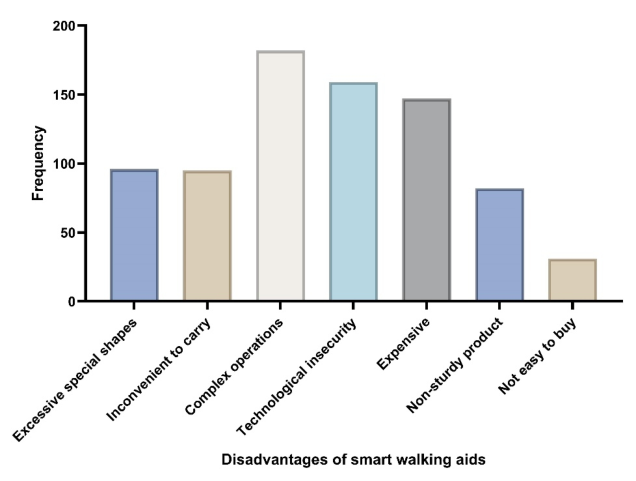
Based on the responses, participants emphasized safety assurance (e.g., anti-slip), additional intelligent functions, and sturdy products when purchasing smart walking aids (see Figure 1 (a)). In contrast, participants were less concerned with good after-sales service and innovative looking. Complex operations, technology insecurity, and high prices were consi- dered the main disadvantages of existing smart walking aids, as shown in Figure 1 (b). More information about technology assurance should be thus introduced to reduce the preconceptions of people about smart walking aids.
Table 1. Demographic characteristics of the participants (n = 264).
Table available in the original PDF paper.
Characteristics Number (percentage %) Age (year) 50–60 years 122 (46.2%) 61–70 years 117 (44.3%) 71–80 years 22 (8.3%) 81–90 years 3 (1.1%)
Gender Female 116 (43.9%) Male 148 (56.0%) Education Primary education or below 24 (9.0%) Lower secondary education 47 (17.8%) Secondary education (including diploma and certificate) 81 (30.6%) Post-secondary education or above 112 (42.4%)
Monthly income (RMB)
Low 60 (22.7%) Moderate 126 (47.7%) High 64 (24.2%) Extremely high 14 (5.3%) Living arrange- ment Living alone 33 (12.5%) Living with family members 217 (82.1%) Living with relatives 5 (1.8%) Living with caregivers 5 (1.8%) Living in elderly care institutions 4 (1.5%)
Chronic diseases 89 (33.7%) No diseases 175 (66.2%)
Health status
An Exploratory User Study on the Design of Smart Walking Aids 63
(a)
(b)
Figure 1: The frequency statistics of (a) Factors affecting purchase behavior intention of smart walking aids; and (b) The disadvantages of smart walking aids.
Fall alert (27.6%), health monitoring (24.3%), and positioning (24.3%) were the most popular functions among community-dwelling older adults. Meanwhile, these three functions achieved the highest score (health monitoring = 4.21, positioning = 4.10, and fall alert = 3.96) in the questions of usefulness evaluation. Therefore, individuals tend to pre- fer functions that they feel confident in. Enhancing users’ education
Table 2. The p-value of chi-square tests between variables.
Living arrangement Health status 0.001 0.000 0.002 0.014 0.571 0.005 0.104 User history 0.002 0.000 0.007 0.321 0.246 0.168 0.390
about intelligent technologies would contribute to implementing smart walking aids.
Table 2 shows no significant group differences in all variables concer- ning purchase preference and attitudes among gender (p > 0.06), education (p > 0.35), and living arrangement (p > 0.06). A significant group difference exists in attitudes toward the purchase and the most popular functions (fall alert, health monitoring, and positioning) among age (p < 0.02) and health status (p < 0.02). Besides, there are significant differences in purchase atti- tudes among participants with different monthly incomes and user histories (p < 0.05).
The conducted binary logistic regression models are all statistically signi- ficant (p < 0.05) (see Table 3). Individuals with chronic diseases preferred to purchase smart walking aids (p = 0.007, odds ratio (OR) = 2.683) and accept higher prices (p = 0.002, OR = 2.683) compared with heal- thy individuals. Individuals with a user history of smart walking aids are about ten times more likely to buy smart walking aids than those with no user history (p = 0.025, OR = 10.376). Meanwhile, individuals aged 61–70 years are more interested in the intelligent functions of fall alert (p = 0.002) and health monitoring (p = 0.021). Older adults aged 71– 80 preferred smart walking aids over other age groups (p = 0.048). In summary, individuals with different backgrounds had various attitudes and design expectations of smart walking aids. The user-centered design should be thus adopted to prompt the usability and personalization of smart walking aids.
However, there are some limitations in this study. For example, the explo- ratory user study focuses on general groups of community-dwelling older adults. People with specific diseases (diabetes, hypertension, cardiovascu- lar diseases) may or may not have different design expectations for smart walking aids. Moreover, based on the results, older adults seemed to have limited knowledge of the technology of smart walking aids. Thus, we sug- gest future studies should focus more on the effect of education on attitudes
An Exploratory User Study on the Design of Smart Walking Aids 65
Table 3. The results of binary logistic regression models.
Table available in the original PDF paper.
Variables in equation p-value OR 95% CI for OR Purchase preference (smart walking aids) (χ2 = 32.368, p < 0.001) Age (50-60) 0.022 Age (61-70) 0.079 2.072 (0.920, 4.667) Age (71-80) 0.048 0.323 (0.106,0.990) Age (81-90) 0.999 339419610.000 - Disease (chronic diseases) 0.007 2.683 (1.306, 5.510) User history (with experience) 0.025 10.376 (1.350, 79.756)
Price (higher) (χ2 = 57.929, p < 0.001) Age (50-60) 0.007 Age (61-70) 0.001 2.999 (1.591, 5.655) Age (71-80) 0.817 1.133 (0.395, 3.252) Age (81-90) 0.802 1.420 (0.092, 21.964) Disease (chronic diseases) 0.002 2.683 (1.449, 4.966) User history (with experience) 0.007 3.746 (1.433, 9.788) Income (low) 0.001 Income (moderate) 0.023 2.258 (1.118, 4.559) Income (high) 0.000 4.998 (2.128, 11.738) Income (extremely high) 0.002 10.168 (2.263, 45.684) The usefulness of fall alert (more useful) (χ2 = 27.330, p < 0.001) User history (with experience) 0.053 2.969 (0.987, 8.932) Age (50-60) 0.002 Age (61-70) 0.000 4.044 (1.982, 8.255) Age (71-80) 0.740 1.191 (0.424, 3.350) Age (81-90) 0.999 693781595.900 -
The usefulness of health monitoring (more useful) (χ2 = 12.033, p = 0.007) Age (50-60) 0.021 Age (61-70) 0.002 2.847 (1.461, 5.547) Age (71-80) 0.832 1.116 (0.404, 3.082) Age (81-90) 0.999 676245283.100 - The usefulness of positioning (more useful) (χ2 = 16.567, p = 0.002) Disease (chronic diseases) 0.016 2.203 (1.156, 4.195) Age (50-60) 0.054 Age (61-70) 0.072 1.887 (0.946, 3.763) Age (71-80) 0.148 0.476 (0.174, 1.301) Age (81-90) 0.999 536169523.700 -
The usefulness of pill reminder (more useful) (χ2 = 8.076, p = 0.044) Age (50-60) 0.053 Age (61-70) 0.018 2.003 (1.124, 3.568) Age (71-80) 0.920 0.953 (0.370, 2.450) Age (81-90) 0.294 0.272 (0.024, 3.088)
and perceptions toward smart walking aids among community-dwelling older adults.
CONCLUSION
Most community-dwelling older adults are interested in smart walking aids and prefer to purchase them instead of traditional walking aids. Older adults have limited knowledge about smart walking aids and thus express concerns about technology security issues. Moreover, users tend to prefer the intelli- gent functions they feel confident in. Therefore, more education on intelligent technologies is recommended to enhance users’ knowledge of smart walking
aids. From the perspective of design, community-dwelling older adults emph- asize the economic and time cost of smart walking aids. Individuals with different demographic backgrounds have various requirements for intelligent functions, and user-centered designs call for the development of a series of products that users can use to prompt the implementation of smart walking aids in the community.
ACKNOWLEDGMENT
This work was supported by the Shenzhen-Hong Kong-Macao Science and Technology Project Fund [grant no. SGDX20210823103403028]; the Under- graduate Research and Innovation Scheme Grant [P0038485] and the School of Design Collaborative Research Fund [grant no. P0035058] at the Hong Kong Polytechnic University.
REFERENCES
Cetin, E., Muzembo, J., Pardessus, V., Puisieux, F. & Thevenon, A. 2010. Impact of different types of walking aids on the physiological energy cost during gait for elderly individuals with several pathologies and dependent on a technical aid for walking. Annals of physical and rehabilitation medicine, 53, 399–405. Cox, V. & Cox, V. 2017. Exploratory Data Analysis: What Data Do I Have?
Translating Statistics to Make Decisions: A Guide for the Non-Statistician, 47–74. Dabir, A., Solkar, R., Kumbhar, M. & Narayanan, G. GPS and IOT equipped smart walking stick. 2018 International Conference on Communication and Signal Processing (ICCSP), 2018. IEEE, 0322–0326. Laufer, Y. 2004. The use of walking aids in the rehabilitation of stroke patients.
Reviews in Clinical Gerontology, 14, 137–144. Mcmaughan, D. J., Oloruntoba, O. & Smith, M. L. 2020. Socioeconomic status and access to healthcare: interrelated drivers for healthy aging. Frontiers in public health, 8, 231. Ntakolia, C., Dimas, G. & Iakovidis, D. K. 2022. User-centered system design for
assisted navigation of visually impaired individuals in outdoor cultural environ- ments. Universal Access in the Information Society, 1–26. Oladele, D. A., Markus, E. D. & Abu-Mahfouz, A. M. 2021. Adaptability of assistive mobility devices and the role of the internet of medical things: Comprehensive review. JMIR Rehabilitation and Assistive Technologies, 8, e29610. Page, S., Saint-Bauzel, L., Rumeau, P. & Pasqui, V. 2017. Smart walkers: an
application-oriented review. Robotica, 35, 1243-1262. Pons, J. L. 2008. Wearable robots: biomechatronic exoskeletons, John Wiley & Sons. Shi, D. & Zhang, L. Multifunctional Crutches for the Elderly. ISMSEE 2022; The 2nd International Symposium on Mechanical Systems and Electronic Engineering, 2022. VDE, 1–4. Tyson, S. F. 1994. Hemiplegic gait symmetry and walking aids. Physiotherapy Theory
and Practice, 10, 153–159. Yan, Q., Huang, J., Tao, C., Chen, X. & Xu, W. 2020. Intelligent mobile walkingaids: perception, control and safety. Advanced Robotics, 34, 2–18. Ye, J., Huang, J., He, J., Tao, C. & Wang, X. Development of a width-
changeable intelligent walking-aid robot. 2012 International Symposium on Micro-NanoMechatronics and Human Science (MHS), 2012. IEEE, 358-363.
An Exploratory User Study on the Design of Smart Walking Aids 67
Yusif, S., Soar, J. & Hafeez-Baig, A. 2016. Older people, assistive technologies, and the barriers to adoption: A systematic review. International journal of medical informatics, 94, 112-116. Zhang, N. 2022. Risk perception, mental health distress, and flourishing during the
COVID-19 pandemic in China: The role of positive and negative affect. Current Psychology, 1–9. Zhao, X., Zhu, Z., Liu, M., Zhao, C., Zhao, Y., Pan, J., Wang, Z. & Wu, C. 2020. A smart robotic walker with intelligent close-proximity interaction capabilities for elderly mobility safety. Frontiers in Neurorobotics, 14, 575889.
LISTED IN THE AHFE DIGITAL BOOKSTORE CATALOGUE
Explore the complete digital volume
Human Factors in Aging and Special Needs
Read this individual research paper free through the original publisher, or explore the full digital proceedings book.
ISBN 978-1-958651-64-3
Explore this ISBN in the AHFE Bookstore ↗Listed in the July 2026 bookstore catalogue; search by ISBN to confirm current availability · Digital book purchase optional