Qian Mao, Zhen Zhao, Lisha Yu, Hailiang Wang (2024). Unveiling the Future Design of Health Management Systems: An Exploratory Study on Older Adults’ Perceived Usefulness of Functional Modules. In: Human Factors in Aging and Special Needs. AHFE Open Access, vol. 133, pp. 178–186. https://doi.org/10.54941/ahfe1004906
Degradation of physical functions with aging contributes to multiple chronic diseases among older adults. In the era of global aging, older adults’ health management has brought considerable challenges to the economy, health system, and society due to the giant care burden and complex care requirements. Advanced technology (e.g., sensors, computing) prompted diverse digital health management systems, allowing stakeholders to monitor, evaluate, treat, and manage older adults’ health status. Despite these systems’ great efficiency and convenience, older adults’ attitudes toward the usefulness of functional modules in expanding health knowledge and enhancing health management remain uncertain. This study explored older adults’ perceived usefulness of five functional modules in health management systems: education, evaluation, tailored profiles, monitoring, and telemedicine modules. The results will provide valuable insights for designing future health management products. Participants were recruited through a convenience sampling method on a professional Web-based survey platform. The questionnaire included demographic information and participants’ perceived usefulness of the five functional modules in expanding health knowledge and enhancing health management. Friedman’s tests were conducted to compare older adults’ perceptions of the five functional modules, and ordinal logistic regressions were performed to assess the effects of demographics on perceived usefulness. A total of 109 valid responses were included in the data analysis (76 males and 33 females; mean age = 64.5±4.5 years). The results showed significant differences in older adults’ perceptions of the usefulness of five functional modules in enhancing health management (𝝌2 = 21.646, p < 0.001). Older adults believed the evaluation module was significantly more useful than the monitoring module in enhancing health management (p = 0.036); however, no significant differences existed in the perceived usefulness of expanded health knowledge (𝝌2 = 4.966, p = 0.291) among five modules. The results of ordinal logistic regressions showed that individuals living in care institutions were more likely to believe that the evaluation module was useful in enhancing health management than those living with relatives (OR= 333.33, 𝝌2 = 7.31, p = 0.01). Older adults without a fall history were more convinced that a monitoring module could contribute to health management than those with a fall history (OR= 4.92, 𝝌2 = 4.00, p = 0.04). Older adults had positive attitudes toward the usefulness of functional modules in expanding health knowledge and enhancing health management. The adoption of age-friendly design strategies in health management systems is recommended to promote individuals’ use of healthcare products and improve their well-being in the long term.
Unveiling the Future Design of Health Management Systems 179
INTRODUCTION
Aging is highly associated with negative biological changes, including mus- cular weakness, mobility degradation, reduced balance, and postural control, which can contribute to the development of chronic diseases (Dallaire et al., 2021). Approximately 80% of older adults had at least one chronic disease, and 77% of them suffered from multiple chronic diseases, such as hyperten- sion, diabetes, Alzheimer’s disease, and dementia (Philip et al., 2021). These chronic diseases were responsible for about 48% of deaths in older adults, 23% of the global cost burden, and 24.4 hours of weekly care (Prince et al., 2015), bringing considerable challenges for families and society. Given the dynamic and complex health status among older adults, long-term health management is crucially needed to enhance older adults’ quality of life and well-being, reduce caregivers’ care burden, and prompt social health systems.
Recently, the development of technologies, such as sensors (Mao et al., 2023), the Internet of Things (Philip et al., 2021), and computing capability (Wan et al., 2020), has boosted diverse digital health management systems for health monitoring, assessment, and interventions. For example, information systems allow clinicians to track individual’s health conditions and maintain awareness of interventions. Patients also have access to their electronic health records and enhance their control of themselves (Blandford, 2019). Multiple sensors (e.g., motion, environmental, or biometric sensors) were commonly used in health management systems for ambient assisted living to moni- tor older adults’ postures, activities, and physiological health (Stavropoulos et al., 2020). Diverse platforms and systems have been designed to provide telecare, digital interventions, and self-management based on vital sign data and artificial intelligence algorithms (Moon et al., 2020; Blandford, 2019). These intelligent systems allow older adults to have healthy, active aging and aging in place (Blandford, 2019). However, despite the advances and diver- sity of digital health technology, older adults rejected or abandoned health management systems for long-term use (Greenhalgh et al., 2017). More- over, although the health management systems were designed to help health management and knowledge expansion, older adults’ attitudes toward the perceived usefulness of different functional modules remain unclear. There is also limited understanding of the impact of demographic information on perceived usefulness.
In this context, this study aims to explore older adults’ perceived use- fulness of diverse functional modules in enhancing health management and increasing health knowledge. Based on previous studies (Blandford, 2019; Greenhalgh et al., 2017; Philip et al., 2021), we categorized the functional modules of health management systems into education, evaluation, tailored profiles, monitoring, and telemedicine modules. The results are anticipated to enhance designers’ knowledge of age-friendly design strategies and prompt the application and adoption of health management systems among older adults, thereby enhancing older adults’ health and well-being.
METHODS
Questionnaire Design A two-part questionnaire was designed in this exploratory user study to probe older adults’ perceived usefulness regarding the functional modules in health management systems. Specifically, the first part consisted of seven items of demographic information, including gender, age, education levels, living arrangement, monthly income, health status, and fall history in the last year. The second part concerns older adults’ attitudes toward the usefulness of five functional modules in enhancing their health management and knowl- edge. Therefore, ten items were scored on a five-point Likert scale to quantify older adults’ perceived usefulness (1 = strongly disagree; 5 = strongly agree). Two experts assessed the clarity and validity of the questionnaire; after appro- priate modifications, the questionnaire was distributed on an online platform through the convenience sampling method (Wang et al., 2020).
Data Analysis Descriptive statistics were calculated firstly for demographic information and older adults’ perceived usefulness regarding the five functional modules. Then, Friedman’s tests compared individuals’ attitudes toward the usefulness of five functional modules in enhancing health management or expanding health knowledge. If there was a significant difference, post hoc pairwise comparisons were performed with the Bonferroni correction to adjust the significance level. Moreover, ordinal logistic regressions were computed to evaluate the demographic correlates of perceived usefulness regarding five functional modules. The significance level was set as p = 0.05 in all statistical analyses conducted with IBM SPSS v26 (SPSS Inc.; Chicago, IL, USA).
RESULTS AND DISCUSSION
A total of 109 older adults (female = 33; mean age = 64.50 ± 4.50 years) were included in the data analyses. About half of the participants were between 60∼64 years old (56.0%) and obtained undergraduate education (51.4%). Around three in four older adults lived with family members, and three in five participants had moderate monthly income or over. Approxi- mately 60% of older adults had at least one chronic disease, such as diabetes, dementia, hypertension, etc. Among all participants, one in seven had expe- rienced at least one fall. The demographic characteristics of participants are shown in Table 1.
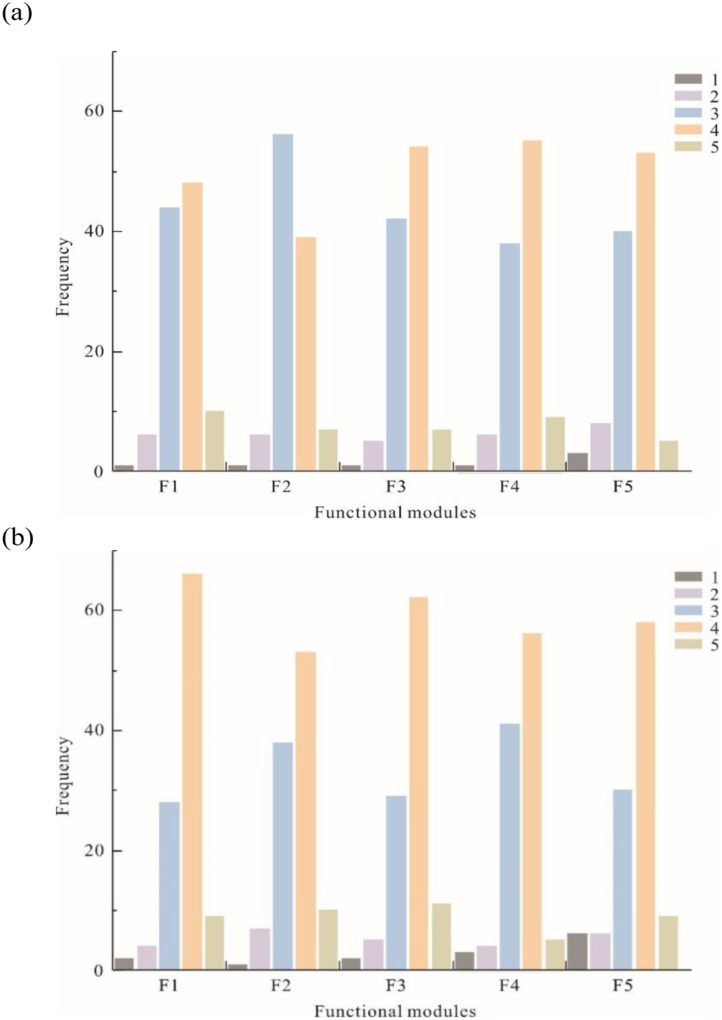
Based on the responses, few individuals strongly disagreed that five func- tional modules were helpful in enhanced health management, as shown in Figure 1(a). Most older adults had neutral or positive attitudes towards the usefulness of functional modules in enhancing health management, accounting for about 40% and 45% of all responses. Moreover, about 7% of individuals strongly agreed on the usefulness of functional modules. Regarding the perceived usefulness of five functional modules in expanding health knowledge, almost half of the participants agree that five func- tional modules could help them increase their health knowledge, as shown
Unveiling the Future Design of Health Management Systems 181
in Figure 1(b). However, about 30% of the older adults had a neutral attitude to the usefulness of functional modules. Throughout the data, despite a few individuals having negative attitudes toward functional mod- ules’ usefulness, most older adults tended to believe that five functional modules could benefit health management and knowledge. The positive perceived usefulness of older adults is expected to prompt individuals’ accep- tance of technology and the application of health management systems in communities.
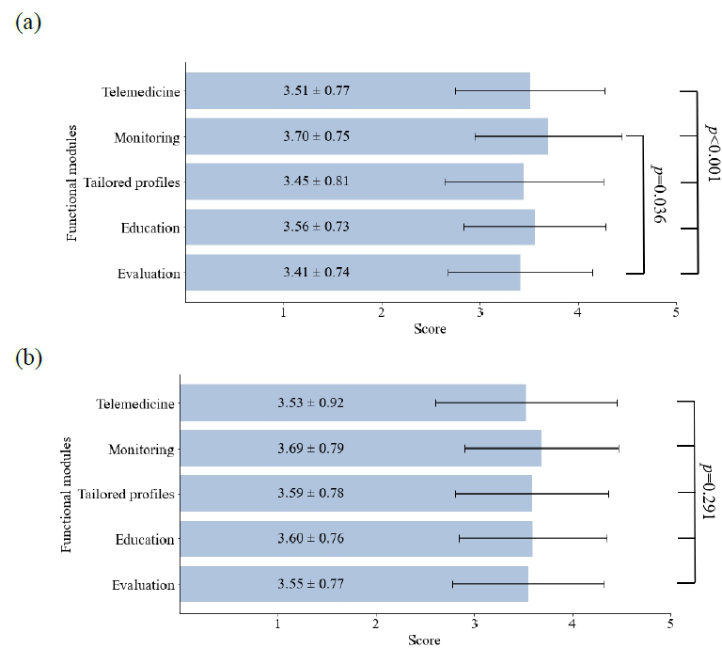
As shown in Figure 2(a), the results of Friedman’s tests showed that there was a significant difference in individuals’ perceived usefulness of five functional modules in enhancing health management (χ2=21.646, p < 0.001). The post hoc pairwise comparisons revealed that older adults had significantly more positive attitudes towards the usefulness of the evaluation module in enhancing health management compared with the monitoring module (p = 0.036). Nevertheless, no significant difference was observed in older adults’ perceived usefulness of five functional mod- ules in expended health knowledge (χ2=4.966, p = 0.291), as shown in Figure 2(b).
Table 1. Demographic characteristics of the participants (n = 109).
Table available in the original PDF paper.
Characteristics Number (Percentage %) Gender Female 33 (30.3%) Male 76 (69.7%) Age 60∼64 age 61 (56.0%) 65∼69 age 31 (28.4%) 70∼74 age 15 (13.8%) 75∼80 age 2 (1.8%) Education Primary or below 2 (1.8%) Junior secondary 14 (12.8%) Secondary 34 (31.2%) Undergraduate 56 (51.4%) Postgraduate or above 3 (2.8%) Living arrangement Alone 19 (17.4%) With family members 85 (78.0%) With relatives 2 (1.8%) In care institutions 3 (2.8%) Monthly income Low 22 (20.2%) Moderate 45 (41.3%) High 29 (26.6%) Extremely high 13 (11.9%) Health status Chronic diseases 64 (58.7%) No diseases 45 (41.3%) Fall history None 94 (86.2%) At least one time 15 (13.8%)
Figure 1: Scores of perceived usefulness of functional modules in (a) enhanced health management and (b) expended health knowledge (F1: education; F2: evaluation; F3: tailored profiles; F4: monitoring; F5: telemedicine).
Considering the average scores of perceived usefulness regarding the five functional modules, we found that the monitoring module had the high- est score, followed by the education module. However, the evaluation module obtained the lowest perceived usefulness. A potential reason is
Unveiling the Future Design of Health Management Systems 183
that individuals trust intelligent systems’ diagnostic results less than clinic professionals.
The ordinal logistic regressions indicated no significant correlation existed between demographic information and the perceived usefulness of education, tailored profiles, and telemedicine modules in enhancing health management (all p values > 0.05), as shown in Table 2. However, older adults living in care institutions significantly more believed that the evaluation module could help them enhance health management compared to those living with rel- atives (OR = 333.33, χ2 = 7.31, p = 0.01). Interestingly, we also found that individuals without a fall experience significantly had more positive atti- tudes toward the usefulness of the monitoring module in enhancing health management (OR = 4.92, χ2= 4.00, p = 0.04).
Figure 2: The results of Friedman’s tests in (a) enhanced health management and (b) expended health knowledge.
Moreover, demographic information showed no significant correlation with the perceived usefulness of education, tailored profiles, monitoring, and telemedicine modules in expanding health knowledge (all p values > 0.05), as shown in Table 3. Older adults living with relatives significantly more
believed that the evaluation module could help expand their health knowl- edge compared to those living in care institutions (OR = 75.79, χ2 = 4.04, p = 0.04).
Overall, demographic factors seem to have a small impact on older adults’ perceived usefulness of five functional modules. However, certain contex- tual factors, such as living arrangements and previous health experiences, may influence individuals’ attitudes toward specific functional modules. These findings emphasize the importance of considering individual prefer- ences, needs, and environmental factors when designing and implementing functional modules of health management systems among older adults.
Table 2. Ordinal logistic regression regarding the perceived usefulness in expanding health knowledge.
Table available in the original PDF paper.
Demographic Information F1 F2 F3 F4 F5 Gender 0.29 0.08 0.61 0.81 0.49 Age
60∼64 versus 75∼80 years 0.49 0.15 0.27 N/A N/A 65∼69 versus 75∼80 years 0.88 0.24 0.37 N/A N/A 70∼74 versus 75∼80 years 0.54 0.56 0.96 N/A N/A Education Primary or below versus Postgraduate or above 0.20 0.97 0.36 0.45 0.70 Junior secondary versus Postgraduate or above 0.83 0.49 0.16 0.19 0.83 Secondary versus Postgraduate or above 0.16 0.86 0.59 0.69 0.74 Undergraduate versus Postgraduate or above 0.14 0.43 0.75 0.57 0.45 Living arrangement
Live alone versus Live in care institutions N/A 0.11 0.79 0.88 0.88 Live with family members versus Live in care institutions N/A 0.20 0.44 0.56 0.89 Live with relatives versus Live in care institutions N/A 0.01 0.27 0.32 0.31 Income (Low versus Extremely high) 0.52 0.37 0.58 0.32 0.56 Income (Moderate versus Extremely high) 0.64 0.93 0.90 0.38 1.00 Income (High versus Extremely high) 0.06 0.21 0.11 0.83 0.75 Health status 0.28 0.89 0.26 0.16 0.27 Fall history 0.26 0.77 0.28 0.04 0.95 Notes. F1: education; F2: evaluation; F3: tailored profiles; F4: monitoring; F5: telemedicine; N/A: Not applicable.)
Table 3. Ordinal logistic regression regarding the perceived usefulness in enhancing health management.
Table available in the original PDF paper.
Demographic Information F1 F2 F3 F4 F5 Gender 0.27 0.37 0.40 0.82 0.75 Age
60∼64 versus 75∼80 years 0.81 0.28 N/A N/A 0.86 65∼69 versus 75∼80 years 0.90 0.36 N/A N/A 0.78 70∼74 versus 75∼80 years 0.37 0.71 N/A N/A 0.77 Education Primary or below versus Postgraduate or above 0.61 0.16 0.11 N/A 0.92 Junior secondary versus Postgraduate or above 0.52 0.15 0.26 0.31 0.39 Secondary versus Postgraduate or above 0.93 0.41 0.64 0.82 0.70 Undergraduate versus Postgraduate or above 0.92 0.99 0.92 0.71 0.98
(Continued)
Unveiling the Future Design of Health Management Systems 185
Table 3. Continued Demographic Information F1 F2 F3 F4 F5
Table available in the original PDF paper.
Living arrangement Live alone versus Live in care institutions N/A 0.10 N/A 0.38 0.84 Live with family members versus Live in care institutions N/A 0.31 N/A 0.59 0.76 Live with relatives versus Live in care institutions N/A 0.04 N/A 0.17 0.24 Income (Low versus Extremely high) 0.83 0.11 0.53 0.61 0.93 Income (Moderate versus Extremely high) 0.64 0.50 0.59 0.48 0.91 Income (High versus Extremely high) 0.65 0.81 0.44 0.60 0.64 Health status 0.56 0.81 0.49 0.27 0.61 Fall history 0.40 0.48 0.64 0.14 0.52
Despite the contributions of this study in understanding the perceived usefulness of functional modules among older adults, there are some lim- itations in this study. For instance, the exploratory study lacked inclusion and exclusion criteria on more demographic information, which may create bias when applying the results to specific groups. The study also had a lim- ited understanding of older adults’ intention to use the functional modules. Therefore, we suggested more research exploring specific groups’ attitudes and perceptions towards health management systems.
CONCLUSION
Older adults had positive attitudes towards the usefulness of health man- agement systems’ functional modules in enhancing health management and expanding health knowledge. Specifically, monitoring and education modules achieved higher perceived usefulness among older adults, while the evalua- tion module obtained the lowest perceived usefulness. Given the difference in older adults’ perceived usefulness of diverse functional modules, more stud- ies are suggested to understand the potential factors and perform age-friendly design strategies for health management systems. Moreover, living arrange- ments and fall history significantly affect older adults’ perceived usefulness, which calls for future system designers to consider users’ characteristics and environmental contexts. By tailoring functional modules to meet older adults’ specific needs and preferences, health management systems can effectively improve older adults’ health, quality of life, and well-being.
ACKNOWLEDGMENT
This work was partially supported by the Health and Medical Research Fund [grant no.: 20211201] and grants from The Hong Kong Polytechnic University [grant no.: P0045769; P0042959].
REFERENCES
Blandford, A. (2019). HCI for health and well-being: Challenges and opportunities.
International journal of human-computer studies, 131, 41–51.
Dallaire, M., Gagnon, G., Fortin, É., Nepton, J., Severn, A.-F., Côté, S., Smaili, S. M., Gonçalves De Oliveira Araújo, H. A., DE Oliveira, M. R. & Ngomo, S. (2021). The Impact of Parkinson’s Disease on Postural Control in Older People and How Sex can Mediate These Results: A Systematic Review. Geriatrics, 6, 105. Greenhalgh, T., Wherton, J., Papoutsi, C., Lynch, J., Hughes, G., Hinder, S., Fahy, N.,
Procter, R. & Shaw, S. (2017). Beyond adoption: a new framework for theoriz- ing and evaluating nonadoption, abandonment, and challenges to the scale-up, spread, and sustainability of health and care technologies. Journal of medical Internet research, 19, e8775. Mao, Q., Yu, L., Zhang, J., Yang, F.& Wang, H.Do Sensor-Based Interventions Differ from Traditional Physical Therapies in Improving Older Adults’ Balance? Pro- ceedings of the Human Factors and Ergonomics Society Annual Meeting, (2023). SAGE Publications Sage CA: Los Angeles, CA, 21695067231192520. Moon, S., Song, H.-J., Sharma, V. D., Lyons, K. E., Pahwa, R., Akinwuntan, A. E. &
Devos, H. (2020). Classification of Parkinson’s disease and essential tremor based on balance and gait characteristics from wearable motion sensors via machine learning techniques: a data-driven approach. Journal of neuroengineering and rehabilitation, 17, 1–8. Philip, N. Y., Rodrigues, J. J., Wang, H., Fong, S. J. & Chen, J. (2021). Internet of Things for in-home health monitoring systems: Current advances, challenges and future directions. IEEE Journal on Selected Areas in Communications, 39, 300–310. Prince, M.J., Wu, F., Guo, Y., Robledo, L.M.G., O’donnell, M., Sullivan, R.& Yusuf,
S. (2015). The burden of disease in older people and implications for health policy and practice. The Lancet, 385, 549–562. Stavropoulos, T. G., Papastergiou, A., Mpaltadoros, L., Nikolopoulos, S. & Kompatsiaris, I. (2020). IoT wearable sensors and devices in elderly care: A literature review. Sensors, 20, 2826. Wan, S., Gu, Z. & Ni, Q. (2020). Cognitive computing and wireless communica-
tions on the edge for healthcare service robots. Computer Communications, 149, 99–106. Wang, J., Jing, R., Lai, X., Zhang, H., Lyu, Y., KNOLL, M. D. & FANG, H. (2020).
Acceptance of COVID-19 Vaccination during the COVID-19 Pandemic in China. Vaccines, 8, 482.
LISTED IN THE AHFE DIGITAL BOOKSTORE CATALOGUE
Explore the complete digital volume
Human Factors in Aging and Special Needs
Read this individual research paper free through the original publisher, or explore the full digital proceedings book.
ISBN 978-1-964867-09-0
Explore this ISBN in the AHFE Bookstore ↗Listed in the July 2026 bookstore catalogue; search by ISBN to confirm current availability · Digital book purchase optional