Wen Wang (2023). Human comfort factors towards 3D digital fashion design. In: Human Factors for Apparel and Textile Engineering. AHFE Open Access, vol. 86, pp. 47–53. https://doi.org/10.54941/ahfe1003639
Fashion can not only be designed and made by traditional manual methods, but also be realized and produced by digital modelling and 3D printing. At present, although it has not been applied to a wide range in the garment manufacturing, it has put forward new possibilities for traditional clothing manufacturing. It is necessary to study these novel methods on clothing design and production. In this paper, through the digital design to 3D printing for fashion production involved in materials, processes, techniques and other aspects of the study and analysis. From the perspective of human comfort to analysis 3D digital design for fashion production that is more suitable for human wear and higher comfort.
Since the technology is well widespread, the exploration of 3D printing in tex- tiles and clothing is a new and promising direction. It shows a great potential in the field of textiles and clothing. It opens a new door for the future field of textile and apparel. Fashion can not only be designed and made by traditional manual methods, but also be realized and produced by digital modelling and 3D printing. The 3D digital design of fashion production is a new proces- sing method, which is the combination of art and technology. At present, 3D printing has been developed in many traditional fields, and applied in many industries. From 3D printed shoes, furniture to specialized jewellery design, although it has not been applied to a wide range in the production of garment manufacturing, it has put forward new possibilities for traditional clothing manufacturing (Spahiu et al. 2020).
The production process of 3D parametric modelling and 3D printing is very different from traditional clothing production. 3D printing has incom- parable advantages over traditional fabrics and processes in the design of clothing shapes and contours. Therefore, it is necessary to study these novel methods on clothing design and production. In this paper, through the digital design to 3D printing for fashion production involved in materials, processes, techniques and other aspects of the study and analysis. From the perspective of human comfort, to analysis 3D digital design for fashion production that is more suitable for human wear and higher comfort.
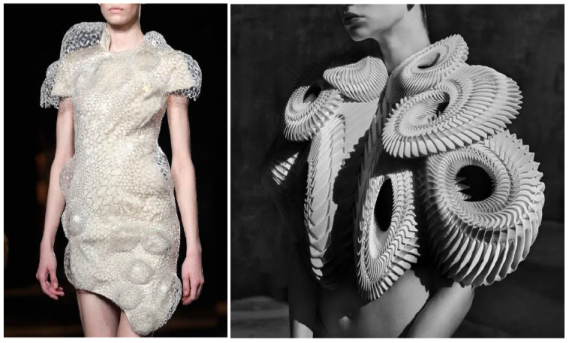
OVERVIEW OF 3D PRINTING CLOTHING TECHNOLOGY Compared with traditional clothing, 3D printing clothing has attracted wide attention in the clothing field because of its features such as high utilization rate of raw materials, less waste of resources, simple process, fast molding speed and unlimited design space. However, when clothing is used as the application form of 3D printing technology creativity and innovative design, the 3D printing technology needs high requirements in terms of flexibility, firmness, comfort and other aspects. Therefore, it is of great practical signi- ficance to improve the structure of printed products and develop flexible materials with high wearability. This will expand the use of 3D printing technology in wearable clothing (see Figure 1).
Different technologies of 3D shaping should be targeted at different mate- rials and methods. 3D digital modeling is the most crucial step in the 3D printing of clothing. In the early stage of design, it is necessary to analyze which production method is more reasonable, efficient, and more in line with the needs of human factors. Further modification and experiment, in order to achieve the best effect of clothing production.
Figure 1: 3D printing fashion. (Iris van Herpen, 2013).
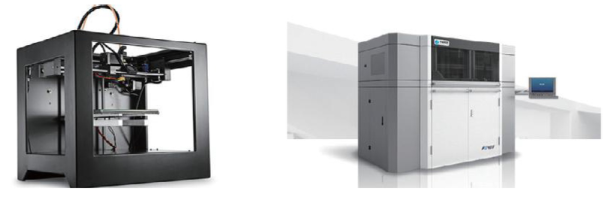
TECHNIC AND PROCESS The forming process of 3D printed clothes is mainly made use of melt depo- sition (FDM) and laser sintering (SLS) technology in 3D printing. There are various types of 3D printing processes, including FDM process, SLA process, selective laser sintering (SLS) process, layered solid manufacturing (LOM) process and 3D printing (3DP) process (see Figure 2). Among them, SLA pro- cess is the earliest used in the manufacturing of functional parts; FDM process using heating melting technology molding, and its products high temperature resistance; SLS process is the most widely used 3D printing clothing techno- logy, which is formed by laser melting technology and can process a wide range of materials (Kim et al. 2019).
Human Comfort Factors Towards 3D Digital Design of Fashion 49
Figure 2: 3D printing equipment FDM and SLS.Table 1. Analysis of SLA process, FDM process and SLS process.
Table available in the original PDF paper.
Process Technology Material Principle Advantage Disadvantage High cost SLA Laser strengthe- ning High precision, Fast forming, High material, utilization rate
UV laser scanning liquid pho- tosensitive polymer liquid by layer to achieve the solidfaction of liquid materials, gradually accumulated forming
Liquid pho- tosensitive polymer such as acrylic resin, epoxy resin, etc.
FDM Heating melting
ABS, PLA, resin, etc.
Poor surface accuracy
Less pollution, High recovery of raw materials, Low cost
After the filamentous consu- mables are fused at high tem- perature, they are piled up layer by layer under the com- puter control to get the three- dimensional parts
SLS Laser melting
PA, ABS, PC, Metal, etc.
Variety, wide range of usage
Long molding time
The powder material is fused by laser at high temperature. The laser moves based on the set tra- jectory and gathers the material into shape
It was found that the hardness of SLS and FDM was higher. The elasti- city and flexibility of products can be improved by improving the material composition or product structure to meet the requirements of clothing. Using ABS as test material, the influence of ambient temperature on molding accu- racy was found. It is found that the higher the ambient temperature, the lower the warpage rate and the higher the molding accuracy of the product. Through the experiment and design analysis, it is also concluded that the height, printing speed, printing temperature are the core factors affecting the printing accuracy (Prabhakar et al. 2021). Table 1 briefly lists the status of SLA process, FDM process and SLS process of 3D printing clothing.
3D PRINTING MATERIALS Many materials can be used for 3D printing, which are mainly nylon, engi- neering plastics, photosensitive resins, environmental biological materials, flexible polyurethane and so on. At present, 3D printing clothing molding mainly relies on composite materials and additives to achieve.
50 Wang
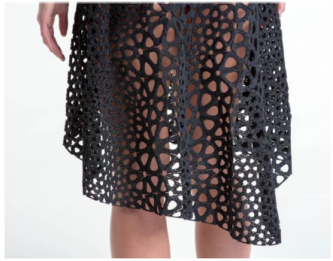
Nylon Nylon is PA, which has good tensile strength, elasticity and toughness. It is suitable for the printing and production of clothing, but the precision of the printed products is relatively low, and the surface is not smooth enough, which cannot well meet people’s wearing requirements for the soft material of clothing. It is found that the concentration of solution after dissolution (or melting) of traditional fibers such as polyester, polypropylene and acrylic can be increased first, and then PA can be processed for 3D printing, which can improve the printing accuracy of products (see Figure 3).
Engineering Plastics At present, ABS is the main plastic used to print wearable clothes. As a thermoplastic material, ABS has the characteristics of high strength, high tou- ghness, low temperature resistance, smooth wire production, strong coloring power, etc., and the surface of its printed products is more delicate than PA (Rosu et al. 2014).
Environment-Friendly Materials PLA is a degradable and environmentally friendly material with excellent ten- sile and melting properties, which is regarded as the most valuable polymer in the field of clothing. But PLA products are brittle, poor thermal stability, toughness and impact strength are not as good as ABS products, so it is not suitable for processing very thin clothing parts. The printing effect under dif- ferent conditions was compared. It was found that the setting of printing temperature, layer thickness, extrusion speed and other parameters was the key to improve the printing effect of PLA products (Gebler et al. 2014).
Compared with traditional clothing, 3D printing can currently use very limited materials for clothing, mainly lighter plastics such as ABS, PLA and nylon powder. ABS and PLA, as rigid plastic materials, are mainly suitable for printing creative silhouettes of large surfaces and contours. The main design point of these materials is to forming creative fashion shapes and contours
Figure 3: 3D printing effect of Nylon material (Kinematics dress by nervous system 2013).
Human Comfort Factors Towards 3D Digital Design of Fashion 51
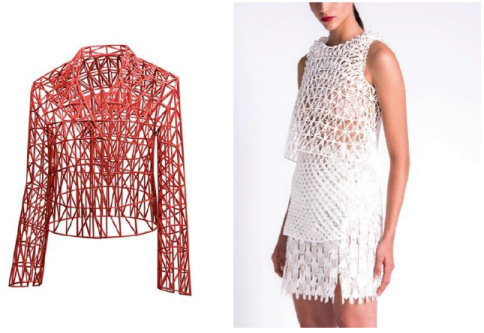
Figure 4: 3D printing clothes (Danit Peleg, 2013).
through the combination of texture and block surface. Nylon material has good flexibility, with a certain practical wearing function (see Figure 4).
TEXTURE AND STRUCTURE Flexibility and comfort are the core factors affecting the wearability of 3D printed clothing. In order to improve the softness of 3D printing clothes, the organization structure of products can be designed by points, lines, surfaces, bodies and other elements. For example, the structure of geometric clasp is designed for printing, or the interlocking S shaped chain is designed to make the fitting 3D printed clothing. Rigid 3D printed garments can be made more flexible by reorganizing their structures. The imitation of fabric structure is another way to make flexibility, shaping woven fabric from the perspective of 3D structure or simulating the structural characteristics of knitted fabric, so as to improve the current situation of 3D printing clothing (Xiao and Kan, 2022). In the parts with high requirements for clothing comfort, for example in the elbow, waist and neck, can through the change of texture structure to achieve higher comfort. So as to enhance the comfort and creativity of 3D printed wearable clothing.
ADVANTAGES AND DEVELOPMENT PROSPECTS Compared with traditional clothing production technology, 3D printing technology has significant advantages as below:
(a) It can truly realize personalized production; (b) It is a one-time forming, eliminating the traditional process of multiple processes; (c) It uses incremental method rather than traditional decrement method, which saves raw materials and basically produces no waste.
52 Wang
With the rapid development of 3D printing technology and continuous research and development of new textile materials, combined with 3D anth- ropometry, CAD and other technologies, clothing will realize automation and “single piece single cut” of form-fitting body in the future. In the future, con- sumers will be able to purchase and download a style map and print out the desired product.
CONCLUSION
3D printing technology has put forward new possibilities for traditional clo- thing manufacturing. It is necessary to study these novel methods on clothing design and production. In this paper, through the digital design to 3D printing for fashion production involved in materials, processes, techniques and other aspects of the study and analysis. From the perspective of human comfort, to analysis 3D digital design for fashion production that is more suitable for human wear and higher comfort.
Compared with traditional clothing production technology, 3D printing technology has significant advantages. It can truly realize personalized produ- ction; It is a one-time forming, eliminating the traditional process of multiple processes; It uses incremental method rather than traditional decrement method, which saves raw materials and basically produces no waste.
When clothing is used as the application form of 3D printing techno- logy creativity and innovative design, the 3D printing technology needs high requirements in terms of flexibility, firmness, comfort and other aspe- cts. With the rapid development of 3D printing technology and continuous research and development of new textile materials, combined with 3D anth- ropometry, CAD and other technologies, in the future, fashion design will continue to deepen practice and exploration in the direction of combining these technologies and materials.
ACKNOWLEDGMENT
The authors would like to thank the Philosophy and Social Sciences Pro- gram Project of Guangdong (No. GD21CYS04); and Teaching Quality and education reform project of Guangdong (No. 6040321158).
REFERENCES
Gebler M, Schoot Uiterkamp AJM, Visser C (2014) A global sustainability perspective on 3D printing technologies. Energy Policy 74:158–167. Hrženjak, R., Bogovi´c, S., & Rogina-Car, B. (2021). 3D Printing Technologies for
Clothing Industry: A Review. In Proceedings of the 8th International Ergono- mics Conference: ERGONOMICS 2020 8 (pp. 103–109). Springer International Publishing. Kim, S., Seong, H., Her, Y., & Chun, J. (2019). A study of the development and improvement of fashion products using a FDM type 3D printer. Fashion and Textiles, 6(1), 1–24. Prabhakar, M. M., Saravanan, A. K., Lenin, A. H., Mayandi, K., & Ramalingam,
P. S. (2021). A short review on 3D printing methods, process parameters and materials. Materials Today: Proceedings, 45, 6108–6114.
Human Comfort Factors Towards 3D Digital Design of Fashion 53
Rosu, S., Flavius, P., & Tatu, R. F. (2014). ABS 3D Printed Facial Study Model Using Hermite Matrix Interpolation for Manufacturing Facial Epistasis. Mat. Plast, 51, 290. Spahiu, T., Canaj, E., & Shehi, E. (2020). 3D printing for clothing production. Jour-
nal of Engineered Fibers and Fabrics, 15, 1558925020948216. Xiao, Y. Q., & Kan, C. W. (2022). Review on development and application of 3D-Printing technology in textile and fashion design. Coatings, 12(2), 267.
LISTED IN THE AHFE DIGITAL BOOKSTORE CATALOGUE
Explore the complete digital volume
Human Factors for Apparel and Textile Engineering
Read this individual research paper free through the original publisher, or explore the full digital proceedings book.
ISBN 978-1-958651-62-9
Explore this ISBN in the AHFE Bookstore ↗Listed in the July 2026 bookstore catalogue; search by ISBN to confirm current availability · Digital book purchase optional