Chris Lowe, Neil Hall (2023). The Usage of 3D Building Information Management (BIM) and Digital Twin Models to Support the Identification and Management of Human Factors Integration Issues. In: Human Factors and Systems Interaction. AHFE Open Access, vol. 84, pp. 300–307. https://doi.org/10.54941/ahfe1003616
Publisher statistics will load when you open Metrics.
AHFE OPEN ACCESS OPEN ACCESS CONFERENCE PROCEEDINGS PAPER
The Usage of 3D Building Information Management (BIM) and Digital Twin Models to Support the Identification and Management of Human Factors Integration Issues
3D Building Information Management (BIM) and digital twin models are a growing trend in the construction industry. It provides numerous benefits, such as improved collaboration, visualisation, and accuracy. In recent years, there has been a growing interest in using these technologies to support identifying and managing human factors integration (HFI) issues.HFI is a critical aspect of construction project management as it involves integrating human factors, such as physical and mental capabilities, into the design and construction of buildings. Integrating HFI considerations helps ensure the safety, health, and well-being of construction workers and occupants of the building. However, managing HFI issues can be a complex and time-consuming task.3D BIM and digital twin models allow for the creation of detailed, accurate, and interactive representations of the building and its components. This enables stakeholders to visualise the HFI issues in the building and assess their potential impacts on the construction workers and occupants. The digital twin model can also be used to simulate different scenarios and evaluate the possible effects of HFI issues on the building's performance.Furthermore, using 3D BIM and digital twin models enables the integration of HFI considerations into the design and construction process. This permits the identification and resolution of HFI issues at an early stage, reducing the risk of costly delays and rework. These technologies also facilitate collaboration among stakeholders, improving communication and coordination.Overall, 3D BIM and digital twin models offer a powerful tool for identifying and managing HFI issues in construction projects. It enables stakeholders to visualise HFI issues and evaluate their potential impacts, facilitating the integration of HFI considerations into the design and construction process and ultimately helping to ensure the safety, health, and well-being of construction workers and building occupants.
The Usage of 3D Building Information Management (BIM) 301
and manage all information related to a building project in a single, centrali- zed location (Farnsworth et al., 2014). BIM software typically includes tools for 3D modelling, scheduling, cost estimating, and collaboration. This appro- ach allows for improved communication and coordination among project team members. 3D BIM tools are intended for better decision-making, col- laboration, and, ultimately, a more efficient and successful project (Demian and Walters, 2013).
A digital twin is a virtual replica of a physical asset or system. It can be used to simulate and analyse the performance of a building or infrastructure in a virtual environment before it is built (Jones et al., 2020). This allows for more accurate predictions of how the building will perform in the real world and can help identify potential issues before construction begins. This can also be used to test the building’s performance, energy consumption, and maintenance needs (Kaewunruen, Rungskunroch and Welsh, 2019).
BIM and digital twin technology are becoming increasingly popular in the construction industry as they provide many benefits, such as impro- ved collaboration, visualization, and accuracy (Demian and Walters, 2013). They are intended for more efficient and cost-effective building design and construction.
Human Factors Integration (HFI) is becoming increasingly important in building design (Tau-Matsie, 2017). HFI is the process of designing and developing buildings, systems, equipment, and facilities that consider the abi- lities, limitations, and characteristics of the people who will use them. The HFI approach focuses on tailoring the design of buildings to the users’ needs and preferences rather than just aesthetic or technical considerations. It aims to create efficient, cost-effective, user-friendly, and safe buildings. It can be applied to any building, but it is especially beneficial for buildings that are intended for public or commercial use and that will be used by a wide range of people.
In addition, standards such as the Building Code of Australia (BCA) and Approved Document M in the UK are primary standards relevant to the human-centred design of buildings, particularly regarding accessibility.
HUMAN FACTORS ISSUES REGISTER MANAGEMENT PROCESS During the building design process, a Human Factors Issues Register (HFIR) is a tool used to track and manage issues related to HFI (Edmonds, 2016), which can include ergonomics, human-computer interaction, and other factors that can impact the usability and safety the building. The HFIR is used to identify and document issues, track progress in addressing them, and ensure that they are resolved before the design is finalized.
While HFI requirements are established early in the development process and used as a design guide, the HFIR is used to document and track any issues that arise during the development or testing of the building and ensure that they are addressed before the design is finalized (Gupta, 2005).
Some potential challenges can arise when trying to implement the HFIR management process in general, such as:
302 Lowe and Hall
Lack of buy-in from stakeholders: It can be challenging to get buy-in from key stakeholders, such as engineers and managers, who may not see the value in the HFIR process or may be resistant to change.
Difficulty in identifying and documenting issues: Identifying and docu- menting human factors issues can be challenging, especially if personnel are not trained in human factors or do not have the necessary tools or processes.
Difficulty in prioritizing and resolving issues: Once issues are identified, it can be challenging to prioritize them and develop practical solutions, espe- cially if there are competing demands for resources or conflicting opinions on the best course of action.
Difficulty in maintaining the HFIR: Keeping the HFIR updated and ensuring that it is being used effectively can be challenging, primarily if personnel are not held accountable for contributing to or using the information in the HFIR.
Difficulty in integrating with other processes: In some cases, the HFIR may need to be integrated with other processes, such as risk management and testing, making it challenging to align and implement.
These challenges mean it can take time and effort to implement and oversee the HFIR management process.
HUMAN FACTORS ISSUES REGISTER MANAGEMENT PROCESS Our experience shows that 3D BIM tools can help to address some of the chal- lenges listed above when trying to implement the HFIR management process as follows:
Lack of buy-in from stakeholders: One way to overcome this challenge is to involve stakeholders in the process by providing them with training on the importance of human factors and the benefits of the HFIR process. Additionally, by providing a centralized digital platform for storing and sharing information through BIM tools, stakeholders can easily access and see the benefits of the process. For example, if a building manager can see in 3D the potential ergonomic issues of the design, they can better understand the need for the HFIR process.
Difficulty in identifying and documenting issues: One way to overcome this challenge is to provide training on human factors and ergonomics to personnel involved in the HFIR process. BIM tools can also help by provi- ding a more accurate and detailed representation of the building, allowing for more precise identification of issues.
Difficulty in prioritizing and resolving issues: a straightforward process for evaluating and prioritizing issues should be established to overcome this challenge. BIM tools can also provide a way to visually display and analyse the building model, making it easier to identify potential problems and evaluate potential solutions.
Difficulty in maintaining the HFIR: One way to overcome this challenge is to establish clear roles and responsibilities for maintaining the HFIR and
The Usage of 3D Building Information Management (BIM) 303
holding personnel accountable for contributing to and using the informa- tion in the HFIR. BIM tools can also provide a centralized digital platform for storing and managing information and automating updating the HFIR.
Difficulty in integrating with other processes: One way to overcome this challenge is to establish clear processes and procedures for integrating the HFIR process with other processes, such as risk management and testing. BIM tools can also provide a way to integrate the HFIR process with other processes, such as linking the HFIR to specific building model elements.
For example, it is common for stakeholders to be more likely to support the HFIR process if they can see the issues in a 3D model, as it allows them to visualize the potential problems and understand the impact on the usability and safety of the product or system. This method can be more impactful than reading a list of issues in a document, as it allows stakeholders to understand the problem better.
HFI ISSUE VISUALISATION In addition, visualizing a problem in a 3D model can make the solution more apparent or easier to conceptualize (Wong, Zhou and Chan, 2018). When stakeholders can see the problem in a 3D model, they can better understand the problem’s context and the impact of the problem on the usability and safety of the product or system. This approach can make it easier for them to develop potential solutions and evaluate their effectiveness.
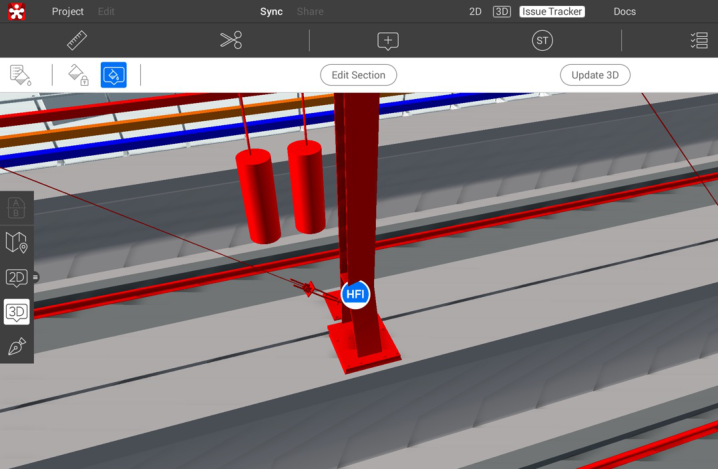
There are several advantages to associating a human factors issue with a particular location in a 3D BIM model (Figure 1), such as:
Figure 1: 3D BIM HF issue identification.
304 Lowe and Hall
Improved traceability: By tagging a human factors issue against a specific location in the model, it becomes easier to trace the issue back to its origin and understand how it may have been caused. This can help identify the issue’s root cause and develop a more effective solution.
Better communication: Tagging an issue against a specific location in the model can improve communication among stakeholders by providing a clear and visual reference point for the issue. This method can make it easier for stakeholders to understand the issue and collaborate on a solution.
Improved accountability: Tagging an issue against a specific location in the model can improve accountability by clarifying which team or individual is responsible for addressing the issue.
Better prioritization: By tagging an issue against a specific location in the model, it becomes easier to prioritize issues based on their location and potential impact on the usability and safety of the product or system.
Improved maintenance: By tagging an issue against a specific location in the model, it becomes easier to plan maintenance and repairs of the building or system.
Better monitoring: By tagging an issue against a specific location in the model, it becomes easier to monitor the progress of resolving the issue and ensure that it is resolved before the product or system is released.
By associating a human factors issue with a particular location in a 3D BIM model, it provides a more effective way of managing the HFIR by improving traceability, communication, accountability, prioritization, maintenance and monitoring of the issues. This method helps ensure that issues are resolved promptly and efficiently and that the building or system is safe and usable for its intended users.
It is also the case that visual tagging of HF issues in a 3D BIM model can make it easier to see how issues may interact, which is essential when considering a solution. By tagging an issue against a specific location in the model, it becomes easier to see how the issue may be related to other issues or impact other areas of the building or system.
For example, an issue regarding the maintainability of a chiller plant can be tagged against the chiller plant object in the model. Through visual tagging, it becomes easier to see how this issue may impact other areas of the building, such as the HVAC system, or how it may be related to other issues, such as energy efficiency or accessibility.
This approach can help to identify potential solutions that address multi- ple issues simultaneously and evaluate the effectiveness of these solutions. It also helps to ensure the solution is holistic, considering all the interactions between different human factors and issues.
3D BIM AND HFIR DISADVANTAGES While there are many potential advantages to managing the HFIR process via a 3D BIM model, there are also some potential disadvantages or problems that may be encountered. For example, BIM models are typically focused on
The Usage of 3D Building Information Management (BIM) 305
the physical aspects of the building or system, such as geometry, materials, and construction methods. While BIM models can provide detailed informa- tion about the physical characteristics of a building or system, they may only capture some of the necessary information for managing specific HF issues. Some HF issues, such as human-computer interaction and workload, may not be directly related to the physical characteristics of a building or system.
For example, a BIM model may provide detailed information about a room’s layout and the equipment’s positioning, but it may need to capture information about the temperature or humidity, which can significantly impact the space’s ergonomics. This can make it challenging to identify and document issues of this type and can limit the ability of stakeholders to evaluate potential solutions.
Another example is the information related to the people who will use the building, such as their physical abilities, expectations, and needs. BIM models typically do not include this kind of information, making it challenging to identify and document issues related to accessibility or usability for different user groups.
Managing human factors issues related to staffing levels and workload requires information about the number of staff, the roles and responsibili- ties of the staff, and the tasks they need to perform. This information is not typically included in a BIM model and needs to be gathered separately.
Additionally, the operational status of the building or system can change over time, and the human factors issues related to staffing levels and wor- kload can also change; therefore, it would be difficult to track these changes over time using a 3D BIM model.
USING MULTIPLE METHODS TO RESOLVE HFIR ITEMS To overcome these limitations, it is essential to use 3D BIM models and other human factors tools and methods to gather and analyse the information necessary for identifying and managing issues.
Accessibility or usability issues can be identified and resolved in a building design project by involving users in the design process to understand their needs and expectations. By involving users early in the design process, it is possible to identify and resolve accessibility or usability issues before they become significant problems.
Conducting usability evaluations is another effective method of identifying and resolving accessibility or usability issues in a building design project. This process involves testing the building or system with representative users to identify accessibility or usability issues.
Accessibility standards such as the Disability Discrimination Act in Australia and the Equality Act in the United Kingdom can also identify and resolve accessibility or usability issues in a building design project. These gui- delines provide a set of standards that must be met to ensure that the building is accessible to all users. By using accessibility standards, designers can ensure that their building designs meet the necessary standards for accessibility and usability.
306 Lowe and Hall
CONCLUSION
The construction industry is adopting 3D BIM and digital twin technology for improved collaboration, visualization, and accuracy. HFI is also beco- ming important in building design to consider the needs and limitations of the users. The HFIR is used to manage HFI issues during the building design process. However, there are challenges to implementing an effective HFIR process, including lack of buy-in, difficulty in identifying and docu- menting issues, prioritizing and resolving issues, maintaining the HFIR, and integrating with other processes.
3D BIM tools can help address these challenges in implementing the HFIR process. By involving stakeholders in the process and providing a centralized, digital platform for information sharing, stakeholders can better understand the importance of HFI and the benefits of the HFIR process. Personnel can also be trained in human factors and ergonomics to help identify and docu- ment issues. Additionally, BIM tools can visualize potential issues, making prioritizing and resolving them easier.
Our research shows that using 3D BIM tools in the HFIR process can provide several benefits, such as improved communication, better decision- making, and efficient use of resources. By providing a visual representation of potential HFI issues, stakeholders can better understand the need for the HFIR process, which can lead to increased buy-in.
In conclusion, while there are challenges to implementing an effective HFIR process, using 3D BIM tools can help address these challenges and provide benefits such as improved communication, better decision-making, and efficient use of resources. By providing a centralized digital platform for information sharing, stakeholders can access and share information quickly, reducing the need for physical meetings and improving the overall flow of information. It is recommended that the construction industry adopts BIM tools in their HFIR processes to achieve more efficient and effective building design and construction.
REFERENCES
Demian, P., and Walters, D. (2014) The advantages of information management through building information modelling, Construction Management and Econo- mics, 32(12), pp. 1153–1165. Edmonds, J. (2016). Human factors integration within design/engineering programs.
Human Factors in the Chemical and Process Industries, pp. 169–185. Farnsworth, C. B., Beveridge, S., Miller, K. R. and Christofferson, J. P. (2014).
Application, Advantages, and Methods Associated with Using BIM in Comme- rcial Construction.International Journal of Construction Education and Research, 11(3), pp. 218–236. Gupta, M. S., (2005). Succeeding at Human Factors Integration (HFI). In Contemporary Ergonomics 2005: Proceedings of the International Conference on Contemporary Ergonomics (CE2005), 5–7 April 2005, Hatfield, UK (p. 163). CRC Press. Jones, D., Snider, C., Nassehi, A., Yon, J. and Hicks, B. (2020). Characterising
the Digital Twin: A systematic literature review. CIRP Journal of Manufacturing Science and Technology, 29, pp. 36–52.
The Usage of 3D Building Information Management (BIM) 307
Kaewunruen, S., Rungskunroch, P. and Welsh, J. (2019). A Digital-Twin Evaluation of Net Zero Energy Building for Existing Buildings. Sustainability, [online] 11(1), p. 159. Tau-Matsie, S., (2017). The need for Human Factors Integration in the design of
stations to improve passenger safety. Ergonomics SA: Journal of the Ergonomics Society of South Africa, 29(1), pp. 11–19. Wong, J. K. W., Zhou, J. X. and Chan, A. P. C. (2018). Exploring the linkages between the adoption of BIM and design error reduction. International Journal of Sustainable Development and Planning, 13(01), pp. 108–120.
LISTED IN THE AHFE DIGITAL BOOKSTORE CATALOGUE
Explore the complete digital volume
Human Factors and Systems Interaction
Read this individual research paper free through the original publisher, or explore the full digital proceedings book.
ISBN 978-1-958651-60-5
Explore this ISBN in the AHFE Bookstore ↗Listed in the July 2026 bookstore catalogue; search by ISBN to confirm current availability · Digital book purchase optional