Roman Maciej Kalina (2023). Complementary Medicine – An Example of the application of the Basic Research Method of Innovative Agonology. In: Healthcare and Medical Devices. AHFE Open Access, vol. 79, pp. 316–324. https://doi.org/10.54941/ahfe1003944
We owe the term ‘complementary medicine’ (1932) to Max Friedemann (according to WoS data). Determining who first applied the term ‘complementary approach’ to science would not be easy. Historians and philosophers of science, as well as specialists in the general methodology of sciences, would easily argue that science as a whole is based on the complementary approach. Unfortunately, those accustomed to the separation of individual disciplines (among whom there is no shortage of novices and luminaries of science) miss the important detail that ignoring such an approach leads directly to the dehumanization of science and harms the foundations of sustainable human development en bloc in almost every respect.An inspiring source for such reasoning can be found in the maxim “Let none but geometers enter here” at the entrance to the olive grove that is Plato’s Academy (387 BC to 529 AD), dedicated to the Athenian hero Akademos. Whoever already knew geometry and was given the honour of taking the first and subsequent steps in this symbolic university of antiquity became a living example of the complementary approach. Looking at science precisely from a historical and symbolic perspective entitles us to assign some questions (i.e. issues worthy of being recognized as scientific) to each new step; it also entitles us to assign methods, means and tools (figuratively the compass, ruler, etc.) to answers to these questions. Over time, the generalized sets of questions and answers from symbolic geometry evolved into the general methodology of the sciences, as part of logic.The author of this outline of the methodological foundations of the complementary approach in contemporary scientific research was inspired by four main premises: the achievements of the Lviv-Warsaw school of logic and the methodology of sciences; praxeology (i.e. Tadeusz Kotarbiński’s proper methodology); Albert N. Whitehead’s reflection on Science and the Modern Word; and the cognitive and social mission of innovative agonology. A simple model of the social mission of science is expressed by the triad ‘curiosity - understanding - applications’. The first two terms, on the one hand, show the origin of science ‘from curiosity to satisfying the need for understanding’. On the other hand, they are directly related to the postulate of freedom of scientific research and any idealization of the mission of science. The third part, applications, is admittedly meant to emphasize the positive aspects of science and the hope that, through scientific discoveries, the mission of dignified survival of homo sapiens can be realized with a clear emphasis on respect for all life, the natural environment and human dignity. Unfortunately, the third part of the triad also includes numerous pathologies. The most dangerous are the interferences of authorities and interest groups at various levels in the freedom of science. A sophisticated way to satisfy the selfish goals of these entities is the instrumental use of scientists and the most competent research teams in a given field, with varying degrees of success. Concern for the freedom of science and the fulfilment of its social mission is a sufficient reason not to ignore these threats or the methodological possibilities of innovative agonology while respecting the complementary approach as a method of modern scientific research.
Complementary Medicine – An Example of the Application of the Basic Research Method 317
INTRODUCTION
We owe the term ‘complementary medicine’ (1932) to Max Friedemann (according to WoS data). However, it would not be easy to determine who first applied the term ‘complementary approach’ to science. Historians and philosophers of science, as well as specialists in the general methodology of sciences, would easily argue that science - as a whole - is based on the complementary approach. Unfortunately, those accustomed to the separa- tion of individual disciplines (among whom there is no shortage of novices and luminaries of science) miss the important detail that ignoring such an approach leads directly to the dehumanization of science and harms the foundations of sustainable human development en bloc in almost every respect.
An inspiring source for this reasoning can be found in the maxim ‘Let none but geometers enter here’ at the entrance to the olive grove that is Plato’s Academy (387 BC to 529 AD), dedicated to the Athenian hero Akade- mos. Whoever already knew geometry and was given the honor of taking the first and subsequent steps in this symbolic university of antiquity became a living example of the complementary approach. Looking at science precisely from a historical and symbolic perspective entitles us to assign some questi- ons (i.e., issues worthy of being recognized as scientific) to each new step; it also entitles us to assign methods, means and tools (figuratively the com- pass, ruler, etc.) to answers to these questions. Over time, the generalized sets of questions and answers from symbolic geometry evolved into the general methodology of the sciences as part of logic.
The author of this outline of the methodological foundations of the com- plementary approach in contemporary scientific research was inspired by four main premises: the achievements of the Lviv-Warsaw school of logic and the methodology of sciences (Kotarbinski, 1986); praxeology (i.e., proper methodology) Tadeusz Kotarbi´nski’s (1982); Albert N. Whitehead’s refle- ction on Science and the Modern Word (1925); and the cognitive and social mission of innovative agonology.
Medicine, as a field of practice, fills a continuum of activities that remain within the competence of predominantly medically trained professionals. Let me emphasize: predominantly medical, but not exclusively. Associations with medical engineering, digitization and other modern technologies are com- mon and justified. Less obvious is the fact that since medical professionals commonly use statements (and not only in the media sphere), the meaning of which boils down to the real “fight against disease and the fight for life,” sup- port from innovative agonology (IA) specialists appears indispensable. The fact that the subject of IA’s research is the phenomenon of struggle in a broad sense dedicated, among other things, to the defense against factors degenera- ting health, up to directly life-threatening (Kalina, 2016, 2020) should arouse curiosity.
The purpose of this paper is to argue that the prerequisite for a radical increase in the effectiveness of complementary medicine is the widespread application of the innovative agonology basic research method.
318 Kalina
THE BASIC METHOD OF INNOVATIVE AGONOLOGY Innovative agonology is an applied science dedicated to promotion, pre- vention and therapy related to all dimensions of health and regarding the optimization of activities that increase the ability to survive (from micro to macro scales). The basic method of IA in the research and application sphere is a complementary approach in the broadest possible cognitive-behavioral perspective.
However, the complementary research methodology has not yet been published, so both its critique and its recommendations are lacking. Since the articulated applications of the complementary approach in various areas of practice supported by scientific knowledge or even derived from scienti- fic discoveries are historical facts, then the key theorems of complementary research methodology must be formulated at a higher level of generality than those already accepted in the areas of specialized fields of human activity. A prominent example, but not the only, is indeed ‘complementary medicine.’ That is, the theorems of complementary research methodology would be superior to the formulated theorems in the field of complementary medicine and in any other area of medicine.
This principle is not new, after all, one can easily identify many pairs of sciences, the language of one of which is superior to another (e.g., the claims of general psychology are superior to the psychology of medicine, and the reverse cannot be true). In other words, it is unacceptable that identi- cal phenomena named and defined in the language of a science that has a superior function to a more specific science would be named and defined differently in that specific science. With the sensible assumption that scie- nce is one, and there are many disciplines and specialties, we will come to the equally sensible conclusion that the following example statements are embar- rassing science: ‘aggressive therapy’, ‘aggressive slalom crossing by a skier’, ‘aggressive defense’ (this is, after all, nothing more than a mutually destru- ctive struggle, and these phenomena are dealt with by IA). Such phrases are abundant in journalistic phraseology. Unfortunately, in the public debate they are also used by scholars.
These examples highlight the urgent need for at least a foundation of com- plementary research methodology. Before doing so, let us first establish the relationship of primacy of the terms ‘complementary’ and ‘interdisciplinary’: any complementary approach is at the same time an interdisciplinary appro- ach, but not the other way around. Simultaneously, this is the most general rule for investigating the causes of the two elementary phenomena of all human activity. Thus, it is exclusively about the human factor (decisions, choices and manipulative actions of the whole body, its parts or part). A secondary issue is the appropriateness of the things used in the activity, since this is always derived from the choices made.
The first of these phenomena is obvious mistakes, the most tragic result of which is the unintentional killing of oneself or of anyone else. These are all circumstances in which the perpetrator (individual or team) ignores some ele- ment of a complementary approach, as to which there is no doubt that when used in action, it will not necessarily always ensure the achievement of the
Complementary Medicine – An Example of the Application of the Basic Research Method 319
goal, but will not lead to its negation (in extreme cases, to the unintentional death of anyone).
The second phenomenon is every use of the best knowledge and available things (including tools, devices, installations, etc.) not only with the inten- tion of not harming anyone, but with the awareness of putting one’s own life at risk while helping others. However, instead of the goal, the acting sub- ject achieves its negation - in extreme cases, he loses his own life, the life of rescued people and animals. He is also unable to protect against irreversible destruction of things that are commonly valued goods (artifacts, works of art, etc.). These are all circumstances in which the perpetrator is aware that his interdisciplinary approach may not be sufficient, and yet takes the risk of acting in the name of the noblest goals.
In the field of medicine, this rule applies, on the one hand, to identifying errors in medical art, and on the other hand, to discovering phenomena that in the fight for health and life will begin to increase the effectiveness of medi- cal specialists widely supported by knowledge from other specific sciences. With regard to the study of these two categories of phenomena, it is essential to use the innovative agonology methodology to the greatest extent possible.
TWO IMPORTANT IMPLICATIONS First, since medical specialists do not have sufficient knowledge about the phenomenon of struggle, nor about the rules and methods of struggle that could increase the effectiveness of their professional activity, this situation slows down progress in many fields of medicine and might even make it impossible in some areas. Secondly, the implementation of IA as a mandatory subject in medical studies may bring positive effects in the distant future. An alternative solution with almost immediate effects is the implementation of IA methods and tools in those areas traditionally associated with medicine, where medicine has been helpless for thousands of years, and there is clear evidence of this.
However, it would be inappropriate to conclude that the author almost directly suggests the inclusion of innovative agonology as one of the detailed medical sciences.
POLES OF THE CONTINUUM OF COMPLEMENTARY MEDICINE When I ask (mostly students) about the poles of the continuum of comple- mentary medicine, they nearly always accurately describe the pole concerning extreme cases of fighting for life, and unmistakably list medical specialists whose participation in these activities is necessary (anesthesiologist, surgeon, etc.). And nearly always, when asked, they can neither name the pole descri- bed here (accident and emergency medicine, A and E), nor define the opposite pole.
This opposite pole is preventive medicine. Since I do not ask these questi- ons to medical students or medical historians, I do not even assume that they know anything about the pioneers of public health, especially the American epidemiologist Milton J. Rosenau (1869-1946), the author of the concept of
320 Kalina
‘conquest of fear’, which stimulated the development of preventive medicine (Rosenau 1913; Maxcy, 1956). The more so that the concept of ‘conquest of fear’ was in fact a kind of strategy of fear management and led to the gradual domination of preventive pro-health strategies by the permanent the- rapy strategies. Rosenau himself wrote about the negative consequences of this strategy (Rosenau 1913); they were presented in a literary form by the French writer Jules Romains.
Preventive Medicine Nowadays, preventive medicine is mainly associated with preventing disea- ses through vaccination, eliminating disease carriers (e.g., mosquitoes that spread malaria), with screening programs and other factors affecting health. From the perspective of scientific research methodology, the simplest and often groundbreaking discoveries or solutions to practical problems are often the source of issues that, for some reason, have already been omitted at the initial stages of identifying the explored phenomena. Therefore, the details hidden under the words ‘other factors’ are important when it comes to their impact on health.
According to the American Board of Preventive Medicine “a specialist in Preventive Medicine focuses on the health of individuals and defined popula- tions in order to protect, promote and maintain health and well-being, and to prevent disease, disability and premature death. They may be a specialist in: … Public Health & General Preventive Medicine.” (www.abms.org). Since there ‘may be’ some, but neither those who absolutely must be included, nor those who should be included (but for some reason may be omitted) are indi- cated, then basically we are dealing with a vicious circle. Next, the official site of ABMS Home / Preventive Medicine, reads that “the distinctive com- ponents of Preventive Medicine include: … Control of environmental factors that may adversely affect health; Control and prevention of occupational factors that may adversely affect health safety; Clinical preventive medicine activities, including measures to promote health and prevent the occurrence, progression and disabling effects of disease and injury; and Assessment of social, cultural and behavioral influences on health” (www.abms.org) Confronting these recommendations with the classification of sciences and the creations of higher professional education (these are professionals with clearly defined qualifications) in such a way that the various scientific disciplines and specialties are assigned names of professional qualifications (alternatively, the names of fields of study), will create a matrix of many inconsistencies. In other words, many legitimate directives of preventive medicine are not reflected in the specialties of education within the field of medicine. On the other hand, many professional qualifications that are more or less closely related to preventive medicine are obtained by graduates in fields of study not assigned to medicine, and therefore not associated with health sciences either.
Physical education is a profession and field of study directly related to promoting health and preventing the occurrence of disease and injury, and therefore to the distinctive components of preventive medicine. Even to a
Complementary Medicine – An Example of the Application of the Basic Research Method 321
lesser extent, the following professions fit into this model: personal trainer, recreation expert, adapted physical activity (APA) expert. Perhaps with the exception of APA, the rest of the listed professions (fields of education) are associated with sports science. Physiotherapy and psychotherapy will most often be associated with health sciences, but I would not be so sure whether it will be so obvious to associate the first occupational specialty with the somatic health dimension and the second with the mental health dimension.
The authors of the general recommendation on the competence of a pre- ventive medicine use the general term ‘health’ without distinguishing between its three dimensions: somatic, mental and social health. However, they list a specialist of public health specialist among the fields in which candidates are recruited.
Accident and Emergency Medicine (A and E) An orderly methodological finding regarding the superiority of the theorems of this pole of the continuum of complementary medicine says that specific rules, directives, etc. applicable to the field of either battlefield medicine or disaster medicine should be justified and explained using theorems of a higher level of generality.
During this category of practical activities, the essence of which is the actual struggle for human life (from the individual to the entire population), the participation of medical specialists and medical support personnel adequ- ate to the specific circumstances is dominant. In the scientific study of these phenomena from a medical perspective, in documenting and disseminating knowledge about them, the language of A and E would be appropriate.
COMPLEMENTARY MEDICINE FROM THE PERSPECTIVE OF SOCIAL EXPECTATIONS The multiplicity and variety of more or less intuitive social expectations rela- ted to health and life care seem to center around the issue of complementary medicine. However, even a cursory analysis of the exploration of this issue, as measured by the simplest indicators from the major literature databases, does not support this hypothesis.
As of early March 2023, 6,850 results from the Web of Science Core Col- lection for ‘complementary medicine’ included these keywords in the titles of publications indexed since 1900. The leader of the ranking based on the num- ber of citations (735) is a paper from 2005 (Molassiotis et al., 2005), while the leader of over forty papers whose title consisted only of these two words is cited 46 times and occupies the 526th position in this ranking (Abbot et al. 1996). However, in the titles of the vast majority of these publications, the information is expanded to include ‘complementary and alternative medicine (CAM).’ The fifth publication in this ranking (498 citations) from 1994 (and the dates are an important reasoning argument), as its title would suggest, is dedicated to ‘complementary medicine.’ However, the authors refer to com- plementary medicine in the broader semantic, practical and legislative context of the services provided: “Even the term complementary medicine is not enti- rely satisfactory, lumping together as it does a wide range of methods with
322 Kalina
little in common except that they are outside the mainstream of medicine. The most accurate term is perhaps ‘unconventional therapeutic methods.’ (Fisher and Ward, 1994). As of the 127th ranking position, the papers have been cited less than 100 times.
Already, these most elementary indicators are proof that complementary medicine occupies the attention of researchers of this phenomenon almost exclusively in a selective aspect. The papers are dedicated to specific issues and, to a large extent, are a consequence of the increasing separation of scie- nces and scientific specialties. On the one hand, this separation is inevitable, due to the influx of scientific discoveries and the expansion of technological achievements. Unfortunately, many of the applications serve the convenience of people not only of the richest societies, but also have their infamous share in the dehumanization and demoralization of modern man en bloc.
The other side is the lack of synchronization between the naturally dee- pening separation of the detailed sciences and the parallel, but much slower, attempts to solve major social problems based on the complementary appro- ach. The current dilemma is the question: will not the complementary approach (which is necessary to solve these problems optimally) turn into a new, fashionable research direction? A possible separation, this time of complementary health science with any other complementary science could prove counterproductive. Science would not fulfill its social mission, but would serve to deepen dehumanization, demoralization to the point of self-destruction of the human race.
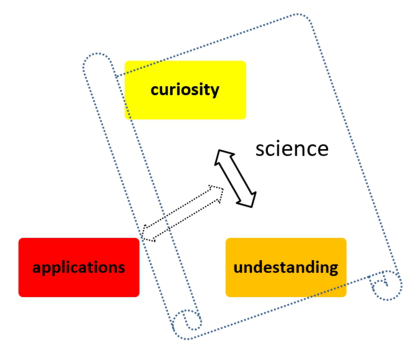
A SIMPLE MODEL OF THE SOCIAL MISSION OF SCIENCE A simple model of the social mission of science is expressed by the triad ‘curi- osity - understanding - applications’ (Figure 1). The first two terms, on the one hand, show the origin of science ‘from curiosity to satisfying the need for understanding’. On the other hand, they are directly related to the postu- late of freedom of scientific research and any idealization of the mission of
Figure 1: A model of the social mission of science.
Complementary Medicine – An Example of the Application of the Basic Research Method 323
science. The third part, applications, is admittedly meant to emphasize the positive aspects of science and the hope that, through scientific discoveries, the mission of dignified survival of homo sapiens can be realized with a clear emphasis on respect for all life, the natural environment, and human dignity. Unfortunately, the third part of the triad also includes numerous pathologies. The most dangerous are the interferences of authorities and interest groups at various levels in the freedom of science. A sophisticated way to satisfy the selfish goals of these entities is the instrumental use of scientists and the most competent research teams in a given field, with varying degrees of success. Concern for the freedom of science and the fulfillment of its social mission is a sufficient reason not to ignore these threats or the methodological possibi- lities of innovative agonology while respecting the complementary approach as a method of modern scientific research.
CONCLUSION
Innovative agonology also offers specific research and educational methods, means, and tools that can be widely applied in the field beyond preventive medicine. What is more, through the application of these unique capabili- ties and repeatedly empirically verified effects, two issues have been solved that broad medicine has not dealt with for thousands of years. One is dia- gnosing and reducing the susceptibility of the body to injuries during the fall (Ga˛sienica Walczak, and Kalina 2021, Iermakov et al., 2022), the other is diagnosing and reducing aggressiveness (Klimczak and Klimczak 2018). Both issues fall within the competence of specialists in public health and general preventive medicine, but in a general sense. That is, they can be predi- cted, planned, controlled, documented, etc. by these specialists. Undertaking procedures to reduce both of these natural human ailments already requires specific qualifications that are lacking in the traditional offerings of medical, psychological, and any other education. If we agree that science is one, then breaking the modern paradigm of science and the paradigm of education should be based on the mutually-complementary principle, which is much broader than the complementary approach.
REFERENCES
Abbot, NC; White, AR., Ernst, E. (1996) Complementary medicine. NATURE 381 (6581); pp. 361–361. https://www.abms.org/board/american-board-of-preventive-medicine/ Fisher, P., Ward, A. (1994) Medicine in Europe: Complementary medicine in Europe BMJ 1994;309:107 doi: https://doi.org/10.1136/bmj.309.6947.107. Friedemann, M. (1932) Complementary Medicine. ZEITSCHRIFT FUR PSYCHO-
LOGIE UND PHYSIOLOGIE DER SINNESORGANE. Volume 125; Issue 1-2, p. 109–109. Ga˛sienica Walczak, B., Kalina, R. M. (2021) Validation of the new version of “the susceptibility test to the body injuries during the fall” (STBIDF-M). ARCH BUDO 17: 371–400. Iermakov, S., Podrigalo, L., Podrigalo, O., Yermakova, T., Jagiełło, W. (2022) Means
and methods of physical activity in the context of prevention and treatment of
324 Kalina
Alzheimer’s disease (analysis of Russian-language scientific resources) and the per- spective of implementing the unique achievements of the “Polish School of Safe Falling”. ARCH BUDO 18: pp. 121–143. Kalina, R. M. (2016) Agonology – the prospect of an effective defence of peace and unrestricted freedom of scientists. ARCH BUDO 2016; 12: 1–13. Kalina, R. M. (2020) Language and methods of innovative agonology as a guide
in interdisciplinary research on interpersonal relationships and people with the environment – from micro to macro scale. ARCH BUDO 16 pp. 271–280. Klimczak, M., Klimczak, J. (2018) Application of multidimensional simulation research tools in the diagnosis of aggressiveness among the youth – review of innovative methods. ARCH BUDO SCI MARTIAL ART EXTREME SPORT 14: pp. 205–213. Kotarbinski, T. (1982) Traktat o dobrej robocie. Wroclaw-Lód´z: ZAKŁAD NARO-
DOWY IMIENIA OSSOLINSKICH WYDAWNICTWO, Wyd. 7, (In Polish, summary in English and Russian). Kotarbinski, T. (1986) Elementy teorii poznania, logiki formalnej i metodologii nauk. Warszawa: 3rd edition; PA ´NSTWOWE WYDAWNICTWO NAUKOWE (in Polish). Maxcy, K. F. (ed.) (1956) Rosenau’s Preventive Medicine and Public Health.
APPLETON-CENTURY-CROFTS, New York. Nowaczyk, A., ˙Zołnowski, Z. (1974) Logika i metodologia bada´n naukowych dla lekarzy. Warszawa: PA ´NSTWOWY ZAKŁAD WYDAWNICTW LEKARSKICH (in Polish). Rosenau, M.J. (1913) Preventive Medicine and Hygiene. New York–London: D.
APPLETON AND COMPANY. Molassiotis, A., Fernandez-Ortega, P., Pud, D., Ozden, G., Scott, J. A., Pante- lil, V., Margulies, A., Browall, M., Magri, M., Selvekerova, S. (2005) Use of complementary and alternative medicine in cancer patients: a European survey. ANNALES OF ONCOLOGY. Volume 16; Issue 4: pp. 655–663 DOI 10.1093/an- nonc/mdi110. Whitehead, A. N. (1925) Science and the Modern World. Lowell Lectures. Cambridge at the University Press.
LISTED IN THE AHFE DIGITAL BOOKSTORE CATALOGUE
Explore the complete digital volume
Healthcare and Medical Devices
Read this individual research paper free through the original publisher, or explore the full digital proceedings book.
ISBN 978-1-958651-55-1
Explore this ISBN in the AHFE Bookstore ↗Listed in the July 2026 bookstore catalogue; search by ISBN to confirm current availability · Digital book purchase optional