Michael Schneeberger, Martin Pszeida, Melanie Lenger, Lisa Heiler, Helmut Simi, Dietmar Wallner, Anna Weber, Alexander Almer, Silvia Russegger, Lucas Paletta (2023). Impact of Acute Physical Exercise on Cognitive Performance. In: Cognitive Computing and Internet of Things. AHFE Open Access, vol. 73, pp. 93–103. https://doi.org/10.54941/ahfe1003978
Numerous studies have found that aerobic endurance exercise increases neural activation and reduces reaction times suggesting that acute bouts of exercise may selectively boost executive function performance involving inhibitory control and attention. The objective of the presented study was to understand the concrete impact of a “standardised incremental exercise test to exhaustion” on certain cognitive functions, such as, sustained attention, and flexibility in the reaction behaviour. The results of the intervention demonstrate that reactive resilience increased (p=.008**) and reaction time was reduced (p<.001***) under application of the Determination Test (DT). Nevertheless, the number of errors increased but not in a significant manner (p>.05). The results of the Psychomotor Vigilance Task (PVT) showed that the reaction times were significantly decreasing as well (p=.002**), however, the errors in terms of “false starts” were significantly increasing (p=.002**). This research study demonstrates that acute physical exercise had a measurable impact on the cognitive performance of the participants. In particular, the PVT reported a statistically significant detrimental impact that refers to changes in sustained attention.
In the context of acute exercise in cognitive functioning (Heijnen et al., 2016), numerous studies have found that aerobic endurance exercise increases neu- ral activation (Dietrich & Audiffren, 2011) and reduces reaction times (RT; Bermejo et al., 2018) suggesting that acute bouts of exercise may selecti- vely boost executive performance involving inhibitory control and attention (Tsai et al., 2014). This may even be reversed into an impairment when exe- rcise is prolonged or reaches exhaustion (Sudo et al., 2017). The relationship between acute exercise and cognitive functioning is reported to be complex and sensitive to multiple factors (Tomporowski et al., 2008) and therefore requires further investigation.
The objective of the presented study was to understand the concrete impact of a standardised incremental exercise test to exhaustion on certain cognitive functions that are relevant in the context of first responders, like firefigh- ters (Bijelic et al., 2022). The study was conducted with young healthy participants (students) that were engaged in the level test of physiological per- formance diagnostics with intensive ergometric use. We aim to investigate the impact on specific cognitive performance aspects like sustained attention and flexibility in the reaction behaviour on first responders, such as, firefighters during emergency missions (Paletta et al., 2022).
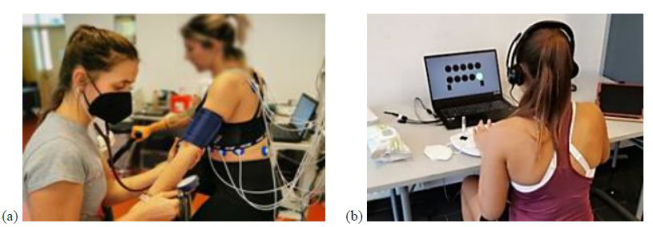
In a pilot study in Austria (Figure 1) students went into an intensive, acute exercise task (Figure 1a). We applied pre-post cognitive performance tests in order to measure a potential impact of the intervention. We particularly esti- kmated the flexibility in the reaction behaviour using the DT (Schuhfried, 1986; Figure 1b). In addition, we measured the sustained attention and feed- back on neurobehavioral changes in vigilant attention, state stability, and impulsivity, estimated by the PVT (Dinges & Powell, 1985; Basner et al., 2017, 2021).
Figure 1: Details of the intervention. (a) Acute intensive exercise in the form of a graded exercise test on an ergometer. (b) Determination Test (DT) designed by Schuhfried GmbH (Schuhfried, 1986). Credit: Joanneum Research / M. Schneeberger.
The results demonstrate that acute physical exercise of a relatively short duration has a significant measurable impact on cognitive performance. While reactive resilience increased and reaction times were reduced, error rates increased significantly. We hypothesise that this combinatory effect may refer to the speed-accuracy trade-off (Zimmermann, 2011; Heitz, 2014). It is important to note that the results should also be linked to physiological data to further validate the results of the subjective questionnaires.
RELATED WORK: ACUTE EXERCISE & COGNITIVE PERFORMANCE Regarding the role of acute exercise in cognitive functioning (Heijnen et al., 2016), some studies have found that aerobic endurance exercise increases the warning state and neural activation of the participants (Dietrich and Audif- fren, 2011) suggesting that acute bouts of exercise may selectively boost executive function performance involving inhibitory control and attention (Tsai et al., 2014). In addition, previous research has shown that acute aero- bic exercise reduces reaction times (RT; Bermejo et al., 2018) although this
Impact of Acute Physical Exercise on Cognitive Performance 95
facilitation does not seem to extend into the post-exercise period more than a few minutes (Dietrich and Audiffren, 2011) and may even be reversed into an impairment when exercise is prolonged and/or reaches exhaustion (Sudo et al., 2017). This disparity of results does not necessarily question the assumption that there is a positive relationship between acute exercise and cognition, but rather, shows that this relationship is complex and sensitive to multiple factors (Tomporowski et al., 2008). For example, the time gap between the cessation of exercise and the evaluation of cognitive functioning is one crucial variable due to the transience of the psychophysiological effe- cts of the acute exercise (Crabbe & Dishman, 2004). Therefore, considering that intense exercise may be considered to represent a stressor (Tsai et al., 2014), and consequently modulate the performance of cognitive functions (Lambourne and Tomporowski, 2010) and cortisol levels (Engel et al., 2014), the latter could potentially be related to the effects of exercise on cognition (Henckens et al., 2012).
In the study of Bermejo et al. (2019) with 34 intensively active male per- sons (24-48 years) the main results indicate that fatigue protocol elicited an increase in cortisol level and degraded cognitive performance (e.g., in PVT on reaction time and lapses). Indeed, exercise-induced stress had only a detrimental effect on attention without any impact on declarative memory and finding improvements in working memory performance due to his trai- ning. With respect to the PVT, reaction time (RT) was significantly higher in post-fatigue than in pre-fatigue conditions. The accuracy of response (lap- ses) differed significantly between pre- and post-fatigue conditions, showing a decrease in accuracy in post-fatigue condition. These findings coincided with previous research (Soga et al., 2015) confirming a deterioration after exercise of an intensity of at least 70% of maximum heart rate. In general, the impairment was characterised by significantly slower reaction times and fewer correct responses in both task conditions and particularly pronounced in the first blocks. According to the theories of arousal, the relationship betw- een stress and performance follows an inverted U-shaped function (Joëls et al., 2006). The time elapsed between the cessation of exercise and evaluation of cognitive functions is another crucial variable for psychophysiological effects of exercise-induced stress (Crabbe & Dishman, 2004).
STRESS MODELS OF COGNITIVE PERFORMANCE The Yerkes-Dodson law is an empirical relationship between arousal and per- formance, originally developed by psychologists Robert M. Yerkes and John Dillingham Dodson in 1908 (Yerkes & Dodson, 1908). The law dictates that performance increases with physiological or mental arousal, but only up to a point. When levels of arousal become too high, performance decreases. The process is often illustrated graphically as a bell-shaped (inverted U-shaped) curve which increases and then decreases with higher levels of arousal. Lupien et al. (2007) reviewed the effects of stress hormones (glucocorticoids, GC) and human cognition and revealed that memory performance vs. circulating levels of glucocorticoids does manifest an upside-down U-shaped curve and the authors noted the resemblance to the Yerkes-Dodson curve.
A more recent model is the Maximal Adaptability Model, which assumes that heat exerts its detrimental effects on performance by competing for and eventually draining attentional resources. Hancock and Vasmatzidis (2003) used this model as the theoretical basis for their limits. Input stress can vary from a low extreme (hypo-stress) to a high extreme (hyper-stress). In the middle of this continuum is the normative zone, which requires no compen- satory action on the part of the individual. Surrounding the normative zone is the zone of comfort wherein cognitive adjustments to task demands are easily accomplished. As a result, performance within the comfort zone is at near- optimal level. As the level of environmental stress increases (by increasing exposure duration or the intensity level of the stressor or both), attentional resources are progressively drained. Initially, the remaining resources are effi- ciently used by the individual via adaptive strategies such as attentional focus, with the net result being no performance decrement, or even performance enhancement. This behaviour is a reflection of psychological adaptability and is noticed within the psychological zone of maximal adaptability. At higher levels of stress, depletion of cognitive resources results in a progressive decline of performance efficiency, as indicated by the dashed line comprising the boundary of the psychological zone of maximal adaptability. For example, in a recent study, Chase et al. (2005) reported poor dual-task performance due to the inability of the participants to successfully allocate attention to the tasks of the study. At this point (beyond the boundary), physiological stability is also disturbed. Further increases in stress intensity move the body outside the zone of homeostasis (physiological zone of maximal adaptability) into life-threatening circumstances (heat stroke for example). With respect to heat stress, the maximal adaptability model establishes a relationship between the physiological and psychological aspects of work in the heat. As it assumes attentional resource depletion to be the mechanism for the debilitating effe- cts of heat stress, it also establishes a relationship between the magnitude of such depletion (expressed in terms of dynamic body core temperature incre- ase) and the onset of performance decrement. This relationship is represented by the limits proposed by Hancock and Vasmatzidis (2003). They concluded that this structure provides the most comprehensive description, as it pertains to thermal stress and its general principles can be applied to understanding the action of all forms of occupational stress.
STUDY DESIGN Incremental Exercise Test. While acute exercise refers to the practice of a sin- gle session of exercise lasting from a few seconds to perhaps several hours, chronic exercise refers to the repetition of exercise over time during a period lasting from weeks to years (Dietrich & Audiffren, 2011). The reason for our study was to approve the impact of physiological strain on different cognitive functions, (i) reactive resilience and (ii) sustained attention. For this purpose, a substantial number of participants voluntarily performed an incremental exercise test on a bycicle ergometer. The subjects were encouraged to go to their physical limits but to stop in case of any discomfort or other per- sonal reasons. The graded exercise test on the ergometer (Customed) was
Impact of Acute Physical Exercise on Cognitive Performance 97
medically supervised by an experienced physician. The intervention began with a warm-up period starting with 30/40 watt load (female/male) then wattage was increased by 15/20 watts every minute until exhaustion. After termination, the students were asked to cycle out for three more minutes at 30/40 watt, if possible. The influence of physiological strain on the subjects’ (i) reactive resilience and (ii) sustained attention was determined before and directly after the intervention using the challenging DT and PVT, respectively. These two tests are described in the following.
Determination Test (DT). The DT is a complex multi-stimuli response test that allows testing of reactive stress tolerance and associated reactivity. During the DT, the subject has to react to both coloured stimuli and acou- stic signals by pressing the appropriate buttons on the response panel and by using the respective foot pedal. The stress element of the DT arises from the need to sustain continuous, rapid and varying responses to rapidly changing stimuli. Since the chosen test form is adaptive, any individual can be con- fronted with stimuli at a frequency sufficiently high to place him or her in a situation in which he or she is over-challenged and can no longer execute the necessary responses. The DT can therefore be used to investigate behaviour under various levels of psychophysical stress. The test is used in recruitment for positions with safety-related requirements (safety assessments), in staff development, in clinical neuropsychology, in traffic psychology and in sports psychology. The DT was developed by the Schuhfried Company and is part of their Vienna Test System (VTS), a test suite for computerized psychological assessments (Schuhfried, 1986).
Psychomotor Vigilance Test (PVT). The PVT (Dinges & Powell, 1985) is a commonly used test to determine behavioural alertness and sustained atten- tion because of its great sensitivity to sleep deprivation and its psychometric advantages over other cognitive tests. The standard PVT lasts 10 min and measures sustained or vigilant attention by recording reaction times to visual (or auditory) stimuli occurring at random inter-stimulus intervals (Goel et al., 2015). We re-implemented the PVT test according to Basner and Rubinstein (2011) and Grant et al. (2017) in order to be able to use it in our test environ- ment, e.g. on a tablet. In our reimplementation, a test person is asked to tap on a number that suddenly and randomly appears in the middle of a touch- screen. The value of the number changes permanently and represents the time in milliseconds since its appearance on the screen. The number disappears as soon as the user taps on the screen or after a timeout (3 seconds) is reached. The test lasts 3 minutes.
Borg Scale. The Borg scale (Borg, 1962;1998) is an assessment method for grading the severity of subjective perceived exhaustion, dyspnea, or pain. The original scale was developed to measure subjective fatigue (Ratio of Perceived Exertion, RPE) as a measure of physical strength. The rating ranges from 6 (“no exertion at all”) to 20 (“maximal exertion”), multiplied by 10 yields approx. the corresponding heart rate (60 to 200 beats/min). Borg ratings can easily be used for comparison with other psychphysiological data. The BORG scale was applied during the graded exercise test on the ergometer before and after each power step.
EXPERIMENTAL RESULTS In our study, a total of 31 healthy students with 19–29 years of age (M = 21.8; SD = 2.5; 26 women and 5 men) took part in the Entrance Examination (EGU) at the Sport Science Laboratory of the FH JOANNEUM Gesellschaft mbH, University of Applied Sciences, Bad Gleichenberg, Austria, an examina- tion that students can carry out voluntarily in the first and second semesters of the Bachelor’s degree programme “Health and Tourism Management”. The participants attended the incremental exercise test on a bicycle ergo- meter (ergoselect 100, ergoline GmbH, Bitz, Germany). All subjects signed informed consent as part of the University evaluation. One female subject had to discontinue the study for circulatory reasons during the exercise. The main data collected in the study resulted from four different sources: (i) the maximum watt load when stopping the exercise, (ii) the Borg scale, (iii) the results of the DT and, (iv) the outcome of the PVT. The cognitive tests were applied by the staff of the Human Factors Laboratory, DIGITAL – Institute for Digital Technologies, Joanneum Research Forschungsgesellschaft mbH, to students and analyzed in the sequel.
(i) Ergometry. The ergometry was terminated between 8 and 19 minutes. The female subjects stopped the exercise at M = 183.6; SD = 27.3 watts and the male subjects at M = 316.0; SD = 57.1 watts.
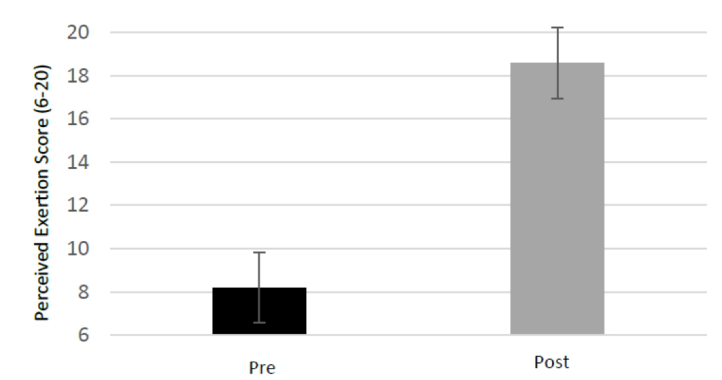
(ii) Borg scale. The average Borg score before the intervention was M = 8.2; SD = 1.6 (M = 8.4; SD = 1.6 for women; M = 7.4; SD = 1.2 for men). The participants reported a mean Borg score of M = 18.6, SD = 1.7 (M = 18.6; SD = 1.7 women; M = 18.4; SD = 1.4 men) at maximum load when stopping the exercise (see Figure 2). The Borg was queried again at the end of the EGU, after the second round of the cognitive tests. At the end, the values approximately repeated initial values M = 9.8; SD = 1.8 (M = 9.8; SD = 1.9 women; M = 10.0; SD = 1.4 men).
Figure 2: Descriptive statistics (M, SD) of the perceived exertion score (“Borg”) before (“pre”) and after (“Post”) the acute exercise intervention.
Impact of Acute Physical Exercise on Cognitive Performance 99
(iii) Determination Test (DT). The subjects underwent the cognitive tests before and immediately after the physically stressful intervention. The time between the end of the intervention and the “post”test session was M = 2:44; SD = 0:52 minutes:seconds, respectively. The test sessions started with the DT (4 minutes netto) followed by the PVT (3 minutes).
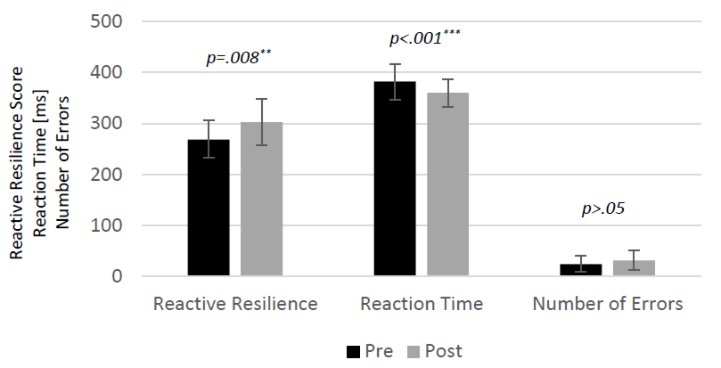
The results of the DT shows (Figure 3) the reactive resilience before and after the exercises, represented by two columns on the left (pre M = 268.77, SD = 36.72; post M = 302.67, SD = 44.87; p=.008**). The column pair in the middle show the “pre”- and “post”-reaction times (pre M = 382.07, SD = 34.95; post M = 360.02, SD = 27.32; p<.001***) and the right two columns depict the pre/post number of errors (pre M = 24.67, SD = 15.35; post M = 31.53, SD = 19.12; p>.05).
The DT demonstrates the mostly positive impact of the acute physical exercise. Reactive resilience and reaction times position in the direction of positive impact of physical exercises with statistically significant improve- ments in reactivity and stimulus reaction times (Figure 3; left, mid diagram). However, the number of errors is increasing, but not in a significant manner.
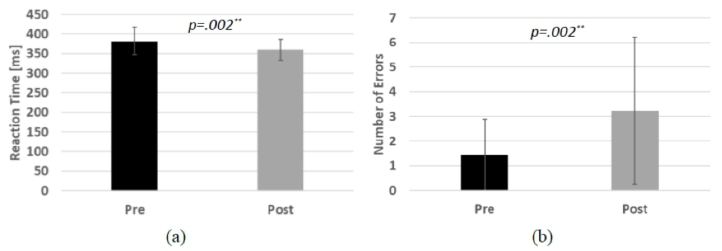
Figure 3: Study results of a multivariate analysis of variance (MANOVA) with repea- ted measure design (dependant variable: reactive resilience, reaction time, number of errors; independent variable: time point) for the DT as impact of the acute physical exe- rcise. Reactive resilience score (number of correct timely and delayed reactions) and reaction times position in the direction of positive impact of physical exercises with statistically significant improvements in reactivity and stimulus reaction times (left, mid diagram). However, the number of errors is increasing, but not in a significant manner (right). (iii) Psychomotor Vigilance Task (PVT). The results of the PVT are depi- cted in Figure 4. Three subjects were excluded from the analysis due to non-compliance. In Figure 4a we see the reaction times before and after the exercise and Figure 4b shows the errors in terms of “false starts”.
The results, including two-sided paired t-tests, demonstrate that the stu- dents were pushed by the physical intervention into a state of increased arou- sal with accelerated, i.e., significantly better reaction times (pre M = 381.93,
Figure 4: Study results of the PVT (two-sided paired t-tests). (a) The reaction times were decreasing in a statistically significant manner. (b) The errors in terms of “false starts” were increasing in a statistically significant manner.
SD = 34.66; post M = 359,86, SD = 27,30; p=.002**). Furthermore, the number of errors increased to a statistically significant higher value (pre M = 1.44, SD = 1.60; post M = 3.22, SD = 2.99; p=.002**). The com- plex relationship between an individual’s willingness to respond slowly and make relatively fewer errors compared to their willingness to respond quickly and make relatively more errors is described as the speed–accuracy trade-off (Zimmermann, 2011; Heitz, 2014). The increased arousal led to the result that the number of errors increased.
Test repetition effects. The PVT is proved to be free of repetition effects that may confound measured effects of an intervention, e.g., acute exercise or sleep loss, on performance (Basner et al., 2017) and this distinguishes the PVT from more complex cognitive tests. Basner et al. (2017) reported that the mean and median RT, response speed, and lapses, which are among the most frequently used PVT outcomes, did not change systematically with repeated administration.
In contrast, the more complex DT has a known “training” effect with improvements of reactive force, capacity and alertness that are observed even up to the fifth processing (Schranz & Osterode, 2009) and reaction time is reported to improve by 8.94 % with a second and by 5.85 % with a third ses- sion, respectively. It is noted therefore that the introduction of a control group in the context of an intervention, such as is the case for an acute exercise test, would support the discrimination between training effects and impact of the intervention.
DISCUSSION AND CONCLUSION This research study demonstrates that acute physical exercise had a measu- rable impact on the cognitive performance of the participants. In particular, the PVT reported a statistically significant detrimental impact that refer to changes in vigilant attention, state stability, and impulsivity. We hypothesize that there might be differences in the impact on different cognitive functi- ons, such as, sustained attention (measured by PVT) and flexibility in the reaction behavior (measured by DT), since there were significant differences
Impact of Acute Physical Exercise on Cognitive Performance 101
between these tests identified, e.g., in the significance of the impact on the error levels. Regarding the stress models – the inverted U-shaped performance curve and the Maximal Adaptability Model – we hypothesize that post PVT- based performance seemed to be in a decaying branch below baseline level while the post DT-based performance was measured on a relatively higher level. Longitudinal studies would shed more light on the time course of these performance curves and particularly on the differences in the time course of the two different investigated cognitive functions.
Future studies would include a control group in the context of the acute physical exercise-based intervention in order to determine the statistical significance of measured differences of the DT. Finally, linking the results to psychophysiological data that were captured during the acute physical exercise could provide better insight into the impact.
ACKNOWLEDGMENT
This work was partially funded from the project SIXTHSENSE (grant No 883315, Horizon 2020 Research and Innovation Program of the European Commission) and from the Austrian Defense Research Programme FORTE, project VitalMonitor, funded by the Austrian Research Promotion Agency (FFG) and the Austrian Federal Ministry of Finance.
REFERENCES
Basner, M. and Rubinstein, J. (2011). Fitness for duty: a 3-minute version of the Psychomotor Vigilance Test predicts fatigue-related declines in luggage-screening performance. Journal of Occupational and Environmental Medicine, 53(10), pp. 1146–1154. doi: 10.1097/JOM.0b013e31822b8356. Basner, M., Hermosillo, E., Nasrini, J., McGuire, S., Saxena, S., et al. (2017). Repe-
ated Administration Effects on Psychomotor Vigilance Test Performance, Sleep, Volume 41, Issue 1, January 2018, zsx187, doi: 10.1093/sleep/zsx187. Basner, M. et al. (2021). Response speed measurements on the psychomotor vigilance test: how precise is precise enough?, Sleep, doi:10.1093/sleep/zsaa121. Bermejo, J. L., García-Massó, X., Paillard, T., & Noé, F. (2018). Fatigue
does not conjointly alter postural and cognitive performance when stan- ding in a shooting position under dual-task conditions. J. Sports Sci., doi: 10.1080/02640414.2017.1313443 Bijelic, G., Stefanovi´c, C., Morschhauser, A., Carballo Leyenda, A. B., Paletta, L., Falk, A., Kosti´c, M., Strbac, M., Jorgovanovic, N., Jobst, G., Paradiso, R., Magenes, G., Fanjul Bolado, P., Eschenbacher, P., Vujic, A. (2022). Sixth Sense: Smart Integrated Extreme Environment Health Monitor with Sensory Feedback for Enhanced Situation Awareness. 2022 IEEE-EMBS International Conference on Wearable and Implantable Body Sensor Networks (BSN), Ioannina, Greece, 2022, pp. 1–4, doi: 10.1109/BSN56160.2022.9928493. Borg, G. (1962). Physical performance and perceived exertion. Studia Psychologica
et Paedagogica. Series altera, Investigationes XI). Lund: Gleerup, 1962. Borg, G. (1998). Borg’s perceived exertion and pain scales. Humankinetics. Chase, B., Karwowski, W., Benedict, M. E., & Queseda, P. M. (2005). Effects of Thermal Stress on Dual Task Performance and Attention Allocation. Jour- nal of Human Performance in Extreme Environments, 8(1), Article 1. doi: 10.7771/2327-2937.1039.
Crabbe, J. B. and Dishman, R. K. (2004). Brain electrocortical activity during and after exercise: a quantitative synthesis. Psychophysiology, 41(4), pp. 563–574. doi: 10.1111/j.1469–8986.2004.00176.x. Dietrich, A. and Audiffren, M. (2011). The reticular-activating hypofrontality (RAH)
model of acute exercise. Neurosci. Biobehav. Rev., 35(6), pp. 1305–1325. doi: 10.1016/j.neubiorev.2011.02.001. Dinges, D. F. and Powell, J. W. (1985). Microcomputer analyses of performance on a portable, simple visual RT task during sustained operations. Behavior Research Methods, Instruments, & Computers, 17, pp. 652–655. Engel, F., Härtel, S., Strahler, J., Wagner, M. O., Bös, K., & Sperlich, B. (2014). Hor-
monal, Metabolic, and Cardiorespiratory Responses of Young and Adult Athletes to a Single Session of High-Intensity Cycle Exercise. Pediatr. Exerc. Sci., 26(4), pp. 485–494. doi: 10.1123/pes.2013–0152. Goel, N., Basner, M., & Dinges D. F. (2015). The PVT: Example of a Behavioral Assay for Phenotyping Responses to Sleep Loss. In Methods in Enzymology, 552, Chapter 13, 1st Edition, pp. 285–308. Grant, D. A., Honn, K. A., Layton, M. E., Riedy, S. M., & Van Dongen, H. P. A.
(2017). 3-minute smartphone-based and tablet-based psychomotor vigilance tests for the assessment of reduced alertness due to sleep deprivation. Behav Res Methods, 49(3), pp. 1020–1029. doi: 10.3758/s13428-016-0763-8. Hancock, P. A. and Vasmatzidis, I. (2003). Effects of heat stress on cognitive performance: the current state of knowledge. International Journal of Hyperthermia, 19(3), pp. 355–372. doi:10.1080/0265673021000054630. Heijnen, S., Hommel, B., Kibele, A., & Colzato, L. S. (2016). Neuro modulation of Aerobic Exercise - A Review. Front. Psychol., 6. https://doi.org/10.3389/fpsyg.2015.01890 Heitz, R. P. (2014). The speed-accuracy trade off: history, physiology, methodology,
and behavior, Frontiers in Neuroscience, Vol. 8, doi: 10.3389/fnins.2014.00150 Joels, M., Pu, Z., Wiegert, O., Oitzl, M. S., & Krugers, H. J. (2006). Learning under stress: how does it work? Trends Cogn. Sci.10, pp. 152–158. doi: 10.1016/j.tics.2006.02.002 Lambourne, K. and Tomporowski, P. (2010). The effect of exercise-induced arousal
on cognitive task performance: A meta-regression analysis. Brain Res., 1341(Sup- plement C), pp. 12–24. doi: 10.1016/j.brainres.2010.03.091. Lupien, S. J., Maheu, F., Tu, M., Fiocco, A., & Schramek, T. E. (2007). The effects of stress and stress hormones on human cognition: Implications for the field of brain and cognition. Brain and Cognition, 65(3), pp. 209–237. doi: 10.1016/j.bandc.2007.02.007. Paletta, L., Pszeida, M., Schneeberger, M., Dini, A., Reim, L., & Kallus, K. W. (2022).
Cognitive-emotional Stress and Risk Stratification of Situational Awareness in Immersive First Responder Training, 2022 IEEE-EMBS International Conference on Biomedical and Health Informatics (BHI), Ioannina, Greece, 2022, pp. 1–4, doi: 10.1109/BHI56158.2022.9926805. Schranz, S., and Osterode, W. (2009). Übungseffekte bei computergestützten psychologischen Leistungs tests. Wien Klin Wochenschr 121, pp. 405–412 (2009). doi: 10.1007/s00508-009-1193-8. Schuhfried, G. (1986). Manual Determinations test (DT). Mödling: SCHUHFRIED
GmbH. Soga, Shishido, & Nagatomi (2015). Executive function during and after acute moderate aerobic exercise in adolescents. Psychology of Sport and Exercise, 16, pp. 7–17.
Impact of Acute Physical Exercise on Cognitive Performance 103
Sudo, M., Komiyama, T., Aoyagi, R., Nagamatsu, T., Higaki, Y., & Ando, S. (2017).
Executive function after exhaustive exercise. Eur. J. Appl. Physiol., 117(10), pp. 2029–2038. doi: 10.1007/s00421-017-3692-z. Tomporowski, P. D., Davis, C. L., Miller, P. H., & Naglieri, J. A. (2008). Exercise and Children’s Intelligence, Cognition, and Academic Achievement. Educ. Psychol. Rev., 20(2), 111. doi: 10.1007/s10648-007-9057-0. Tsai, C.-L., Wang, C.-H., Pan, C.-Y., Chen, F.-C., Huang, T.-H., & Chou, F.-Y.(2014).
Executive function and end ocrinological responses to acute resistance exercise. Front. Behav. Neurosci., 8. doi: 10.3389/fnbeh.2014.00262. Yerkes, R. M. and Dodson, J. D. (1908). The relation of strength of stimulus to rapidity of habit-formation. Journal of Comparative Neurology and Psychology. 18(5), pp. 459–482. doi: 10.1002/cne.920180503.
LISTED IN THE AHFE DIGITAL BOOKSTORE CATALOGUE
Explore the complete digital volume
Cognitive Computing and Internet of Things
Read this individual research paper free through the original publisher, or explore the full digital proceedings book.
ISBN 978-1-958651-49-0
Explore this ISBN in the AHFE Bookstore ↗Listed in the July 2026 bookstore catalogue; search by ISBN to confirm current availability · Digital book purchase optional