Hu Zhao, Yuan Xiang (2023). A study on the current state of development of data-driven intelligent design and its impact on design paradigm. In: Artificial Intelligence and Social Computing. AHFE Open Access, vol. 72, pp. 170–180. https://doi.org/10.54941/ahfe1003285
With the rise of big data and artificial intelligence, intelligent design platforms with data technology-driven and application scenarios have gradually become a common focus of design academia and industry, during which various intelligent design platforms have emerged, bringing profound changes to the design paradigm. This paper firstly, by collecting and analyzing related literature and cases, we elaborate the concept of data-driven intelligent design and sort out the research and application status of intelligent design tools based on the design process; then we analyze the impact of intelligent design on the design paradigm from three perspectives: design process, design object and designer, combined with the application and development status of intelligent design tools. We found that the development and application of intelligent design tools have made considerable progress, but at this stage the design process still requires the participation of human designers, so human-machine collaborative intelligence will be one of the long-term issues in the development of intelligent design tools; secondly, the application and development of intelligent design tools, while empowering the design process, also poses new challenges to the functions of designers and the adaptation of human-machine relationships.
Design is a creative activity carried out by human beings to achieve a specific purpose, the tools of design are different in different times, and the objects of design are also different (He, 2019). From the agricultural and handicraft era to the industrial era to the information era, especially since 2016 when artifi- cial intelligence entered the 2.0 era (AI2.0) (Pan, 2016). Since then, the rapid development of AI represented by technologies such as deep learning and adversarial neural network and its application in the design field have grea- tly improved the productivity of designers in both design research and design content generation, and have also given rise to a large number of intelligent design platforms, which are inseparable from massive data and intelligent algorithms, and therefore they are also considered as data-driven intelli- gent design. The emergence of such intelligent design platforms cannot be separated from the massive data and intelligent algorithms, so they are also
A Study on the Current State of Development of Data-Driven Intelligent Design 171
considered as data-driven intelligent design platforms. With the widespread use of intelligent design platforms in various scenarios, designers’ design efficiency and design quality have been improved, the relationship between design platforms and human-machine has been gradually diversified, and the design paradigm has been greatly transformed (Wu & Zhang, 2020). The- refore, the study of new design paradigms is of great significance for the long-term development of designers and the design industry.
OVERVIEW OF THE DATA-DRIVEN INTELLIGENT DESIGN PLATFORM Definition of Data-Driven Intelligent Design
Design work is based on creative output (Dorst & Cross, 2001), creativity is a fundamental characteristic of human intelligence (Boden, 1998). Therefore, intelligent design focuses more on the human intelligence simulation of cre- ativity (Boden, 2009) in order to make the machine creative and inspire the designers, and help designers to output the design content beyond their own cognitive and experiential range, and further unleash the designers’ creati- vity, for example, Frich J et al. (Frich et al., 2019) define intelligent design as Creative Support Tools (CST-Creativity Support Tools). However, from the perspective of the whole design process, data collection, screening, monito- ring and analysis are essential for both design research and design output, so design computing is also an important research direction for intelligent design (Gómez de Silva Garza, 2019). Thus, Tang et al. (Tang et al., 2019) outlined intelligent design as an artificial intelligence technique that solves problems in the design and creative output process and generates creative solutions.
To sum up, the definition of data-driven is the whole process of data- enabled design, therefore, the data-driven intelligent design discussed in this paper refers to the mining and processing of massive data (user comment- s/preferences, user behavior, product sales data, product layout/graphics, designer behavior, etc.) based on big data engines, and through artificial intel- ligence technologies (mainly deep learning, machine vision, natural language processing, etc.) to assist design research or assist in the generation of design content artificial intelligence technology.
History of Intelligent Design Platform After human society entered the information age, with the development of computer technology, design activities began to be assisted by computers, i.e., Computer Aided Design (CAD), which is usually involved in the design output stage of the design process, i.e., transforming creative solutions into industrial drawings that can be mass-produced. Therefore, computer-aided design gives designers certain support in the design output stage and impro- ves the production accuracy and efficiency of design content, but it does not give designers much help in the process of design activities that are mainly creative output. At the same time, the early computer-aided design platform could not synchronize with the designer’s design intention (Yu et al., 2005). In addition, cognitive psychology suggests that the designer’s process of inno- vative design is a continuous process, while the memory during the process
172 Zhao and Yuan
is a short term dynamic memory (Do et al., 2000). Therefore, the design tools and design information needed by designers should be dynamic, and more computer-aided design software has been researched and applied in this regard, i.e., by analyzing the designer’s behavior and capturing the designer’s design intention, it can be used to provide the designer with timely, neces- sary and non-redundant design resources, which is the initial performance of intelligent design.
With the increase of design data and the continuous iterative update of artificial intelligence technology, the research and application of artificial intelligence in different design fields and design phases are increasing. In the design research stage, the intelligent design platform integrates as well as analyzes various kinds of data used to assist designers in analyzing user requi- rements, design trends, etc. In the design content generation phase, intelligent design platforms have evolved from expert systems in the beginning, to supe- rvised learning algorithms based on statistical learning, feature extraction and optimization techniques, to a series of unsupervised learning algorithms based on deep learning techniques, such as generative adversarial networks (Goodfellow et al., 2020). The emergence of artificial intelligence techniques step by step optimizes the operational logic of the design platform and evolves its functionality towards seeking near-optimal solutions. Based on this, with the high integration of various types of data in the design process and the implementation of design databases, a data-driven intelligent design frame- work begins to take shape, and this design paradigm can also be summarized as a data and intelligent science-driven design paradigm, i.e., data will create value in the whole process of design.
CURRENT STATUS OF INTELLIGENT DESIGN RESEARCH AND APPLICATION The design process can be mainly divided into four stages: requirement analy- sis, idea stimulation, prototyping, and design evaluation. The development and application of intelligent design platforms have greatly facilitated all aspects of the design process and promoted the change of the design process. From the perspective of the design process, intelligent design methods are mainly used in design research and design content generation (Y. H. Liu et al., 2021) two aspects to assist designers, and in different design content output, different design areas, etc. have more research, the following are some repre- sentative intelligent design-related research and applications. (see Table 1 and Table 2)
Design Research Design requirement analysis: Requirements analysis refers to the observa- tion of users’ behaviors, preferences and intentions to gain insight into their true needs, and designers generally believe that successful design and creative work often comes from a full understanding and grasp of user needs (Maguire & Bevan, 2002). Designers generally agree that successful design and crea- tive work often comes from a good understanding and grasp of user needs (Maguire & Bevan, 2002). In the data-driven intelligent design paradigm,
A Study on the Current State of Development of Data-Driven Intelligent Design 173
Table 1. Intelligent design applications and research in the field of design research.
Table available in the original PDF paper.
Application Scenarios Main Uses Representative Studies Design Requirements Analysis
User portrait Precision marketing
Automatic user profile generation, user natural behavior capture, user profile database Design trend analysis Trend insights Creative inspiration
Trend word clustering, trend insights and design integrated platform, creative vocabulary and image generation; tools such as FashionQ, AI-sketcher Design Evaluation Benefits assessment Aesthetic calculation
User data tracking, graphic design evaluation; tools such as Webthetics
Table 2. Application and research of intelligent design in the field of design content generation.
Table available in the original PDF paper.
Application Scenarios Main Uses Representative Studies Two-dimensional design
Intelligent generation based on hand drawing, intelligent typography based on content awareness, intelligent generation and iteration of text-based interfaces/images; tools such as DeepFaceDrawing, Sketch2Code, Blu, ArchiGAN, DALLE-2, Midjourney, etc. Three-dimensional design
Assisted modeling Automatic model generation
Intelligent perception, data-driven modeling assistance, sketch-based model generation, photo-based model generation, text description-based model generation; tools such as Descriptive, PIFuHD, Point-E
traditional user research methods, such as user interviews and questionnai- res, are gradually being replaced by automated persona generation (APG) based on massive amounts of data (Jung et al., 2020), which collects user data through online media platforms, including but not limited to user inte- raction behaviors, target attributes, and topic preferences to generate user profiles to propose targeted design solutions. Representative studies include Wang et al. (Wang et al., 2017) proposed IRGAN, Bharadhwaj et al. (Bha- radhwaj et al., 2018) gave the proposed RecGAN and Perera et al. (Perera & Zimmermann, 2019) proposed CnGAN, such models are able to generate relevant potential user preferences directly based on data samples of user behaviors, supporting designers to analyze and summarize a large amount of user data in a more fine-grained and all-around manner, thus ensuring that the product maximally satisfies the user’s needs. Then, Liu et al. (H. Liu et al.,
174 Zhao and Yuan
2015), based on the 4C theory (consumer, cost, convenience, and communi- cation) to build a user portrait database, and the database mining to carry out consumer group segmentation, so as to carry out accurate marketing of products.
Design trend analysis: In the era of mobile internet, design trends and trends are changing rapidly, especially in the fashion industry, and it is extre- mely important for designers to accurately grasp design trends in order to generate great commercial value for their design works. On the other hand, how quickly designers can comprehend new design trends requires scienti- fic design stimulation, also known as creative stimulation. Hyosun A et al. (An & Park, 2020) used text mining and semantic analysis to identify fash- ion trend words with design characteristics in social platforms and used time series to cluster these words to provide guidance for fashion design. Dubey A et al. (Dubey et al., 2020) developed an integrated apparel design trend insight and apparel-assisted design platform that helps apparel designers to grasp the current trends by analyzing the sales and design trends of different garments, in addition to generating customized garments directly through the integration and migration of new design styles. Jeon Y et al. (Jeon et al., 2020) proposed FashionQ, whose main function is to quantify fashion style trends, which were previously judged by subjective experience, to assist designers in their decision making. Hao et al. (Hao et al., 2019), in contrast, from the perspective of textual inspiration, by using an evolutionary algorithm appro- ach to search tens of thousands of licensed patents and industrial products for inspiring words, the most inspiring words are filtered out and presen- ted to designers. In terms of graphic drawing inspiration, Cao N et al. (Cao et al., 2019) developed AI-sketcher to automatically generate high-quality, vectorized design sketches by analyzing designers’ drawing behaviors, which provides more references for designers’ next drawing process and inspires designers’ creativity.
Design evaluation: Design evaluation is an indispensable step in the design process to evaluate the quality of design results and thus assist in design ite- rations (Han et al., 2019). From the perspective of the benefits generated by the design, the object of design evaluation is mainly quantitative sales data and qualitative evaluation by users; from the perspective of the content of the design output, it is mainly inclined to aesthetic evaluation, i.e. aesthetic calculation (Bo et al., 2018). For the former, most online sales platforms can track the sales data and user evaluations of each product; for the latter, rese- arch focuses on allowing intelligent design tools to simulate human thinking to perform aesthetic evaluation of design output, which in turn assists intelli- gent design platforms in iterative optimization. Current research on aesthetic computing in the design field is mainly applied to the evaluation of some 2D design contents, mainly graphical user interfaces (GUIs) (Dou et al., 2019) and logos (Miniukovich & De Angeli, 2016) etc. For example, Dou et al. (Dou et al., 2019) proposed Webthetics, a web aesthetics evaluation tool, which enables automatic evaluation even in the absence of evaluation data by applying an evaluation model trained in advance to the web aesthetics evaluation task.
A Study on the Current State of Development of Data-Driven Intelligent Design 175
Design Content Generation Two-dimensional design: Artificial intelligence is widely used in 2D design, mainly in the areas of assisted visual prototyping (sketching, user interface drawing, etc.), graphic layout, and image generation, and more commercial intelligent design platforms have emerged. In the area of aided visual prototy- ping, Chen S Y et al. (Chen et al., 2020) studied DeepFaceDrawing, which generates real faces by inferring texture and shadow information in sketches through deep learning algorithms. The Sketch2Code system from Microsoft AI Lab (Jain et al., 2019), which converts users’ hand-drawn sketches into editable UI elements and HTML code in real time. In terms of graphic layout as well as image generation, Pandian et al. (Pandian et al., 2020) developed Blu, a tool that automatically generates different UI layouts based on existing UI design cases and existing UI elements, improving designers’ design effici- ency. Similarly, in terms of architectural layouts, ArchiGAN, developed by Chaillou S (Chaillou, 2020), can automatically generate functional partitions based on building floor plans, color filling and furniture layout for different partitions. In addition, text-to-design content generation is a hot research topic nowadays. For example, OpenAI (Brown et al., 2020) has developed the general-purpose natural language processing model GPT-3, which allows users to generate editable interface prototypes by simply entering descriptive text about a UI interface. Another example is the AIGC software such as DALLE-2, Midjourney, Stable Diffusion (Borji, 2022) The generated images can be edited by adding elements, expanding the content, and iterating over the generated images by repeating the description.
Three-dimensional design: Compared to 2D content generation, AI is not much used in 3D content generation, mainly focusing on modeling assi- stance. Rotation, scaling, dragging and dropping in the modeling process need to be assisted by intelligent perception more than 2D graphic drawing. For example, Chaudhuri S et al. (Chaudhuri & Koltun, 2010) drive mode- ling generation through data, and the system can provide suitable model cases when the appearance of the model is not clear. For model design in VR/AR scenes, tools that recognize gestures allow designers to perform rapid modeling (Jailungka & Charoenseang, 2018). In terms of model genera- tion, Bobenrieth C et al. (Bobenrieth et al., 2020) developed Descriptive, a sketch-based modeling method that generates 3D models from 2D sketches. Saito S et al. (Saito et al., 2020) developed PIFuHD to generate models from objects in photographs, but the model accuracy needs to be improved for objects with more surfaces. The 3D model generator Point-E, developed by Nichol A et al. (Nichol et al., 2022), can generate 3D printable models in a minute or two after entering text descriptions, which is more efficient than any previous model generators, but the shortcoming is that Point-E genera- tes point clouds instead of meshes, but the team has developed an additional system to convert point clouds to meshes.
EVOLUTION OF DESIGN PARADIGMS IN THE CONTEXT OF DATA-DRIVEN INTELLIGENT DESIGN The wide coverage of design activities and the development of all industries require the designers’participation. At the beginning of AI intervention in
176 Zhao and Yuan
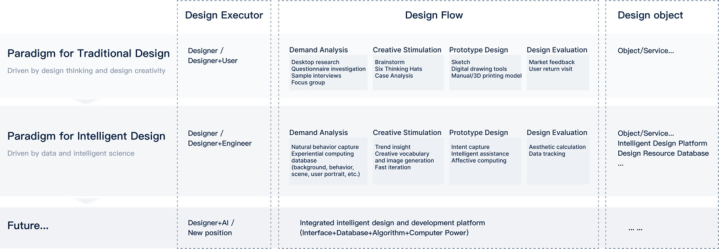
design, the differences between different industries lead to different forms of design processes and design tools, making it difficult to form a unified design paradigm to guide (Visser, 2009). With the intelligent upgrading of traditio- nal manufacturing and information industries in recent years, AI, design, and industry began to deeply integrate, and data gradually played an increasing role in the whole process of design and production, and a data-driven intel- ligent design paradigm gradually took shape (Hou & Jiao, 2020). However, this design paradigm does not have a fixed design method, but is more of a theory based on the designer, design object, and design process. Therefore, this paper tries to combine these three elements to explain the evolution of the design paradigm (see Fig. 1).
Design thinking and design creativity are important human characteristics in design activities, therefore, the traditional design paradigm is conside- red to be design innovation guided by design thinking and design creativity, whose process can be summarized as from user research to product function and style design, and design iteration based on design evaluation. With the development of artificial intelligence and its application in the design field, data begins to play an increasingly important role in all stages of design, for example, demand analysis may be replaced or supplemented by natural beh- avior capture, massive data and experience computing; creative stimulation may be replaced or supplemented by generative design and big data-based design trends. In the era of intelligent design, data, algorithms, and computing power are considered to be the three most important factors (Wu & Zhang, 2020), therefore, the new design paradigm is considered to be database and intelligent science-led design innovation.
In the intelligent design paradigm, the design object has also been defi- ned in a new way. Ever since artificial intelligence started to be applied in the design field, designers have formed different relationships with different intelligent design tools (Zhou et al., 2020). As deep users of intelligent design tools, designers are the most vocal about the construction of their functions, operations, and forms. At the same time, in the data-driven design para- digm, it is also the designer’s responsibility to build the database content of various design scenarios, such as the tagging system in the user or product portrait and the human-computer interaction scenario library. Therefore, in
Figure 1: Evolution of design paradigm.
A Study on the Current State of Development of Data-Driven Intelligent Design 177
the intelligent design paradigm, the designer’s design objects will no longer be limited to the design of traditional objects or services, but will also include the design of intelligent design platforms, design resource databases and even algorithms.
The evolution of the design process and design objects also places new demands on designers, who should not only be proficient in new design tools, but also have the ability to collaborate with AI engineers and understand the new design paradigm from the data perspective in order to quickly adapt to the diverse intelligent design platforms and human-machine relationships.
From the current perspective, AI is still in a high development phase, which means that the design paradigm will change in the future. In particular, with the advent of ChatGPT in late 2022 and the AIGC (Li et al., n.d.)), the content output-based design industry has been significantly impacted and has also brought many changes to the intelligent design field. For example, some cre- ators have used Midjourney and ChatGPT to directly generate ground-usable and very well-designed web pages, which means that perhaps designers and engineers could be merged into a new position, and design and development work could be integrated into an integrated platform, which would then lead to a whole new design paradigm. For designers, artificial intelligence is not only a means of design implementation, but also a new way of thinking, desi- gners need to have the ability to adapt to changes in the design paradigm, in order to be able to stand firm in the trend of the times.
CONCLUSION
This paper compares the current status of research and application of intel- ligent design from the perspective of design process, so as to summarize the design paradigm in the era of artificial intelligence, and provides some outlook on the future design paradigm, hoping to provide reference for the development of intelligent design platform. This paper also analyzes the intel- ligence that designers should have in the intelligent design paradigm, hoping to provide reference for design education and talent restructuring of the design industry. Artificial intelligence is still developing at a high speed, design paradigms will continue to change, design is gradually moving towards a new era, and I believe that the future of design will be even better with the deep collaboration between human and machine in the future.
ACKNOWLEDGMENT
This research is supported by the National Key Research and Development Program of China (No. 2021YFF0900600)
REFERENCES
An, H., & Park, M. (2020). Approaching fashion design trend applications using text mining and semantic network analysis. Fashion and Textiles, 7(1), Article 1. https://doi. org/10.1186/s40691-020-00221-w Bharadhwaj, H., Park, H., & Lim, B. Y. (2018). RecGAN: Recurrent genera-
tive adversarial networks for recommendation systems. Proceedings of the 12th
178 Zhao and Yuan
ACM Conference on Recommender Systems, 372 -376. https://doi.org/10.1145/ 3240323.3240383 Bo, Y., Yu, J., & Zhang, K. (2018). Computational aesthetics and applications. Visual Computing for Industry, Biomedicine, and Art, 1(1), Article 1. https://doi.org/10. 1186/s42492- 018-0006-1 Bobenrieth, C., Cordier, F., Habibi, A., & Seo, H. (2020). Descriptive: Interactive 3D
Shape Modeling from A Single Descriptive Sketch. Computer-Aided Design, 128, 102904. https://doi.org/10.1016/j. cad.2020.102904 Boden, M. A. (1998). Creativity and artificial intelligence. Artificial Intelligence, 103(1-2), 347–356. https://doi.org/10.1016/S0004- 3702(98)00055-1 Boden, M. A. (2009). Computer Models of Creativity. AI Magazine, 30(3), 23. https:
//doi.org/10.1609/aimag.v30i3.2254 Borji, A. (2022). Generated Faces in the Wild: Quantitative Comparison of Stable Diffusion, Midjourney and DALL-E 2. https://doi.org/10.48550/arXiv.2210. 00586 Brown, T., Mann, B., Ryder, N., Subbiah, M., Kaplan, J. D., Dhariwal, P.,
Neelakantan, A., Shyam, P., Sastry, G., Askell, A., Agarwal, S., Herbert-Voss, A..., Krueger, G., Henighan, T., Child, R., Ramesh, A., Ziegler, D., Wu, J., Winter, C.,... Amodei, D. (2020). Language Models are Few-Shot Learners. Advances in Neural Information Processing Systems, 33, 1877–1901. https:// proceedings. neurips.cc/paper/2020/hash/1457c0d6bfcb4967418bfb8ac142f64a- Abstract.html Cao, N., Yan, X., Shi, Y., & Chen, C. (2019). AI-Sketcher: A Deep Generative Model for Producing High-Quality Sketches. Proceedings of the AAAI Conference on Artificial Intelligence, 33(01), Article 01. https://doi.org/10.1609/aaai.v33i01. 33012564 Chaillou, S. (2020). ArchiGAN: Artificial Intelligence x Architecture. Architectural
Intelligence, 117–127. https://doi.org/10.1007/978-981-15-6568 -7_8 Chaudhuri, S., & Koltun, V. (2010). Data-driven suggestions for creativity support in 3D modeling. ACM SIGGRAPH Asia 2010 Papers, 1–10. https://doi.org/10.1145/ 1866158.1866205 Chen S.-Y., Su W., Gao L., Xia S., & Fu H. (2020). Deep Generation of Face Images
from Sketches. https://arxiv.org/abs/2006.01047v2 Do, E. Y.-L., Gross, M. D., Neiman, B., & Zimring, C. (2000). Intentions in and relations among design drawings. Design Studies, 21(5), 483–503. https://doi.or g/10.1016/S0142-694X (00)00020-X Dorst, K., & Cross, N. (2001). Creativity in the design process: Co- evolution of problem-solutions. Design Studies, 22(5), 425–437. https://doi.org/ 10.1016/S0142-694X (01)00009-6 Dou, Q., Zheng, X. S., Sun, T., & Heng, P.-A. (2019). Webthetics: Quantifying web-
page aesthetics with deep learning. International Journal of Human-Computer Studies, 124, 56–66. https://doi.org/10.1016/j.ijhcs.2018.11.006 Dubey, A., Bhardwaj, N., Abhinav, K., Kuriakose, S. M., Jain, S., & Arora, V. (2020).
AI Assisted Apparel Design. https://doi.org/10.48550/arXiv.2007.04950 Frich, J., MacDonald Vermeulen, L., Remy, C., Biskjaer, M. M., & Dalsgaard, P. (2019). Mapping the Landscape of Creativity Support Tools in HCI. Procee- dings of the 2019 CHI Conference on Human Factors in Computing Systems, 1- 18. https://doi.org/10.1145/3290605.3300619 Gómez de Silva Garza, A. (2019). An introduction to and comparison of computati-
A Study on the Current State of Development of Data-Driven Intelligent Design 179
Goodfellow, I., Pouget-Abadie, J., Mirza, M., Xu, B., Warde-Farley, D., Ozair, S., Courville, A., & Bengio, Y. (2020). Generative adversarial networks. Communi- cations of the ACM, 63(11), 139–144. https://doi.org/10.1145/3422622 Han, J., Forbes, H., & Schaefer, D. (2019). An Exploration of the Relations betw-
een Functionality, Aesthetics and Creativity in Design. Proceedings of the Design Society: International Conference on Engineering Design, 1(1), 259–268. https: //doi.org/10.1017/dsi.2019.29 Hao, J., Zhou, Y., Zhao, Q., & Xue, Q. (2019). An evolutionary computation based method for creative design inspiration generation. Journal of Intelligent Manufacturing, 30(4), 1673 -1691. https://doi.org/10.1007/s10845-017-1347-x He, R. K. (2019). History of industrial design (5th ed.). 2019–1. https:/ /book.douban.com/subject/33445533/ Hou, L., & Jiao, R. J. (2020). Data-informed inverse design by product usage infor-
mation: A review, framework and outlook. Journal of Intelligent Manufacturing, 31(3), 529 -552. https://doi.org/10.1007/s10845-019-01463-2 Jailungka, P., & Charoenseang, S. (2018). Intuitive 3D Model Prototyping with Leap Motion and Microsoft HoloLens. human-computer Interaction. interaction Technologies, 269- 284. https://doi.org/10.1007/978-3-319-91250-9_21 Jain, V., Agrawal, P., Banga, S., Kapoor, R., & Gulyani, S. (2019). Sketch2Code:
Transformation of Sketches to UI in Real-time Using Deep Neural Network. https: //doi.org/10.48550/arXiv.1910.08930 Jeon, Y., Jin, S., Kim, B., & Han, K. (2020). FashionQ: An Interactive Tool for Analyzing Fashion Style Trend with Quantitative Criteria. extended Abstracts of the 2020 CHI Conference on Human Factors in Computing Systems, 1–7. https: //doi.org/10.1145/3334480.3382978 Jung, S.-G., Salminen, J., & Jansen, B. J. (2020). Giving Faces to Data: Creating Data-
Driven Personas from Personified Big Data. Proceedings of the 25th International Conference on Intelligent User Interfaces Companion, 132–133. https://doi.org/ 10.1145/3379336.3381465 Li, B. Y., Bai, Y., Zhan, X. N., & Li, G. (2022). A new species of the genus Phyllostachys (Coleoptera, Staphylinidae) from China. (n.d.). Technical features and morphological evolution of artificially intelligent generated content (AIGC). Library Intelligence Knowledge, 1-9. Liu, H., Lu, H., Ruan, J. H., Tian, B. Q., & Hu, S. Z. (2015). Research on precise mar-
keting segmentation model based on “user portrait” mining. Silk, 52(12), 37–42 +47. Liu, Y. H., Li, W. G., Ji, T., Xiao, Y., You, L. S., & Zhao, Y. Y. (2021). A review of foreign research on generative product design. Packaging Engineering, 42(14), 9–27. https://doi.org/10.19554/j.cnki.1001-3563.2021.14.002 Maguire, M., & Bevan, N. (2002). User Requirements Analysis. usability, 133-148.
https://doi.org/10.1007/978-0-387-35610-5_9 Miniukovich, A., & De Angeli, A. (2016). Pick me! Getting Noticed on Google Play. Proceedings of the 2016 CHI Conference on Human Factors in Computing Systems, 4622–4633. https:// doi.org/10.1145/2858036.2858552 Nichol, A., Jun, H., Dhariwal, P., Mishkin, P., & Chen, M. (2022). Point-E: A System
for Generating 3D Point Clouds from Complex Prompts (arXiv:2212.08751). arXiv. https://doi.org/10.48550/arXiv.2212.08751 Pan, Y. H. (2016). Artificial intelligence towards 2.0. engineering, 2(04), 51–61. Pandian, V. P. S., Suleri, S., & Jarke, M. (2020). Blu: What GUIs are made of.
Proceedings of the 25th International Conference on Intelligent User Interfaces Companion, 81–82. https://doi.org/10.1145/3379336.3381497
180 Zhao and Yuan
Perera, D., & Zimmermann, R. (2019). CnGAN: Generative Adversarial Networks for Cross-network user preference generation for non-overlapped users. The World Wide Web Conference, 3144 -3150. https://doi.org/10.1145/3308558. 3313733 Saito, S., Simon, T., Saragih, J., & Joo, H. (2020). PIFuHD: Multi-Level
Pixel-Aligned Implicit Function for High-Resolution 3D Human Digitization. arXiv:2004.00452 [Cs]. https://arxiv.org/abs/2004.00452 Tang, Y., Huang, J., Yao, M., Wei, J., Li, W., He, Y., & Li, Z. (2019). A review of design intelligence: progress, problems, and challenges. frontiers of informa- tion technology & electronic engineering, 20(12), 1595 -1617. https://doi.org/10. 1631/FITEE.1900398 Visser, W. (2009). Design: One, but in different forms. Design Studies, 30(3), 187–
223. https://doi.org/10.1016/j.destud.2008.11.004 Wang, J., Yu, L., Zhang, W., Gong, Y., Xu, Y., Wang, B., Zhang, P., & Zhang, D. (2017). IRGAN: A Minimax Game for Unifying Generative and Discriminative Information Retrieval Models. Proceedings of the 40th International ACM SIGIR Conference on Research and Development in Information Retrieval, 515–524. https://doi.org/10.1145/3077136.3080786 Wu, Q., & Zhang, C. J. (2020). A Paradigm Shift in Design Driven by AI. Artificial
Intelligence in HCI, 167–176. https://doi.org/10.1007/978-3-030-50334-5_11 Yu, M. J., Ye, J., Lu, C. D., & Xu, Z. M. (2005). Timely intelligent aided design techniques based on intention capture. Computer Applications Research, 12, 82–84. Zhou, Z. H., Zhou, Z. B., Zhang, Y. Y., & Sun, L. Y. (2020). Artificial intelligence-
enabled digital creative design: progress and trends. Computer Integrated Manu- facturing Systems, 26(10), 2603–2614. https://doi.org/10.13196/j.cims.2020.10. 001
LISTED IN THE AHFE DIGITAL BOOKSTORE CATALOGUE
Explore the complete digital volume
Artificial Intelligence and Social Computing
Read this individual research paper free through the original publisher, or explore the full digital proceedings book.
ISBN 978-1-958651-48-3
Explore this ISBN in the AHFE Bookstore ↗Listed in the July 2026 bookstore catalogue; search by ISBN to confirm current availability · Digital book purchase optional