Oleksandr Burov, Evgeniy Lavrov, Svitlana Lytvynova, Olha Pinchuk, Kateryna Horska, Oleksii Tkachenko, Natalia Kovalenko, Yana Chybiriak (2023). On the way to hybrid intelligence: influence of the human-system interaction rate on the human cognitive performance. In: Human Interaction and Emerging Technologies (IHIET-AI 2023): Artificial Intelligence and Future Applications. AHFE Open Access, vol. 70, pp. 18–24. https://doi.org/10.54941/ahfe1002925
IntroductionHybrid job and learning create new opportunities and set new requirements to control a human-machine interaction. It is important to keep in mind that modern and future participants of these activi-ties can include the artificial intellect (AI-actor) as well. One of the critical features of their interaction could be the rate of the information exchange, because an AI-actor can accept and produce tasks in a quite stable rate, in contrast with a human-actor whose performance quality can very in time. As a result, their interaction needs to be adjusted in many cases from viewpoint of complexity and rate. It is supposed that the process of the information task flow should correspond an individual or moderate rate, in the best case. But according to our preliminary data (Burov, 1990, 1996), the moderate rate (even individually adapted) of perceptual and cognitive task flow was accompanied by a higher physiological strain than slow and fast ones. Because the cognitive component of the mental work becomes more and more significant both for a job and for a teaching/learning, it is useful for adaptive systems’ design to clarify if the free (“auto”) and moderate rates have the same and/or similar influence on a human performance quality (reliability and speed) and health consequences. GoalTo carry out the comparison analysis of the speed and reliability of cognitive activity by subjects performing computer tasks at a free and fixed pace, considering the physiological "cost" of such activities. Discussion of ResultsThe methodological basis of our research are models and methods for assessment a human ability to cognitive work using the computer system for psychophysiological research developed by authors. The survey included cognitive test task performance, blood pressure and heart rate before and after the test performance, as well as electropuncture diagnostics (EPD) after Nakatani (including 3 stress-points) for each subject. 47 subjects participated in experiments, 4 times per month (three times performing tests in the fix pace, one time in the free pace, each test session in a week). The duration of each test session was 3 continuous hours. Variation of the cognitive test task performance (accuracy and reliability) over the research period were studied and compared with changes of psychological and physiological indices, namely heart rate, blood pressure, vegetative stress index after Bayevsky as well as stress indices after Nakatani. It has been revealed strong increase of the stress by physiological and EPD indices and deterioration in activity (task performance time, reliability) in test sessions with fixed pace. Individual and inter-dividual variations are considered.Significance of the Proposed PresentationThe results can be applied to optimize a human and digital system interaction accounting a hu-man cognitive and psychophysiological limitations in interaction pace. The optimization goal can be to adjust their interaction pace to achieve maximal general performance in short- and long-term per-spective.
Hybrid job and learning create new opportunities and set new requirements to control a human-machine interaction. Informational overload, identified back in the last century by A. Toffler (Toffler, 1970), has become a pro- blem partly because of the psychophysiological limits of a human’s ability to perceive information. This is what led to the formation of the so-called “clip consciousness”, when a human, in conditions of diversification of sources, tends to perceive small information fragments to cover large volumes, but at the same time is deprived of the possibility of a holistic perception of the picture including military affairs, education, media industry etc. And here, artificial intelligence technologies have achieved a significant presence preci- sely due to the ability to structure information flows and focus the consumer’s attention on certain media content (Horska, 2020).
On the Way to Hybrid Intelligence: Influence of the Human-System Interaction Rate 19
It is important to keep in mind that modern and future participants of these activities can include the artificial intellect (AI-actor) as well (Richter, 2023). One of the critical features of their interaction could be the rate of the information exchange, because an AI-actor can accept and produce tasks in a quite stable rate, in contrast with a human-actor whose performance quality can vary in time. As a result, their interaction needs to be adjusted in many cases from viewpoint of complexity and rate according to the Infor- mation and communication technology (ICT) applied (Burov et al., 2020). It is supposed that the process of the information task flow should correspond an individual or moderate rate, in the best case. But according to our pre- liminary data (Burov, 2008), the moderate rate (even individually adapted) of perceptual and cognitive task flow was accompanied by a higher physio- logical strain than slow and fast ones. Because the cognitive component of the mental work becomes more and more significant both for a job and for a teaching/learning, it is useful for adaptive systems’ design to clarify if the free (“auto”) and moderate rates have the same and/or similar influence on a human performance quality (reliability and speed) and health consequences depending on the learning style (Glazunova et al., 2020). The answer such a question can be obtained by modelling cognitive activity using a control- led flow of tasks of adjustable complexity and intensity with measuring the physiological “cost” of such an activity.
METHODS
The research method was a development of the method used in our previous research of the psychophysiological maintenance of cognitive performance and applications to learners as operator-researchers (Burov, 2008, 2021).
1,5 months’ experimental research was based on the use of a computer system SPPR (system of psycho-physiological research) to monitor the cogni- tive activity of high school and university students. The survey includes test task performance (2 types of logical tasks), blood pressure (systolic BPs, dia- stolic BPd) and heart rate (HR) in parallel with the test performance, as well as electropuncture diagnostics (EPD) by Nakatani, only upper points measu- red on hands according to the technique used in our prior research (Rudenko, 2012) was conducted after the test session for each subject. The cognitive (logical-combinatoric) test was used. The test material: a sequence of numbers (from 0 to 9) which were not repeated and placed in a random order; the task was to rearrange the numbers in ascending order in a few steps, on each one could only change 2 adjacent numbers. Time for every task performance was free during the test session (the next task appeared just after entering the answer), “auto”-pace (test T6) or fixed one (time for every task was limited and fixed in each session, calculated as an averaged time plus 25%, after the training session). The time (Tl) and accuracy of the task performance were measured.
Duration of every test session was 180 minutes, 5 sessions (the first one was training to adapt to the cognitive test and physiological indices measurement) were organized 1 time per week, at the same day of week and the same day
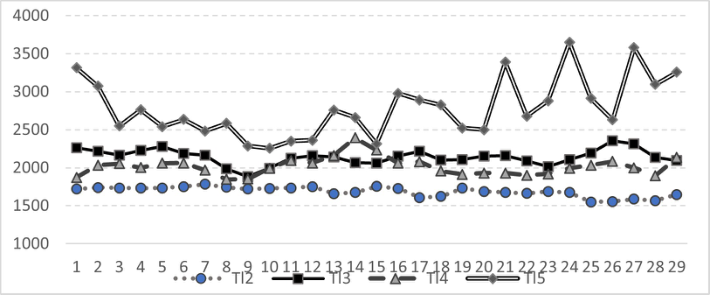
Figure 1: Changes of tasks performance time in experiments E2…E5, subject GA.
time to eliminate infradian and circadian rhythms. Test T5 was used in the experiment sessions 2, 3 and 4 (E2…E4), test T6 was used in E5.
Variation of the cognitive test task performance (accuracy and reliability) over the research period in fixed and free pace experiments were studied and compared with changes of psychological and physiological indices, namely heart rate, blood pressure, heart rate variability indices including high frequ- ency (HF), low (LF) and very frequency (VLF), vegetative stress index after Bayevskii B-in with data averaged by 5-minute periods according to (Kuo and Chen, 1998), as well as indices of the electropuncture diagnostics according to Nakatani Test.
Subjects: Group Gr1 - 23 medical professionals and 22 (aged 23-43-years- old), Group Gr2 - MSc. students (aged 21-23-years-old).
RESULTS AND DISCUSSION
The test time performance (Tl) was measured in milliseconds in every task. An average time varied depending on individual’s features from 2000 ms to 5000 ms even in tests with fixed pace, because the time limit was adjusted to the particular subject. Figure 1 demonstrated changes of Tl over time in experiments E2…E5, averaged by consequent periods of 5 minutes for one subject GA.
It is necessary to note that average Tl can vary between subjects, but general profile of its changes do not differ very significantly in experiments E2…E4. However, Tl in the test with free pace (Tl5) has clearer individual dynamics over 180 minutes.
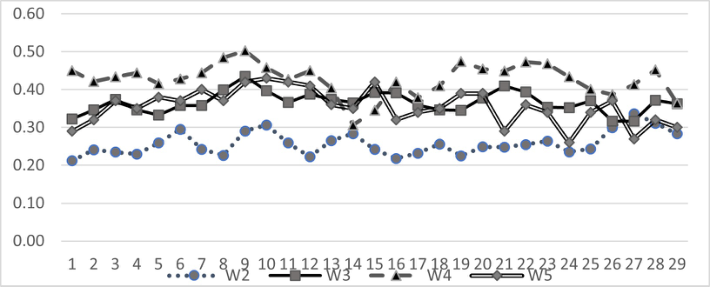
We used the productivity factor to accounting efficiency of the test perfor- mance as the ratio of reliability (ratio of correct solved tasks to the whole numbers, R) to Tl in every 5-minute period: W = R/Tl*1000. As shown in Figure 2, the dynamics of productivity W5 in the test 5 does not differ from W2…W4 so significantly as Tl. This can be explained by the fact that the reliability in tests E2…E4 is significantly lower than in E5 (in average, 0.6 vs. 0.95).
On the Way to Hybrid Intelligence: Influence of the Human-System Interaction Rate 21
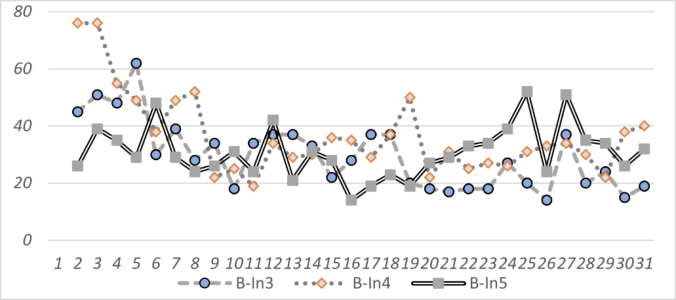
Figure 2: Changes of the productivity in experiments E2…E5, subject GA.Figure 3: Changes of the vegetative stress index in experiments E3…E5, subject GA.
It is known that purposeful activity of a human is accompanied by the adaptation of his/her regulatory physiological mechanisms to reduce the cost of the organism’s resources, and the stress of adaptation is manifested in the variation of the heart rate indices and their dynamics (Baevskii et al., 2012) including an integral index of the vegetative stress after Baevskii. Figure 3 illustrates the example of such changes in our 3-hours experiments with the same subject. According to clinical practice, the normal value of the stress index is 30–120 conventional units. If the results of the survey are within this range, then this means that the person copes well with the stresses (psycholo- gical and physical) that exist in his/her life. But this index can be even more informative in relation to short periodical changes.
The Figure 3 shows that values of the Baevskii index is declining from the beginning to the end of the test performance in experiments with the fixed pace (B-in3 and B-in4). But in the experiment with the free pace (B-in5) it is not declining, and its variation increases, that is, the human organism adapts to the conditions of activity with relatively monotonous activity. In contrast, the fixed pace makes the heart rate more rigid, that may indicate a greater regulation tension.
Table 1. Averaged data of performance indicators in tests and of physiological regulation stress in both groups of subjects in tests E2…E4 (fix pace) and E5 (auto pace).
Table available in the original PDF paper.
Groups Experiment B-in Tl, ms R W Gr1 Fix 59,2 4605 0,63 0,19 Auto 71,8 4757 0,89 0,14 Gr2 Fix 27,5 4520 0,44 0,10 Auto 23,3 3969 0,91 0,23 Total Fix 49,7 4639 0,53 0,11 Auto 50,2 4446 0,90 0,20
Note: B-in – Baevsky index; Tl – average task performance time, millise- conds; R – reliability; W – productivity, conventional units.
Table 2. Averaged data of the HRV wave structure’s indices in tests in both groups of subjects in tests E2…E4 (fix pace) and E5 (auto pace).
As it was possible to expect, inter-individual difference in such changes was significant and depended on individual differences in psychophysiologi- cal features of subjects. But the general rule suggests that the average time of test performance was longer, and reliability was significantly lower in experiments with the fixed pace in comparison with the free pace (Table 1).
At the same time, the difference in both groups of subjects was clear. Fir- stly, the group Gr1 performed all tests slowly than Gr2, though more reliably in tasks with the fixed pace. Wherein, Baevskii index was lower than in the test with free pace. The Gr2 performed tasks faster and more reliably (but not significantly) in the free pace test. But what attracts attention is the vege- tative stress index that was lower the “norm” in both modes. We believe that it could be explained by a better physical condition of Gr2 subjects, because they were students of a military academy and had to be well-trained as sport- smen. Accordingly, the adaptive potential of the cardiovascular system should have been higher, and they managed mental workload especially easy under absence of time pressure (free pace).
That analysis has been made as a widely used method in Eastern Europe. Its results coincided with the Frequency Domain Measures of HRV, as the Table 2 has demonstrated. If to compare results of measurement in experi- ments with the recommended norms (Kuo and Chen, 1998), they look like a deviation from the norms. All norms were recommended for the clinic diagnostic, but in our research, we interested in changes of the physiolo- gical “cost” of the cognitive activity with and without a time “pressure”. Therefore, we compared variation of indices studied in their dynamics and
On the Way to Hybrid Intelligence: Influence of the Human-System Interaction Rate 23
accounting interindividual differences. What we did not expect, the differe- nce between two groups of subjects of almost similar age groups (average 22- and 32-years-old), of the same gender (only men) and in the same condi- tions (the same laboratory conditions, equipment, workload). But the main differences were statistically not significant and main trend was similar.
Results of measurement of the low frequency LF part of the heart rate variation both measured and normalized (LF norm) were higher the norm that correspond the idea of such an increase when a human was not in a relaxed state but performed a physical or mental tasks. The ratio HF/LF was significantly higher in all conditions and all subjects that corresponded to their adaptation to the work requirements. But the high level of the very low frequency (VLF) band of the HRV frequency spectrum could point at the use of additional reserves of physiological regulation, because VLF bound should be not more than 1/3 in a normal state. The growing stress of adaptation may be evidenced by the growth of LF in the second half of the 3-hour activity: more than in two times.
To study results of adaptation to the relatively monotonous cognitive tests performance, we compared level of activity of the heart meridian (left- and right-hand points HT7* according to the International Nomenclature for Acupuncture Points, heart meridian) by Nakatani Test before and after the test performance session. Deviations from the norm (according to gender, age and season of year) were not registered for all subjects. It has been revea- led that both points (left and right) demonstrated decreasing of the meridian activity for all subjects without exception. But the reduction rate differed significantly (p < 0.01): 25% in the test with the free pace and 45% in the test with the fix pace, in average.
It is necessary to highlight that decreasing of the meridians activity for all subjects have been revealed for all meridians. This result can be interpreted as a decrease in the activity of adaptive regulation under the workload influence, and to a greater extent under conditions of a limited time for performing tasks.
Our findings are in line with studies aimed to use cardiovascular state chan- ges in adaptive automation (Mulder et al., 2003) and in wider application to operator functional state assessment (Hockey, 2003), as well as to time- critical environments (Okkonen et al., 2021). Application could be useful in designing of human-robots interaction (Rosen, 2021).
CONCLUSION
The study was aimed to compare influence of modus operandy in Human- System interaction under different pace of interaction from point of view of tension of a human physiological mechanisms of regulation. The evidence- based analysis clearly demonstrated that the fixed pace of task performance needed a higher increase of physiological adaptation support in comparison with the free pace, even if such a fixed pace is similar to the individual free pace. This fact has been confirmed by comparative analysis of test tasks’ time performance and reliability, as well as set of heart rate variability and electropuncture reflexology indices according to the I. Nakatani Test. This
result could be interpreted as a decrease in the activity of adaptive regulation under the workload influence, and to a greater extent under conditions of a limited time for performing tasks.
The results can be applied to optimize a human and digital system intera- ction accounting a human cognitive and psychophysiological limitations in interaction pace. The optimization goal can be to adjust their interaction pace to achieve maximal general performance in short- and long-term perspective.
REFERENCES
Baevski˘ı, R. et al. (2012). [The problem of estimation of the organism adaptable opportunities under stressful influences]. Rossi˘ıskii fiziologicheski˘ı zhurnal imeni I.M. Sechenova / Rossi˘ıskaia akademiia nauk. 98. 95–107 Burov, O. (2008) Day-to-day monitoring of an operator’s functional state and fitness-
for-work: a psychophysiological and engineering approach. In Ergonomics and Psychology (pp. 107–126). CRC Press. Burov, O., Bykov, V. and Lytvynova, S. (2020). ICT Evolution: from Single Computational Tasks to Modeling of Life. In ICTERI Workshops, pp. 583–590. Burov, O. et al. (2021) Cognitive performance degradation in high school students
as the response to the psychophysiological changes. In Advances in Neuroergono- mics and Cognitive Engineering: Proceedings of the AHFE 2020 Virtual Confere- nces on Neuroergonomics and Cognitive Engineering, and Industrial Cognitive Ergonomics and Engineering Psychology, July 16-20, 2020, USA (pp. 83–88). Springer International Publishing Glazunova, Olena, et al.. (2020). Learning style identification system: design and data analysis. ICTERI 2020, ceur-ws.org/Vol-2732/20200793.pdf, pp. 793–807. Hockey, G. R. J. (2003). Operator functional state as a framework for the assessment
of performance degradation. NATO SCIENCE SERIES SUB SERIES I LIFE AND BEHAVIOURAL SCIENCES, 355, 8–23. Horska, K.(2020) A New Test of Artificial Intelligence: Should the Media Industry Be Afraid? Science and education a new dimension. Humanities and Social Sciences. VIII(39), Issue 231. P. 26–29. Kuo Cheng-Deng and Chen Gau-Yang (1998). Heart Rate Variability Standards.
Circulation. 1998; 98:1587b–1590. https://doi.org/10.1161/circ.98.15.1587/b Mulder, L. J. M. et al. (2003). How to use cardiovascular state changes in adaptive automation. Hockey, G.R.J., Gaillard, A.W.K., Burov, O. (Eds.), Operator Functi- onal State. The Assessment and Prediction of Human Performance Degradation in Complex Tasks. NATO Science Series. IOS Press, Amsterdam, pp. 260–272. Okkonen, J. et al. (2021). Design for AI-Enhanced Operator Information Ergonomics
in a Time-Critical Environment. Advances in Neuroergonomics and Cognitive Engineering. H. Ayaz et al. (eds.): AHFE 2021, LNNS 259, pp. 213–221. Richter, F. (Feb 6, 2023) How AI will change our lives - new survey. World Economic Forum Website: https://www.weforum.org/agenda/2023/02/ai-lives-ipsos-survey- technology/ Rosén, J. (2021). Expectations in Human-Robot Interaction. In: Ayaz, H., Asgher,
U., Paletta, L. (eds) Advances in Neuroergonomics and Cognitive Engineering. AHFE 2021. Lecture Notes in Networks and Systems, vol 259. Springer, Cham. https://doi.org/10.1007/978-3-030-80285-1_12. Rudenko, S.A. (2012). Study of school children chronic fatigue with method of acupuncture diagnostic by Nakatani. In: Seminar Proceedings Psychophysiological aspects of giftedness: theory and practice. 3 February 2012, Kyiv, Ukraine. 92–97 Toffler, Alvin. (1970).Future Shock. New York: Random House. p. 367.
LISTED IN THE AHFE DIGITAL BOOKSTORE CATALOGUE
Explore the complete digital volume
Human Interaction and Emerging Technologies (IHIET-AI 2023): Artificial Intelligence and Future Applications
Read this individual research paper free through the original publisher, or explore the full digital proceedings book.
ISBN 978-1-958651-46-9
Explore this ISBN in the AHFE Bookstore ↗Listed in the July 2026 bookstore catalogue; search by ISBN to confirm current availability · Digital book purchase optional