Gabriela Reyes Zárate, Claudia Lizette Garay Rondero (2023). Experiential Learning for Industry 4.0 in Higher Education: a Challenge-based learning case study. In: Intelligent Human Systems Integration (IHSI 2023): Integrating People and Intelligent Systems. AHFE Open Access, vol. 69, pp. 880–887. https://doi.org/10.54941/ahfe1002913
Organisations and institutions worldwide know the need for trained workers to handle future workplace challenges. This assertion focuses on the growth of digital literacy and several other skills and abilities known as digital transformation competencies. Universities, employers, governments, and organisations recognise an existing gap in the students' education about developing, utilising, and implementing new technologies. The contribution of this work is to present an educational innovation case study in which students implemented and customised Industry 4.0 technologies. The team designed an assembly line with a collaborative robot and real-time data-accessing dashboards with an Overall Equipment Efficiency (OEE) indicator. Undergraduates start the experiential learning process by studying time and movement tasks, designing workstations, and placing the components for the assembly. Digital tools are used to track assembly line availability, efficiency, and quality in real time, demonstrating the positive impact of a collaborative robot on production. By introducing Industry 4.0 into the industrial engineering curriculum, students can improve their digital tools knowledge, problem-solving, teamwork, and communication. This study provides future directions for students' activities incorporating more technologies and digital enablers in Industry 4.0, adding relevant transversal skills regarding sustainability and citizenship.
Service and manufacturing companies seek to increase their efficiency and flexibility in the face of client demands and high competition. Digital tran- sformation allows connectivity and efficiency in organisations by providing real-time data for decision-making (Simões et al., 2022). Due to the accelera- ted changes in the last years, managers started to shift towards the digital transformation of their processes (Cimini et al., 2020), not only questio- ning how to deliver new innovative products and services with a higher added value; but more about how to integrate human factors and capabi- lities (cognitive, physical, sensory, and team dynamics) into a production or service system (D’Addona et al., 2018). In Industry 4.0, digital technologies
Experiential Learning for Industry 4.0 in Higher Education 881
have revolutionised manufacturing and production techniques by developing and adapting technologies for collaboration with people (Romero & Sta- hre, 2021). To have flexible production systems that can meet the increasing demands, manufacturing companies have directed their efforts to these chan- ges (Cimini et al., 2020). Technological developments have a high impact on people to achieve innovative experiences and solutions in production environments.
To be able to face these changes, it is essential to have people with digi- tal skills for these new jobs. To develop new skills, some authors propose learning spaces for developing digital transfer in universities (Bygstad et al., 2022); (Mohamed Hashim et al., 2022). A student who develops these skills can participate in digital environments and understand the importance of their digital identity.
The main challenge for teaching Industry 4.0 is to define the speci- fic digital transformation skills required to recruit new employees (Mor- gan, Sibson, and Jackson, 2022). Companies should understand the cur- rent level of digital competencies of their labour force, how to develop digital competencies in the workforce to increase the use of new tech- nologies and human-robot collaboration, and the minimum requirements for people with the necessary skills to take on the challenge of digital transformation. In addition, training new professionals to integrate these technologies is essential to correctly implement Industry 4.0 in companies (Koyuncuo˘glu, 2022).
Faced with these changes, the increased demand for people to obtain and develop digital skills is essential for current and future jobs (World Economic Forum, 2016, 2020). Digital transformation is looking to find solutions to the problems in its field with the intelligent and timely incorporation of cutting- edge digital technologies (Tecnológico de Monterrey, 2019) (Tecnológico de Monterrey, 2018). Current challenges, such as the integration of individu- als in a globalised world, technological advancements, and the demand for new skills in the market are leading to the transformation of higher educa- tion institutions and the creation of new educational models (Tecnológico de Monterrey, 2021) (Olivares Olivares et al., 2021).
METHODOLOGY
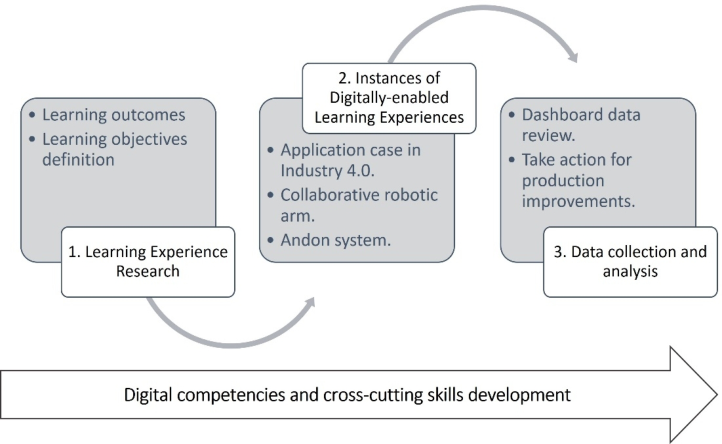
This research was developed in an experiential learning space using Challenge-based Learning and Competency-based Education. Figure 1 shows the steps in the design for a Digitally enabled Learning Experience.
The first step was to define the learning experience research, learning outcomes, and learning objectives. As a result, the student can apply the knowledge acquired during his career designing, analysing, and improving production processes through fieldwork experience. Next, a Digitally ena- bled Learning Experience was considered with a collaborative robotic arm and a digital Andon system. Furthermore, this step included the basis of the digital transformation context and learning space by transitioning from manual workstations and manual data-gathering registers to the implemen- tation of digital equipment and ergonomic improvements. The final step
882 Reyes-Zárate and Garay-Rondero
Figure 1: Methodology design for a Digitally enabled Learning Experience. (Adapted from Salinas-Navarro et al., 2023).
considered the digital transformation of processes and operations within the learning space, working in multidisciplinary teams using digital technologies to impact operational results in quality, efficiency, and availability. The stu- dents used different technologies, enablers, and tools to act for production improvements.
LEARNING EXPERIENCE: A HUMAN-ROBOT COLLABORATION CASE OF STUDY IN DIGITALLY ENABLED LEARNING SPACES The methodology described in Figure 1 was developed in a senior-year Industrial Engineering course named IN3038 Operational Design and Opti- mization Laboratory (SAMP | Tecnologico de Monterrey, 2022). Sixteen undergraduate students designed and participated in a challenge to create a production process in two phases, the first one through manual assembly and the second customising, adjusting and implementing a digitally transformed assembly line design.
Phase one includes the production process design and assembly, structu- red in three stages: i) preparation, ii) standardisation and iii) transformation into a pull production system. These three phases are based on an experien- tial learning space named Lean Thinking Learning Space (Garay-Rondero, Rodríguez Calvo, and Salinas-Navarro, 2019). Furthermore, this work pro- poses applying a case study in Phase Two by implementing a collaborative robotic arm and a digital Andon system. These technology enablers allowed the development of the student’s learning experience through the imple- mentation and use of real-time dashboard information and human-robot collaboration, transforming the production line and process into a Digitally
Experiential Learning for Industry 4.0 in Higher Education 883
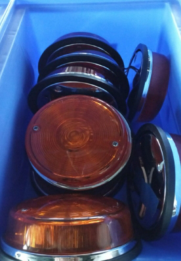
Figure 2: Assembly products used in the case of study: three different car side lamps.
enabled Lean Thinking Learning Space (Salinas-Navarro, Garay-Rondero, and Arana-Solares, 2023).
The production process consisted of three different family products of car side lamps. Each type with different shapes, sizes, and components or stock- keeping units (see Figure 2).
During Phase 1, students organised the workstations for the manual assem- bly process using scissors, screwdrivers, and an ink stamp. The process started with marking and cutting identification cards for packaging car side lamps and assembling the product. Afterwards, the assembly process for the packa- ging box took place. Then, the product was placed in the box along with the identification card; finally, the box was ink stamped.
Students applied their knowledge about time study and movement mea- sures to obtain each activity’s standard time. The results were as follows: marking and cutting 45.11 sec; lamp assembly 46.01 sec; box assembly and packaging 42.75 sec; and box stamping 12.03 sec.
The production run, batch, and shift took place every 30 minutes. Students performed a team back and rapped-up at the end of each round to study and present a manual report about the production results regarding safety and Key Performance Indicators (KPI) on the production line. Furthermore, they investigated each workstation observing the most relevant ergonomics factors such as seating postures and tools used in the workplace within reach of their hands. During this first phase, no defective parts were reported. The final cycle time, considering the manual operation was 55 seconds.
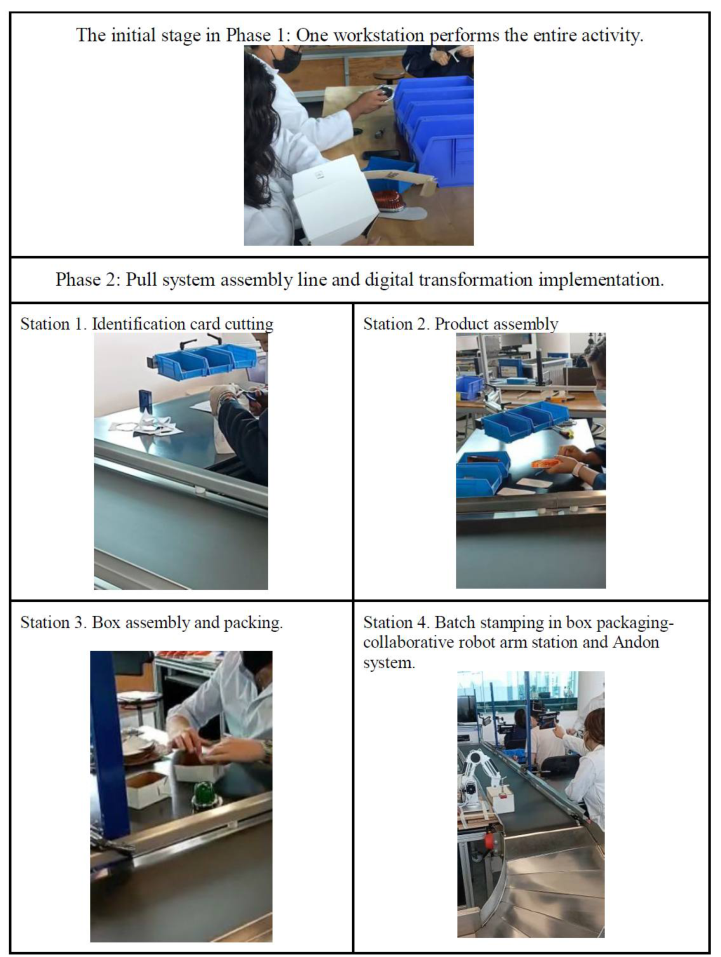
The experiential learning objective during this phase was for students to apply their knowledge, abilities, and values to make decisions to generate incremental improvements within the production process and observe their learning process and performance when a problem is being solved. The appli- cation of lean manufacturing tools aided this learning process. Figure 3 shows the comparison between the beginning of Phase 1 and how students changed the production process through the stages of improvement to Phase 2 and digital integration.
During the box assembly and packing time, the collaborative robot arm helped the third workstation, leaving only three activities (see Figure 3). The standard time was reduced due to the application of the pull system and lean manufacturing strategies, in addition to the implementation of technologies and digital enablers that helped to transform activities and their performance in the car lamp assembly line.
884 Reyes-Zárate and Garay-Rondero
Figure 3: Evolution from Phase 1 - initial stage to Phase 2 - assembly line and digital transformation.
The following section describes the findings and discussion of the KPI and students’ perceptions.
FINDINGS: COLLABORATIVE ROBOTIC ARM AND A DIGITAL ANDON SYSTEM IMPLEMENTATION By implementing a collaborative robot and a digital Andon system, the conventional production line was transformed into a digitalised one, and
Experiential Learning for Industry 4.0 in Higher Education 885
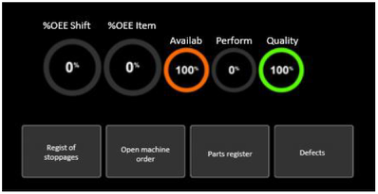
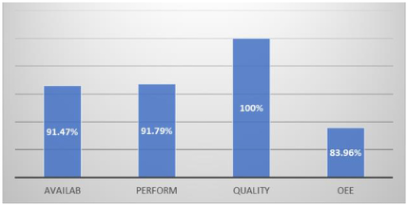
Figure 4: Digital Andon system-OEE dashboard results.Figure 5: Overall Equipment Efficiency results: last production run.
the student’s learning experience into a Digitally-enabled Lean Thin- king Learning Space (Salinas-Navarro, Garay-Rondero, and Arana-Solares, 2023). During the digital Andon system implementation in Phase 2, each sta- tion had a tablet (hardware) and system interphase with the cloud (software) to gather relevant data and information during the production runs. The main objective was to determine the Overall Equipment Efficiency (OEE) KPI (see Figure 4). Each operator was responsible for registering stoppages and types, orders, Stock Keeping Units, parts, defects, and other additional information. The system recorded the data in the cloud to deliver OEE and other real-time information to tablets and dashboards visible in the production line.
Students paused at the end of each production run or 30-minute work shift to review OEE reports showing availability, efficiency, and quality. Then, before the next production run or the following shift, they decided which adjustments and changes were needed to improve the OEE indicators. This process is based on Digital Lean Manufacturing or Lean 4.0. Digital techno- logies support lean practices more than other technologies, and it is essential to understand these different implications over time (Cifone et al., 2021). The reports generated by the OEE system are shown in figure 5.
CONCLUSION
This study proposes experiential learning research carried out in a Mexico university within the case study for the digitalization of the Lean Thin- king Learning Space laboratory. The main findings present the results of implementing a human-robot collaboration within an Industrial Engineering Higher Education course in the context of a cutting-edge Learning Model
886 Reyes-Zárate and Garay-Rondero
with Challenge-based Learning and Competency-Based Education as pillars. Additionally, active and experiential learning proposes an innovative way to generate experience to develop digital transformation competencies and transversal skills for future generations. Future research aims to develop and provide more case studies implementing digital enablers around Industry 4.0, incorporating the concepts of Society 5.0, thereby gathering, measuring, and analyzing students ‘competencies.
The main contribution of this research work is to provide practitioners, academics, and learners, with new ways to teach and obtain knowledge in the era of Education 4.0 towards enhancing the students towards a more equitable and inclusive world technology at the service of humanity straight to the construction of a Society 5.0 (Holroyd, 2020).
ACKNOWLEDGMENT
The authors would like to acknowledge the financial support of Writing Lab, Tecnologico de Monterrey, Mexico, in producing this work.
REFERENCES
Bygstad, B. et al. (2022) ‘From dual digitalization to digital learning space: Exploring the digital transformation of higher education’, Computers and Education, 182. Available at: https://doi.org/10.1016/J.COMPEDU.2022.104463. Cifone, F.D. et al. (2021) “‘Lean 4.0”: How can digital technologies support lean
practices?’, International Journal of Production Economics, 241. Available at: https://doi.org/10.1016/j.ijpe.2021.108258. Cimini, C. et al. (2020) ‘A human-in-the-loop manufacturing control architecture for the next generation of production systems’, Journal of Manufacturing Systems, 54, pp. 258–271. Available at: https://doi.org/10.1016/j.jmsy.2020.01.002. D’Addona, D.M. et al. (2018) ‘Adaptive automation and human factors in manu-
facturing: An experimental assessment for a cognitive approach’, CIRP Annals, 67(1), pp. 455–458. Available at: https://doi.org/10.1016/j.cirp.2018.04.123. Garay-Rondero, C.L., Rodríguez Calvo, E.Z. and Salinas-Navarro, D.E. (2019) ‘Experiential learning at Lean-Thinking-Learning Space’, Internatio- nal Journal on Interactive Design and Manufacturing [Preprint]. Available at: https://doi.org/10.1007/s12008-019-00578-3. Holroyd, C. (2020) ‘Technological innovation and building a “super smart” society: Japan’s vision of society 5.0’, https://0-doi-org.biblioteca- ils.tec.mx/10.1080/17516234.2020.1749340, 15(1), pp. 18–31. Available at: https://doi.org/10.1080/17516234.2020.1749340. Koyuncuo˘glu, D. (2022) ‘Analysis of digital and technological competencies of university students’, International Journal of Education in Mathematics, 10(4), pp. 971–988. Available at: https://doi.org/10.46328/ijemst.2583. Mohamed Hashim, M.A., Tlemsani, I. and Matthews, R. (2022) ‘Higher educa-
tion strategy in digital transformation’, Education and Information Technologies, 27(3), pp. 3171–3195. Available at: https://doi.org/10.1007/S10639-021-10739- 1/FIGURES/6. Morgan, A., Sibson, R. and Jackson, D. (2022) ‘Digital demand and digital deficit: conceptualising digital literacy and gauging proficiency among higher educa- tion students’, Journal of Higher Education Policy and Management, 44(3), pp. 258–275. Available at: https://doi.org/10.1080/1360080X.2022.2030275.
Experiential Learning for Industry 4.0 in Higher Education 887
Olivares Olivares, S. L., López Islas, J. R., Rodríguez Chapa, J. A., Aguayo Hernández, C. H., & Peña Ortega, L. O. (2021). Tec21 Educational Model: challenges for a transformative experience. Editorial Digital del Tecnológico de Monterrey. Romero, D. and Stahre, J. (2021) ‘Towards the Resilient Operator 5.0: The Future of
Work in Smart Resilient Manufacturing Systems’, in Procedia CIRP. Elsevier B.V., pp. 1089–1094. Available at: https://doi.org/10.1016/j.procir.2021.11.183. Salinas-Navarro, D. E., Garay-Rondero, C. L., & Arana-Solares, I. A. (2023). Digitally Enabled Experiential Learning Spaces for Engineering Edu- cation 4.0. Education Sciences 2023, Vol. 13, Page 63, 13(1), 63. https://doi.org/10.3390/EDUCSCI13010063 SAMP | Tecnologico de Monterrey (2022) Course IN3038 Operational Design and Optimization Laboratory. Available at: https://samp.itesm.mx/Materias/ VistaPreliminarMateria?clave=IN3038&lang=EN# (Accessed: 1 December 2022). Simões, A.C. et al. (2022) ‘Designing human-robot collaboration (HRC) workspa-
ces in industrial settings: A systemic literature review’, Journal of Manufacturing Systems, 62, pp. 28–43. Available at: https://doi.org/10.1016/j.jmsy.2021.11.007. Tecnológico de Monterrey (2018) Modelo Educativo. Tecnológico de Monterrey (2019) Competencias transversales Una visión desde el Modelo Educativo DOCUMENTO GUÍA. World Economic Forum (2016) ‘The Future of Jobs - Reports - World Economic
Forum’, Research Report, (January), p. 12. Available at: https://www.weforum. org/reports/the-future-of-jobs-report-2018%0Ahttp://reports.weforum.org/ future-of-jobs-2016/chapter-1-the-future-of-jobs-and-skills/. World Economic Forum (2020) ‘Schools of the future: Defining new models of education for the fourth industrial revolution’, World Economic Forum, (January), pp. 1–33.
LISTED IN THE AHFE DIGITAL BOOKSTORE CATALOGUE
Explore the complete digital volume
Intelligent Human Systems Integration (IHSI 2023): Integrating People and Intelligent Systems
Read this individual research paper free through the original publisher, or explore the full digital proceedings book.
ISBN 978-1-958651-45-2
Explore this ISBN in the AHFE Bookstore ↗Listed in the July 2026 bookstore catalogue; search by ISBN to confirm current availability · Digital book purchase optional