Namrata Arora, Anshuman Shastri, Nabila Rehman (2023). Ergonomic Redesign of Till Operator Workstation to Reduce Overload. In: Intelligent Human Systems Integration (IHSI 2023): Integrating People and Intelligent Systems. AHFE Open Access, vol. 69, pp. 810–818. https://doi.org/10.54941/ahfe1002905
Till Operators are the face of retail and are often overloaded with excessive manual material handling and constant gaze at the VDT screen. This paper presents a study which intends to ergonomically redesign the workstation design for till operators and assess its effectiveness in reducing overload. The study was conducted on 250 till operators engaged in 45 organised FMCG retail stores in India. The study was carried out in three phases namely Load Assessment, Designing of Ergonomic Workstation for till operators and Comparative analysis of existing and ergonomically modified workstation. The comparative analysis was done on the basis of workplace risk assessment, posture, body discomfort perceived by the operator, heart rate, and cycle time. Statistically significant differences were obtained when existing and modified workstations were compared. WERA and REBA scores indicated significant improvements in posture while comparing the existing and ergonomically designed shopping carts. The implementation of the study can play a significant role in improving work conditions for till operators and reducing overload.
Retail industry is changing at an ever-increasing speed and is undergoing a transition with the rise of supermarkets, getting more complex with every new technological advancement. Till operators play pivotal role in the system by performing repetitive light manual material handling tasks while scanning and handling products which involves movement such as select, grab, lift, ori- entate, move and placement of various articles at checkout points along with static work posture irrespective of sitting/standing workstation which result in high risk of musculoskeletal disorders, unsafe posture, muscle fatigue and other discomforts such as back pain, disc pressure, reduced circulation, pre- gnancy related problem etc. among the operators. This places Till operation among the top 12 WMSDs (Work Related Musculoskeletal Disorders) con- tributing industries at the global level. A poor Till design can have significant impact on the working posture of the operator and lead to development of work related injuries. The study, here, presents an attempt to ergonomically redesign the workstation of the the Till operators in order to minimise the
Ergonomic Redesign of Till Operator Workstation to Reduce Overload 811
occurrence of awkward postures, extreme motions, muscle loading conditi- ons and work related injuries and result in higher comfort, performance and improved satisfaction among operators. The major objective of the research was to craft an ergonomically designed Till workstation and to test it against existing workstation and assess the impact on factors like posture, body pains and aches, heart rate, workplace risk factors and productivity.
Literature Review
Checkstand work in grocery stores has been ranked among top 12 industries for contributing non traumatic soft tissue disorders of the neck, back and upper extremities [Silverstein et al. (2003), Department of Consumer and Employment Protection, Government of Western Australia (2005)]. Several studies conducted on checkout operators (sitting and standing) reported pro- blems associated with musculoskeletal disorders [Baron et al. (1991), OSHA (2004)]. Till operators reported to be at great risk of MSDs due to repe- titive nature of work required to be carried for whole duration of shift. In Australia, according to available workers compensation statistics, about 59% of all injuries/disease cases were related with musculoskeletal disorders (ASCC 2012). According to Labor Force Survey (2011), WMSD cases range 387,820 and account for 33% of all worker injury and illness cases reported by BLS; while in Britain, the total number of WMSD cases in 2013–14 was 5,26,000 out of a total 12,41,000 for all work-related illnesses. Largest num- ber of discomforts confronted by cashiers/checkout operators was found in lower back (31%), neck (25%), shoulders (24%) and buttocks (22%) which lead WMSDs mainly due to the poor posture maintained by operators while execution of checkstand activities at poorly designed workstation for long duration of time”. Fareez and Nasrul (2017) reviewed risk factors of MSDs among cashiers of retail industry and found widespread occupational hazard experienced by cashiers were awkward posture, repetition motion, forceful exertions and prolonged sitting. Cashiers were at risk of ULMSDs such as carpal tunnel syndrome (CTS), shoulder pain and back pain and associated serious injuries if no health measures were taken soon by the management. Lehman et al. (2001) studied biomechanical and physiological effect of two type of scanner type that is bi-optic and single window on muscle activity, upper limb and spinal posture. Results revealed that while using bi-optic scan- ner in neck and shoulder region static loading of muscles was recorded high as compared to benchmarks and revealed that while scanning shoulder abdu- ction was found to be for standing. Static loading of muscles was evaluated high as compared to benchmarks and revealed while standing cashiers did not get adequate recovery time to prevent postural stress, fatigue and discomfort among cashiers”.
Methodology
The study was conducted in three stages: Load Assessment, Ergonomic Desi- gning of Till operator’s workstation and Laboratory Experimentation and comparison of the existing and ergonomically designed workstation.
Table 1. Details of Physical Environment of Retail Stores.
Table available in the original PDF paper.
Parameter Range Mean Recommended Illumination (Lux) 216–973 620.48±178.76 500–1000 (Gandotra, et al. 2005) Noise (dBA) 50–72 55.06±5.8 55–65 (Noise Pollution Rules, 2000) Temperature (
C) 22–32 26.28±2.75 12–28 (Reinhold and Tint, 2009) Humidity (%) 24–48 32.06±9.79 40–60 (Reinhold and Tint, 2009)
In Stage I, various kinds of loads incurred on operators (n = 250) such as external load, internal load and task load were assessed. External load comprises load laid from external sources like environment and workplace, whereas internal load consist of strain laid on Till operators due to awkw- ard posture, fatigue, WMSDs, poor physical fitness etc., coupled with task load which encompass the load laid on operators while carrying out certain repetitive tasks while performing job at the Till.
In Stage II, design generation of Till operators’ workstation was done, encompassing shopping cart, checkout counter and sit-stand chair/sup- port was designed in 5 steps namely: Idea Generation, Screening of Ideas, Application of anthropometric data, Prototyping and Development of Final Prototype.
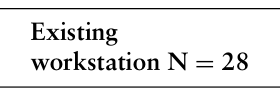
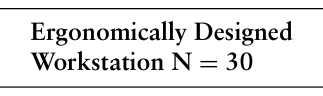
In Stage III, Laboratory Experiment and Comparison of existing and ergo- nomically designed workstation was carried out on Control group (N = 28) and Experimental group (N = 30). Till operators in both the settings perfor- med simulated checkout operation with 30 merchandise in specific weight packaging (groceries like sugar, bread, milk cartons, soaps, detergent, cold drinks, perfumes and deodorant etc.) for 30 cycles and were compared on parameters like self-reported body discomforts, workplace risk factors, posture, heart rate, and cycle time.
Study Findings Stage I: Load Assessment
45 retail stores comprising four major types of organized retail format (Hypermarket, Supermarket, Convenience Store and Departmental Store) supplying FMCG products were surveyed. To assess the External Load (forces that entail on human beings as a result of peripheral situations acting in their proximities), major facets assumed to be responsible for laying the load at workplace were Environmental factors like Illumination, Noise, Tempera- ture and Humidity. Table 1 presents the details of physical environment in the stores surveyed.
Internal load (stress imposed on human body during work at biomechani- cal level) was assessed by measuring range of physical aspects such as Posture by means of Rapid Entire body Assessment (REBA) worksheet, MSDs with Quick Exposure Check (QEC), Physical Fitness through Non Exercise Model of Aerobic Estimate and Fatigue by Checklist Individual strength (CIS). The entire operation was divided into 3 tasks: Task I- Manual Material Handling, Task II- Monetary Transaction and Task III- Customer Handling. The REBA scores while conducting these operations are presented in Table 2.
Ergonomic Redesign of Till Operator Workstation to Reduce Overload 813
Table 2. Frequency and percentage distribution of till operators on REBA score.
Table available in the original PDF paper.
Score 1 2-3 4-7 8-10 11-15 TASK Negligible Low Medium High Very High
MMH n (%) - - 80(32) 154(61.6) 16(6.4) MT n (%) - - 83(33.2) 154(61.6) 13(5.2) CD n (%) - 68(27.2) 116(46.4) 66(26.4) -
Table 3. Frequency and percentage distribution of till operators on scores of QEC.
Table available in the original PDF paper.
Parameters Level of Exposure Low Moderate High Very High n(%) n(%) n(%) n(%) Dynamic Spine - - 197(78.8) 53(21.2) Shoulder/ Arm - 150(60) 88(35.2) 12(4.8) Wrist/Hand - - 238(95.2) 12(4.8) Neck - - - 250(100) Contact Force 244(97.6) 6(2.4) - - Vibration 250(100) - - - Work Pacing - 239(95.6) 11(4.4) - Stress - 14(5.6) 217(86.8) 19(17.6)
WMSDs were assessed with the help of Quick Exposure Check (QEC) tool developed by David et al (2008). Table 3 presents the percentage and distribution of checkout operators on score of QEC for MMH, MT and CD respectively.
Aerobic fitness was assessed with the help of non-exercise model developed by Jackson, et al. (1990). VO2 max was estimated with the help of age, BMI (with height and weight) along with NASA- SR-PA, i.e., self-reported phy- sical activity. Since the aerobic power (VO2 peak) of men and women vary, therefore distinct formulae have been used to estimate non-exercise VO2max of till operators. Table 4 presents the statistical summary of these parameters (n = 250) Assessment of fatigue was done by CIS. Table 5 presents the distribution of respondents (n = 250) on CIS scores.
Task Load was assessed through task, system, or team’s effectiveness or other aspects of performance. Table 6 presents the statistical summary of Workload Dimensions and Overall Workload of Checkout Tasks.
Stage II: Ergonomic redesign of Till operator’s workstation The workstation was divided into seven zones, Unloading, Seating, Stan- ding, VDT, Checkout Counter, Scanning and Bagging area. The information gathered from the baseline survey and thorough analysis of the existing work- stations was used to identify the design deficiencies and thereby generate ideas for the ergonomic design which would lead to decline in risk factors and
Table 4. Statistical summary of BMI and VO2max of checkout operators.
Table available in the original PDF paper.
Equation reproduced from the original PDF.
Mean ± SD Mean ± SD Age(years) 25.65±3.72 24.52±3.73 Height(cm) 172.9±7.40 160.1±7.47 Weight(Kgs) 74.4±7.10 60±6.48 BMI 24.9±2.23 23.39±2.33
Cardiorespiratory Fitness VO2 max ml.kg-1.min-1 46.6±3.92 36.21±2.59
Table 5. Overall distribution of CIS scoring.
Table available in the original PDF paper.
CIS Scoring Cut Off n(%) <27 Healthy adults 2(0.8) 27-34 Moderate fatigue 12(4.8) >35 Severe fatigue 200(80) >70 Risk of fatigue disorder 36(14.4)
Table 6. Statistical summary of workload dimensions and overall workload of checkout tasks.
Table available in the original PDF paper.
Source of Workload Task I Manual Material Handling
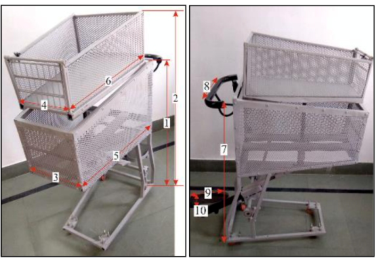
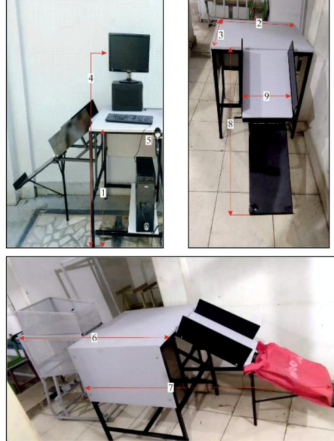
increase in productivity. The sketch of the workstation to turn into prototype was developed integrating all ideas in a single design in order to achieve required outcome from new workstation. Fig. 1 presents the prototype of the ergonomically designed shopping cart and Fig. 2 presents the prototype of the counter. Table 7 presents the dimensions of the ergonomically designed workstation.
Stage III: Laboratory Experimentation and Comparison of Existing and Ergonomically Designed Workstation The ergonomically designed workstation was compared to existing workstation by simulating the activities of the till operators. Labora- tory Experiment and Comparison of existing and ergonomically designed
Ergonomic Redesign of Till Operator Workstation to Reduce Overload 815
Figure 1: Prototype of ergonomically designed shopping cart.Figure 2: Prototype of ergonomically designed counter.
workstation was carried out on Control group (N = 28) and Experimen- tal group (N = 30). Till operators in both the settings performed simulated checkout operation with 30 merchandise in specific weight packaging (gro- ceries like sugar, bread, milk cartons, soaps, detergent, cold drinks, perfumes and deodorant and other similar products) for 30 cycles and were compared on parameters like self-reported body discomforts, workplace risk factors, posture, heart rate, and cycle time.
Table 8 depicts the comparative analysis of REBA scores while working on the existing workstation and the ergonomically designed workstation. ‘t-test’ was used to compare existing checkout counter with ergonomically designed checkout counter. A significant difference was found between REBA scores of Till operators while working on existing and ergonomically designed che- ckout counter (t = 2.88*, p = 0.01), indicating that postural risk reduced while working on ergonomically designed counter.
Table 7. Dimensions of ergonomically designed workstation.
Table 9. Comparison of WERA scores of till operators while working on existing and ergonomically designed workstation.
Table available in the original PDF paper.
WERA scores Existing workstation Ergonomically designed workstation t-value Mean ± SD 38±6.6 28.25±2.9 7.36*
*Significant at 5%.
Table 9 depicts the comparative analysis of REBA scores while working on the existing workstation and the ergonomically designed workstation. t-test was used to compare WERA scores for Till operators working at existing workstation and ergonomic workstation. Statistically significant difference was found between WERA Scores of respondents while working on existing and ergonomically designed workstation (t = 7.36, p = 0.01), indicating that working on ergonomically designed workstation result in less body discomforts.
Table 10 depicts the comparative analysis of heart rate while simulating 30 cycles of checkout process (unloading, scanning, bagging and monetary transaction) at the existing and ergonomically designed checkout worksta- tions. Resting heart rate of the subjects using existing workstation range
Ergonomic Redesign of Till Operator Workstation to Reduce Overload 817
Table 10. Statistical summary of heart rate of till operators while working on existing and ergonomically designed workstation.
Table available in the original PDF paper.
Equation reproduced from the original PDF.Equation reproduced from the original PDF.
Mean±SD Resting Heart Rate (bpm)
While Working Heart Rate (bpm)
Resting Heart Rate (bpm)
While Working Heart Rate (bpm) 70.32±5.32 112.67±9.48 71.2±4.83 104.36±4.80
Table 11. Comparison of task and cycle time taken while working on existing and ergonomically designed workstation.
Table available in the original PDF paper.
t-value p value
Variable Existing Workstation
Ergonomically designed workstation 113±25.75 83.84±12.60 5.53* 0.0001
Unloading & Scanning Time
46.43±6.64 44.03±6.19 1.42ns 0.159
Bagging Time 90.82±10.28 70.03±7.38 8.89* 0.0001 Monetary Transaction Time Total Cycle Time 256.12±31.19 198.01±27.42 7.54* 0.0001
*Significant at 5%; ns Non Significant.
from 62–79 bpm with an average of 70.32±5.32 bpm whereas heart while working rate range from 100–141 bpm with the mean of 112.67±9.47 bpm.
30 simulated checkout cycles (self-paced) with 30 FMCG products carried out by control (N = 28) and experimental group (N = 30) on existing and ergonomically designed workstation were analysed. Time consumed while carrying out major tasks (unloading & scanning, bagging and monetary transaction) along with total cycle time was measured. ‘t’-test was used to compare time taken to perform various checkout operations at existing and ergonomically designed workstation. Statistically significant difference was found between unloading & scanning time (t = 5.53; p = 0.001), bagging time (t = 8.89; p = 0.001) and total cycle time (t = 7.54, p = 0.001). However difference between time consumed while performing monetary transaction task was found to be non-significant at existing and ergonomically designed workstation. Table 11 presents the comparative analysis of cycle times in existing and ergonomically designed workstation.
CONCLUSION
The most common contributing factors of occupational injuries among Till operators are poorly designed workstations and unsafe systems of work which significantly impact the working posture. An ergonomically deficient workplace not only enhances these problems but can also lead to physical and emotional stress, low productivity and poor quality of work (Ayoub, 1990). An ergonomically designed workstation accounts for reduction in incidences of extreme postures and motions of its operators without compromising ope- rator’s efficiency. A comprehensive approach is required and actions need to
be taken at various levels, the administrative level, designing strategies and also at the operator’s level so that these work related injuries and discomforts can be minimised.
REFERENCES
Australian Safety and Compensation Council (ASCC) (2012). Compendium of workers’ Compensation Statistics Australia, 2011-2012, Australian Safety and Compensation council. Retreived from Australian Government web- site: http://www.safeworkaustralia.gov.au/sites/swa/about/publications/pages/ australian-workers%E2%80%99-compensation-statistics-2011-12. Ayoub, M.A. (1990a). Ergonomic Deficiencies: I. Pain at Work. Journal of Occupa-
tional Medicine, 32(1), 52–57. Baron, S., Milliron, M., Habes, D., & Fidler, A. (1991). Health Hazard Evaluation Report (HETA 88-344-2092). Cincinnati: National Institute of Occupational Safety and Health. Retrieved from https://www.cdc.gov/niosh/hhe/reports/pdfs/ 1988-0344-2092.pdf. Department of Consumer and Employment Protection (2005). Industry guidance
Document: Checkout workstation in retail-safe design and work practices. Retri- eved from Government of Western Australia website: https://www.commerce.wa. gov.au/sites/default/files/atoms/files/checkout_design.pdf. Fareez, A. & Nasrul, A. (2017). Risk factors of the upper limb disorders among cashiers in grocery retail industries: A review. International Research and Inno- vation Summit IOP Conference Series: Materials Science and Engineering 226. doi: 10.1088/1757-899X/226/1/012028. Labor Force Survey (2014) by Health and Safety Executive of Great Britain (http://
www.hse.gov.uk/statistics/causdis/musculoskeletal/index.html. Lehman, K. R., Psihogios, J. P & Meulenbroe R. G. J. (2001). Effects of sitting versus standing and scanner type on cashiers. Ergonomics, 44(7), 719–738. OSHA (Occupational Safety and Health Administration), US Department of Labor
2004. Ergonomics for the Prevention of Musculoskeletal Disorders: Guidelines for Retail Grocery stores. OSHA Publications, (pp. 3192). Silverstein, B., Kalat J., & Fan, Z.J. (2003). Work-related Musculoskeletal Disorders in the Neck, Back, and Upper Extremity in Washington state, 1994–2002 (Technical Report 40 8a-2004). Washington State Labor and Industries: SHARP Program.
LISTED IN THE AHFE DIGITAL BOOKSTORE CATALOGUE
Explore the complete digital volume
Intelligent Human Systems Integration (IHSI 2023): Integrating People and Intelligent Systems
Read this individual research paper free through the original publisher, or explore the full digital proceedings book.
ISBN 978-1-958651-45-2
Explore this ISBN in the AHFE Bookstore ↗Listed in the July 2026 bookstore catalogue; search by ISBN to confirm current availability · Digital book purchase optional