Darko Etinger (2023). A Task-Technology Fit Model for Digital Audio Workstations Evaluation. In: Intelligent Human Systems Integration (IHSI 2023): Integrating People and Intelligent Systems. AHFE Open Access, vol. 69, pp. 468–473. https://doi.org/10.54941/ahfe1002867
Music industry changes in the last decade largely shifted the music production tasks from big established studios to music artists. With the addition of online music streaming platforms, an end-to-end process of music creation, publishing, delivery, and consummation is achieved. This phenomenon emphasizes music artists as content creators to handle music production. Digital audio workstation systems enabled end users to compose, record, mix and master music. This research focuses on identifying the fit between various tasks music artists must perform during music creation and the technical characteristic of the tools used, particularly modern digital audio workstations. Ultimately, it is tested whether the task- technology fit (TTF), a well-established information systems theory model is a good predictor of the intention to use digital audio workstation systems by music artists. By applying the PLS-SEM method, results show that TTF positively influences music artists' intention to use DAWs.
The widespread availability of Digital audio workstation (DAW) systems enabled music artists to compose, record, mix and master music, making content creation easier and cheaper for end users. A DAW is a computer- based system used to record, edit, and mix audio content through visual interfaces entirely in digital form and is comprised of four essential com- ponents: computer, audio interface, digital audio editor, and input devices. To create music, artists perform different tasks within a DAW. The functio- nalities of DAW systems are developed to enable music artists to complete various tasks as effortlessly and efficiently as possible. Still, DAW functio- nalities largely resemble a digital version of established analog counterparts used in the past, with only incremental new features. Thus, it is feasible to question the fit between the task characteristics and technical characteristics of DAWs and to discover whether a high level of task-technology fit dri- ves music artists’ adoption and intention to use DAWs. This study proposes the assessment of the Task-Technology Fit model (Goodhue and Thompson 1995) to identify the fit between various tasks music artists must perform during music creation and the technical characteristics of the DAWs used in the process of music creation. The Task-Technology Fit model was exten- sively examined and used in research studies and is considered one of the foundational Information Systems theories (Dwivedi et al. 2012). For this
A Task-Technology Fit Model for Digital Audio Workstations Evaluation 469
study, a research model is developed. It comprises four latent variables (Task characteristics, Technology Characteristics, Task-Technology Fit, and Inten- tion to use). The measurement and structural model are assessed using the PLS-SEM (Partial least squares – structural equation modeling) method. The software tool SmartPLS version 4 (Ringle et al. 2022) is used to apply the PLS-SEM method. Implications of the results are examined.
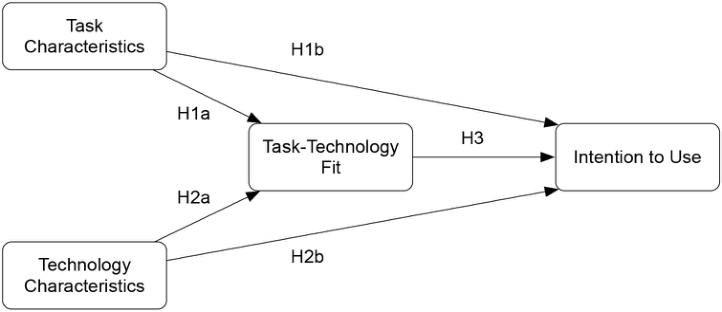
THEORETICAL FRAMEWORK The application of DAWs for music production was studied by Leider (2004), Koemans (2004), Hosken (2010), and Savage (2011). However, none of them analyzed the fit between the task and technology characteristics and its impact on the DAW intention to use by music artists. An integrated TAM- TTF model was developed by Etinger (2016), but it does not account for the direct influence of the task-technology fit on the intention to use. Thus, for this study, a research model with the following hypotheses has been proposed (as shown in Figure 1):
H1a: Task characteristics positively influence the Task-technology Fit H1b: Task characteristics positively influence the Intention to use H2a: Technology characteristics positively influence the Task-technology Fit H2a: Technology characteristics positively influence the Intention to use H3: Task-technology Fit positively influences the Intention to use
Figure 1: Proposed research model.
RESEARCH METHOD AND RESULT ANALYSIS Data Collection Procedures and Data Analysis
For this research, an online survey was used. The survey items related to each construct included in the model were measured using a five-point Likert scale. All items ranged from 1 (strongly disagree) to 5 (strongly agree). The survey items related to Technology characteristics were measured with satisfaction
470 Etinger
degree (1 – very unsatisfied to 5 – very satisfied). Task characteristics were measured using a ten-point Likert scale, with survey items relating to the frequency of performing a specific task. A total of 838 valid surveys from Hard rock and Heavy metal band representatives from around the world were collected. Descriptive information was obtained, including demograph- ics, respondents’ experience with DAW, the most frequent tasks they use the DAW for, and the DAW software of their choice. Regarding DAW software usage, Steinberg’s Cubase dominates as a tool of choice (42%), followed by Avid Pro Tools (14%), Apple Logic (11%), and Cockos Reaper (10%). At the same time, the rest include various DAWs available in the market, both proprietary and open source.
Research Model Assessment The research model based on the Task-Technology Fit model that represents the relationships among the four proposed constructs was measured with 18 items adapted to specific research questions in this study. The measurement and structural model were assessed using the Partial Least Squares Structu- ral Equation Modeling (PLS-SEM) method in SmartPLS version 4 software. PLS-SEM, as a method, estimates partial model relationships in an iterative sequence of ordinary least squares (OLS) regressions, thus maximizing the explained variance of the endogenous latent variables (Hair et al. 2012). To establish the reliability of the items and the convergent and discriminant vali- dity of the constructs, factor analysis was employed. The assessment of the measurement model included determining the indicator reliability (squared standardized outer loadings), internal consistency reliability (composite reli- ability), convergent validity (average variance extracted, AVE), and discrimi- nant validity (Fornell-Larcker criterion, cross-loadings) as shown in Table 1.
Table 1. Measurement model assessment and Discriminant validity of the constructs.
The factor structure matrix of item loadings and cross-loadings (Table 2.) confirms that the convergent validity of each construct is achieved as the item loadings for each construct are above the threshold of 0.708 (Hair et al. 2014). Additionally, Table 3. shows an acceptable HTMT (Heterotrait- monotrait) ratio of correlations.
A Task-Technology Fit Model for Digital Audio Workstations Evaluation 471
Table 2. The factor structure matrix of item loadings and cross-loadings.
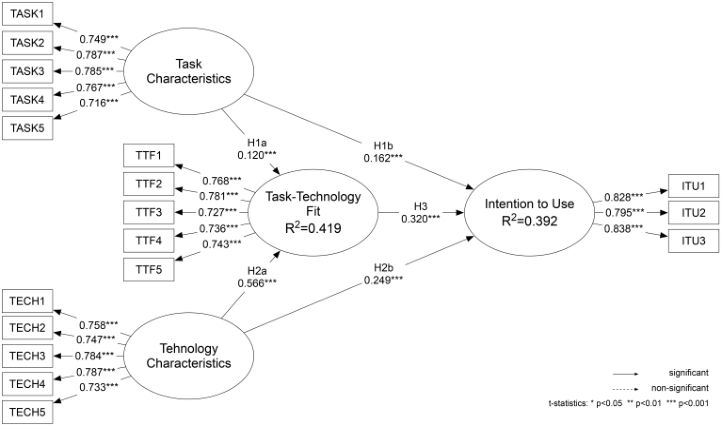
Model Results and Discussion The structural model is examined after establishing the reliability of the indi- cators and the convergent and discriminant validity of the constructs. The results of the PLS analysis for the proposed hypotheses are shown in Figure 2. The structural model shows a significant positive relationship between all constructs. Therefore, hypotheses H1a, H1b, H2a, H2b, and H3 are all sup- ported. These findings are expected considering the vast Task-Technology Fit literature and studies. However, Task-Technology Fit was never applied in this specific setting to analyze the fit between task and technology cha- racteristics for DAW systems. Thus, this study’s findings contribute to the Task-Technology body of knowledge.
Results show that the strongest relationship is the one between Technology Characteristics and Task-Technology Fit (β = 0.566, p < 0.001). Intention to use is strongly affected by Task-Technology Fit (β = 0.32, p < 0.001) and moderately affected by Technology Characteristics (β = 0.249, p < 0.001)
472 Etinger
Figure 2: Research model results.
and Task Characteristics (β = 0.162, p < 0.001). The obtained R-squared coefficients of determination reflect the amount of variance explained by the model, thus indicating its predictive power. The model explains 41.9% of the variance in Task-Technology Fit and 39.2% in Intention to Use. Based on the mapping between tasks and technical functionalities, a cross-examination indicates that the following features are critical for the fit: TASK2-TECH2 (move, split, resize, trim, loop, time stretch, pitch shift, fade, crossfade, slip, snap to grid); TASK3-TECH (zoom, scroll, scrub, jog, tab to audio transi- ent, MIDI navigation); TASK4-TECH4 (group editing, routing, bussing), and TASK5-TECH5 (automation recording, playback, end editing support for track controls and plug-ins). The results also show that the task-technology fit is mainly achieved when DAWs are: TTF1 (updated with features that satisfy the users’ needs), TTF2 (support useful critical functions), TTF3 (suf- ficiently maintained by the provider), TTF4 (reliable, available when needed), and TTF5 (easy to use).
CONCLUSION
DAW functionalities must be mapped to the critical tasks performed by music artists in transforming their vision into a complete product. Special care should be devoted to system maintenance and customer support, as users highly value DAW system reliability. This impacts the overall expe- rience with DAW systems, resulting in increased use and adoption. When the functionalities of the DAW are aligned with the music artists’ tasks, they can focus on their work more efficiently, be more efficient while using the tools at their disposal, and are more driven towards using the DAW systems.
A Task-Technology Fit Model for Digital Audio Workstations Evaluation 473
REFERENCES
Dwivedi, Yogesh K., Michael R. Wade, and Scott L. Schneberger, eds. (2012) Information Systems Theory. Vol. 28. Integrated Series in Information Systems. New York, NY: Springer New York. https://doi.org/10.1007/978-1-4419-6108-2. Etinger, D. (2016) Tools Of The Trade: Digital Audio Workstation Usage Antece-
dents, Informatologia, 49(1-2), str. 61–73. Goodhue, Dale L., and Ronald L. Thompson. (1995) “Task-Technology Fit and Individual Performance.” MIS Quarterly 19 (2): 213. https://doi.org/10.2307/249689. Hair J. F., Hult, G. T. M., Ringle C. M., Sarstedt, M. (2014) A primer on partial
least squares structural equation modeling (PLS-SEM). CA, Los Angeles: Sage Publications Inc. Hair, J. F., Sarstedt, M., Ringle, C. M., Mena, J. A. (2012) An assessment of the use of partial least squares structural equation modeling in marketing research. Journal of the Academy of Marketing Science, 40(3), 414–433. Hosken, D. (2010) An Introduction to Music Technology. New York: Routledge. Koemans, D. (2004) So You Wanna Be a Rock Star: Bringing a Digital Audio
Workstation to the Masses. World Conference on Educational Media and Tech- nology Lugano, Switzerland: Association for the Advancement of Computing in Education (AACE). pp. 1843–1848. Leider, C. N. (2004) Digital Audio Workstation. New York: McGraw-Hill, Inc. Ringle, Christian M., Wende, Sven, & Becker, Jan-Michael. (2022) SmartPLS 4.
Oststeinbek: SmartPLS. Retrieved from https://www.smartpls.com Savage, S. (2011) The Art of Digital Audio Recording: A Practical Guide for Home and Studio. New York: Oxford University Press.
LISTED IN THE AHFE DIGITAL BOOKSTORE CATALOGUE
Explore the complete digital volume
Intelligent Human Systems Integration (IHSI 2023): Integrating People and Intelligent Systems
Read this individual research paper free through the original publisher, or explore the full digital proceedings book.
ISBN 978-1-958651-45-2
Explore this ISBN in the AHFE Bookstore ↗Listed in the July 2026 bookstore catalogue; search by ISBN to confirm current availability · Digital book purchase optional