Zhang Yiran (2023). Visual effects based on blank fractions in the case of multi-paragraph text overlay images. In: Intelligent Human Systems Integration (IHSI 2023): Integrating People and Intelligent Systems. AHFE Open Access, vol. 69, pp. 124–130. https://doi.org/10.54941/ahfe1002829
Multi-segment text overlay images are commonly used in web design, poster layout and other design-related activities. In this paper, we use a character-based blank score calculation model and a text box-based blank score calculation model to investigate which model is more effective in reflecting visual aesthetics in the case of multi-part text overlay images. The text-frame-based blank-score model was found to be more effective in reflecting the visual perception of the subjects by using the fitting tool in MATLAB to fit the subjective scores and the calculated blank scores. The text box in the text box-based blank score model was then optimized by eliminating the part of the last line of each paragraph that was not filled with text, so that the text box was not a regular rectangle, but still a relatively regular linear text box. In the case of multi-paragraph text overlay image, when the line spacing and paragraph spacing are the same, subjects cannot distinguish the beginning and end of several paragraphs of text by line spacing. In this paper, an optimized text box-based margin score calculation model is used to design an experiment to investigate the effect of the margin score of the text box of the last line of the preceding paragraph on the visual effect of subjects' visual division of paragraphs in the case of multiple-paragraph text-covered images. The results show that when the blank area of the last line of the previous paragraph is about half of the area of the previous line, the visual aesthetic satisfaction is the highest, i.e., people can quickly and accurately divide the paragraph without reading the text content, while when the last line of the previous paragraph is filled with text, the visual aesthetic satisfaction is the lowest, and people cannot intuitively divide the paragraph without reading the text content.
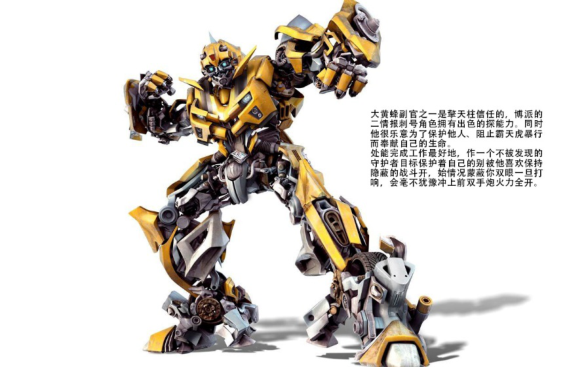
Visual aesthetics is an important aspect of interaction design and product design (Liu, 2003). Recently, many scholars have devoted themselves to stud- ying the influence of interface beauty on the overall user experience in the process of interaction between human and computer system. As shown in Figure 1, the text coverage image model is a common model in computer system, which is mostly used in PPT, poster and other design. Text overlay image is a way of combining text and image. In the process of operation, the text is usually overlaid on the image, and the image generally includes obvi- ous subject and background. Compared with the traditional text, the text
Visual Effects Based on Blank Fractions in the Case 125
Figure 1: Text overlay image model.
overlay image mode combines the image and text organically, and enhances the user’s experience. When text is combined with pictures, the determina- tion of the best way to present the text is not only related to the overall visual beauty, but also affects the understanding of the audience. Text presentation includes text position, text paragraph, text word number, etc. The location of the text should not block the main object in the picture, but should be placed in the appropriate position of the background area, to give the viewer a harmonious aesthetic feeling. At this time, we need a computing model that can quantify the user perception, and associate the aesthetic attraction of the interface with the text overlay image mode.
Based on the principle of “visual weight”, Lai et al. (2010) developed a computational model for the balance and symmetry of text overlay images, and evaluated it through user interface experiments. The experimental results show that the best position to cover the text on the image is the position with the largest average balance value. And then mien Tsung Tsai et al. Studied the relationship between the blank fraction of text overlay image and visual aesthetic feeling, and found that calculating the area ratio between the blank region and the background region of the image is very important for jud- ging the aesthetic feeling of text overlay image, and proposed four blank fraction calculation models. Finally, through experimental verification and data processing, it is concluded that two of the four models are based on the background The model can effectively reflect human visual beauty.
In the experiment, mien Tsung Tsai and others divided the text into small paragraphs and assigned them to different images to form a regular rectan- gular text box covering the image, that is, each line in the text box was filled with the same number of text. However, in real life, users often input a large number of segmented text in the interface or design, and will not align the last word of the last line with the last word of each line above every time. An important issue derived from this is: for more than one paragraph of text, how much “blank” is left in the last line of each paragraph of text to increase the aesthetic experience of users.
126 Zhang
On the basis of the above research, this paper will explore the following three issues: (a) optimize the selection of text box in the calculation model of blank fraction of text overlay image; (b) explore the relationship between the two blank fraction models and visual aesthetics, and (c) determine the best way to leave blank for a given image. In the following chapters, we first optimize the calculation model determined by mien Tsung Tsai, and then design experiments to explore the relationship between the two optimized models and the visual aesthetic appeal of text overlay images, and compare the results. In the part of discussion and conclusion, the research results and prospects are discussed.
Calculation Model of Quantitative Blank Fraction White space: the “white space” between and around page layout elements. Blank space includes margin, space around graphic image, line spacing, word spacing, etc. Depending on the background color of the page, white space is not necessarily white. When the page size remains the same, adding more text characters will reduce the entire white space.
Blank score: refers to the ratio of blank space to the overall space of the page.
w: Picture width in pixels h: Picture height (in pixels) AP: The area of a picture (the product of W and H) AB: The area of all pixels in the background area AC: The area of all pixels of a character block Abox: The area of all pixels in the text box (1) Background white space score based on character WCB = AB −P AC
AB
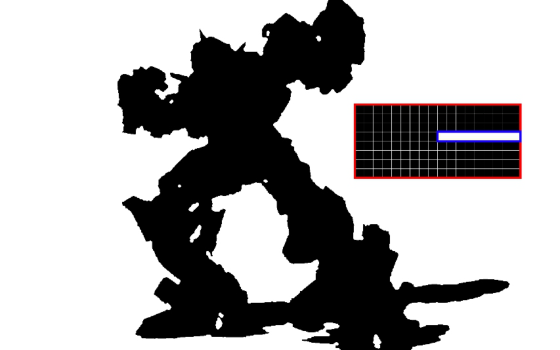
The blank fraction is based on characters. All spaces except characters in the background area are regarded as blank areas. Divide the blank area by the background area to get the proportion of the blank area to the background area, as shown in Figure 2.
Equation reproduced from the original PDF.
AB
The blank score is based on the actual text box. In the traditional text box, the part without characters is removed to get the actual text box. The space outside the text box in the background area is regarded as a blank area, and the blank area is divided by the background area to get the proportion of the blank area in the background area, as shown in Figure 3.
Experiment In the experiment, there were 10 participants (ranging in age from 22 to 26 years; 5 males and 5 females). All participants had normal or corrected vision
Visual Effects Based on Blank Fractions in the Case 127
Figure 2: Background white space score model based on characterl.Figure 3: Background blank score model based on text box.
and normal color vision. Considering that the interest and specialty of partici- pants may lead to their different sensitivity to visual beauty, in order to avoid introducing any potential impact, three men and three women from design related majors have stronger sensitivity to visual beauty, and the experimen- tal results may be more realistic. Two men and two women from non design related majors may have more modern experimental results Superficial.
Participants were asked to see several pictures. Each image contains the same clear perceptible subject and background area, which is relatively uni- form and spacious. In the background area, two pieces of text without semantics are covered, and the interval between paragraphs and lines is the same, the number of lines of the two pieces of text is the same, and there is no indent of the first line. In order to generate a group of test images with diffe- rent blank areas, the number of words in the last line of the first paragraph is changed and the second paragraph is unchanged. The choice of font size and color takes into account readability and overall aesthetics. Each line of text usually contains 15 to 25 Chinese characters. Lai et al. (2010) showed that the average visual balance (BM) is closely related to the aesthetic attraction of the text covered image. In order to reduce the impact of visual balance on
128 Zhang
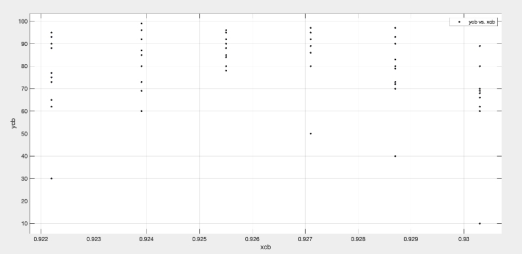
Figure 4: Score data of background blank score model based on character.
the experiment, the position of two paragraphs of text should be selected in the area where the BM value is as high as possible, while avoiding occlusion of the subject in the image. The details of the image are not only meaningless, but also affect or distract the participants’ attention in the experiment. As a result, the resolution of the image remains at a medium value. The appendix lists all the images used in the experiment and the processed images.
The experiment was conducted in a well lit room. The display has a reso- lution of 3072 × 1920 pixels, and all test images are 1280 x 800 pixels. Each participant sat at a table, watched all the test images on a 16 inch display, and scored six images on a 100 point scale. Before the experiment, partici- pants were instructed that the text in the image had no semantic meaning, and their judgment should be based on the visual aesthetic impression of the test image, not the content of the image or text. In order to avoid the impact of image content on participants, participants will quickly browse 6 images in 5 seconds. During the experiment, only one image was displayed on the screen for 15 seconds at a time, and then the participants were instructed to score the images within 5 seconds. The value of 1–100 reflects the aesthetic attraction of each image, and a higher score corresponds to a higher degree of aesthetic attraction. The presentation sequence of the test image is ran- dom order to avoid the influence of the regular increase or decrease of the blank area on the participants. It usually takes three to five minutes from the preparation stage to the end of the experiment.
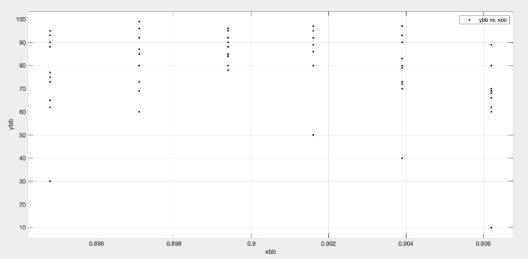
The results are shown in Figures 4 and 5. The y-axis corresponds to the subjective score of the participants, while the number on the x-axis corresponds to the blank score.
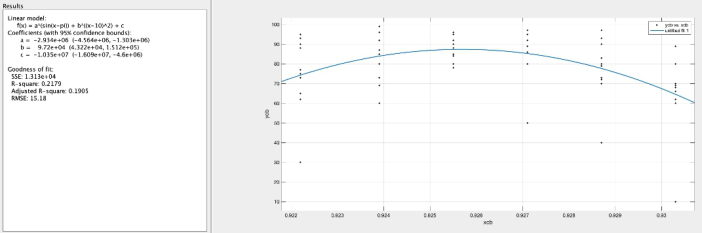
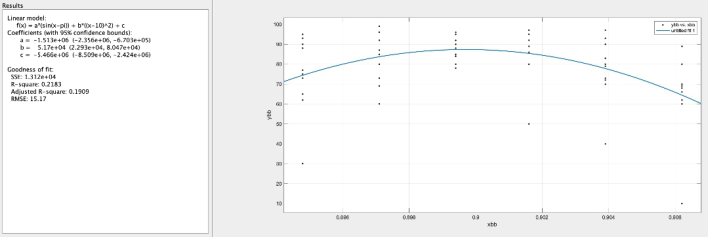
As shown in figures 6 and 7, using the fitting tool in MATLAB, we can find that the relationship between subjective rating (y) and blank score (x) seems to follow the curve of a certain polynomial equation. The fitting results are shown in the figure.
The values in the figure can reflect the degree of fit. In Figure 7, the value of background white space score based on character is 0.2179; in Figure 7, the value of background white space score based on text box is 0.2183. The comparison shows that the difference between the two models is very small, and the background blank score model based on text box has better fitting effect.
Visual Effects Based on Blank Fractions in the Case 129
Figure 5: Background blank score model score data based on text box.Figure 6: Character based background blank score model score data fitting.Figure 7: Background blank score model score data fitting based on text box.
CONCLUSION
This paper optimizes the selection of text box in the background blank score model based on text box, eliminates the part of the last line in the text overlay image model that is not filled, breaks the pattern of rectangular text box, but still gets a relatively regular linear text box. Through experiments, this paper explores the influence of the last line of the previous text on the visual aesthetic attraction when the text is overlaid on the image. The results show that the background blank score model based on text box can better express the visual aesthetic attraction. When the line spacing and segment spacing are the same, it is impossible to distinguish the beginning and end of a paragraph
130 Zhang
by the spacing. When the blank area of the last line of the previous paragraph is about half of the whole line area, it is the most attractive to people’s visual aesthetics, while when the last line of the previous paragraph is full, it is the least attractive to people’s visual aesthetics.
ACKNOWLEDGMENT
This research is supported by the National Key Research and Development Program, China(No.2020YFB1708400).
REFERENCES
Altaboli, A., & Lin, Y. (2011). Investigating effects of screen layout elements on interface and screen design aesthetics. Advances in Human-Computer Interaction, 10. doi: 10.1155/2011/659758. Bauerly, M., & Liu, Y. (2006). Computational modeling and experimental investi-
gation of effects of compositional elements on interface and design aesthetics. International Journal of Human Computer Studies, 64, 670–682. Bauerly, M., & Liu, Y. (2011). Effects of symmetry and number of compositional elements on interface and design aesthetics. International Journal of Human-Computer Interaction, 24, 275–287. Lai, C. Y., Chen, P. H., Shih, S. W., Liu, Y., & Hong, J. S. (2010). Computational
models and experimental investigations of effects of balance and symmetry on the aesthetics of text-overlaid images. International Journal of HumanComputer Studies, 68, 41–56. Liu, Y. (2003). Engineering aesthetics and aesthetic ergonomics: Theoretical foundations and a dual-process research methodology. Ergonomics, 46, 1273–1292.
LISTED IN THE AHFE DIGITAL BOOKSTORE CATALOGUE
Explore the complete digital volume
Intelligent Human Systems Integration (IHSI 2023): Integrating People and Intelligent Systems
Read this individual research paper free through the original publisher, or explore the full digital proceedings book.
ISBN 978-1-958651-45-2
Explore this ISBN in the AHFE Bookstore ↗Listed in the July 2026 bookstore catalogue; search by ISBN to confirm current availability · Digital book purchase optional