Zhecheng Wang, Ruifeng Yu (2022). Effects of cognitive ability and social presence on performance of mathematical calculation and recognition memory tasks. In: Social and Occupational Ergonomics. AHFE Open Access, vol. 65, pp. 173–180. https://doi.org/10.54941/ahfe1002673
For individuals, cognitive ability is often an important reference for predicting education level, academic achievement, and work ability. In many cases, people usually work or study in a group situation with co-actors. For example, many students study together in a classroom, or workers work together in a workstation. People in a group interact and influence each other, which means they become each other’s social presence. Some studies found that the cognitive ability of group members affected the overall performance of the group. Therefore, it is also necessary to consider the individual cognitive ability factors in the research of social facilitation effects. We are curious about whether group members’ difference in cognitive abilities would moderate the effect of social presence on his task performance when they complete tasks in a group situation. In other words, we are interested in the effects of social presence on the intensity or direction of social facilitation exerting on people with different cognitive abilities when completing cognitive tasks.This paper investigated the effects of individual cognitive ability, social presence and task difficulty on the performance of mathematical calculations and recognition memory tasks. The mathematical calculation tasks and memory tasks are two kinds of typical cognitive tasks that people often need to deal with in work or study. Moreover, the extant studies verified that the social facilitation effect existed in those tasks. Hence, this study selected them as experimental tasks respectively. A three-factor mixed design experiment was conducted. The Cognitive Ability factor had two levels: low and high, which were distinguished by the score of the Cognitive Ability scale. The difficulty factor had two levels: easy and hard. The social presence factor had two levels: alone and group. In the alone condition, the participant did the task alone in a room. In the group condition, two participants conducted the experiment face-to-face in the room at the same time. There were 4 experimental conditions of two within-subject factors (2 difficulty × 2 social presence). Every participant needed to finish a trial of easy tasks and a trial of hard tasks in both alone and group conditions. The trials were randomly and balanced assigned in a counterbalanced design to the 8 trials across the experiment used. Thirty-six participants participated in this study. The response time and accuracy rate were used to assess the task performance. The results indicated that, although cognitive ability had a significant main effect on the performances, the interaction effect between cognitive ability and social presence on task performance was not significant. There existed a two-way interaction effect between social presence and task difficulty on response time of both tasks. The findings provide useful information for work organization and task allocation in a group work.
Cognitive ability could be defined as “mental capability that involves the abi- lity to reason, plan, solve problems, think abstractly, comprehend complex ideas, learn quickly and learn from experience” (Gottfredson, 1997). Human cognitive ability can be divided in to multiple parts of abilities, such as lingui- stic, logical-mathematical, memory, spatial, musical, bodily-kinesthetic, etc. (Visser, Ashton, & Vernon, 2006). In present cognitive science, it is general to measure cognitive ability by means of self-report methods or performa- nce tests. Some well-standardized cognitive tests or intelligence scales are commonly used, for example, the Wechsler Intelligence Scale (Wechsler & Kodama, 1949). For individuals, cognitive ability is often an important refe- rence for predicting education level, academic achievement, and work ability (Rhode & Thompson, 2007; Offermann, 2009).
In many cases, people usually work or study in a group situation with co-actors. For example, many students study together in a classroom, or workers work together in a workstation. People in a group interact and influence each other (Campion et al., 1993), which means they become each
other’s social presence. In this case, the presence of others may lead to a social facilitation effect and thus promote or inhibit their own task perfor- mance (Zajonc, 1965). In contrast to study alone, students’ group study could change their learning behavior and learning efficiency (Springer, 1999; Gil- lies, 2004; Davidson, 1991), promote the efficiency of language learning and memory (Sharan, 1980). In addition, some studies found that the cognitive ability of group members affected the overall performance of the group (Neu- man, 1999; Devine, 2001). Therefore, it is also necessary to consider the individual cognitive ability factors in the research of social facilitation effe- cts. We were curious about whether group members’ difference in cognitive abilities would moderate the effect of social presence on his task performance when they complete tasks in a group situation. The mathematical calculation tasks and memory tasks are two kinds of typical cognitive tasks that people often need to deal with in work or study. Moreover, the extant studies verified that the social facilitation effect existed in those tasks (Park & Catrambone, 2007; Liu et al., 2017). Hence, this study selects them as experimental tasks respectively. This study was able to provide suggestions for the work organi- zation methods of the team organizer, such as whether individuals should be assigned to work alone or in a group, and how to organize the team according to the cognitive ability of individuals in the team.
METHOD
TASKS AND MATERIALS Modular arithmetic task. The modular arithmetic task required the partici- pants to judge whether a math formula like “76 ≡56 mod 8” is true. The above formula means that 76 and 56 have the same remainder when divi- ded by 8. The difficulty of the modular arithmetic task was determined by the number of digits. In the easy task, the numbers were all single-digit like “7 ≡1 mod 3”, while in the hard task, the numbers contained double-digit numbers, such as “51 ≡19 mod 8”. This task was similar to that of Park’s experiment (2007).
Recognition memory task for English words. An old-new recognition method was used in this experiment. A batch of recognition memory tasks included 30 English words, among which 15 words were “old”, and 15 were “new”. In the memory stage, 15 “old” words were displayed to the partici- pants. In the recognition stage, all 30 words were randomly displayed to the participants in turn. The participants should point out whether the words were “new” or “old”. For the easy task, “old” words and “new” words were easily distinguished by spelling. While for the hard task, words with similar spellings were used.
Participants Thirty-six native Chinese (14 men and 22 women), aged 18 to 45 years (M = 35 years and SD = 9.02 years) were recruited as participants in this experiment. All the participants had normal vision or corrected nor- mal vision. The participants had mathematical calculation ability and English
Effects of Cognitive Ability and Social Presence 175
word recognition and reading ability, and did not have past experience with similar tasks.
Apparatus and Workplace Conditions The participants used a personal laptop with a 14.0-inch LED display (1600 pixel × 900 pixel) to do all tasks. The experimental program was develo- ped on PsychoPy (Peirce et al., 2019) for stimulus presentation and response recording. The font in the experiment was 72pt Arial. The participants used a set of a mouse and a keyboard as input tools. The program can automatically record the participants’ clicking key-response and clicking time. In the alone condition, the participants sat alone in the middle of the room. In the group condition, the two participants sat opposite each other and sat in the middle of the room.
Experimental Design The experiment employed a three-factor mixed design for the modular arith- metic task and the recognition memory task. The within-subject factors were difficulty factor and social presence factor, and the between-subject factors was individual cognitive ability. The Cognitive Ability factor had two levels: low and high, which were distinguished by the score of the Cognitive Ability scale. The difficulty factor had two levels: easy and hard. The social presence factor had two levels: alone and group. In the alone condition, the partici- pant did the task alone in a room. In the group condition, two participants conducted the experiment face-to-face in the room at the same time. Every participant needed to finish a trial of easy tasks and a trial of hard tasks of modular arithmetic, and also a trial of easy tasks and a trial of hard tasks of recognition memory in both alone and group conditions.
Measurement The cognitive ability of participants was measured by the cognitive ability scale of APESK logic test v3.14 Chinese version. This cognitive test scale con- sisted of 32 questions, which could measure people’s basic logical reasoning, mathematical ability and language ability. The full marks were 100. This scale was said to be based on the fourth edition of the Wechsler Adult Intel- ligence Scale (http://114.215.185.169:8080/EX/ExamTest.asp?id=1399&hi d=16549&authorcode=apesk). The performance of the modular arithmetic task contained two indicators: response time and accuracy rate. The response time referred to the time interval from the moment of seeing a formula to the end of completing calculating the formula and pressing a key of “Y” or “N”. The accuracy rate refers to the ratio of the number of correctly respon- ded tasks to the total number of completed tasks. The performance of the recognition memory task also contained two indicators: response time and accuracy rate (correct response rate). The response time referred to the time from starting to seeing a word to making the judgment of “old” or “new” and pressing a key of “Y” or “N”. The accuracy rate refers to the ratio of the number of correctly judged words to the total number of words.
176 Wang and Yu
PROCEDURE The whole experiment includes 2 trials of practice tasks and 8 trials of formal tasks. Before the experiment began, the purpose of the experiment and the process of the whole experiment were introduced to the participants. They then completed two trials of practice tasks to become familiar with the expe- rimental software and operation method of the equipment. The participants needed to complete 8 trials of tasks corresponding to 8 combinations of task difficulty, social presence and task type. Participants need to complete a trial of an easy task and a trial of the hard task of both modular arithmetic and recognition memory, and repeat the above tasks in a group condition. The order of the 8 trials was random and balanced for all the participants.
In modular arithmetic tasks, a problem formula was represented in the center of the screen. The participants were asked to judge whether the for- mula was true. If they thought the formula was true, press the “Y” key on the keyboard, otherwise press the “N” key. A trial of modular arithmetic tasks contains 50 formulas to be judged. In recognition memory tasks, 15 “old” words were displayed to the participants at an interval of 6 seconds and each word appeared for 2 seconds. Then the participants were asked to judge whether the following 30 words were “old” or “new”, and press key “Y” for “old” news, “N” for “new” words. In the alone condition, the parti- cipants needed to complete the tasks alone in a room. In the group condition, the participants should sit face-to-face with the other participant to carry out the experiment. After completing all experimental tasks alone and in a group, the participants get paid and finished the experiment.
RESULTS
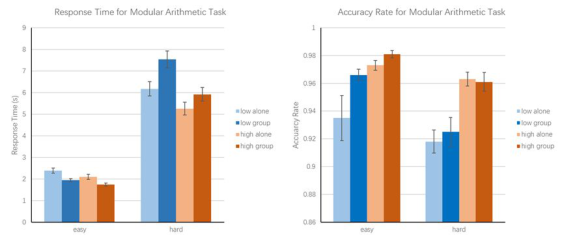
Effects on Modular Arithmetic Tasks The means and standard deviations of the response time and accuracy rate of the modular arithmetic tasks on each condition were shown in Figure 1. The cognitive ability factor was divided into two parts (low and high) according to the results of APESK cognitive ability test (18 low and 18 high, Mlow = 35.00, SD = 9.06, Mhigh = 60.69, SD = 10.47, T = 21.73, P-value < 0.001).
The social presence factor showed a marginally significant main effect on response time (p = 0.082). The main effect of task difficulty factor on response time was significant (F(1,35) = 560.17, p < 0.001). The response time of hard modular arithmetic task (Mhard = 6.275 s, SD = 2.150) was larger than that of easy task (Measy = 2.054 s, SD = 0.616). The main effect of cognitive ability on response time was significant (F(1,35) = 18.35, p < 0.001). The response time of participants with higher cognitive abi- lity (Mhigh = 3.754 s, SD = 2.246) was smaller than that of participants with lower cognitive ability (Mlow = 4.510 s, SD = 2.891). The interaction of social presence × difficulty had significant effects on the response time (F(1,35) = 16.09, p < 0.001). For the easy tasks, the response time of parti- cipants alone (Malone = 2.256 s, SD = 0.711) was larger than that of partici- pants with co-actors (Mgroup = 1.852 s, SD = 0.420). But for hard tasks, the
Effects of Cognitive Ability and Social Presence 177
Figure 1: Response time and accuracy rate as functions of task difficulty, social presence and individual cognitive ability for modular arithmetic tasks. Error bars represented ±1 SE.
response time of participants alone (Malone = 5.752 s, SD = 1.193) was shor- ter than that of participants with co-actors (Mgroup = 6.798 s, SD = 2.257). The interaction effect of difficulty × cognitive ability on the response time of modular arithmetic tasks was also significant. For participants with lower cognitive ability, the response time for easy task (Measy = 2.166 s, SD = 0.6432) was shorter than that of hard task (Mhard = 6.855 s, SD = 2.296). For participants with higher cognitive ability, the response time for easy task was (Measy = 1.922, SD = 0.5588) and the response time for hard task was (Mhard = 5.587 s, SD = 1.742).On the accuracy rate, the main effect of social presence was not significant (Malone = 95.51%, SD = 0.064, Mgroup = 95.74%, SD = 0.045). The main effect of difficulty factor on accuracy was significant (F(1,35) = 12.44, p < 0.001, Measy = 96.26%, SD = 0.057, Mhard = 94.00%, SD = 0.052). The main effect of cognitive ability was also significant (F(1,35) = 28.62, p < 0.001). The performance of participants of higher cognitive ability (Mhigh = 96.94%, SD = 0.028) was larger than that of the lowers (Mlow = 93.60%, SD = 0.069). There was no interactions effect significant on the accuracy rate.
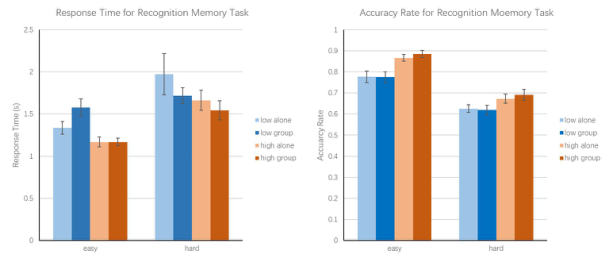
Effects on Recognition Memory Tasks The means and standard deviations of the response time and accuracy rate of the recognition memory tasks on each condition were shown in Figure 2.
As for the response time of recognition memory task, the factors of task difficulty (F(1,35) = 20.71, p < 0.001) and cognitive ability (F(1,35) = 8.65, p = 0.004) showed significant main effects. For difficulty factor, the response time of easy task (Measy = 1.326 s, SD = 0.482) was larger than that of hard task (Mhard = 1.735 s, SD = 0.965). And for cognitive ability factor, the result showed that people with higher cognitive ability (Mhigh = 1.386 s, SD = 0.556) took shorter response time in the memory task than people with lower cognitive ability (Mlow = 1.652 s, SD = 0.925). The effect of the inte- raction between social presence and difficulty on the response time of reco- gnition task was marginally significant (F(1,35) = 2.91, p = 0.089). It was revealed in the results that when faced with easy recognition memory task, people showed shorter response time when they were alone (Malone = 1.260 s,
178 Wang and Yu
Figure 2: Response time and accuracy rate as functions of task difficulty, social presence and individual cognitive ability for recognition memory tasks. Error bars represented ±1 SE.
SD = 0.413) than when they were in a group (Mgroup = 1.392 s, SD = 0.538). And for hard recognition memory task, participants alone (Malone = 1.831 s, SD = 1.217) showed longer response time than participants with a co-actor (Mgroup = 1.639 s, SD = 0.613). The difficulty factor (F(1,35) = 121.58, p < 0.001) and the cognitive ability factor (F(1,35) = 25.56, p < 0.001) have been found main effects on the accuracy rate of recognition memory task. The hard tasks showed lower accuracy rate than easy tasks (Mhard = 65.00%, SD = 0.132, Measy = 82.19%, SD = 0.141). The accuracy rate of participants with higher cognitive ability (Mhigh = 77.92%, SD = 0.150) was larger than that of lower cognitive ability participants (Mlow = 69.96%, SD = 0.162). No significant effect of social presence on the accuracy rate of memory task was found.
DISCUSSION AND CONCLUSION This study explored the effects of social presence (alone or with a co-actor), individual cognitive ability (relatively high or low) and task difficulty (easy or hard) on the response time and accuracy rate of modular arithmetic task and memory recognition task for English words. This study verifies the conclusion of Park and Catrambone (2007) on the social facilitation effect of modular arithmetic tasks, that is, for easy tasks, the reaction time in the presence of co actor was longer than that under alone conditions; For hard tasks, the response time under co actor condition was shorter than that under alone condition. For the accuracy rate, the social facilitation effect was not signifi- cant. However, the interaction between social presence and cognitive ability was not significant. In other words, the results show that there was no signi- ficant difference in the intensity and direction of social facilitation effect for participants with different cognitive abilities.
As for the recognition memory task for English words, the main effects of task difficulty and cognitive ability on task performance (response time and accuracy rate) were also significant. Participants took longer response time to hard tasks and had a lower accuracy rate. Similarly, participants with higher cognitive ability had shorter reaction time and higher accuracy rates
Effects of Cognitive Ability and Social Presence 179
than those with lower cognitive ability. For the recognition memory task, the existence of social facilitation effect has also been confirmed. For the accuracy rate, social presence had no significant effect on the accuracy rate of the recognition memory task. This phenomenon may need further inve- stigation and research, because for Chinese people, the recognition, reading and memory modes of English words may be different from that of native English speakers. For the recognition memory task, the interaction between social presence and cognitive ability was also not significant.
Our hypothesis about the possible interaction between the intensity of social facilitation effect and cognitive ability has not been confirmed. In other words, people with different cognitive abilities generally receive almost the same degree of social facilitation. But it is possible to study whether the inten- sity of social facilitation effect would change in a larger group. What’s more, experiment with other tasks were also needed to be carried out.
ACKNOWLEDGMENT
This work was supported by the National Natural Science Foundation of China under Grant number 71771134.
REFERENCES
Campion, M. A., Medsker, G. J., & Higgs, A. C. (1993). Relations between work group characteristics and effectiveness: Implications for designing effective work groups. Personnel psychology, 46(4), 823–847. Davidson, N., & Kroll, D. L. (1991). An overview of research on cooperative learning
related to mathematics. Journal for Research in Mathematics Education, 22(5), 362–365. Devine, D. J., & Philips, J. L. (2001). Do smarter teams do better: A meta-analysis of cognitive ability and team performance. Small group research, 32(5), 507–532. Gillies, R. M. (2004). The effects of cooperative learning on junior high school
students during small group learning. Learning and instruction, 14(2), 197–213. Gottfredson, L. S. (1997). Why g matters: The complexity of everyday life. Intelligence, 24(1), 79–132. Liu, N., Yu, R., Yang, L., & Lin, X. (2017). Gender composition mediates social
facilitation effect in co-action condition. Scientific reports, 7(1), 1–13. Neuman, G. A., & Wright, J. (1999). Team effectiveness: beyond skills and cognitive ability. Journal of Applied psychology, 84(3), 376–389. Offermann, L. R., Bailey, J. R., Vasilopoulos, N. L., Seal, C., & Sass, M. (2004). The
relative contribution of emotional competence and cognitive ability to individual and team performance. Human performance, 17(2), 219–243. Park, S., & Catrambone, R. (2007). Social facilitation effects of virtual humans. Human factors, 49(6), 1054–1060. Peirce, J., Gray, J. R., Simpson, S., MacAskill, M., Höchenberger, R., Sogo, H., ... & Lindeløv, J. K. (2019). PsychoPy2: Experiments in behavior made easy. Behavior research methods, 51(1), 195-203. Sharan, S. (1980). Cooperative learning in small groups: Recent methods and
effects on achievement, attitudes, and ethnic relations. Review of educational research, 50(2), 241–271.
180 Wang and Yu
Springer, L., Stanne, M. E., & Donovan, S. S. (1999). Effects of small-group learning on undergraduates in science, mathematics, engineering, and technology: A meta- analysis. Review of educational research, 69(1), 21–51. Visser, B. A., Ashton, M. C., & Vernon, P. A. (2006). Beyond g: Putting multiple
intelligences theory to the test. Intelligence, 34(5), 487–502. Wechsler, D., & Kodama, H. (1949). Wechsler intelligence scale for children. New York: Psychological corporation. Zajonc, R. B. (1965). Social facilitation. Science, 149(3681), 269–274.
LISTED IN THE AHFE DIGITAL BOOKSTORE CATALOGUE
Explore the complete digital volume
Social and Occupational Ergonomics
Read this individual research paper free through the original publisher, or explore the full digital proceedings book.
ISBN 978-1-958651-41-4
Explore this ISBN in the AHFE Bookstore ↗Listed in the July 2026 bookstore catalogue; search by ISBN to confirm current availability · Digital book purchase optional