Mohammad Allagha, Oskar Kruschitz, Stefanie Binder, Katherina Voss, Kevin Truckenthanner (2022). Digital Matching for live-in care. In: The Human Side of Service Engineering. AHFE Open Access, vol. 62, pp. 376–383. https://doi.org/10.54941/ahfe1002579
In Austria, 25,000 to 30,000 people being cared for by live-in caregivers. Live-in caregivers are defined as workers who are employed to provide care services to elderly and disabled people living in their private households. Activities in home care are predominantly carried out by immigrant women because of the special conditions that home care provides. These conditions can have many positive aspects for both the care workers and the care recipients, if they are well and appropriately matched to the skills of the caregivers and the needs of the persons being cared for. The live-in caregivers in Western countries come mostly from Eastern Europe. On the one hand, because of the worldwide shortage of qualified care workers and, on the other hand, due to the higher wages in contrast to their home countries and the prospects that such a position brings with it.However, they can also bear risks of dependency on their employers, leading to isolation, on-call work, and the risk of exploitation, while putting live-in care workers in a particularly vulnerable position with respect to immigration policy. Working conditions are often extremely harsh, with fees and contracts strictly regulated by recruiting agencies.Live-in care workers are an important but forgotten sector of long-term care. Without improving their working conditions, we will not be able to provide affordable, quality care to citizens, who are very urgently in need of this service. Even though this is often the only affordable solution for affected families. In order to improve the working conditions and to ensure that the caregivers continue to be employed in households that best match their skills and aspirations, we have created a new live-in care matching platform. Before creating the platform, we conducted focus group interviews to find out what is important to the stakeholders.Together with families of people in need of care and care workers, we developed a platform that meets the requirements of both sides and optimally supports both sides in the placement process. Here, both caregivers and persons in need of care (or their families) have the opportunity to disclose what they value, what skills they possess and what special features there are by answering a questionnaire. Using an innovative matching algorithm, the platform selects the ideal combination of caregivers and persons in need of care. In this paper, we will analyze the results of the focus group interviews in more detail, elaborate on the lessons learned and discuss which attributes play a particular role in the matching process based on our algorithm. In the future, the process should be simplified for both parties and will serve as a validation for the stakeholders
The number of transnational live-in caregiver in European private households has been increasing since the 1990s. The reasons for this increase are, on the one hand, the demographic development and the increase in older people in need of care and nursing, and on the other hand, the increasing employment of women with a constant division of labour. In addition, there have been restrictions on public services in recent years. Live-in care must now more often be organized and paid for privately (Mairhuber & Allinger, 2021).
The live-in caregivers model was legalized in Austria in 2007 and has been financially supported since then (Mairhuber & Allinger, 2021). In the recrui- tment of self-employed personal caregivers, placement agencies have played a central role, especially since the EU’s eastward expansion in 2007 (Steiner, Prieler, Leiblfinger, & Benazha, 2019/ 44). In addition to placing caregivers in private households, the agencies often also take care of the business registra- tion, the registration with social security and even the caregivers transport (Aulenbacher, Leiblfinger, & Prieler, 2018).
For some agencies, the placement of caregivers already takes place online on their website. Most agencies place live-in caregivers in jobs that require supervision or care, regardless of specific skills or requirements.
Our smart live-in care matching platform is designed to precisely coun- teract this phenomenon. Our goal is to find live-in caregivers for people in need of care who fit their situation, meet their requirements, and have the necessary skills. Through our algorithm, we do our best to find the right job for each caregiver and can thus ensure that the expectations on both sides are met.
LIVE-IN CARE MATCHING: NEEDS, CHALLENGES AND LACK OF SMART SOLUTIONS To better understand the live-in care market, it was important for us to analyze the target groups and learn from involved persons. Thus, we ini- tiated a scientific analysis based on focus group discussions to identify the affected users and groups as well as the current challenges. This process hel- ped us to identify the user groups and objectives of the planned smart live-in care matching platform.
Analysis Through Focus Groups In order to analyze the needs of the market based on focus groups, a meth- odology was designed and elaborated, which was as follows: three focus groups were formed and interviewed. These interviews were conducted and analyzed scientifically. The three focus groups (affected families, caregivers, cities/towns) basically had the same questions to answer. These questions were divided into three categories: (1) challenges of live-in care (e.g., what are currently known and used solutions), (2) experiences with technology (e.g., usage of digital platforms and communication apps, usage of PC, smartph- one, tablet), and (3) objectives of a modern solution for live-in care matching (e.g., which questions are useful for a questionnaire in the matching process).
Involved Users and Groups in Live-In Care The focus group discussions and interviews identified the following users and groups involved in live-in care.
Persons in need of care One of the main users in live-in care are persons in need of care. If they are still fit enough to seek help themselves, they often struggle with administra- tive and legal challenges. And when they are no longer able to look for help themselves, they often ask their families for help.
Families of persons in need of care Families are often responsible for finding appropriate caregivers for per- sons in need of care in their family environment. They often struggle with administrative and legal challenges, as well as with the general process of finding a suitable caregiver.
Caregivers A caregiver is a person who supports and helps a person in need of care. They are willing to help but often experience legal challenges and have a hard time finding new patients themselves.
Caregiver agencies To help both sides, caregivers, and persons in need of care, there are caregi- ver agencies that have the task to bring both sides together. Agencies support both sides with administrative and legal challenges during the matching pro- cess. Based on the requirements of the person in need of care, the available caregivers, and their skills, they try to bring both sides together.
Cities / Towns Live-in care is a part of public welfare, especially in cities or towns. Cities and towns mostly have limited possibilities for nursing homes and therefore live-in care is a necessary complement.
Government / Public Health Based on the different needs and requirements of persons in need of care, the government is supporting them financially. This support can differ throughout states, based on local regulations and laws.
Identified Challenges for Live-In Care During the conduct of the focus groups, several challenges for live-in care and involved users were ascertained. The main challenges are:
Administrative challenges Persons in need of care, their families, and caregivers, are all facing admi- nistrative challenges. Some of these challenges are quite basic, such as how to find the opposite party, some of them are quite specific, e.g., how much financial support is one entitled to and how can this support be obtained.
Legal circumstances Persons in need of care, or their families, and caregivers enter a live-in care contract. Both parties often struggle in setting up a proper contract or reacting to legal changes throughout the contract period.
Misreported needs Due to lack of knowledge, persons in need of care or their families often do not know what kind of care they need. The families often find themselves
Digital Matching for Live-in Care 379
unprepared in such a situation and do not know how to act or where to find the right support to solve their situation and challenge. They often demand wrong needs because they simply do not know it better.
Mismatch of competencies and needs It often is hard to bring the right parties together. Caregiver agencies often do not have all caregivers available, and as already mentioned earlier, needs are not always reported correctly. Due to all this circumstances, and the many involved parties, it often happens that non-ideal parties are being matched. This is a huge problem because it leads to dissatisfaction for at least one party.
Lack of Smart Digital Solutions for Live-In Care Current solutions for live-in care are mostly provided in a non-digital way. Caregivers and persons in need of care or their families are getting in contact with a caregiver agency. The agency then helps both parties to “find” each other. The use of digital solutions by caregiver agencies is increasing. None- theless, persons in need of care, their families, or caregivers do not directly benefit from these solutions due to lack of transparency. This means that they still have to trust the caregiver agency to find the right counterpart. Interna- tionally, digital health and care solutions are increasing, but based on our research there is still a lack in smart services which cover the overall live- in care process with all its challenges by placing the involved persons in the center of the smart solution.
FROM ANALYSIS TO SMART SOLUTION: LIVE-IN CARE MATCHING AS A SMART SERVICE After identifying and evaluating all users, groups, challenges as well as the current solutions provided in regard of live-in care, it became clear that there is currently no optimal solution and therefore a new smart solution should be developed.
Objectives of a Smart Live-In Care Matching Platform To develop our smart service and measure its outcome, several objectives were defined upfront. The main objectives include the following:
Multilingual Single Point of Assistance Everyone should be able to use our smart service without any special kno- wledge or support. The goal is to build a single point of assistance, which means that all necessary information for persons in need of care, families and caregivers will be provided via the platform. The platform should not only help in finding the right counterpart, but also simplify all identified challen- ges and barriers by guiding and assisting the user through the whole process (e.g. contracting, contract maintenance, administrative and legal challenges, etc.).
Process Optimization Current procedures should be optimized and provided in a more transpa- rent and understandable way. Families or persons in need of care should be able to have a satisfying experience without struggles or difficulties.
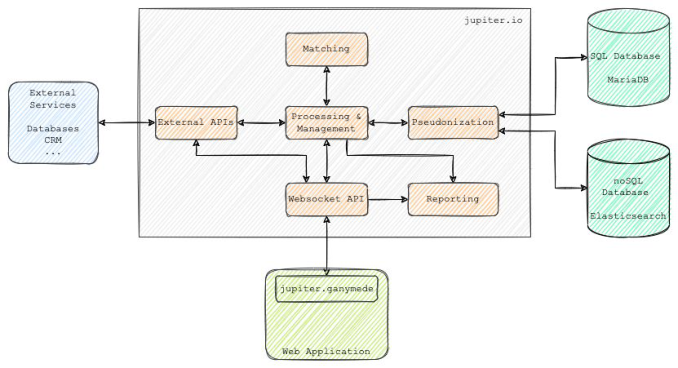
Figure 1: Smart live-in care matching platform architecture.
Quality Improvement The process of matching persons in need of care and caregiver should be optimized and supported digitally. To accomplish this objective, an innova- tive, new approach with a matching algorithm design specifically for this use cases is developed.
Solution Design & Architecture After evaluating the required features throughout the analysis-phase, a proper design and architecture had to be planned. Over the past years the Huemer Group R&D team has developed a framework, called jupiter framework, which was used for realizing this project. Technically, the platform includes the following components in Figure 1.
jupiter.io Backend framework written in Scala. This component basically includes all the logics needed for the various processes. It furthermore includes our deve- loped matching algorithm. The matching algorithm is based on the BM25 algorithm taking term frequency (TF) and inverse document frequency (IDF) into account. The algorithm is generating a score based on the weighted answer set defined for the questionnaire. Weighted answer set means, that not every question has the same weighting, and thus the score is differently affected by different questions. Overall, the outcome of the algorithm means: the higher the score gets, the better the match fits.
jupiter.ganymede Frontend framework based on React with TypeScript. The platform is developed as a website but is also especially designed for mobile use on dif- ferent devices. The communication between frontend and backend is based on a secure websocket connection.
MariaDB SQL database used for storing basic user data.
Digital Matching for Live-in Care 381
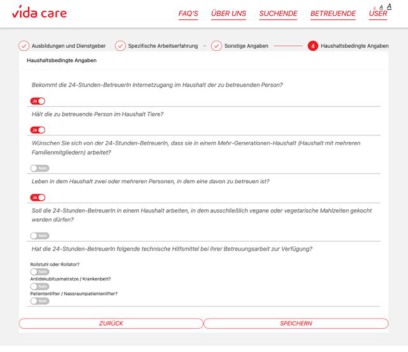
Figure 2: Matching questionnaire.
Elasticsearch NoSQL database used for storing questionnaire answers for our matching algorithm.
Smart Live-In Care Matching Platform The smart live-in care matching platform was developed as a smart, digital solution in cooperation with vida, a trade union in Austria. The platform offers extensive information for all involved users and groups.
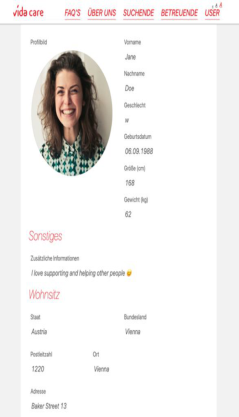
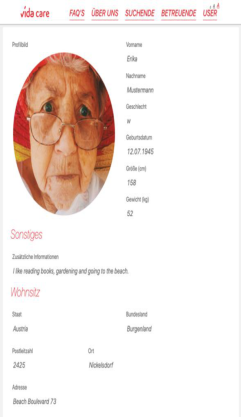
Family members, persons in need of care and caregivers can register on the platform. Persons in need of care do not have to register for their own account, family members can add profiles for their relatives in need of care. Example profiles of a caregiver and a person in need of care are shown in Figure 3 and Figure 4.
Both parties, family members or persons in need of care and caregivers, have to fill in a questionnaire on the platform about their needs or skills. This questionnaire is the basis for the matching process, which includes the developed matching algorithm (Figure 2).
The result of the matching algorithm is shown as a result-search-set for both parties. They can now look through the different profiles and declare their interest in selected persons. If one party is interested in an opposite party, they can get in contact directly from the platform via the chat or videocall function. This enables both parties a quick interaction without leaving the platform and thus without any trouble.
The platform is furthermore designed to help both parties in setting up an appropriate contract and fulfill all necessary regulations and laws. Before setting up the contract, a “needs assessment responsible” is being involved into the process to check whether the match is a real fit and the needs have been properly elicited.
To assure quality, a process was established to regularly contact both involved parties and check the current situation and satisfaction.
Figure 3: Profile of caregiver.Figure 4: Profile of person in need of care.
Future developments aim towards an AI (artificial intelligence) assistant to ensure an even higher availability of single point of live-in care assistance. The AI should help involved parties with specific questions, and further automate several processes, e.g., automatic contract handling in respect to changes of regulations and local laws.
CONCLUSION
Live-in care is a broad field with many involved users and groups. The amount of administrative, regulative, and legal knowledge overwhelms
Digital Matching for Live-in Care 383
persons in need of care, their families as well as caregivers. Our platform is a first step into a digital future of live-in care, especially in the area of finding the best match. We expect the market of digital live-in care soluti- ons to grow over the next years, as more and more features can be offered to caregivers and persons in need of care. We are eager to further develop such exciting and innovative products by using state-of-the art technologies and human centric design. We think that IoT (Internet-of-Things) could also add important value to live-in care in the future. For example, a sensor could detect if a person in need of care has fallen on the floor and alert the caregiver who can then react quickly and help the person who has fallen. Technology enables us to add value in many areas and shape a society where we can pro- vide solutions for a better life through human-centered analysis, design and development.
ACKNOWLEDGMENT
We want to thank vida, a trade union in Austria. They enabled us to par- ticipate in this interesting project and were deeply involved throughout the whole analysis process.
REFERENCES
Aulenbacher, B., Leiblfinger, M., & Prieler, V. (2018). Ein neuer Sorgenmarkt im Wohlfahrtsstaat: 24-Stunden-Betreuung in Österreich und Dienstleistungsange- bote von Wiener Vermittlungsagenturen. In U. Filipic∨, & A. Schönauer, Zur Zukunft von Arbeit und Wohlfahrtsstaat - Perspektiven aus der Sozialforschung (pp. 47–57). Arbeiterkammer Österreich. Mairhuber, I., & Allinger, B. (2021). Transnationale Betreuungs- und Pflegekräfte in
europäischen Privathaushalten. Retrieved from Endbericht für die AK Wien Abtei- lung Gesundheitsberuferecht und Pflegepolitik : chrome-extension://efaidnbmnn nibpcajpcglclefindmkaj/viewer.html?pdfurl=https%3A%2F%2Fwien.arbeiterk ammer.at%2Fservice%2Fstudienundzeitschriften%2Fstudien%2Fgesundheitun dpflege%2FTransnationale_Betreuungskraefte_20210420.pdf&clen=2578333 Rogalewski, A., & Florek, K. (2020). European Economic and Social Committee. Retrieved from The future of live-in care work in Europe: https://www.eesc.europa.eu/sites/default/files/files/report_on_the_eesc_countr y_visits_to_uk_germany_italy_poland_0.pdf Steiner, J., Prieler, V., Leiblfinger, M., & Benazha, A. (2019/ 44). Völlig legal!? Rechtliche Rahmung und Legalitätsnarrative in der 24h-Betreuung in Deutschland, Österreich und der Schweiz. Österreichische Zeitschrift für Soziologie, pp. 1–19. Tarricone, R., & Tsouros, A. D. (2008). Home Care in Europe. World Health
Organization. Retrieved from chrome-extension://efaidnbmnnnibpcajpcglclefi ndmkaj/viewer.html?pdfurl=https%3A%2F%2Fwww.euro.who.int%2F__data %2Fassets%2Fpdf_file%2F0005%2F96467%2FE91884.pdf Weiss, A. (2021). Arbeit&Wirtschaft. Retrieved from 24-Stunden-Betreuung: ziemlich allein gelassen: https://www.arbeit-wirtschaft.at/24-stunden-betreuung-pand emie/
LISTED IN THE AHFE DIGITAL BOOKSTORE CATALOGUE
Explore the complete digital volume
The Human Side of Service Engineering
Read this individual research paper free through the original publisher, or explore the full digital proceedings book.
ISBN 978-1-958651-38-4
Explore this ISBN in the AHFE Bookstore ↗Listed in the July 2026 bookstore catalogue; search by ISBN to confirm current availability · Digital book purchase optional