Unmesa Ray, Abdulaziz Banawi (2022). Development of A Smart Database for Construction Inventory Management Using Deep Learning to Eliminate Supply Chain Bottlenecks Post COVID-19. In: Human Factors in Software and Systems Engineering. AHFE Open Access, vol. 61, pp. 31–37. https://doi.org/10.54941/ahfe1002520
The COVID-19 pandemic has sent shockwaves down the supply chains of industries. The Architecture, Engineering, and Construction (AEC) industry is used to cyclical downturns, but the speed and strength with which COVID-19 has struck are unprecedented. Projects are being delayed or canceled. Supply chains are under threat. National and International policies are being revamped to deal with the transformed landscape. In 2019, the USA receives more than 530 thousand metric tons of steel from Russia, Germany, Italy, Canada, Mexico, and other such countries. The US building industry is dependent largely on other countries for the supply of raw materials, which make the construction industry at risk due to trade restrictions that have ensued in the post COVID world. One way to deal with such a changing environment is to diversify the dependence portfolio in supply chains to reduce shocks. The other alternative is to look to build an inventory based on predictive analytics. This research aims to implement the two reactionary measures of portfolio diversification and inventory infrastructure development by leveraging predictive analytics and big data. The project will be mainly divided into three phases – PHASE 1 will be mainly focused on the gathering of the relevant manufacturer and supplier data of construction materials both within and external to geographical borders of the USA. PHASE 2 will focus on the selection and integration of algorithms with the live database that has been created in phase 1. PHASE 3 will be devoted to the creation of custom-made user interfaces for the project owners. This phase will also focus on the automation of live reports, notifications,s, etc. to be sent to project owners. The deep learning algorithms would need continuous feedback and improvement to increase their credibility and reliance on a continuous basis. Thus, it will help to reduce the risks generated through uncertainties by developing a resilient smart responsive database that will provide stockholders accurate data and predictions in response to the market and industry behavior.
Supply chains are susceptible to intermittent shocks and the pandemic has reiterated the statement. Countries, organizations, and individuals are seeing
a tectonic shift in which traditional supply chains have been working in the pre-COVID times. National and international policies are being revamped in order to deal with the transformed landscape. “As a consequence of all this, manufacturers worldwide are going to be under greater political and compe- titive pressures to increase their domestic production, grow employment in their home countries, reduce or even eliminate their dependence on sources that are perceived as risky, and rethink their use of lean manufacturing stra- tegies that involve minimizing the amount of inventory held in their global supply chains” (Suniya. S. Luthar, 2007).
The USA is dependent to a large extent on other countries for the supply of raw materials for construction. According to www.statista.com, “With expenditures reaching over 1,293 billion U.S. dollars, the United States is one of the largest construction markets worldwide”. Heavy dependency on global manufacturers and suppliers can put the construction industry at risk due to trade restrictions that have ensued in the post COVID world. One way to deal with such a changing environment is to “address heavy dependence on one medium- or high-risk source (a single factory, supplier, or region) is to add more sources in locations not vulnerable to the same risks” (Giulia Cerè, 2018). In addition to distributing the dependence portfolio a country or an organization,” should determine how much extra stock to hold in the interim, in what form, and where along the value chain” (Sarah Forbes, 2018).
This research study focuses on the implementation of the two reactio- nary measures that have been discussed in the previous paragraph. The first of which is to make the construction supply chain resilient by empowering project stakeholders to make the dependence portfolio diverse. This study intends to leverage predictive analytics to provide the project stakeholders with resilient alternatives (Manufacturers and Suppliers) with respect to the procurement of construction materials. Secondly, it addresses the issue of inventory planning and optimization by predicting the demands of building materials in the next.
The study aims to address the research gap, where so far, the supply chain decision making has been based primarily on reductionist approaches (Willy C. Shih, 2020). There is a need to look beyond just the realms of lean supply chains (Emad Mohamed, 2016). Secondly, the framework of this study also aims to address the issue of inventory capacity management to ensure an optimum supply of construction materials as and when required.
OBJECTIVES The focus of this research is to revamp the way in which construction sup- ply chains are operating presently, by leveraging big data and analytics. The COVID-19 pandemic has disrupted supply chains across industries and has made it clear that the need of the hour is to look at supply chains not only in quantitative terms of Key Performance Indicators, like profit, revenue, and growth but also, in qualitative terms like the effect of a crisis on existing value chains in industries. The value chain of a construction sector supply chain typically consists of its various stakeholders such as the project owners, contractors, subcontractors, site engineers, etc. There is a need to make
Development of a Smart Database for Construction Inventory Management 33
the decision-making process of these stakeholders insightful and data-driven (Mohd Nasrun Mohd Nawi, 2014).
To make the decision-making process data-driven, this study conceptuali- zes the prototype of a smart database that draws information from live data feeds of construction materials demand and supply on the internet and proje- cts its predictions to enable smart inventory planning. The research also aims to gain insights into the financial and production stability of manufacturers and suppliers to plan for a better choice of stakeholders.
A Data-Driven Approach to Tackle Supply Chain Disruptions When it comes to data-driven insights, one of the main factors that still pla- gues the supply chains of the construction industry is the unavailability of robust and reliable datasets (Muhammad Bilal,2016). There is a need for an efficient mechanism to collect, evaluate and store consistent data that can be used to derive meaningful insights into the end-to-end working of construction supply chains.
The various financial and production parameters of a company are a cru- cial indicator of its health. This makes it important for the project manager to make decisions regarding the manufacturers or suppliers to choose the most ideal candidates for the project. This study aims to conceptualize a user interface that will help in a more insightful decision-making process by highlighting the KPIs such as production capacity, supplier reach, company revenue, etc.
METHODOLOGY
This research was divided into three stages initial analysis, concept integra- tion, and final validation analysis.
The first phase was focused on the gathering of datasets of imports of critical building materials like cement and steel in the USA from various open- source websites and doing an exploratory data analysis through the extract, transform and load (ETL) approach. This was followed by running necessary imputations and modifications on the dataset to make it time series native. The exploratory data analysis phase also gave us critical insights into the various components of trend, seasonality, and noise that are present in the time-series data. This further guided in selecting an appropriate time series model such as ARIMA, SARIMAX, etc. for the analysis in the second phase of the research.
The second phase of the research was centered around running simulations using the selected time series algorithms. For the same, using the past data from the economic recession period and the year 2008 was used as the criti- cal year of reference. (The filing of bankruptcy of the Lehman Brothers). In this phase, the focus was on the inventory capacity management of building materials by forecasting the imports and demands of these materials in the USA for a time frame of the next ten years.
The third phase of the research was mainly focused on the conceptualiza- tion of an interactive user interface that would enable the stakeholders of a
34 Ray and Banawi
Figure 1: Diagram showing data extraction process.Figure 2: The dataflow matrix.
project to take optimum decisions based on the predictive analytics results provided.
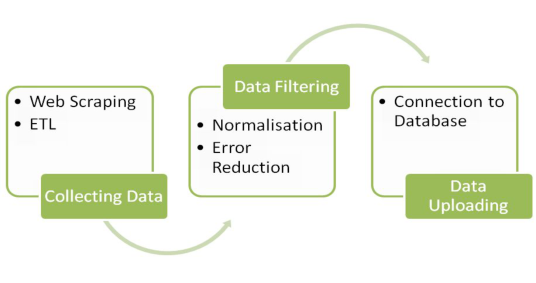
Since it will be using highly fragmented and distributed datasets through web scraping on the internet, it will be of utmost importance to run the simu- lations after properly fine-tuning the datasets. Figure 1 below shows how data was collected and stored in the database.
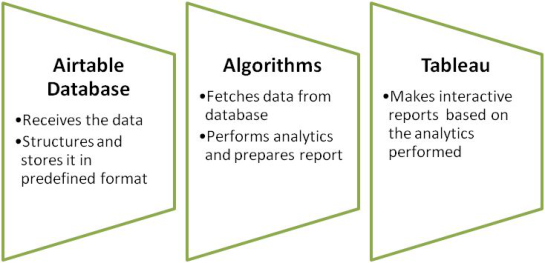
Algorithm Design and Implementation The time series algorithms will be dealing primarily with two questions. Fir- stly, what is the demand for construction materials in the USA going to look like in the next 10 years? Secondly, for the given demand, are the manufactu- rers, suppliers, and the inventory ready. Figure 2 below shows the dataflow architecture that was designed to get the results.
Prediction of Demand in Construction Materials in the USA The demand for construction materials in the USA was done by a predictive time series algorithm that was fed the consumption patterns of building mate- rials in the USA with 2008 (Year of the financial crisis) as the year of reference. This helped understand the consumption patterns in the aftermath of the COVID-19 pandemic, which is also staring at the face of recession.
Development of a Smart Database for Construction Inventory Management 35
Figure 3: The various layers of data processing and automation hierarchy.
Prediction of Production Capacity of Building Materials in the USA The next step was to look at the production patterns of the USA in the last 15 years (2005 -2020), in order to predict how much building materials the country can produce in the next 10 years. This was primarily done to under- stand the demand and supply gap of indigenously produced building mate- rials as “The pandemic also represents a shock to supply.”(McKinsey,2021). A positive gap would have meant underproduction of building materials and a negative gap, an overproduction.
Importing and Analysing live Data Regarding Construction Manufacturers and Suppliers There was a need to create a database to import live data of variables such as production capacity, supplier reach, the financial health of various manu- facturers and suppliers in the USA. We used the “google finance” module in google sheets to import the live data into google sheets.
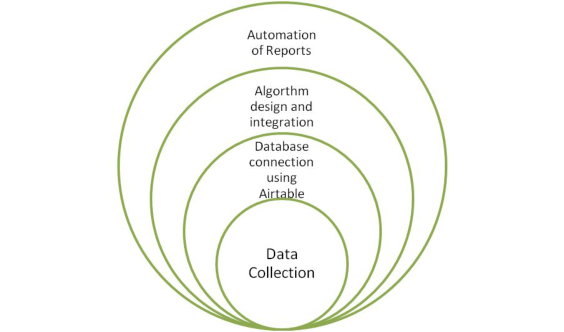
The next step was to connect this live data to a database that can then render the results in the form of an interactive user interface. For this, the “Airtable” tool was connected to google sheets through an API (Application Programming Interface). A layered approach was followed where every indi- vidual sheet in google sheets was connected to a specific database table in Airtable. This was primarily done to run the time series algorithms indivi- dually on different variables such as production capacity or financial health of an organization and then display the results as individual components of the user interface. Figure 3 below shows the automation hierarchy that was implemented.
RESULTS AND DISCUSSION
Results for Inventory Analysis An initial analysis of monthly demand and supply data for steel was carried out using time series algorithms and tableau. Monthly data for the demand
36 Ray and Banawi
and import of steel was obtained from www.usgs.gov. The annual and mon- thly data was then fed to a time series model running under the ARIMA model and the results thus obtained show that 27% of the shipments that were ordered to meet the project requirements will get delayed in the fourth quarter of 2021. If such delays take place then there is a high probability that the construction projects that are relying on these shipments will get affected thereby leading to suspension or even cancellation of these projects.
We also noticed that there was an inventory that was shipped early, and this comprised close to 45% of the shipment. This needed a proper manage- ment and storage infrastructure to make sure that the materials are under a controlled environment to ensure usable condition.
Results for Smart Database and Interactive User Interface Prototyping The predictive results from the Airtable database were transformed into an interactive card-based user interface using the in-built capabilities of Airtable.
The interface displayed the current live data as well as the predicted data for the next 3 months using a 90-day moving average method. The interface cards were kept flexible to accommodate data that was needed to be displa- yed on priority. The organization names have been abstracted in the below figure. This has been done to ensure confidentiality.
The database was also integrated with a smart notification feature that sends the project stakeholders customized notifications for tracking inventory.
CONCLUSION
Inventory management of construction materials with the help of smart data- bases is an optimal way to make sure that there is an uninterrupted supply of materials on site. There is a need for organizations to diversify their portfo- lio of suppliers and manufacturers in order to choose the ones that have the maximum output in terms of both revenue and quality.
The supply chain of the construction sector is highly fragmented (Ashik Talupula,2018) and there is an underlying need to integrate the existing value chains in the sector. This can be achieved through a holistic transformation of the way in which the metrics of a traditional supply chain are monitored and measured.
Time series algorithms have been tried and tested in order to under- stand consumption patterns of building materials (Mohd Nasrun Mohd Nawi,2014) and supply chains (Willy C. Shih,2020). Therefore, the appli- cation of time series algorithms to accurately forecast multidimensional data such as the construction materials supply data should be a good choice in the future as well.
REFERENCES
A. Chmitorz, A. Kunzler, I. Helmreich, O. Tüscher, R. Kalisch, T. Kubiak, M. Wessa, K. Lieb, Giulia Cerè, Yacine Rezgui, Wanqing Zhao, A critical review of existing built
environment resilience frameworks: Directions for future research, International Journal of Disaster Risk Reduction, Volume 25, 2017, Pages 173–189
Development of a Smart Database for Construction Inventory Management 37
Intervention studies to foster resilience – A systematic review and proposal for a resilience framework in future intervention studies, Clinical Psychology Review, Volume 59, 2018, Pages -78–100 Limon Barua, Bo Zou, Yan Zhou, Machine learning for international freight tran-
sportation management: A comprehensive review, Research in Transportation Business & Management, Volume 34, 2020, Pages 100–153. Luthar SS, Cicchetti D, Becker B. The construct of resilience: a critical evaluation and guidelines for future work, Child Dev, 2000, Volume 71(3), Pages 543–562 Mohd Nawi, Mohd Nasrun & Baluch, Nazim & Bahaudin, Ahmad Yusni. (2014).
Impact of Fragmentation Issue in Construction Industry: An Overview. MATEC Web of Conferences. 15. 10.1051/matecconf/20141501009. Muhammad Bilal, Lukumon O. Oyedele, Junaid Qadir, Kamran Munir, Saheed O.
Ajayi, Olugbenga O. Akinade, Hakeem A. Owolabi, Hafiz A. Alaka, Maruf Pasha, Big Data in the construction industry: A review of present status, opportunities, and future trends, Advanced Engineering Informatics, Volume 30, Issue 3,2016, Pages 500–521 https://www.mckinsey.com/business-functions/operations/our- insights/covid-19-and-supply-chain-recovery-planning-for-the-future Udara Ranasinghe, Marcus Jefferies, Peter Davis, Manikam Pillay, Resilience Engineering Indicators and Safety Management: A Systematic Review, Safety, and Health at Work, Volume 11, Issue 2, 2020, Pages 127–135 Willy C. Shi, 2020, “Global Supply Chains in a Post-Pandemic World”: Harvard
Business Review, Web
LISTED IN THE AHFE DIGITAL BOOKSTORE CATALOGUE
Explore the complete digital volume
Human Factors in Software and Systems Engineering
Read this individual research paper free through the original publisher, or explore the full digital proceedings book.
ISBN 978-1-958651-37-7
Explore this ISBN in the AHFE Bookstore ↗Listed in the July 2026 bookstore catalogue; search by ISBN to confirm current availability · Digital book purchase optional