Ruiyuan Hong, Kai Qu, Shan Gao, Lei Wang (2022). Pilot's Visual Attention Allocation When Taking Risk in Flight Simulator. In: Human Factors in Transportation. AHFE Open Access, vol. 60, pp. 607–614. https://doi.org/10.54941/ahfe1002496
Pilots play a key role in the flight deck and their visual attention allocations also strongly affect their flight risk-taking behaviors. This study aims to investigate the pilot’s patterns of visual attention allocation during an approach with low visibility. A total of 20 professional airline pilots were recruited to conduct an approaching task on a B737-800 flight simulator with high fidelity, and 19 of them provided valid data. We collected their eye movement data during the task. Meanwhile, according to their risk-taking behaviors (go around or land), they were divided into a safe group or risky group. Results showed that the distribution of visual attention was related to the pilot’s visual areas of interest (AOIs), but the risk-taking behaviors were not affected by the fixation parameters. Our findings provide empirical insights about pilots’ visual attention allocation during approach and suggestions for optimizing the design of the instrument in the cockpit.
Flight safety is key to the development of the aviation industry. Although pilots often activate the autopilot mode during the most time of a flight (crui- sing), they need manually control the aircraft during takeoff and land, which are the most accident-prone stages. “To err is human”means humans inevita- bly making mistakes, especially under adverse weather conditions. According to the Safety Report from the International Air Transport Association (IATA), meteorology ranked the first place (35%) of all threatening factors in aircraft accidents during the recent five years (2017-2021). To reduce the probability of human errors, the critical stages of a flight under abnormal weather are noteworthy to investigate (Wang and Sun, 2021).
Vision is the main channel of receiving information. Kasarskis et al. (2001) found that pilots’ attention allocation affected their flight performance. Gao and Wang (2020) indicated that the pupil diameter and mean scanning speed of participants with good safety performance were greater than those with poor safety performance. Endsley (1996) showed that flight information from the head-up display (HUD) and external visual information competed for pilots’ attention resources, and affected flight performance. Liu and Su (2016) found that participants allocated more attention to the inside of the cockpit compared with the outside information, and expert pilots paid less
attention to the cockpit than novices. Wang and Gao (2020) explored the eye movement pattern of flight cadets during an approach, and the results sho- wed that the eye movement parameters (including fixation counts, average fixation duration, the proportion of fixation time, and pupil diameter) could indirectly reflect the attention distribution pattern and mental workload of flight cadets. However, the results from this topic seem to be conflicting, suggesting that attention allocation sometimes does not affect performance. For example, Bai et al. (2018) explored the effect of low visibility on pilot information processing, and the results showed that there was no significant correlation between them. Due to the contradictions in the previous studies, it is important to investigate the visual attention allocation in critical flight stages.
Adverse weather was generally designed in flight simulators to cre- ate a stressful situation in the aviation domain (Pauley et al., 2008; Andrzejczak et al., 2014; Wang et al., in press). To explore the pilot’s patterns of visual attention allocation in an approach, we designed a flight simulated task under low visibility based on a B737-800 flight training device with high fidelity.
METHODS
Participants A total of 20 participants (10 captains and 10 first officers, all-male) from an airline participated in this experiment. Since the eye movement data of one captain was lost, 19 commercial airline pilots provided valid data for analysis. They were aged from 26 to 41 (M = 30.895, SD = 4.081), the mean of total flight hours was 6206.895 (SD = 3809.214), and the mean of total experienced hours was 5100.579 (SD = 3436.936).
Apparatus In this experiment, a B737-NG (Next Generation) flight training device was used to design, test, and implement the flight scenario. An eye-tracker (Tobii Glasses 2) was used to collect eye-movement data.
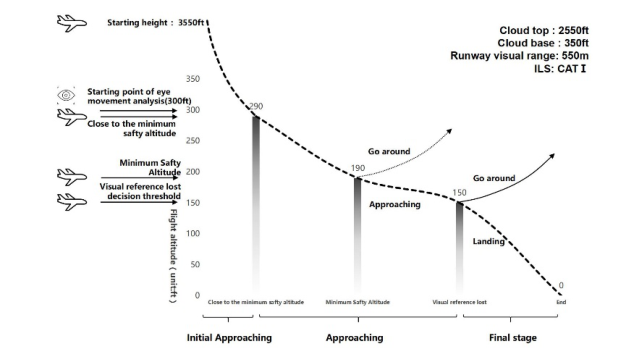
Design An approach task under low visuality was designed to explore the relation- ship between the pilot’s visual attention allocation and risk-taking behaviors. The initial altitude of the aircraft was set at 3,550 feet (above ground level, AGL), 15 nautical miles away from the runway with 180 knots speed and 359 degrees heading. The weather was reported as cloudy with 2550 feet top and 350 feet base. In the final approach, the weather condition was turned to marginal meteorology at 190 feet (the minimum decision altitude), reque- sting pilots to make their first decision to go around or continue approaching. When pilots decided to continue landing, they experienced a temporary visual reference loss at 150 feet. They should redecide to go around or land. The procedure of this experiment is shown in Figure 1.
Pilot’s Visual Attention Allocation When Taking Risk in Flight Simulator 609
Figure 1: The diagram of the flight simulated task.
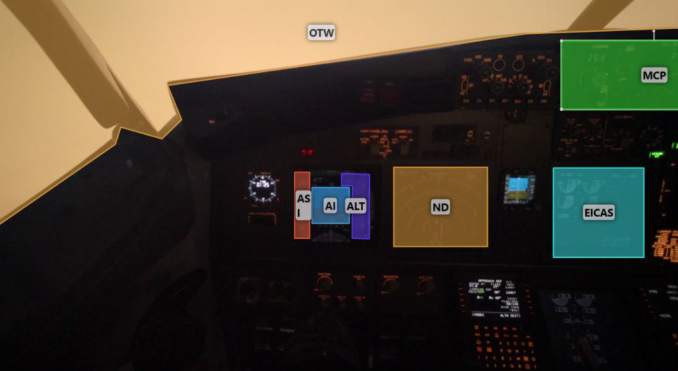
According to the rules of the Civil Aviation Administration of China, pilots should go around immediately if they cannot establish a visual refe- rence (visualizing the runway or continuously introducing lights) under the minimum decision altitude (Civil Aviation Administration of China, 2018). Therefore, the pilots who decided to go around or land were classified as the safe group or risky group respectively; we focused on seven area of inte- rest (AOI): Out of the Window (OTW), Airspeed Indicator (ASI), Attitude Indicator (AI), Altitude Indicator (ALT), Navigation Display (ND), Engine Indication and Crew Alerting System (EICAS) and Mode Control Panel (MCP) (see Figure 2). We took a two-factor mixed design (between-subject: risk-taking behavior; within-subject: AOI).
Figure 2: The seven AOI of this study.
Procedure Before the experiment, all participants signed informed consent to allow their data to be used for academic research. Then, a researcher detailly explained the experimental procedures, aircraft and environment information. Parti- cipants were informed that they need to conduct a CAT I approach in this task and their eye movement data were collected. Subsequently, they ente- red the simulated cockpit and wore the eye tracker with the assistance of a researcher. Before the experiment started, they had 20 minutes for practicing. After the participants reported that they were ready, the experiment officially began. The participants performed an ILS land (CAT I). An ATC reported the runway visual range (RVR) was 550m (clear for landing). Pilots who decided to go around should follow the missed approach procedure, and their expe- riments would be finished immediately. For pilots who decided to land, their experiments would be finished after they landed on the runway. The whole experiment lasted about 10 minutes.
Data Analysis For the participants who decided to go around, their fixation parameters were collected from 300ft to the moment of go-around (the green signal of “TO/GA” (take-off/go-around) is lighted on PFD when pilots press the go- around button). For participants who decided to land, fixation parameters were collected for an equivalent duration. The Proportions of fixation count and duration in different AOI were extracted.
We used SPSS version 25.0 to analyze our data. To examine the impact of attention allocation on flight risk-taking behaviors, we chose AOI and risk-taking behaviors as independent variables and attention parameters (the Proportions of fixation count and duration) as dependent variables, a two-way repeated measure ANOVA was conducted. The assumption of sphericity was verified by using Mauchly’s test and the violation of sphe- ricity was corrected by Greenhouse-Geisser. The Bonferroni was conducted to perform pairwise comparisons after a statistically significant interaction. The effect size of factors and interactions were quantified by partial eta square (ηp2).
RESULTS
Table 1 showed the means and standard deviations of fixation count propor- tions and fixation duration proportions in the seven AOI. Participants paid more attention to OTW than to other AOI in the final approach but paid no attention to MCP.
Effect of Visual Attention Allocation on Flight Decision All participants decided to continue their approach at the minimum deci- sion altitude (190ft). And when the visual reference was lost at 150ft, seven participants decided to go around while the other twelve decided to continue landing.
Pilot’s Visual Attention Allocation When Taking Risk in Flight Simulator 611
Table 1. Means and standard deviations of fixation parameters in different AOI.
Table available in the original PDF paper.
Fixation parameter Area of interest (AOI) M SD Proportions of fixation count (%)
0.533 1.709
Out of the Window (OTW) 29.957 23.692 Airspeed Indicator (ASI) 2.004 2.687 Attitude Indicator (AI) 19.471 16.951 Altitude Indicator (ALT) 7.680 7.168 Navigation Display (ND) 4.984 7.877 Engine Indication and Crew Alerting System (EICAS) Mode Control Panel (MCP) 0.000 0.000 Proportions of fixation duration (%)
0.323 1.107
Out of the Window (OTW) 30.528 24.939 Airspeed Indicator (ASI) 1.012 1.374 Attitude Indicator (AI) 21.967 20.088 Altitude Indicator (ALT) 5.490 5.880 Navigation Display (ND) 2.562 3.421 Engine Indication and Crew Alerting System (EICAS) Mode Control Panel (MCP) 0.000 0.000
Table 2. Repeated measure ANOVA with flight risk-taking behaviors and AOI as independent variables.
Table available in the original PDF paper.
Dependent variable Source of variation df MS F ηp2 Proportions of fixation count
The results of the two-way repeated measure ANOVA showed that there were significant differences in the Proportions of fixation count and fixation duration among the seven AOI (all ps < 0.01) (see Table 2), that is, there were significant differences in the allocation of visual attention to different instru- ments and external environment. However, the main effect of risk-taking behaviors and the interaction effect of risk-taking behaviors and AOI were not significant (all ps > 0.05).
Pairwise Comparisons of Fixation Parameters in Different AOI The results of Pairwise comparisons were shown in Table 3. Pilots allocated significantly more attention to OTW than to ASI, EICAS or MCP. Besides, there was no significant difference among other AOI.
Perception has a direct impact on decision-making, that is, people make deci- sions based on their perceived external information (Plous, 2004). Fixation pattern is an important factor affecting pilots acquiring visual information (Wang and Ren, 2017). In this study, no matter whether the participants decided to go around or not, both of them paid more attention to the inside area of cockpit, than to the outside area. Meanwhile, compared with each other AOI in this study, OTW attracted more attention in the final approach. That is to say, in this period, they paid their attention not only to the instru- ments in the flight deck to obtain an appropriate awareness of the aircraft state, but also to the information from outside to establish a visual reference for land or go around.
Specifically, other than to the OTW, among the instruments in the cockpit, participants all allocated attention to each one without significant differences, which is different from Liu and Su (2016). AI was allocated more attention in their study. However, Liu and Su (2016) also indicated that attention allo- cation would be adjusted as pilots carry out tasks with different difficulties. To some extent, it is contradictory to the irrelevance between the fixation parameters and the pilots’ risk-taking behaviors (go around or land) in our results. A possible explanation is that the influence of different flight sce- narios on visual attention. Our study designed a low visibility condition for airline pilots, while Liu and Su (2016) recruited pilots to perform aerobatic tasks in a normal visual condition. Similarly, under a low visibility condition,
Pilot’s Visual Attention Allocation When Taking Risk in Flight Simulator 613
Bai, et al. (2018) and Graber (1998) reported that compared to the high- visibility condition, participants paid more attention to the outside view of the cockpit, which validated our finding. This also implied that pilots may make some adjustments to the pattern of attention allocation under different task demands (Niu, et al., 2013).
In addition, some previous studies indicated that pilots showed signifi- cant differences in their scanning paths and areas during a flight. Ho, et al., (2016) compared the visual attention differences between fighter pilots and civil pilots. The former paid more attention to the outside visual scene of the cockpit, while the latter mostly paid more attention to the PFD information. For our participants, commercial airline pilots should perform a go-around at any altitude once they cannot visualize the runway or continuously intro- ducing lights in the final approach at 190ft (Civil Aviation Administration of China, 2018). Hence, they had to pay enough attention to the outside area of the cockpit in such a low visibility context.
CONCLUSION
This study investigated the pilot’s patterns of visual attention allocation in the final approach under low visibility in a B737-800 flight simulator. We found that the distribution of visual attention was related to the pilot’s visual area. Specifically, pilots paid more attention to OTW than to ASI, EICAS or MCP. And there was no significant difference of visual attention allocation among other AOI. Besides, we did not find a main effect of the pilot’s visual attention allocation on their flight risk-taking behaviors. Our findings are expected to help designers to optimize the cockpit interface layout, and improve pilots’ efficiency of visual attention allocation.
ACKNOWLEDGMENT
The authors would like to appreciate the support of the National Natural Science Foundation of China (grant no. 32071063).
REFERENCES
Andrzejczak, C., Karwowski, W. and Thompson, W. (2014) ‘The identification of factors contributing to self-reported anomalies in civil aviation’, International Journal of Occupational Safety and Ergonomics, 20(01), pp. 3–18. Bai, J., Liu, S. Y. and Yang, K. (2018) ‘Effect of different visibility on pilot’s eye
movements during take-off’, Chinese Journal of Ergonomics, 24(02), pp. 17–21. (in Chinese). Civil Aviation Administration of China (CAAC). (2018) The general operation and flight rules – No. 91. 119: minimum safety altitude. Beijing: Policy and Regulation Department, Standard No. CCAR-91-R3. (in Chinese). Gao, S. and Wang, L. (2020) ‘Effects of mental workload and risk perception
on pilots’ safety performance in adverse weather contexts’, Proceedings of the International Conference on Human-Computer Interaction, 12187, pp. 278–291. Graeber, D. A. and Andre, A. D. (1999) ‘Assessing visual attention of pilots while using electronic moving maps for taxiing’, Proceedings of the 10th International Symposium on Aviation Psychology, 2, pp. 791–796.
Ho, H. F., Su, H. S., Li, W. C., Yu, C. S. and Braithwaite, G. (2016) ‘Pilots’ latency of first fixation and dwell among regions of interest on the flight deck’, Interna- tional Conference on Engineering Psychology and Cognitive Ergonomics, 9736, pp. 389–396. Jones, D. G. and Endsley, M. R. (1996) ‘Sources of situation awareness errors in
aviation’, Aviation, Space, and Environmental Medicine, 67(6), pp. 507–512. Kasarskis, P., Stehwien, J., Hickox, J., Aretz, A. and Wickens, C. (2001) ‘Comparison of expert and novice scan behaviors during VFR flight’, Proceedings of the 11th International Symposium on Aviation Psychology, 6. Liu, Z. F. and Su, H. (2016) ‘Exploring the individual and task difficulty differe-
nce of situation awareness in aviation working environment: the advantages of eye tracking method’, Chinese Journal of Applied Psychology, 22(01), pp. 12–25. (in Chinese). Niu, S. F., Lu, Z. S. and Lu T. J. (2013) ‘Analysis on eye movement indices based on simulated flight task of fighter pilots’, Progress in Modern Biomedicine, 13(34), pp. 6776–6780. (in Chinese). Pauley, K., O’Hare, D. and Wiggins, M. (2008) ‘Risk tolerance and pilot involvement
in hazardous events and flight into adverse weather’, Journal of Safety Research, 39(4), pp. 403–411. Plous, S. (2004) The Psychology of Judgement and Decision Making. Translated from the English by Wang, X. and Shi, J Q. Beijing: Posts & Telecom Press, 14–15. Wang, J. and Sun, H. (2021) ‘Analysis and prevention of aviation accidents’, Logistics
Sci-tech, 44(01), pp. 81–84. (in Chinese). Wang, L. and Gao, S. (2020) ‘Study on eye movement and physiological characteristics of flying risk-taking behaviors’, China Safety Science Journal, 30(09), pp. 22–28. (in Chinese). Wang, L., Gao, S., Tan, W. and Zhang, J. Y. (in press) ‘Pilots’ mental workload
variation when taking a risk in a flight scenario: a study based on flight simula- tor experiments’, International Journal of Occupational Safety and Ergonomics. doi:10.1080/10803548.2022.2049101. Wang, L. and Ren, Y. (2017) ‘Study on fixation pattern in visual landing’, Journal of Psychological Science, 40(02), pp. 283–289. (in Chinese).
LISTED IN THE AHFE DIGITAL BOOKSTORE CATALOGUE
Explore the complete digital volume
Human Factors in Transportation
Read this individual research paper free through the original publisher, or explore the full digital proceedings book.
ISBN 978-1-958651-36-0
Explore this ISBN in the AHFE Bookstore ↗Listed in the July 2026 bookstore catalogue; search by ISBN to confirm current availability · Digital book purchase optional