Sophie Feinauer, Irene Groh, Tibor Petzoldt (2022). Driver instruction for automated vehicles: Assessing the role of specific elements on learner motivation and mental model development. In: Human Factors in Transportation. AHFE Open Access, vol. 60, pp. 492–500. https://doi.org/10.54941/ahfe1002482
Along with the increasing degree of automation of the driving task, calls for user education on automated driving have emerged. Indeed, previous studies could show positive effects of user education, e.g., on driving performance and mental model development. However, recent research has not yet examined the effectiveness of specific elements in that context. Research in educational psychology has shown that motivation to learn is crucial for learning success. Thus, in the present study we examined the role of specific instructional elements on learner motivation for automated vehicles.Following psychological needs theory, we examined the influence of autonomy and competence on the dependent variables intrinsic learning motivation and mental model development, trust in and acceptance of the automated vehicle. To that end, we developed learning material on an automated vehicle that was embedded in an online study and structured into four topics. Depending on the experimental group, different elements were added to this material to assess their effect on the dependent variables.A total of N = 193 participants took part in the online study. Participants were randomly assigned to one of four groups: (1) A group that could freely choose the order in which they read the provided topics to operationalize the aspect of autonomy. (2) A group that received feedback on answering simple yes/no questions after reading the instructions on each topic to operationalize the aspect of competence. (3) A group that received a combination of both autonomy and competence elements, and (4) a control group that read the material without any further manipulation. Participants’ mental models were assessed with a questionnaire for declarative knowledge and 17 pictures (created in a simulation program) of an automated vehicle from the driver’s perspective in different situations. Participants should anticipate the automated vehicle’s behavior in the given situation and choose the correct action. In addition, to allow for a longitudinal assessment, we also evaluated the dependent variables in a follow-up survey two weeks later.Statistical analysis indicated that combination and competence groups exhibited in tendency more motivation to learn the content than the autonomy and control groups. Incorporation of feedback elements thus seemed to have successfully facilitated learning motivation. Concerning the participants’ mental models, results indicate that the competence group showed a better declarative knowledge compared to the autonomy group, although all groups showed a decline in their knowledge after two weeks. However, concerning situation specific knowledge, no group differences were found. A significant interaction effect indicated that at follow-up, participants in the competence group reported higher trust ratings than the other groups. No significant effects for acceptance were found. Taken together, results indicate that by fostering feelings of competence, mental model formation for automated vehicles can be supported. However, contrary to our expectation, offering learners the freedom to choose their own order of learning did neither facilitate intrinsic motivation nor trust or mental model development. Thus, this study suggests that feedback elements support learning outcomes for driver instruction of automated vehicles and can be incorporated into different means of instruction.
Currently, drivers face a transition phase, in which the driving task is increasingly automated. According to the Society of Automotive Engineer’s taxonomy (SAE, 2018), Level 2 (L2) or partially automated driving functi- ons are available in on the market, which take over lateral and longitudinal guidance. However, the driver always has to supervise the system and the environment. In contrast, Level 3 (L3) functions allow drivers to allocate their attention to non-driving related tasks (NDRT) and issue a take-over request (TOR) when the driver is required to drive manually again. L3 functions are not available on the market yet, however, future vehicles might feature both, L2 and L3 functions (Winner and Merkel, 2017), which leads to a fun- damental change in the interaction between driver and vehicle, and thus to new challenges for drivers (Kyriakidis et al., 2019). In that context, drivers’ mental models are crucial to ensure adequate trust and acceptance (Beggi- ato and Krems, 2013). A mental model is defined as knowledge structure in
Driver Instruction for Automated Vehicles: Assessing the Role of Specific Elements 493
long-term memory that includes the user’s understanding of the automated driving system’s scope, its functionality, and the reasons for system behavior (Carroll and Olson, 1987; Durso and Gronlund, 1999). To support mental model formation, user education is considered a key element (Casner and Hutchins, 2019). Indeed, recent research provides first evidence that user education beyond the user manual enhances, e.g., mental model formation (Krampell et al., 2020).
To design an effective educational concept it is crucial to consider lear- ner motivation (Noble et al., 2020). More specifically, intrinsic motivation (Ryan and Deci, 2000) to learn fosters cognitive processing of the learning material (Cordova and Lepper, 1996) and transfer of learning (Blume et al., 2010). Thus, by enhancing motivation to learn, mental model formation in the context of automated driving could be promoted (Feinauer et al., under review). Following this line of reasoning, we aimed to assess how specific elements can foster learning motivation, as well as mental model formation and development. In addition, we evaluated the effect on trust in and acce- ptance of the automated vehicle. To that end, we developed an instructional concept that provided information on a L2/L3 automated vehicle and imple- mented it in an online study. Information was either enriched with feedback elements, opportunities for choice, a combination of both, or none of these, resulting into four experimental groups. To assess long-term effects of these elements on mental model development, trust, and acceptance, we included a follow-up measurement of these variables two weeks after the manipulation.
METHOD
Instructional Design The content of the instruction was structured into four sections: Human- machine interface, the driver’s responsibilities, functionality, and purpose of the function. The information was provided on two pages of text and figures.
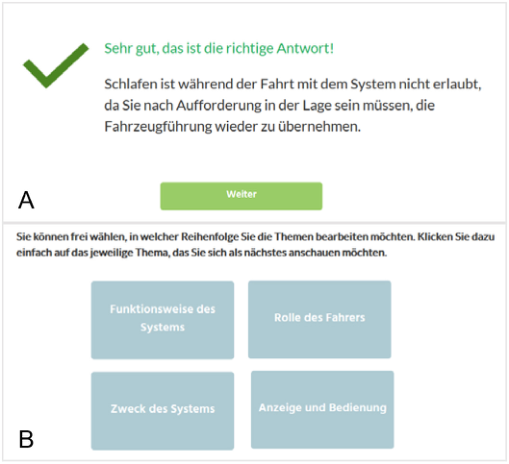
To promote intrinsic motivation, according to basic psychological needs theory (Ryan and Deci, 2017), three needs should be fulfilled: Competence, autonomy, and social relatedness. In the present study we focused on the two needs of competence and autonomy. To fulfil the need of competence, feedback has been shown to be an effective measure (Ryan and Deci, 2017). Thus, yes/no questions at the end of each section were included. After a cor- rect answer a green check mark and ‘well done, this answer is correct’ was displayed (Figure 1a). To enhance feelings of autonomy, conveying choice is a potential measure to provide an autonomy-supportive context (Joussemet et al., 2004). In the present study, participants were free to choose the order in which they read the four sections (Figure 1b). However, all sections had to be read to continue the study. Additionally, in the combination group, both ele- ments (feedback and choice) were included. As a control condition, a fourth group did not receive any of these elements.
Online Study Sample. N = 220 participants completed both parts of the survey. Twenty- seven participants had to be excluded due to a short processing time (below
Figure 1: A: Feedback to a correctly answered question. B: Sections provided which could be read in a freely chosen order.
median time divided by two) or to a long processing time (part one: above 80 minutes, part two: above 40 minutes) for either part of the study. The remai- ning N = 193 participants (44% female) were included in the data analysis. Mean processing times were 31 minutes (SD = 14 min) in part one, and 10 minutes (SD = 6 min) for part 2. Participants were recruited via a German online survey service. The sample’s mean age was 46.3 years (SD = 13.4, min = 20, max = 75). Cell sizes were n = 43 for the combination group, n = 47 for the competence group, n = 46 for the autonomy group and n = 57 for the control group. The four groups’ mean age ranged between 44.6 and 47.5 years and the proportion of female participants between 33% and 58%. Dependent Variables. To measure intrinsic motivation to learn the provi- ded information, the subscale ‘Interest’ of the Intrinsic Motivation Inventory (Ryan et al., 1983) was applied as it has previously been used as self-report measure of intrinsic motivation (Deci et al., 1994). The subscale consists of seven statements, to which participants rated their agreement on a five-point Likert scale.
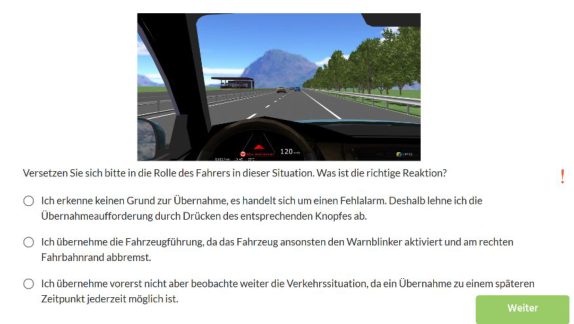
Participants’ mental models were assessed with a self-developed questi- onnaire which included knowledge of the L2/L3 vehicle covered in the instruction. It consisted of 36 statements, to which participants stated their agreement on a 5-point Likert scale. Higher values indicate a better perfor- mance on the questionnaire. In addition, we aimed to measure the transfer of knowledge to situations that could be encountered when using the veh- icle described in the instruction. Twelve situations (e.g., that required a take-over or referred to system functionality) were designed in a CarMa- ker (IPG Automotive, 2019) and displayed as pictures from the driver’s
Driver Instruction for Automated Vehicles: Assessing the Role of Specific Elements 495
Figure 2: Example of an item to measure knowledge transfer to situations.
perspective (Figure 2). Fifteen items were developed in which participants had to anticipate the vehicle’s behavior and choose the correct reaction within a single-choice scheme.
Trust was assessed with the Automation Trust Scale (Jian et al., 2000) in a German translation. Acceptance was measured with the acceptance scale by Van der Laan et al. (1997), which consists of the two dimensions usefulness and satisfaction. Nine pairs of adjectives are rated on a 5-point semantic differential.
Study Design and Procedure. The study employed a two-factorial mixed design with the four-level between factor instruction type and the within factor time of measurement. After giving consent, participants filled out que- stionnaires on trust in and acceptance of the automated vehicle as baseline measure of these constructs. Then, they were randomly assigned to one of the experimental groups and received the instruction, followed by the measure- ment of intrinsic motivation. Afterwards, the questionnaires on acceptance, trust and mental model were filled out. After two weeks, participants recei- ved an invitation for the follow-up, in which again mental model, trust, and acceptance were assessed.
Statistical Procedure and Data Analysis. Data was analyzed and visua- lized in R (R Core Team, 2020) and SPSS (IBM, 2011). To examine the effect of the factor instruction type, we employed an analysis of varia- nce (ANOVA), which always involved the between factor instruction type, and, depending on the dependent variable, a two- (mental model) or three- level (trust, acceptance) within factor for the time of measurement. If the assumption of sphericity (as indicated by Mauchly’s Test) was violated, Greenhouse-Geisser corrected degrees of freedom were used. Due to une- qual cell sizes, the ANOVA was based on Type 3 Sum of Squares (Bortz and Schuster, 2010). In case of a significant effect for instruction type, post- hoc Dunnett tests were computed, in which each group was compared with the control group. An alpha level of α = 0.05 was applied unless stated otherwise.
RESULTS
Intrinsic Motivation A one-factorial ANOVA with the between factor instruction type indica- ted that the experimental groups differed in their motivation to learn the provided information, F(3,189) = 3.20, p = .025, η2
p = 0.05. Post-hoc Dunnett comparisons yielded a significant difference between the control (M = 3.50, SD = 0.80) and combination group (M = 3.85, SD = 0.73), p = .047, and control and competence group (M = 3.78, SD = 0.86), p = .032. The comparison of the autonomy (M = 3.44, SD = 0.93) with the control group was not statistically significant, p = .80. Generally, motivation to learn the provided content tended to be high across all groups.
Mental Model
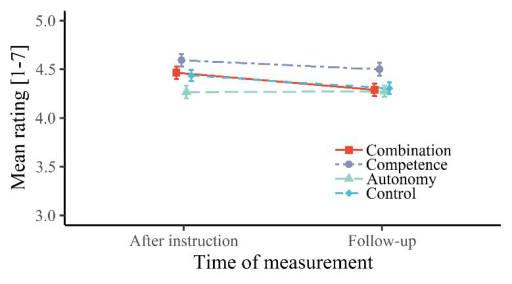
Figure 3 shows the results of the mental model questionnaire. Also concer- ning this dependent variable, ratings on the questionnaire generally tended to be high. The ANOVA yielded significant main effects for instruction type, F(3,189) = 3.90, p = .01, η2
Equation reproduced from the original PDF.
p = 0.08, indicating a decrease in kno- wledge (Figure 3). The interaction effect was not statistically significant, F(3,189) = 2.47, p = .06, η2
p = 0.04. Post-hoc comparisons of the control group with the other groups revealed a significant difference to the compete- nce group, p = .03, but not to the combination, p = .73, or autonomy group, p = .99.
Concerning knowledge transfer, participants in the competence group ach- ieved the highest number of correct answers after the instruction (M = 8.2, SD = 2.6), followed by the combination (M = 7.7, SD = 2.6), control (M = 7.4, SD = 3.1), and autonomy groups (M = 6.9, SD = 2.7). At follow up, similar means were found: On average 8.3 correct answers of the compe- tence group (SD = 2.9), the combination group achieved 7.5 correct answers on average (SD = 2.9), the control group 7.2 correct answers (SD = 2.7) and the autonomy group a mean of 6.9 (SD = 2.4) correct answers. Inferen- tial statistics did neither yield a significant main effect for instruction type, F(3,189) = 2.39, p = .07, η2
Equation reproduced from the original PDF.
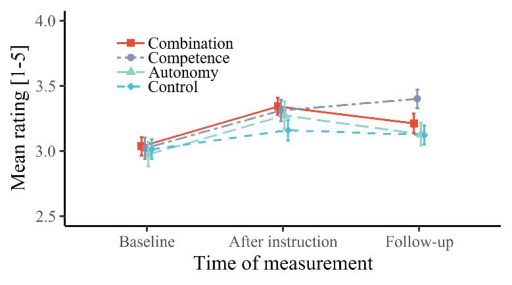
Trust and Acceptance The results of the trust questionnaire are presented in Figure 4. No signifi- cant differences between the experimental groups were found, F(3,189) < 1. The ANOVA yielded significant effects for the factor time of measurement, F(1.81,342.75) = 42.26, p < .001, η2
Equation reproduced from the original PDF.
p = 0.05. As shown in Figure 4, this effect may be caused by an increase in trust ratings of the competence group in comparison to the control group at follow-up.
Concerning acceptance, a multivariate analysis of variance (Wilk’s Lam- bda) of the two scales usefulness and satisfaction revealed no effects of instruction type, 3 = 0.98, F(6,376) < 1, or an interaction effect, 3= 0.94,
Driver Instruction for Automated Vehicles: Assessing the Role of Specific Elements 497
Figure 3: Means (± 1 SE) of the mental model questionnaire at the two times of measurement.Figure 4: Means (± 1 SE) of the trust questionnaire at the three times of measurement.
F(12,492) < 1; however, it yielded a significant effect for time of measure- ment, 3 = 0.94, F(4,186) = 2.87, p = .025, η2
p = 0.06. Following univariate ANOVAs (α = .025) indicated that for the scale useful, ratings increased over the course of the experiment, F(1.90,358.19) = 5.19, p = .007, η2
p = 0.03: Means especially increased from baseline (M = 0.24, SD = 0.67) to after the instruction (M = 0.32, SD = 0.69) and also slightly to follow-up (M = 0.35, SD = 0.64).
DISCUSSION
Based on basic psychological needs theory, the present study examined the effect of specific elements (feedback and choice in task completion) on intrinsic learning motivation and learning outcomes in the context of user education for automated driving.
Results of the intrinsic motivation questionnaire revealed that, indeed, feedback elements promoted learning motivation compared to the control group; a result that is in line with previous literature (Ryan and Deci, 2017). This was also the case when combined with choice in task completion. How- ever, merely having a choice did not enhance motivation to learn. A potential
reason could be that the manipulation was not efficient in inducing feelings of autonomy because participants had to complete all chapters to proceed with the survey and receive full compensation.
Further, we predicted an enhanced mental model formation for the experi- mental groups compared to the control group. Results show that, again, the competence group performed better than the control group, indicating that feedback elements supported mental model formation. Looking at Figure 2, this effect may be caused especially by a better performance on the questi- onnaire at the follow-up point of measurement, indicating that this group forgot less information on the automated vehicle. Contrary to our expecta- tion, choice, and a combination of choice and feedback, did not lead to better performances compared to the control group on the mental model questi- onnaire. As outlined above, a reason might be the manipulation of choice. Additionally, task autonomy may also be a double-edged sword: its effects can be moderated by different state or trait dependent determinants, e.g., by the need for autonomy (Langfred and Moye, 2004). Depending on the par- ticipants’ characteristics, it can thus potentially affect learning performance in a negative way. Concerning the transfer of knowledge to specific situati- ons, no differences between groups were found, though on a descriptive level again the competence group performed best. However, it should be noted that this kind of knowledge was measured with pictures and predefined answer categories, which might have compromised external validity.
Concerning trust, the significant interaction effect indicates that at follow- up, higher trust in the automated vehicle was developed for the competence group compared to the other groups. In the literature, mental model qua- lity has been associated with trust (Beggiato and Krems, 2013), so feedback could have led to a better mental model and thus also affected trust into the automated vehicle in a positive way. However, contrary to our expectation, this effect was not found for acceptance. Nevertheless, results indicate that acceptance increases along with a more comprehensive knowledge, which is again in line with the study by Beggiato and Krems (2013).
A major limitation of the study is that it was executed online, which can constrain external validity and reduce experimental control. Furthermore, the control group in this study received the same information as the other groups. It can be assumed, however, that drivers do not necessarily have con- siderable knowledge on the automated vehicle before they interact with it for the first time. Thus, future studies also could include a less informed control group. Additionally, the role of motivation in driver education for automa- ted vehicles could be further assessed with studies on the presentation of the educational material, e.g., on a tablet or in written form.
Overall, the present study contributes to the growing body of research on driver education for automated vehicles and suggests that feedback elements seem to have the possibility to enhance mental model formation and trust in the automated vehicle. Because such elements are comparatively easy to implement, they could be included into different means of instruction.
ACKNOWLEDGMENT
This research was supported by Audi AG.
Driver Instruction for Automated Vehicles: Assessing the Role of Specific Elements 499
REFERENCES
Beggiato, M. and Krems, J. (2013) ‘The evolution of mental model, trust and acceptance of adaptive cruise control in relation to initial information’, Transportation Research Part F: Traffic Psychology and Behaviour, 18, pp. 47–57. Blume, B. D., Ford, J. K., Baldwin, T. T. and Huang, J. L. (2010) ‘Transfer of Training:
A Meta-Analytic Review’, Journal of Management, 36(4), pp. 1065–1105. Bortz, J. and Schuster, C. (2010) Statistik für Human- und Sozialwissenschaftler, 7th edn, Berlin, Heidelberg, Springer. Carroll, J. M. and Olson, J. R. (1987) ‘Mental Models in Human-Computer Inte-
raction: Research Issues about What the User of Software Knows: Workshop on Software Human Factors: Users’ Mental Models (Washington, District of Columbia, May 15-16, 1984)’. Casner, S. M. and Hutchins, E. L. (2019) ‘What Do We Tell the Drivers? Toward Minimum Driver Training Standards for Partially Automated Cars’, Journal of Cognitive Engineering and Decision Making, 13(2), pp. 55–66. Cordova, D. I. and Lepper, M. R. (1996) ‘Intrinsic motivation and the process of lear-
ning: Beneficial effects of contextualization, personalization, and choice’, Journal of Educational Psychology, 88(4), pp. 715–730. Deci, E. L., Eghrari, H., Patrick, B. C. and Leone, D. R. (1994) ‘Facilitating internalization: the self-determination theory perspective’, Journal of Personality, 62(1), pp. 119–142. Durso, F. and Gronlund, S. D. (1999) ‘Situation Awareness’, in Durso, F.,
Nickerson, R., Schvaneveldt, R., Dumais, S., Lindsay, D. and Chi, M. (eds) Handbook of Applied Cognition, Wiley, pp. 283–314. Feinauer, S., Schuller, L., Groh, I. and Petzoldt, T. (under review) ‘The potential of gamification for user education of partial and conditional driving automation: A driving simulator study’, Transportation Research Part F: Traffic Psychology and Behaviour. IBM (2011) IBM SPSS Statistics for Windows (20.0) [Computer program]. IPG Automotive (2019) CarMaker (8.1.1) [Computer program]. Jian, J.-Y., Bisantz, A. M. and Drury, C. G. (2000) ‘Foundations for an Empiri-
cally Determined Scale of Trust in Automated Systems’, International Journal of Cognitive Ergonomics, 4(1), pp. 53–71. Joussemet, M., Koestner, R., Lekes, N. and Houlfort, N. (2004) ‘Introducing uninteresting tasks to children: a comparison of the effects of rewards and autonomy support’, Journal of Personality, 72(1), pp. 139–166. Krampell, M., Solís-Marcos, I. and Hjälmdahl, M. (2020) ‘Driving automation state-
of-mind: Using training to instigate rapid mental model development’, Applied Ergonomics, 83, Article 102986. Kyriakidis, M., Winter, J. C. F. de, Stanton, N., Bellet, T., van Arem, B., Brookhuis, K., Martens, M. H., Bengler, K., Anderson, J. R., Merat, N., Reed, N., Flament, M., Hagenzieker, M. and Happee, R. (2019) ‘A human factors perspective on automa- ted driving’, Theoretical Issues in Ergonomics Science, 20(3), pp. 223–249. Langfred, C. W. and Moye, N. A. (2004) ‘Effects of task autonomy on performa-
nce: an extended model considering motivational, informational, and structural mechanisms’, The Journal of applied psychology, 89(6), pp. 934–945. Noble, A. M., Klauer, S. G., Machiani, S. G. and Manser, M. (2020) ‘Importance of Training for Automated, Connected and Intelligent Vehicle Systems’, in Fisher, D. L., Horrey, W. J., Lee, J. D. and Regan, M. A. (eds) Handbook of Human Factors for Automated, Connected, and Intelligent Vehicles, CRC Press, pp. 395–420.
R Core Team (2020) R: A Language and Environment for Statistical Computing (4.0.2) [Computer program]. Available at: https://www.r-project.org/ Ryan, R. M. and Deci, E. L. (2000) ‘Self-determination theory and the facilitation of
intrinsic motivation, social development, and well-being’, American Psychologist, 55(1), pp. 68–78. Ryan, R. M. and Deci, E. L. (2017) Self-determination theory: Basic psychological needs in motivation, development, and wellness, New York, London, Guilford Press. Ryan, R. M., Mims, V. and Koestner, R. (1983) ‘Relation of reward contingency and
interpersonal context to intrinsic motivation: A review and test using cognitive evaluation theory’, Journal of Personality and Social Psychology, 45(4), pp. 736– 750. SAE (2018) Taxonomy and Definitions for Terms Related to Driving Automation Systems for On-Road Motor Vehicles ((No. J3016R)) [Online], Warrendale, PA, SAE International. Van der Laan, J. D., Heino, A. and Waard, D. de (1997) ‘A simple procedure for
the assessment of acceptance of advanced transport telematics’, Transportation Research Part C: Emerging Technologies, 5(1), pp. 1–10. Winner, H. and Merkel, N. L. (2017) ‘Mode-Confusion und Inkompatibilitäten in der Migrationsphase des automatisierten Fahrens’, (Wie) wollen wir automatisiert fahren? 8. Darmstädter Kolloquium 7./8. März 2017. Darmstadt, pp. 53–64.
LISTED IN THE AHFE DIGITAL BOOKSTORE CATALOGUE
Explore the complete digital volume
Human Factors in Transportation
Read this individual research paper free through the original publisher, or explore the full digital proceedings book.
ISBN 978-1-958651-36-0
Explore this ISBN in the AHFE Bookstore ↗Listed in the July 2026 bookstore catalogue; search by ISBN to confirm current availability · Digital book purchase optional