Babatunde Fatai Ogunbayo, Clinton Aigbavboa, Didi Thwala, Opeoluwa Akinradewo, Olusegun Oguntona (2022). Institutional Evaluation of Public and Private Partnerships Relevant Contributions to Housing Delivery System. In: Human Factors in Architecture, Sustainable Urban Planning and Infrastructure. AHFE Open Access, vol. 58, pp. 370–378. https://doi.org/10.54941/ahfe1002374
1 Cidb Center of Excellence and Sustainable Human Settlement and Construction Research Center, Faculty of Engineering and the Built Environment, University of Johannesburg, Johannesburg, South Africa ↗
2 Department of Civil Engineering, College of Science, Engineering and Technology, University of South Africa (UNISA), Pretoria, South Africa ↗
3 Department of Built Environment, Walter Sisulu University, Eastern Cape, South Africa ↗
Housing provision through institutional contributions has helped Public-Private Partnerships (PPPs) provide a sustainable strategy for promoting and accelerating housing development for national development and growth. This study aimed to evaluate the relevant contribution of institutions involved in the PPPs housing delivery system using Lagos State, Nigeria as a case study. A systematic random sampling method was used, and questionnaires were distributed to 124 professionals in government and private institutions that participate in the PPPs housing delivery system. The result indicated that the relevant contribution of the public institution is majorly land and site and services, while its fragility includes bad administration, lacking a good financial base, and capacity to absorb risk factors. On the other hand, a private institution provides a good financial base, equipment, labour, and plant with good management responsibility and ready to absorb risk. While factors such as unstable government policy and economic conditions affect private institutions in the PPPs housing delivery system. The study recommended that for public and private institutions to annex the benefit of contributing to the PPPs housing delivery system, the government needs to repeal the present act of law such as the 1978 land use act through an act of legislation, in order to provide easy access to land for investors and to improve on its site and services by making necessary provision like access road, electricity, drainage, good layout drawing early before the commencement of future PPPs housing project.
Institutional Evaluation of Public and Private Partnerships Relevant Contributions 371
needs is hampered with ever-growing population expansion and rural-urban migration (Muhammad & Johar, 2018). Decent housing to individuals and nations is essential. In most developing nations housing crisis remains a national problem facing both rural and urban dwellers (Ademiluyi & Raji, 2008). Despite different steps taken by developing countries through reli- gious, social, and political initiatives, many citizens still live in unsanitary substandard residential environments (Ogunbayo & Aigbavboa, 2019). One better way of solving this housing shortage is through a partnership between public (government) and private (corporate) institutions, where the public will provide the enabling environment and suitable policy (Ibem, 2010). The private institutions provide the financial expertise, technical ability, equi- pment, and others required to execute the PPPs housing projects (Ogunbayo et al., 2021). Housing delivery procedures both nationally and internati- onally were a complex subject with various reasons adduced (Ogunbayo et al., 2022). Public-private partnership in housing provision provides sta- ble services, better design, construction method, skill, and financial base required (Ibem, & Aduwo, 2012). In most nations, housing provision is processed through an institutional system geared towards providing an affor- dable and vibrant housing industry. Bringing on dynamic institutions in PPPs arrangement with efficiency business capital base enhanced potent appro- ach towards housing provision system (Ogunbayo et al., 2018). According to Dunn (2000), housing is an environmental space, man acquired for shel- ter purposes and available environmental facilities and amenities that man uses in conjunction with the building that makes life worthy of living. Rural- urban migration is a problem most developing countries encounter, which creates a widening gap in affordable housing provisions (Kabir & Bustani, 2009). PPPs attract corporate investors in addressing the housing deficit and affordability in housing provision in Nigeria ( Ibem, 2010). But the Nigerian governments, in addressing the housing deficit, used various affordable hou- sing schemes partnering with corporate, private institutions, and individual home developers. These schemes met just an inconsequential fraction of the housing deficit (Ismail et al., 2014). Despite the incursion of PPPs into hou- sing provisions, opposite stories reported in different kinds of literature over the years indicate its success and failure (Hodge, 2004). With the PPPs hou- sing delivery system growing entreaty over the years, institutions involved must understand the major and relevant contribution required towards achi- eving the process of providing affordable housing with a decent environment and basic amenities (Trangkanont & Charoenngam, 2014). However, there is a need to compare institutional contributions in the PPPs housing delivery system towards achieving the set goal of housing affordability and availabi- lity. Consequently, the main focus of this study is to evaluate the institutional contributions of PPPs in the housing delivery system using Nigeria as a study.
Rationale for Institutional Contributions of PPPs in Housing Delivery System Housing is the portion of the economic system concerned with the pro- duction, management, and distribution of housing with the blend of the
public institution and well experience private institutions with good fina- ncial backing (Ademiluyi & Raji, 2008). System failure in providing housing through public institutions led to the private institutions’ participation as providers through policies that gear towards provisions of the different affor- dable housing schemes (Olatubara et al., 2007). The flexibility and efficiency of private institutions partnering with a public institution increase the effici- ency and flexibility of the public representative in the partnership, especially in delivering standard and effective public services (Reijniers, 1994). In pro- viding affordable housing in Nigeria, a policy geared towards the National Housing development was established in 1990 by the Nigerian government, modified in the year 2000 (Muhammad & Johar, 2018). The policy considers the observed gap in housing policy, which includes ineffective institutional structures and the problem of finance (Muhammad & Johar, 2018). Though the newly adopted policy reduces the role of the public institutions to regula- tor and enabler, it increases the private institution participation using a more open market-oriented system (Ibem & Aduwo, 2012). With a population of over 170 million, Nigeria has a high rate of rural-urban migration, expan- ding the country’s urban population spectacularly (Fagbadebo, 2007). This has led to a wide gap between production and demand for housing (Alao, 2009). Thus, the housing deficit must be immediately addressed to reduce emigration (Raji, 2008). One major problem affecting the housing delivery system is the political instability that has bedeviled Nigeria for many years since independence (Fagbadebo, 2007). Also, applying for land registration through regulatory bodies remains an obstacle in many African countries, including Nigeria (World Bank, 2017). This has hindered the rapid infrastru- ctural development of the country, especially in the areas of opportunities to partner with vibrant private institutions that have the financial capacity and technical ability (Fagbadebo, 2007). Efficient collaboration of government institutions with private institutions will contribute to housing provisions and the general reduction in public institution financial commitment (Brown et al., 2006). The private institutions consist of technocrats, investors, and individuals with a good economic base guided by efficient service delivery at an affordable cost, with risk and management responsibility in providing affordable housing (Ibem and Aduwo 2012; Ogunbayo et al. 2016). Based on the success recorded by PPPs in many industrial partnerships, major financial institutions and international creditors are encouraging developing countries to adopt institutional partnerships in the provision of affordable housing as against a government-provided approach (Jamali, 2004). However, many appraisal studies of PPPs housing, including Ibem, and Aduwo (2012), Jamali (2004), Fagbadebo (2007), and Ibem and Aduwo (2012), have doubted the contributions of parties to the success of the desired objectives of the public and private housing delivery system.
METHODOLOGY
The study was carried out among public institutions and registered private institutions (corporate bodies) involved in PPPs housing provision within Lagos state south-western, Nigeria. One hundred twenty-four (124) copies
Institutional Evaluation of Public and Private Partnerships Relevant Contributions 373
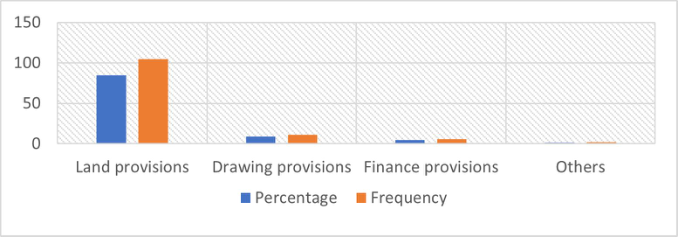
Figure 1: Level of contribution of public institutions to PPPs housing delivery system.
of structured questionnaires were administered to the respondents through a systematic random sampling method. Based on this, 60 copies of the questi- onnaire were administered to public institution administrators, and 65 copies were administered to private institution professionals involved in the PPPs housing delivery system. In all, 124 copies of the questionnaire designed in Likert scale were administered with 100% retrieval. This helps the study eva- luate the relevant contributions and fragility of public and private institutions involved in PPPs housing projects within the study area.
RESULT
Figure 1 appraised level of contribution of public institutions to PPPs hou- sing delivery system. The result revealed that land provisions 84.68% (105) agreed that land provisions are the major contribution from public instituti- ons to housing delivery. 8.87% (11) of respondents said that the government provides drawing, 4.84% (6) stated that the government provides fina- nce, while 1.62% (2) revealed that government institutions provide other contributions such as equipment, labour, and plant.
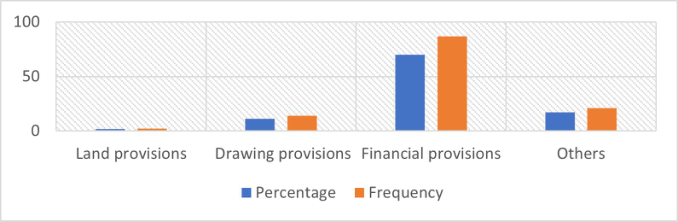
Figure 2 appraised level of contributions of the private institutions to PPPs housing delivery system. The result shows that 70.16% (87) of the respon- dent agree that finance is the major and vital contribution of the private institution towards housing provision. Other respondents, 16.94% (21), fur- ther state that private institution contributes plant, equipment, and labour, while respondents with 11.29% (14) opined those private institutions pro- vide the drawing and respondents with 1.62% (2) state that land provisions are private institution contribution to housing provision.
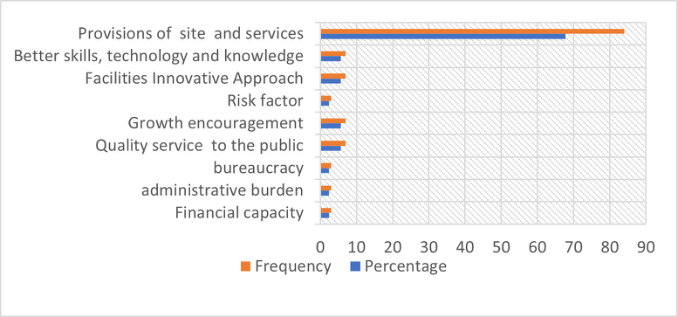
Figure 3 examined the fragility and strength of public institutions in hou- sing delivery. 67.74% (84) of the respondents clearly state that the main public institution area of strength in PPPs housing delivery is the provision of site and services, the result further shows that quality service to the public 5.64% (7), growth encouragement 5.64% (7), facilities Innovative Approach 5.64% (7), and provisions of site and services 5.64% (7) were other partial strength of the public institution, while other respondents state that Financial capacity 2.42% (3), administrative burden 2.42% (3), bureaucracy and risk
Figure 2: Level of contribution of the private institutions to PPPs housing delivery system.Figure 3: Fragility and strength of public institution contributions in PPPs housing.
factor 2.42% (3), were the main fragility of the public institution in housing delivery.
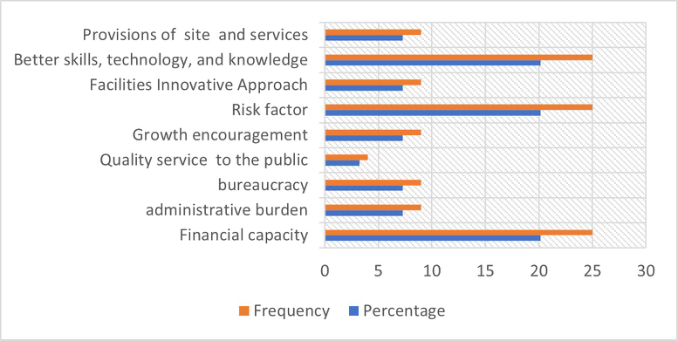
Figure 4 examined the fragility and strength of public institutions in PPPs housing delivery. The result shows that financial capacity 20.16% (25), Risk factor 20.16% (25), Better skills 20.16 % (25), technology and knowledge 20.16% (25) were the area of strength for the private institution. The result further shows administrative burden 7.26% (9), bureaucracy 7.26% (9), facilities innovative approach 7.26% (9) were other partial strengths of the private institution, while respondents with 3.23% (4) opined that Quality service to the public is the most fragility of the private institutions in hou- sing provisions this is because most private institutions in housing provisions were always after profit in investment.
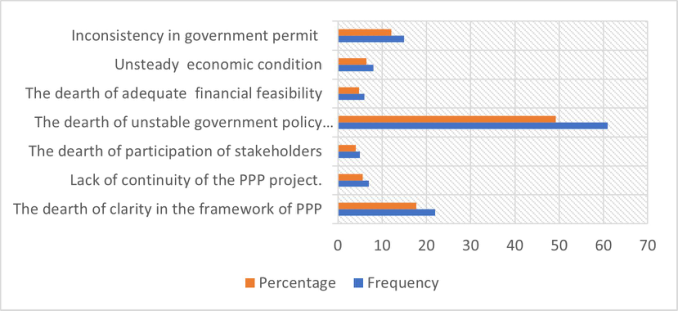
Figure 5 analyzed factors affecting public and private institutions’ contri- butions in PPPs housing delivery. The result shows that 49.19% (61) of the respondents’ state that dearth of unstable government policy support and regulatory framework is the major factor affecting the investment of private institutions in housing delivery in the study area, while 17.74% (22) affirmed that it is a dearth of clarity in the framework of PPPs. 12.10% (15) opined that inconsistency in government permit, while other respondents’ 6.45%(8),
Institutional Evaluation of Public and Private Partnerships Relevant Contributions 375
Figure 4: Fragility and strength of private institution contributions in PPPs housing.Figure 5: Factor affecting public and private institutions contributions in PPPs housing delivery.
and 5.65% (7), agreed that unstable economic condition and lack of conti- nuity of PPPs project affect private institution investment, and 4.03% (5) of the respondent signified dearth of participation of stakeholders.
DISCUSSION
This study appraised public and private institutional relevant contributions to successful housing provisions. Its attempts to identify the factors that affect the PPPs institutions’ participation in the housing delivery system in Nige- ria through their contributions. The finding indicates that land provision is the major relevant contribution from a public institution to the PPPs hou- sing delivery system. This agrees with Ademiluyi and Raji (2008) findings that Nigeria’s 1978 land use degree has vested ownership of land in Nigeria to government institutions. The result of this study also affirmed the con- tribution of the private institutions to be a good financial base, with good
provision of plant, equipment, and labour, supporting it well with a detai- led drawing. The result agrees with Brown et al. (2006), which opined that private institution contribution in housing is hinged on the belief that it will guide a general reduction in public institution financial input. The result of this study also affirmed that a private institution offers little in terms of land provision due to government policy on land ownership. This is in line with World Bank (2017) report that in many African countries, including Nige- ria, applying for land registration through regulatory environments remains an obstacle. The study also indicated that the fragility of public institutions in PPPs housing delivery to be lack of growth encouragement, avoidance of taking a risk, lack of financial capacity, bad administrative burden, and bure- aucracy while its strength is provisions of site and services. The finding is in line with Ibem (2010) and Ogunbayo et al. (2018) that the role of public insti- tutions in PPPs housing is the regulatory and enabler, which is their area of strength. Because they lack financial capacity and are not ready to risk public funds in a fixed project such as housing provision. For private institutions, the study showed that their fragility is about the quality of service provi- ded to the public, while their strength includes good financial capacity base, risk factor consideration, better skills, technology and knowledge, less admi- nistrative burden, less bureaucracy. The finding agrees with the Ibem and Aduwo (2012) and Ogunbayo et al. (2016) that private institutions consist of the technocrat, investors, and individual with a good financial base guided by efficient service delivery at an affordable cost, with risk and management responsibility in the provision of affordable housing. The study further confir- med unstable government policy and regulatory framework, lack of clarity in the framework of PPPs, inconsistency in permit issuance, unstable economic condition as the leading factors affecting private institutions’ investment in PPPs Housing delivery. This agrees with Kabir (2009) that restrictive land-use policy, inconsistent government policies, and high cost of building materials are the inter-related factors responsible for the ever-increasing housing crisis in sub-Sahara Africa.
CONCLUSION
This study evaluates public and private institutions’ relevant contributions to the housing delivery system in Lagos State, Nigeria. It attempted to bridge the relevant contributions gap among parties to PPPs housing. The study indicated that the provision of land, site, and services are the public institu- tion’s contribution to the PPPs housing delivery system. However, the study shows that public housing institutions lack good financial, bad administra- tion, and an enhanced capacity to absorb risk factors. On the other hand, the private institution provides a good financial base, equipment, labour, and plant with good management responsibility to the housing delivery system. While unstable government policy and unstable economic conditions affect public and private institution investment, production, and quality of service to be rendered in the housing delivery system. However, for public and pri- vate institutions to annex boon of contributing to the PPPs housing delivery system; therefore, the study makes the following recommendations:
Institutional Evaluation of Public and Private Partnerships Relevant Contributions 377
i. The government needs to repeal the law act through legislation, such as the 1978 land use act. This will provide easy access and readily available land for an investor in housing provision. ii. Finance needs to be provided through the creation of a better and well- organized mortgage bank with a reasonable interest rate that allows for easy access for both public and private institutions toward the purpose of providing a good housing delivery system. iii. Housing policy and the administrative process should be improved by removing the bottlenecks and avoiding policy somersaulting in the administration process toward a well-organized housing delivery system.
ACKNOWLEDGMENT
The authors would like to acknowledge the cidb Centre of Excellence, Faculty of Engineering, and the Built Environment, University of Johannesburg, South Africa.
REFERENCES
Ademiluyi, A. I., & Raji, B. A. (2008). Public and private developers as agents in urban housing delivery in Sub-Saharan Africa: The situation in Lagos State. Humanity & Social Sciences Journal, 3(2), 143–150. Brown, A., Orr, A., & Luo, J. (2006). The suitability of Public-Private Partnerships in
the provision of sustainable housing in China. World Review of Entrepreneurship, Management, and Sustainable Development, 2(1-2), 101–125. Dunn, J. R. (2000). Housing and health inequalities: review and prospects for research. Housing studies, 15(3), 341–366. Fagbadebo, O. (2007). Corruption, governance, and political instability in Nigeria.
African Journal of Political Science and International Relations, 1(2), 028–037. Hodge, G. A. (2004). Risks in public-private partnerships: Shifting, sharing, or shirking? Asia Pacific Journal of Public Administration, 26(2), 155–179. Ibem, E. O. (2010). An assessment of the role of government agencies in public-
private partnerships in housing delivery in Nigeria. Journal of Construction in Developing Countries, 15(2), 23–48. Ibem, E. O., & Aduwo, B. E. (2012). Public-private partnerships (PPP) in housing provisions in Ogun state, Nigeria: opportunities and challenges. Isma’il, M., Muhammed, Z. D., Farouk, M., & Usman, K. Urban Growth and Hou-
sing Problems in Kubwa District of Bwari Area Council, Abuja, Nigeria. Global Journal of Research and Review, 1, 1–14. Jamali, D. (2004). Success and failure mechanisms of public-private partnerships (PPPs) in developing countries: Insights from the Lebanese context. International Journal of Public Sector Management, 17(5), 414–430. Kabir, B., and Bustani, S. A. (2009). A review of housing delivery efforts in Nigeria.
In ISA International Housing Conference, University of Glasgow, Scotland. Mabogunje, A. L. (2007). Developing Mega Cities in Developing Countries is the text of a lecture delivered at a Colloquium organized by the 2007 Graduating Class. Department of Geography, University of Lagos. Muhammad, Z., and Johar, F. (2018). Critical success factors of public-private par-
tnership projects: a comparative analysis of the housing sector between Malaysia and Nigeria. International Journal of Construction Management, 1–13.
Ogunbayo, B. F., & Aigbavboa, O. C. (2019). Maintenance requirements of students’ residential facility in higher educational institution (HEI) in Nigeria. In IOP Con- ference Series: Materials Science and Engineering (Vol. 640, No. 1, p. 012014). IOP Publishing. Ogunbayo, B. F., Aigbavboa, C. O., Amusan, L. M., Ogundipe, K. E., & Akinra-
dewo, O. I. (2021). Appraisal of facility provisions in public-private partnership housing delivery in southwest Nigeria. African Journal of Reproductive Health, 25. Ogunbayo, B. F., Aigbavboa, C. O., Thwala, W. D., & Akinradewo, O. I. (2022).
Assessing maintenance budget elements for building maintenance management in Nigerian built environment: a Delphi study. Built Environment Project and Asset Management. Ogunbayo, B. F., Ajao, A. M., Alagbe, O. T., Ogundipe, K. E., Tunji-Olayeni, P. F., and Ogunde, A.”(2018). Residents’ Facilities Satisfaction in Housing Project Delivered by Public-Private Partnership (PPP) in Ogun State, Nigeria. International Journal of Civil Engineering and Technology (IJCIET), 9(1), 562–577. Ogunbayo, B. F., Alagbe, O. A., Ajao, A. M., & Ogundipe, K. E. (2016). Determining
the individual significant contribution of the public and private sector in housing delivery in Nigeria, 4(3), 16–26. Olatubara, C., Agbola, T., and Egunjobi, L. (2007). Housing Development and Management: A Book of Reading Published by Department of Urban and Regi- onal Planning Faculty of the Social Sciences. University of Ibadan, Ibadan Nigeria. Raji.O. (2008) Public and private developers as agents in urban housing delivery in
sub-Saharan Africa: the situation in Lagos, Humanity of Social Sciences, 3(2), 143–150. Reijniers, J. J. (1994). Organization of public-private partnership projects: The timely prevention of pitfalls. International Journal of Project Management, 12(3), 137–142. Trangkanont, S., and Charoenngam, C. (2014). Private partner’s risk response in PPP
low-cost housing projects. Property Management.
LISTED IN THE AHFE DIGITAL BOOKSTORE CATALOGUE
Explore the complete digital volume
Human Factors in Architecture, Sustainable Urban Planning and Infrastructure
Read this individual research paper free through the original publisher, or explore the full digital proceedings book.
ISBN 978-1-958651-34-6
Explore this ISBN in the AHFE Bookstore ↗Listed in the July 2026 bookstore catalogue; search by ISBN to confirm current availability · Digital book purchase optional