Dandan Kowarsch, Jingyu Wang (2022). The Impact of Refugees on Economic Growth in Latin America and the Caribbean. In: Human Factors, Business Management and Society. AHFE Open Access, vol. 56, pp. 390–397. https://doi.org/10.54941/ahfe1002294
The aim of this article is to explore the relationship between refugees and the host country’s economic growth in Latin America and the Caribbean using a simulation modeling approach. There is a large body of work on the topic using statistics. However, one big challenge of conducting econometrics methods to unveil any correlation is that regressions are data dependent. Since the current available refugee data doesn’t truly represent the reality as there has been a quite substantial number of unregistered Venezuelan refugees in Latin America and Caribbean region since 2015. Using agent-based simulation modeling approach overcomes the challenges of data issue and passes by strict assumptions for an OLS regression to produce BLUE outcomes. In our ABM model, agents represent labors, defined as age between 16 and 65, and Venezuelan refugees. To evaluate the impact on gender inequality on employment in the host country, despite of age, agents also carry the attributes of gender, work capability, average education years, birth (matured female only), and death. Three countries Venezuela, Colombia, and Chile are modeled as patches in Netlogo . Countries own the attributes of GDP and GDP per capita at macro level. The simulated result based on the initial values suggests that in Latin America and the Caribbean, refugee growth and host country’s economy are positively correlated. In contrast, the simulated results suggest that the higher fertility rate negatively affects the labor value added outcomes. It could imply the more female refugees in the host country, the lower GDP will be. We also found that the life expectancy is correlated to economic growth, labor’s work capacity, and education years. Life expectancy could be an indicator of the overall quality of human capital. In brief, the findings might imply labor value added output or labor capacity is the driver of economic growth.
Violence, insecurity, political changes, oil price crisis, as well as a lack of food, medicine, and other services in Venezuela have forced people to flee the country, creating one of the world’s largest displacement crises. As one of the five countries with the largest number of refugees in the world, displa- ced Venezuelans worldwide have risen to about 6 million, primarily hosted by Lain America and the Caribbean countries. These immigrants have not only led to a loss of the native brain drain in Venezuela, but also put pressure on the economies of other Latin America countries who host the refugees.
The Impact of Refugees on Economic Growth in Latin America and the Caribbean 391
The study of the relationship between refugees and the host country’s econo- mic growth in Latin America and the Caribbean can help us better understand refugee’s impact on the economy in the host country. According to the com- plex adaptive system theory, in an social-ecological environment, there is an intertwined relationship between the system structure on the macro level and the individual power on the micro level, such as different economy conditi- ons among Latin America countries on the macro level and Venezuelans⣙ various capabilities on the micro level. The wealthy refugees can choose a country in which they want to reside, but the less wealthy Venezuelan refu- gees might not have such luck. Colombia and Venezuela share a frontier, so Venezuelans consider Colombia a relatively easy place to migrate. Since the Great Recession, from 2007 to 2010, Colombian economic performance has been mediocre, with a high unemployment rate. Even though Colombia may not be the best destination, the country has better economy and politi- cal circumstance than Venezuela. The requirements for refugees to migrate to Colombia are not harsh. Many refugees first migrate to Colombia before using Colombia it as a springboard to other countries. On the other hand, Chile does not share a border with Venezuela, there are certain prerequi- sites for emigrating to Chile. But Chile is an ideal country of immigration for Venezuelans as the country has a strong education system and resilient economy.
Female and male refugees are unequally distributed. Women make up a high proportion of the refugee population in Colombia. Probably because of the social role of women, it is difficulty for female refugees to find legal and formal jobs in other countries, regardless their capabilities.
Compared to regression analysis, simulation models depict a fuller picture of changes across a defined time span in the system. In our model, using graphs allow us to visually observe the variations of the macro level beh- aviors that are produced by lower-level activities. It helps understand how the external and internal environment affect agents⣙decision making, in terms of migration. Agent-based modeling approach allows us to study the structure of the socio-economic system, allowing us to zoom into the details of the system. Simulation outcomes as guidance can direct decision makers to prepare protentional risks.
LITERATURE REVIEW
From the simulation aspects, there is a handful research on the relationship between Venezuelan refugees and the economic growth of Latin American. Most of these studies focus on the direction of refugee flow, such as origin and destination, but few papers analyze the Latin American refugee problem from the perspective of gender, educational level, and labor capability using agent-based modeling approach. In general, descriptive analysis and qualita- tive analysis based on survey data are the primary methodological approach for this topic.
Chaves-González and Echeverría-Estrada (2020) use Displacement Tra- cking Matrix surveys to analyze the mobility pattern of refugees, the rela- tionship status of Venezuela and host countries, as well as the employment
392 Kowarsch and Wang
and income, health care conditions and urgent needs, and political support of refugees. They depict the current situation of Venezuelan refugees and the relation between Venezuela and other Latin American countries by using exploratory descriptive analysis.
Pérez and Ugarte (2021) study Venezuelan women’s migration and living experience in Peru by interviewing 15 women who immigrated from Vene- zuela to Peru in less than one year. They identified that even those women are well educated, it’s still hard for them to find a formal job, because of educational credential problems and their legally living status in Peru.
The report of Rescue Works (2019) focus on the influence of refugee women on the economy. They choose five countries that have the largest refugee population in the world to estimate the potential contribution of refugee women to GDP. Their results show that GDP can increase by at least $53 billion by legalizing female refugee’s work status in the host coun- tries. We, however, would argue that the sample selection may lead to a biased result because the data is not inclusively enough to reflect the true relationship.
Both the paper of Enrico et al. (2006) and Herbert and Domenico (2018) mentioned how to build an agent-based economic model. Enrico et al. (2006) focuses on the growth and allocation resources in economic activities. They use mathematical theories to explain the growth processes and resource allocation when there is N players in one place. Herbert and Domenico (2018) show the basic model design and theories of agent-based computa- tional macroeconomics. They analyze the influence of labor, consumption, price, technology, and financial assets in macroeconomic agent-based models. However, both studies exclude the individual factors which can be the real drivers of the variations on the macro level. In short, the objective of this study is to find out the impact of refugees on the host country over a long-time span.
MODEL ARCHITECTURE AND INITIALIZATION Our ABM model focuses on the dyadic relationship between Venezuela and two countries: Colombia, and Chile. We choose these two countries as exam- ples of the host countries because the distance between them and Venezuela is markedly different. According to Pérez and Ugarte (2021) and Rescue Works (2019), distance is an important factor in determining the direction of movement of refugees. We find that discrepancies in wealth, education, and capacity emerge in refugees. In addition, the GDP and population of Colombia and Chile are divergent. For instance, the GDP per capita in Colombia is less than the GDP per capita in Chile, while the Colombia population is quite larger than Chiles. Since both host Venezuelan refugees, we assume the two countries should represent two distinguish economic entities.
The model considered both male and female refugees with different age, education, capacity levels. Also, includes birth and death rate, work age, and integration rate among countries. The values for population, GDP, GDP per capita, capacity, and average age are updated based on refugee’s migration.
The Impact of Refugees on Economic Growth in Latin America and the Caribbean 393
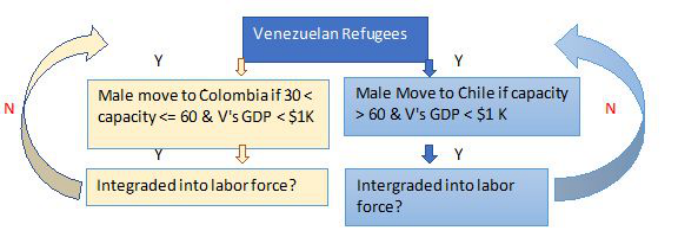
Figure 1: A simplified chart on the interaction between male agents (Venezuelan refugees and patches (Venezuela, Chile, and Colombia).
The influence of refugee movement on national economy is simulated to the maximum extent. Besides the lack of GDP data for Venezuela after 2014, all the initial values in this model are based on the data in 2014 from World Bank.
Based on the World Bank data, the population in Venezuela is 280 (repre- senting 28 million), 470 (47 million) in Colombia, and 180 (18 million) in Chile. For Venezuela and Chile, the proportion of females and males is equal. In Colombia, there are slightly fewer females than males, 230 to 240. As we evaluate Venezuelan refugees, we assume only Venezuelans are allowed to move to other countries or return to Venezuela. An agent who is 16-year-old or above has his own characteristics of education and capacity. People who are younger than 16 cannot enter the labor market. Each country has its own population, GDP, GDP per capita, and capacity. Agents own working years, life expectancy, and fertility rate for women. Macro variables are initialized based on the real-world data and the individual characteristics are randomly assigned.
When Venezuelan refugees move to other countries, it takes time for them to adopt and adapt a new environment. The immigration policy in the host country constrains the refugees’ integration rate. For migrants living in developing countries, the longer they work without legal status the higher likelihood they will leave for another nation or return to Venezuela. The setup for refugees to move into any countries depend on the Venezuela’s economic development as well as the refugees’ capacities: We assume if Venezuela’s GDP per capita is less than 1,000 US dollars, the most capable Venezuelans are expected to move to Chile; while the less capable Venezuelans would be expected to migrate into Colombia.
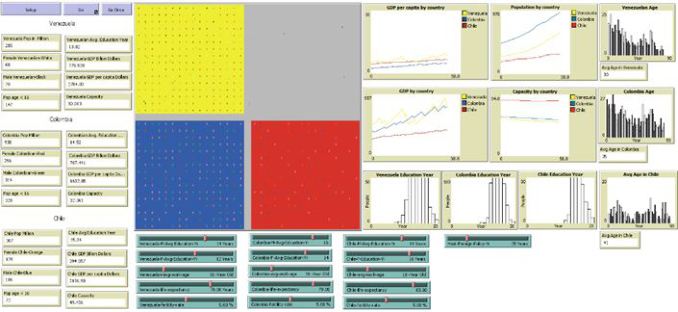
There are other factors which affect refugees’ integration. The refugee’s characteristics along with some “luck” or randomness. Age, gender, and education affect labor’s capacity: We postulate that the older male with an average 16-year education owns higher capacity than a younger male with fewer education years. When agents reach their randomly assigned life expectancy, most die. In contrast of death, female agents carry the additi- onal feature of fertility rate. The new births must wait for 16 years before work. Figure 1 demonstrates the interactions between agents and countries. Figure 2 depicts a sample run based on the initial setup.
394 Kowarsch and Wang
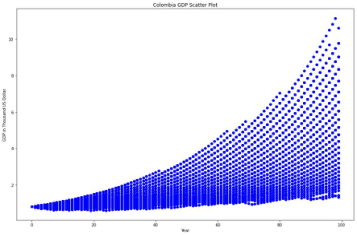
Figure 2: A snapshot of a sample run based on initial setup. The yellow patch repre- sents Venezuela, the blue patch represents Colombia, and the red one represents Chile.Figure 3: Sim. Colombia GDP per capita.
GLOBAL SENSITIVITY ANALYSIS To evaluate the model’s behavior, global sensitive analysis is performed. To check if the model produces consistent outputs, we allow (1) each country’s female fertility rate to be randomly drawn from two percent, three percent, and five percent; (2) a country’s average years of education to be randomly drawn from 12, 14, and 16; (3) the life expectancy to be randomly drawn from 68 to 87 depending on each country’s average life expectancy.
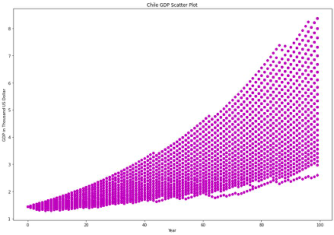
Each simulation runs 101-time steps, and there are 2187 iterations. The simulated data set contains over 22 thousand data points. The GDP per capita for Colombia and Chile are plotted across all 101 steps. The graphs are shown in Figure 3 and 4, respectively.
The x-axis in both graphs displays the time steps across all simulations (from 0 to 100). The y-axis indicates the simulated value for GDP per capita in thousand US dollars. For Colombia (blue), the GDP per capita can be at over 100 thousand dollars but most of time the GDP per capita is below 20 thousand; For Chile (purple), the GDP per capita appears more evenly distri- buted within a wider range between 20 thousand and 80 thousand toward
The Impact of Refugees on Economic Growth in Latin America and the Caribbean 395
Figure 4: Sim. Chile GDP per capita.
the end of iterations. The finding indicates that given a high load of refu- gees in the host country (Colombia hosts more refugees than Chile), there is possibility that the country would be better off in terms of higher GDP per capita.
We also perform Ordinal Least Squares regression to examining the cor- relation between the variables of interest. The dependent variables are each country’s GDP per capita, labor’s value added output, and average years of education. We assume labor’s work capacity and education positively affect the development of human capital, which also affects economic development. The independent variables include (1) the host country’s immigration policy which measures the impact of the length of waiting to be legally integrated into the host country, (2) fertility rate, and (3) the life expectancy. Table 1 shows the regression result in detail.
The regression results based on our aggregated simulation data suggests that life expectancy is statistically significant and positively correlated to GDP per capita, labor capacity, and average years of education. In contrast, fertility rate is statistically significant and negatively associated with labor capacity and average years of education. The openness for the foreign immigration policy and Venezuelan labor work capacity are positively correlated as Vene- zuelan refugees do not want to wait that long to be integrated in a developing country, they return home country. The result also suggests that the long wai- ting time is positively correlated to Chilean labor capacity. One reason could be the refugees move into Chile bear more costs and might be more capable than the refugees who flee into Colombia, Chile has a better economy than Colombia in general, therefore, the refugees tend to stay in Chile regardless of whether to be integrated. The longer waiting time allows the policy makers in the host country to make a thorough policy on immigrants so that refugees won’t become burdens but a replenishment of human capital.
CONCLUSION
The implementation of agent-based modeling approach allows us to unfold the underlying mechanisms that we would not be able to accomplish with statistics. ABM does not require significant empirical data inputs, instead, it is the approach based on the system structure and the embedded decision- making rules for an agent to decide. In addition, global sensitivity analysis is
The Impact of Refugees on Economic Growth in Latin America and the Caribbean 397
used to test whether the model can produce consistent results over all simu- lations. A model producing consistent results has greater predictive power and policy implications. The application of linear regression technique using simulated data is to find the linear correlation between our variables of interest.
Based on these results we conclude that holding the fertility rate constant, the increase in refugee population is positively associated with the host coun- try’s economic activities. The female population is negatively associated with overall labor value added outputs, which rejects the findings of some previous literature. Finally, longer waiting time for the refugees to be legally integra- ted into the host developing country the more likely the refugees to go to other places, but this might be only the case for developing, not developed, countries.
REFERENCES
Braunstein, E., Seguino, S. (2018), The Impact of Economic Policy and Structural Change on Gender Employment Inequality in Latin America, 1990-2010; Review of Keynesian Economics, 6(3). pp. 307–332. Chaves-González, Diego, Echeverría-Estrada. C. (2020), Venezuelan Migrants and
Refugees in Latin America and the Caribbean: A Regional Profile. Washington, DC and Panama City: Migration Policy Institute and International Organization for Migration. Dawid, Herbert and Delli Gatti, Domenico (2018), Agent-Based Macroeconomics, Bielefeld Working Papers in Economics and Management No. 02-2018. Jacqueline Greatbatch. (1989), The Gender Difference: Feminist Critiques of Refugee
Discourse, International Journal of Refugee Law, Volume 1, Issue 4. pp. 518–527. RescueWorks (2019), Reports: RescueWorks: Unlocking Refugee Women’s Potential. International Rescue Committee. Retrieved from https://www.rescue.org/report/rescueworks-unlocking-refugee-womens-potential Scalas, Enrico, Gallegati, Mauro, Guerci, Eric, Mas, David and Tedeschi, Alessandra. (2006), Growth and Allocation of Resources in Economics: The Agent-Based Approach. Physica A: Statistical Mechanics and its Applications. 370. 86–90. 10.1016/j.physa.2006.04.038. Termos, Ali, Picascia, Stefano and Yorke-Smith, Neil (2021), ‘Agent-Based Simu-
lation of West Asian Urban Dynamics: Impact of Refugees’ Journal of Artificial Societies and Social Simulation 24 (1) 2. World Bank, World Development Indicators. (2014), GDP (current US$). Retrieved from https://data.worldbank.org/indicator/NY.GDP.MKTP.CD World Bank, World Development Indicators. (2014), GDP per capita (current US$).
Retrieved from https://data.worldbank.org/indicator/NY.GDP.PCAP.CD World Bank, World Development Indicators. (2014), Population, total. Retrieved from https://data.worldbank.org/indicator/SP.POP.TOTL
LISTED IN THE AHFE DIGITAL BOOKSTORE CATALOGUE
Explore the complete digital volume
Human Factors, Business Management and Society
Read this individual research paper free through the original publisher, or explore the full digital proceedings book.
ISBN 978-1-958651-32-2
Explore this ISBN in the AHFE Bookstore ↗Listed in the July 2026 bookstore catalogue; search by ISBN to confirm current availability · Digital book purchase optional