Jorge Cruz-Cárdenas, Ekaterina Zabelina, Olga Deyneka, Carlos Ramos, Andrés Palacio Fierro (2022). Consumer Behavior in Product Disposal: Mapping the Field. In: Human Factors, Business Management and Society. AHFE Open Access, vol. 56, pp. 170–176. https://doi.org/10.54941/ahfe1002265
The disposal of products within the framework of the discipline of consumer behavior is a decision-making process. In this process, consumers make at least two decisions: the first to stop using a still usable product and the second to select a disposal method. Among the most common methods of disposal are storing products, giving them away, donating them, selling them, or throwing them away. The main difference between disposal and recycling behavior is that in the former the product is still usable, while in the latter the decision is regarding the waste of a product. Product disposal behavior has notable consequences for both consumers and society, which is why a growing number of academics have been attracted to this field of study. Given the growing body of literature that is being generated, the present study aims to generate an image of the body of existing documents on this subject in order to guide future research. The present study used the Scopus database to search for content, as it is a database that presents a good balance of quality and coverage. The search keywords were disposal AND {consumer behavior}. The search was carried out in November 2021. The results were limited only to literature generated in English. As a result, 158 documents were obtained. On this basis of documents, the present study carried out various bibliometric analyses. There is an increasing annual trend in the number of publications (19 in 2019, 29 in 2020, and 39 in 2021). The United States and its institutions are the main countries of affiliation of the authors. Additionally, the European Commission is the main funder. In order to determine the main topics of interest of the research, an analysis of the co-occurrence of words in the contents of the titles and abstracts was carried out using the VOSviewer software. The results showed the existence of three content clusters: 1) decision-making for disposal, 2) types of products disposed of, highlighting electronics, clothing, and food, and 3) social and environmental implications of the disposal of products. The current study ends by discussing the implications of these results.
Product disposal is a process in which a consumer stops using a product that is still functional and discards it, either by storing it, donating it, giving it away, throwing it away, or selling it (Jacoby et al., 1977; Hanson, 1980). Due to its consequences, product disposal behavior is a study area of great impor- tance for society and the environment (Cruz-Cárdenas and Arévalo-Chávez, 2018). For example, while donating, giving away, or selling the product keeps it circulating among new owners, throwing it away means that it winds up in garbage dumps and landfills (Cruz-Cárdenas et al., 2017). Furthermore, product disposal is of great interest to companies because it is associated posi- tively with new purchases (Ha-Brookshire and Hodges, 2009; Cruz-Cárdenas et al., 2016).
Given the great importance of product disposal behavior, research on it has attracted growing interest from academics across various disciplines (Cruz- Cárdenas and Arévalo-Chávez, 2017; Boulet et al., 2021; Islam et al., 2021). However, in high-growth fields of knowledge, efforts that seek to provide a global perspective on the knowledge being generated are advisable so that new research efforts have a better orientation (Singh et al., 2020). Thus, the present article seeks to make such a contribution by generating a bibliometric study of the existing literature on consumer behavior in product disposal.
Consumer Behavior in Product Disposal: Mapping the Field 171
CONSUMER BEHAVIOR IN PRODUCT DISPOSAL Consumer disposal behavior has been an academic area of study for more than four decades. Jacoby et al.’s (1977) founding study introduces this topic, its definition, and disposal methods. Once a consumer consciously or uncon- sciously has stopped using a still-usable product, that product is disposed of by some method. Each method generates a set of different values for the consumer (Cruz-Cárdenas and Arévalo-Chávez, 2018): Donating generates moral value and frees up space at home; giving away generates relational value and space at home; selling generates monetary value and also frees up space; storing generates psychological value by preserving possessions; and throwing away products creates space.
The decision to dispose of products very often is associated with new purchases (Ha-Brookshire and Hodges, 2009; Cruz-Cárdenas et al., 2016). Therefore, as companies’ marketing strategies and technological develo- pments shorten product lifespans – not due to any lack of functional capacity, but rather to fashion or obsolescence – consumer disposal activity will tend to become more frequent.
It is also necessary to consider the COVID-19 pandemic’s impact on consumer behavior, as such a disruptive phenomenon has been generating important changes in consumer behavior, some of which will be temporary and others permanent (Cruz-Cárdenas et al., 2021). The pandemic emerged on the world stage at the end of 2019, and as of the writing of this article, it remains active.
METHOD
The present study’s method followed the recommended steps for bibliome- tric studies or systematic literature reviews (e.g., Osobajo and Moore, 2017; Cruz-Cárdenas et al., 2021). In this way, the present study comprised four stages: 1) formulation of study objectives; 2) establishment of criteria for inclusion of documents; 3) selection of search strategies; and 4) description of the body of documents and of selected literature.
The Introduction section indicates the need for a study that helps provide a general idea and a description of the accumulated body of literature in the area of consumer behavior and product disposal. In this way, the present study, which seeks to fill this need, is guided by the following objectives:
O1: To describe the most relevant characteristics of the body of literature on consumer behavior in product disposal.
O2: To describe the interrelationships between these documents.
With the study objectives established, the next step was to define the cri- teria for inclusion of documents. A central criterion aligned with the study objectives was to find documents that deal with product disposal, but from a consumer behavior perspective. Another important criterion was to include documents of an acceptable quality level. It also was viewed as important to retrieve the documents generated on any date (without time limits). Furth- ermore, it was viewed as important to delimit the documents’ language to English.
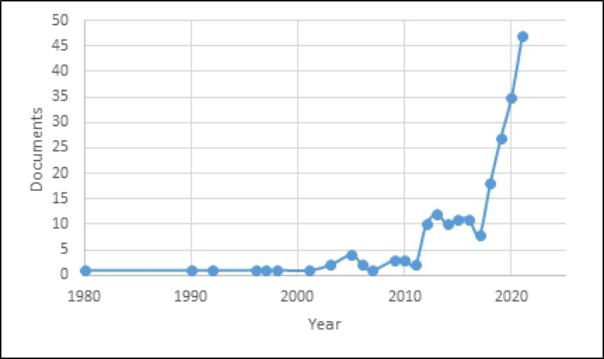
Figure 1: Evolution in the number of documents (Source: Scopus).
Once the inclusion criteria were established, they were operationalized in search strategies. The Scopus database was selected, as it is a database of journals and content with wide coverage using quality criteria (Singh et al., 2020). Next, the search terms that allow for retrieval of documents were established: “disposal AND {consumer behav*}.” The term “disposal” is the commonly accepted term to refer to the behavior under study, but the asterisk next to “behav” allowed for inclusion of different words that refer to beh- avior, such as “behavior” or the British “behaviour” (Cruz-Cárdenas et al., 2021). Furthermore, it was specified that the search for terms should focus on titles, abstracts, and keywords of documents. The search was conducted on January 4, 2022. As a result, 215 documents were obtained.
RESULTS
The first analysis aimed to describe the evolution in the number of documents published over time. As can be seen in Figure 1, until 2017, there was little scientific output on the topic of consumer behavior in product disposal. How- ever, as of 2017, the trend changed significantly toward accelerated growth. During 2021, the last year of the analysis, 47 documents had been published. This growing trend in the topic of consumer behavior in product disposal confirms assertions by several authors (e.g., Cruz-Cárdenas and Arévalo- Chávez, 2017; Boulet et al., 2021; Islam et al., 2021) regarding growing academic interest on this topic.
Another analysis conducted on the body of literature was on the type of documents published. In this sense, articles were the dominant type, at 169 (78.6%), followed by conference papers, at 18 (8.4%). Considering that consumer behavior is a multidisciplinary field, it was also very intere- sting to analyze which areas of knowledge generated the most documents. It should be noted that the same document can be related to several areas. Thus, two areas stood out over the others: “environmental science,” with 105 (48.8%) documents, and “business, management, and accounting,” with 67
Consumer Behavior in Product Disposal: Mapping the Field 173
(31.2%). These two areas of interest reflect product disposal’s impact on consumers, companies, and the environment (Cruz-Cárdenas and Arévalo Chávez, 2018).
As for the most prolific authors, J. Cruz-Cárdenas stands out, with five documents, followed by R. McQueen, with three. Regarding the institutio- nal affiliations of the authors of consumer behavior and product disposal, having at least three associated documents was used as a cut-off point. It was necessary to indicate that a document with different authors can be rela- ted to different institutions. Although no dominant institutions were found, Ecuador’s Universidad Indoamérica and Wageningen University & Research of the Netherlands led the list, with five associated documents each. These rather low numbers suggest that the figures are the result of authors’ efforts, rather than large research programs.
Regarding countries related to authors’ institutions, this was used as a cut- off point when the country was related to 10 or more documents. The U.S. led the list, with 39 documents (18.1%), in which one or more authors were associated with U.S. institutions. Next were the United Kingdom, China, and Germany.
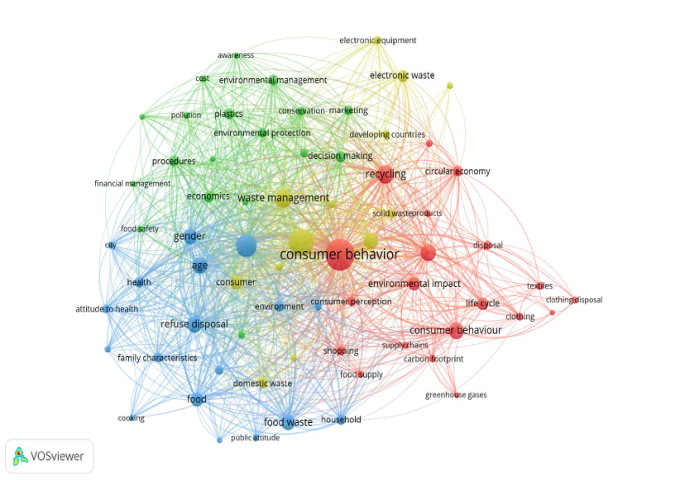
For an analysis of co-occurrence of terms, VOSviewer 1.6.15 software (Van Eck and Waltman, 2010) was used. Co-occurrence was estimated based on document keywords. The minimum frequency of occurrence for a word to be included in the analysis was five, the number that the software established by default. Under this criterion, 94 words passed this cutoff point. Next, a clean-up and debugging were conducted, which involved discarding irrele- vant words, as well as grouping words or terms with similar meanings. The co-occurrence analysis based on keywords allowed for the identification of four clusters, which can be associated with the thematic areas of interest in the research. Figure 2 shows these clusters.
Cluster 1 (green): This cluster comprises words such as “environmen- tal management,” “environmental protection,” “pollution,” “economics,” “packaging waste,” “cost,” and “financial management.” From these words, it can be deduced that this cluster is related to the economic, social, and environmental impact from product disposal.
Cluster 2 (blue): This cluster comprises words such as “attitude to health,” “food,” “food waste,” “household,” and “cooking,” suggesting that this group refers to food disposal.
Cluster 3 (red): This cluster comprises words such as “recycling,” “life cycle,” “clothing,” “textiles,” “clothing disposal,” “textiles waste,” and “circular economy.” From these words, it can be deduced that this cluster focuses on clothing disposal.
Cluster 4 (yellow): This cluster comprises words such as “waste manage- ment,” “domestic waste,” “electronic waste,” “electronic equipment,” “solid waste,” and “decision making.” From this integration, it can be deduced that this thematic area is related above all to the disposal of electronic products.
Finally, an analysis of co-authorship networks was conducted with a cut- off point of at least three documents. The obtained results determined that no important networks existed among the main authors of consumer behavior in product disposal.
Figure 2: Clusters based on keyword co-occurrence.
DISCUSSION, CONCLUSION, AND IMPLICATIONS An important characteristic of consumer behavior literature on product disposal is that in recent years, it has experienced heavy growth in research output. This trend supports other authors’ assertions about growth in this area (e.g., Cruz-Cárdenas and Arévalo-Chávez, 2017; Boulet et al., 2021; Islam et al., 2021).
The results from the bibliometric analysis also establish author affiliations. When this affiliation is established at the country level, the vast majority of authors are linked to institutions in developed or emerging countries. In this way, a recommendation from the present study is for greater research in developing societies, which coincides with calls from other authors (e.g., Cruz-Cárdenas and Arévalo-Chávez, 2018). This expansion of research to other economic and cultural fields will allow for a better understanding of the phenomenon of product disposal.
If it is considered that the results from the analysis of keyword co- occurrence are a good approximation of the areas or topics of interest in the research (Cruz-Cárdenas et al., 2021), it can be concluded that four topics draw the most interest on consumer behavior in product disposal: 1) econo- mic, social, and environmental impact of the disposal; 2) disposal of food; 3) disposal of clothing; and 4) disposal of electronic products. Establishing these four research areas provides support and a guide for future research efforts on the topic of consumer behavior and product disposal.
Food disposal is one of the areas of interest in the studies analyzed. This makes sense considering that in today’s societies, particularly developed ones, a significant percentage of food is wasted (Boulet et al., 2021), a percentage
Consumer Behavior in Product Disposal: Mapping the Field 175
that could be as high as 27% (Conrad, 2020). Food disposal is a complex behavior in which variables internal to the consumer, as well as family and environmental variables, exert influence (Boulet et al., 2021).
Clothing disposal is another area of research interest. Business strategies such as “fast fashion” are further accelerating the pace of clothing repla- cement. For this reason, consumers are moving away from disposal by storage and looking for alternative methods to clear space in their closets for new clothes, such as donating (Ha-Brookshire and Hodges, 2009), gifting (Cruz-Cárdenas et al., 2017), or throwing away.
A third product-disposal category that comprises an important area of study is the disposal of electronic equipment and related accessories. These types of products are one of the fastest-growing waste categories these days, and their environmental impact is enormous (Arain et al., 2020). When con- sumers dispose of these products, they are looking for, above all, ease and convenience (Arain et al., 2020; Islam et al., 2021).
The preceding reflection on the transcendence of clothing, food, and ele- ctronics disposal and its effect on consumers, companies, and society at large allows us to recommend the need for study continuity. Furthermore, studies that identify temporary and permanent changes in disposal behavior with these products due to the COVID-19 pandemic are very necessary.
REFERENCES
Arain, A. L., Pummill, R., Adu-Brimpong, J., Becker, S., Grees, M., Ilardi, M., Van Dam, E., and Neitzel, R. L. (2020), “Analysis of e-waste recycling behavior based on a survey at a Midwestern US University.” Waste Management, 105, 119–127. Boulet, M., Hoek, A. C., and Raven, R. (2021), “Toward a multi-level framework
of household food waste and consumer behavior: Untangling spaghetti soup.” Appetite, 156, 104856. Conrad, Z. (2020), “Daily cost of consumer food wasted, inedible, and consumed in the United States, 2001–2016.” Nutrition Journal, 19(35), 1–9. Cruz-Cárdenas, J., González, R., and del Val Núñez, M. T. (2016), “Clothing disposal
in a collectivist environment: A mixed-methods approach.” Journal of Business Research, 69(5), 1765–1768. Cruz-Cárdenas, J., González, R., and Gascó, J. (2017), “Clothing disposal system by gifting: Characteristics, processes, and interactions.” Clothing and Textiles Research Journal, 35(1), 49–63. Cruz-Cárdenas, J., and Arévalo-Chávez, P. (2018), “Consumer behavior in the dispo-
sal of products: Forty years of research.” Journal of Promotion Management, 24(5), 617–636 Cruz-Cárdenas, J., Zabelina, E., Guadalupe-Lanas, J., Palacio-Fierro, A., and Ramos- Galarza, C. (2021), “COVID-19, consumer behavior, technology, and society: A literature review and bibliometric analysis.” Technological Forecasting and Social Change, 173, 121179. Ha-Brookshire, J. E., and Hodges, N. N. (2009), “Socially responsible consumer
behavior? Exploring used clothing donation behavior.” Clothing and Textiles Research Journal. 27(3), 179–196. Hanson, J. W. (1980), “A proposed paradigm for consumer product disposition processes.” Journal of Consumer Affairs, 14(1), 49–67.
Islam, M. T., Huda, N., Baumber, A., Shumon, R., Zaman, A., Ali, F., Hossain, R., and Sahajwalla, V. (2021), “A global review of consumer behavior toward e-waste and implications for the circular economy.” Journal of Cleaner Production, 316, 128297. Jacoby, J., Berning, C. K., and Dietvorst, T. F. (1977), “What about disposition?
Journal of Marketing, 41(2), 22–28. Osobajo, O. A., and Moore, D. (2017), “ Methodological choices in relationship quality (RQ) research 1987 to 2015: A systematic literature review.” Journal of Relationship Marketing, 16(1), 40–81. Singh, S., Dhir, S., Das, V. M., and Sharma, A. (2020), “Bibliometric overview of
the Technological Forecasting and Social Change journal: Analysis from 1970 to 2018.” Technological Forecasting and Social Change, 154, 119963. Van Eck, N. J., and Waltman, L. (2010), “Software survey: VOSviewer, a computer program for bibliometric mapping.” Scientometrics, 84(2), 523–538.
LISTED IN THE AHFE DIGITAL BOOKSTORE CATALOGUE
Explore the complete digital volume
Human Factors, Business Management and Society
Read this individual research paper free through the original publisher, or explore the full digital proceedings book.
ISBN 978-1-958651-32-2
Explore this ISBN in the AHFE Bookstore ↗Listed in the July 2026 bookstore catalogue; search by ISBN to confirm current availability · Digital book purchase optional